

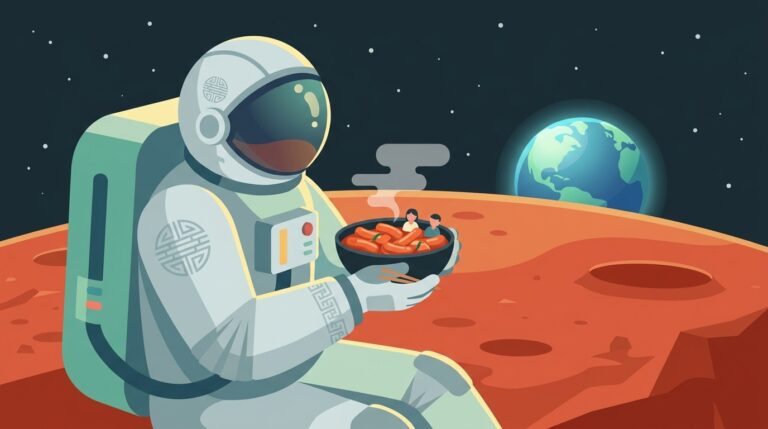
Phase 1: Empathy (Immersive Open)
Hello! I’m your Daily Hangul Editor.
Picture this: You are watching a Korean sci-fi blockbuster like Space Sweepers (승리호) or The Silent Sea (고요의 바다). The stunning VFX shows Korean astronauts traversing the cosmos, but amidst the high-tech spacecraft, what are they doing? They are eating Doenjang-jjigae (soybean paste stew), playing Hwatu (Korean card game), and worrying about paying off their debts.
At the C1 level, your Korean conversations aren’t just about ordering coffee anymore. You’re diving into deep societal issues, global news, and humanity’s future. When Elon Musk tweets about Mars, or when South Korea launches its Nuri rocket, the discussions in trendy Seoul cafes shift to the ‘Space Race and Mars Migration’ (우주 탐사 경쟁과 화성 이주).
But how do you discuss these futuristic concepts without sounding like a translated Wikipedia page? How do you throw in that witty Korean sarcasm about buying real estate on Mars because Seoul apartments are too expensive? Today, we are going to learn how to discuss the cosmos like a true Seoulite.
Phase 2: Deep Dive into Core Expressions
1. 우주 개척 경쟁이 치열하다 (Fierce space exploration race)
- Pronunciation: [uju gaecheok gyeongjaeng-i chiyeolhada] + [Ooh-joo gae-chuck gyung-jang-ee chee-yul-ha-da]
- Tip: ‘으’ sounds like the disgusted sound you make when stepping in gum. ‘치’ is a sharp ‘chee’ like in ‘cheese’.
- Meaning: Literal: The competition to pioneer space is fierce. / Real nuance: The global space race is insanely competitive.
- K-Culture Moment: You’ll hear “치열하다” (fierce) all the time in Korea—describing university entrance exams, job hunting, and now, the international space race. It perfectly encapsulates the Korean mindset of relentless competition.
- Editor’s Insight: Use this expression in a business meeting or a debate club to sound highly educated and culturally aware.
- Situation Spectrum:
- Friends (Casual): ✅ (Though slightly formal, great for serious chats)
- Colleagues (Semi-formal): ✅
- Boss/Elders (Formal): ✅
- 🤔 Think About It: Why is “치열하다” (fierce/intense) such a common adjective in Korean daily life? Does your native culture view technological advancement as a ‘fierce battle’ or a ‘collaborative journey’?
2. 화성 이주 (Mars migration)
- Pronunciation: [hwaseong iju] + [Hwa-sung ee-joo]
- Meaning: Mars migration / relocation to Mars.
- K-Culture Moment: In Korea, “이주” (migration) is often associated with “이민” (immigration) or moving out of the overcrowded capital city. Now, it’s the ultimate escape plan. You’ll see memes of Korean stock/crypto investors screaming “화성 갈끄니까!” (We’re going to Mars!) when discussing high-risk investments.
- Editor’s Insight: While “여행” means travel, “이주” implies packing up your life and settling down. At C1, distinguishing between these nuances shows mastery.
- Situation Spectrum:
- Friends (Casual): ✅
- Colleagues (Semi-formal): ✅
- Boss/Elders (Formal): ✅
- 🤔 Think About It: If Koreans moved to Mars, what would be the first infrastructure they build? (Hint: It’s probably an ultra-fast Wi-Fi network and a 24-hour convenience store.)
3. 우주에 뼈를 묻다 (To bury one’s bones in space)
- Pronunciation: [ujue ppyeoreul mutda] + [Ooh-joo-eh ppyuh-reul moot-da]
- Meaning: Literal: To bury one’s bones in space. / Real nuance: To dedicate one’s entire life to space exploration.
- K-Culture Moment: “뼈를 묻다” is a dramatic, traditional Korean idiom meaning complete dedication to a company or a cause. When applied to modern space scientists at KASA (Korea AeroSpace Administration), it creates a beautiful contrast between traditional devotion and futuristic science.
- Editor’s Insight: This is the ultimate “I’m committing 100%” phrase. You can jokingly use it at work: “I guess I’m burying my bones in this company.”
- Situation Spectrum:
- Friends (Casual): ✅ (Usually used dramatically for comedic effect)
- Colleagues (Semi-formal): ✅
- Boss/Elders (Formal): ⚠️ (Use carefully; implies a very serious life commitment)
- 🤔 Think About It: Does your language have an idiom involving body parts to express ultimate dedication?
Phase 3: Textbook vs. Real Korean
[Discussing investments and the future of Mars]
* 📖 Textbook: 저는 화성 이주 계획에 관심이 많습니다. (I have a lot of interest in the Mars migration plan.)
* 🗣️ Real Korean: 서울엔 내 집 마련 못 하니까, 화성 부동산이나 미리 사둘까 봐요. (Since I can’t afford a house in Seoul, maybe I should just buy Mars real estate in advance.)
* 💡 Why the difference?: Real Korean conversations about space often humorously reflect current socio-economic struggles, like the notoriously high housing prices in Seoul.
[Reacting to a successful rocket launch]
* 📖 Textbook: 로켓 발사가 성공해서 기쁩니다. (I am glad the rocket launch succeeded.)
* 🗣️ Real Korean: 와, 국뽕 차오른다! 우주 시대 가즈아! (Wow, I’m filled with national pride! Let’s go, Space Age!)
* 💡 Why the difference?: “국뽕” (national pride) and “가즈아” (slang for ‘Let’s go’, originating from crypto/investment culture) are essential internet slang words that show genuine emotional excitement.
Bottom Note: At the C1 level, integrating these witty socio-cultural references into complex scientific topics makes you sound like a native intellectual.
Phase 4: Cultural Context — K-Culture Deep Dive
4-1. Non-Verbal Cues: The Collective Breath-Hold
When a major space event happens in Korea (like the launch of the Nuri rocket), watch the news anchors and the crowds. There is a palpable tension, a collective breath-holding, followed by unified cheering. It’s a modern manifestation of Jeong (정) and collective identity. If you are discussing this with a Korean, mirror their enthusiasm and seriousness.
4-2. K-Drama Connection: The Korean Working Class in Space
In Hollywood, space movies often feature highly trained astronauts solving complex math. In Korean sci-fi like Space Sweepers (승리호), the main characters are blue-collar workers cleaning up space junk to pay off debts, complaining about their bosses, and eating rice out of a pot.
This reflects a core Korean sentiment: No matter how far technology advances, the daily grind, the importance of a warm meal (bap), and the fierce struggle to survive remain.
* Critical View: Notice how K-Dramas project Korea’s hyper-capitalist struggles onto the galactic stage. It’s not just about reaching Mars; it’s about asking, “Will I still have to work overtime when I get to Mars?”
Phase 5: Real-Life Roleplay Scenario
Scenario A: The Mars Real Estate Debate
- Setting: Friday night, 8 PM. A trendy, futuristic-themed cafe in Seongsu-dong. You are having drinks with your Korean friends after watching a documentary about SpaceX and Mars migration.
- Characters:
- YOU (The Learner): A tech-savvy expat who closely follows space news.
- Min-su (32): Your Korean coworker. Pragmatic, loves a good joke about the Korean economy.
Dialogue:
Min-su: 일론 머스크가 진짜 화성 갈 생각인가 봐요. 우리도 미리 짐 싸야 되는 거 아니에요?
(Illaon meoseukeuga jinjja hwaseong gal saenggagin-ga bwayo. Urido miri jim ssaya doeneun geo anieyo?)
[Looks like Elon Musk is really planning to go to Mars. Shouldn’t we start packing too?]
YOU: 에이, 전 안 갈래요. 화성에 가면 배달의 민족도 안 될 텐데 어떻게 살아요.
(Ei, jeon an gallaeyo. Hwaseong-e gamyeon baedal-ui minjokdo an doeltende eotteoke sarayo.)
[No way, I’m not going. If I go to Mars, Baedal Minjok (delivery app) won’t work, so how would I live?]
Min-su: 하하, 맞아요! 한국인이라면 화성 도착하자마자 치킨집부터 차릴 텐데요.
(Haha, majayo! Hanguginiramyeon hwaseong dochakajamaja chikinjipputeo charil tendeyo.)
[Haha, true! If it’s Koreans, they’ll open a fried chicken place as soon as they land on Mars.]
YOU: 게다가 우주 개척 경쟁이 워낙 치열해서, 티켓 값도 장난 아닐걸요.
(Gedaga uju gaecheok gyeongjaeng-i wonak chiyeolhaeseo, tiket gapdo jangnan anilgeollyo.)
[Plus, the space race is so fierce, the ticket prices will be no joke.]
Min-su: 그러니까요. 그래도 만약에… 화성에 공짜로 아파트를 한 채 준다고 하면 어떡할래요?
(Geureonilkkayo. Geuraedo manyag-e… hwaseong-e gongjjaro apateureul han chae jundago hamyeon eotteokallaeyo?)
[Exactly. But what if… they offer you a free apartment on Mars?]
🔀 Your Turn! How do you reply?
– A) “그래도 안 가요. 지구 환경을 지키는 게 더 중요하죠.” (Philosophical, very C1 textbook.)
– B) “무조건 가야죠! 서울 아파트 값 생각하면 화성에 뼈를 묻겠습니다.” (Witty, culturally contextualized.)
– C) “헐 대박! 진짜요?” (A bit too simple for C1, breaks the flow of the intellectual joke.)✅ Best Choice: B — Why? You are perfectly blending the C1 idiom (“뼈를 묻겠습니다”) with a sharp, relatable joke about Seoul’s real estate market.
Phase 6: 10-Second Shadowing Drill
Master the intonation! Pay attention to the pauses (/) and the prolonged syllables (~~~).
😤 단호하게 (Determinedly)
저는 / 서울 아파트 값이 / 너무 비싸서, / 차라리 / 화성에 가서 / 뼈를 묻으려고요!
(jeo-neun / seoul apateu gap-si / neo-mu bi-ssa-seo, / cha-ra-ri / hwa-seong-e ga-seo / ppyeo-reul mu-deu-ryeo-go-yo!)
Phase 7: K-Culture Mini Dictionary
| Korean | Romanization | English | Contextual Meaning |
|---|---|---|---|
| 국뽕 | gukppong | National pride | A slang term combining ‘nation’ and ‘intoxication’. Used when Koreans feel immense pride in national achievements, like a successful space launch. |
| 가즈아 | gajeua | Let’s goooo! | Originating from stock/crypto culture, used to express strong desire for a successful outcome (like a rocket launch or a stock going ‘to the moon’). |
| 우주항공청 | ujuhanggongcheong | KASA | The Korea AeroSpace Administration, South Korea’s newly established equivalent to NASA. |
| 뼈를 묻다 | ppyeoreul mutda | To dedicate one’s life | Used humorously or seriously to state complete commitment to a project, company, or even a planet. |
Phase 8: Traveler’s Survival Kit
You might not be traveling to Mars just yet, but what if you visit futuristic space exhibitions like the Gwacheon National Science Museum or the DDP (Dongdaemun Design Plaza)?
🆘 Survival Phrases for Space Exhibitions
– 🇰🇷 “우주 탐사 특별전은 어디서 하나요?” (uju tamsa teukpyeoljeon-eun eodiseo hanayo?)
– 🗣️ Meaning: Where is the special space exploration exhibition?
– 🇰🇷 “이 체험 기구, 어른도 탈 수 있나요?” (i cheheom gigu, eoreundo tal su innayo?)
– 🗣️ Meaning: Can adults ride this simulator too?📌 Editor’s Travel Note
Korea’s science museums are incredibly interactive. Don’t be shy to try the zero-gravity simulators! Just remember, line culture in Korea is strict—no cutting in, even if you’re eager to go to space.
Phase 9: Critical Thinking Corner — “One Step Deeper”
Media vs Reality: The Sci-Fi Boom and the “Pali-Pali” (Hurry) Cosmos
Why is South Korea suddenly producing so many sci-fi dramas and investing heavily in space exploration? In just 70 years, Korea transformed from a war-torn agrarian society into a global tech powerhouse. This hyper-compressed growth is deeply embedded in the national psyche. The “Space Race” is just the latest frontier for Korea’s Pali-Pali (hurry, hurry) culture. Koreans don’t just want to go to space; they want to go there efficiently, set up infrastructure, and ensure high-speed internet is running. Media portrayals reflect this anxiety and ambition—we dream of the stars, but we’re still obsessed with the practicalities of survival and social mobility.
💬 Your Turn: How is space exploration viewed in your home country? Is it seen as a philosophical quest for humanity, or a pragmatic economic race? Let’s debate in the comments!
Phase 10: FAQ & Avoiding Misunderstandings
Q: Can I use idioms like “뼈를 묻다” (bury my bones) with my boss?
Yes, but usually in a positive, loyal context. If you say “이 프로젝트에 뼈를 묻겠습니다” (I will bury my bones in this project), your boss will love your enthusiasm. Just don’t say it if you plan to quit next week!
Q: How do I distinguish between 우주 (Space), 행성 (Planet), and 별 (Star) correctly?
In everyday talk, Koreans sometimes call planets “별” (stars), but at a C1/professional level, you must use “행성” for planets (like Mars = 화성) and “항성” for stars (like the Sun = 태양).
❌ Common Mistake #1: Translating “Alien” simply as “외국인” (Foreigner).
✅ Do this instead: Aliens from space are “외계인” (Oegye-in). Do not mix them up, or you’ll accidentally call expats “extraterrestrials”!
Phase 11: Summary & Action Items
One-Liner Summary: To speak C1 Korean about the cosmos, blend high-level vocabulary (“치열하다”, “이주”) with sharp cultural observations about Korean society’s daily struggles.
Action Mission:
– 🥉 Bronze: Stand in front of a mirror and practice the phrase: “화성 이주 경쟁이 치열하네요.” (The Mars migration race is fierce.)
– 🥈 Silver: Write a short comment in Korean on a YouTube video about SpaceX or the Nuri rocket using the word “국뽕” or “가즈아”.
– 🥇 Gold: Next time you talk with a Korean friend about housing prices or the future, jokingly suggest, “우리 그냥 화성으로 이주할까요?” (Should we just migrate to Mars?)
K-Culture Mission: Watch an episode of The Silent Sea on Netflix and try to spot the moments where traditional Korean hierarchical culture (눈치, 직급) appears even among the astronauts!
Phase 12: Quiz — Interactive Challenge
1. Situational Judgment:
Your Korean friend is complaining about how expensive it is to buy a house in Seoul. Which is the most witty, native-like C1 response?
A) “정말 슬픈 현실이네요.”
B) “그럼 우리 화성 부동산을 알아볼까요? 일론 머스크한테 연락해봐요.”
C) “저는 외계인을 믿어요.”
(Answer: B. It uses the Mars context humorously to relate to their struggle. A is too textbook, C is irrelevant.)
2. Fill in the Blank:
세계 각국의 우주 개척 경쟁이 매우 ( _______ ).
(The space exploration race among countries around the world is very ______.)
(Answer: 치열하다 – fierce)
3. True or False – K-Culture Edition:
In Korean Sci-Fi movies, characters are usually portrayed as wealthy, elite scientists without any earthly worries.
(Answer: False. They are often portrayed as working-class people dealing with debt, reflecting real Korean societal pressures.)
Good luck on your Korean language journey—to Mars and beyond! 🚀
Frequently Asked Questions (FAQ)
Q: What does "우주 개척 경쟁이 치열하다 (Fierce space exploration race)" mean in Korean and how do you pronounce it?
A: In Korean, "우주 개척 경쟁이 치열하다 (Fierce space exploration race)" is pronounced [uju gaecheok gyeongjaeng-i chiyeolhada] and means: a key conversational Korean expression covered in this lesson.
Q: What does "화성 이주 (Mars migration)" mean in Korean and how do you pronounce it?
A: In Korean, "화성 이주 (Mars migration)" is pronounced [hwaseong iju] and means: Mars migration / relocation to Mars.
Q: What does "우주에 뼈를 묻다 (To bury one's bones in space)" mean in Korean and how do you pronounce it?
A: In Korean, "우주에 뼈를 묻다 (To bury one's bones in space)" is pronounced [ujue ppyeoreul mutda] and means: Literal: To bury one's bones in space. / Real nuance: To dedicate one's entire life to space exploration.







