

Hello there! Lead Editor of Daily Hangul here.
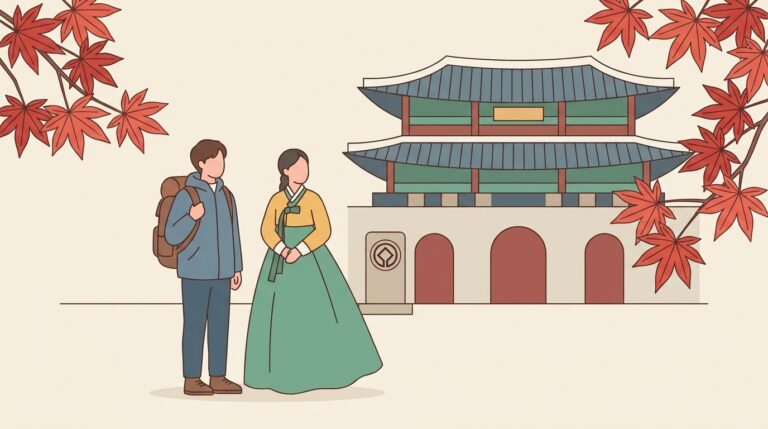
Imagine this: You are standing in the middle of Gyeongbokgung Palace. The autumn breeze is blowing, and you’re surrounded by beautiful traditional architecture. It feels exactly like a scene from that historical K-Drama (Sageuk) you binge-watched last month. Suddenly, the Korean tour guide passionately explains something, pointing at the building, and everyone nods in deep appreciation. You catch the word “UNESCO,” but the rest sounds like a completely different language from the casual Korean you hear in cafes.
Why does historical Korean sound so intimidating?
When exploring Korea’s profound history—especially its UNESCO World Heritage sites—the language shifts. It becomes more formal, poetic, and steeped in respect. But don’t worry! You don’t need a PhD in Korean history to sound like a culturally aware traveler. Knowing just a few key phrases will transform you from a standard tourist into a respectful guest who truly appreciates Korea’s heritage. Let’s dive in!
(Transparency note: This guide is crafted from real questions asked by intermediate learners who wanted to go beyond “Where is the bathroom?” while visiting Korea’s majestic palaces and temples.)
Phase 2: Core Expressions Deep Dive
Here are the essential expressions you will encounter at any Korean historical site.
1. 여기 유네스코 세계문화유산이에요.
- Pronunciation: yeogi yuneseuko segyemunhwayusanieyo. [yuh-gee / yoo-neh-soo-ko / seh-gyeh-moon-hwa-yoo-san-ee-eh-yo]
- Meaning: (Literal) Here is UNESCO World Cultural Heritage. / (Real nuance) This is a UNESCO World Heritage site!
- K-Culture Moment: Koreans are incredibly proud of their UNESCO designations. If you are traveling with a local friend to Bulguksa Temple or Suwon Hwaseong Fortress, they will likely say this with a puffed-out chest. It’s a stamp of national pride.
- Editor’s Insight: The word 유산 (yusan, heritage) is treated with great respect. When you acknowledge this, locals will instantly warm up to you.
- Situation Spectrum:
- Casual with friends: ✅ (Usually shortened to: 여기 유네스코 지정된 데야!)
- Semi-formal (Tour guides): ✅
- Formal: ✅
- 🤔 Think About It: Why does the UNESCO label hold such weight in Korea? Think about Korea’s turbulent modern history. Global recognition of its ancient culture serves as a powerful validation of its enduring identity. Does your country place the same emphasis on UNESCO sites?
2. 관람 시간은 언제까지예요?
- Pronunciation: gwallam siganeun eonjekkajiyeyo? [gwal-lam / shee-gan-eun / uhn-jeh-gga-jee-yeh-yo?]
- Meaning: (Literal) Viewing time is until when? / (Real nuance) What time does it close for visitors?
- K-Culture Moment: You are running toward the palace gates at 4:30 PM. The guard looks at you apologetically. Historical sites in Korea use the formal word 관람 (gwallam, viewing/admiring) instead of the casual 보는 것 (boneun geot, looking).
- Editor’s Insight: Memorize the word 관람 (gwallam). You will see it on tickets, signs, and brochures. It implies “looking with respect and appreciation.”
- Situation Spectrum:
- Casual: ⚠️ (Friends usually say: 언제 문 닫아?)
- Semi-formal (Ticket booth): ✅
- Formal: ✅
- 🤔 Think About It: Korean has many pairs of words where one is native Korean (casual) and the other is Sino-Korean (formal/official). How does this duality help define public vs. private spaces in Korean society?
3. 복원 공사 중입니다.
- Pronunciation: bogwon gongsa jungimnida. [bo-gwon / gong-sah / joong-im-nee-dah]
- Meaning: (Literal) Restoration construction is in progress. / (Real nuance) Under restoration (Do not enter).
- K-Culture Moment: You traveled 4 hours to see a famous pagoda, only to find it wrapped in scaffolding. Welcome to historical preservation!
- Editor’s Insight: 복원 (bogwon) means restoration. Because many of Korea’s wooden structures were destroyed during various wars, restoration is a constant, ongoing effort. You’ll see this sign everywhere.
- Situation Spectrum:
- This is purely signage/announcement language. You read it, you don’t usually say it!
- 🤔 Think About It: Much of Korea’s heritage has been rebuilt. Does the value of a historical site lie in the original materials, or the continuous effort to preserve its spirit?
Phase 3: Textbook vs. Real Korean
[Expressing Awe at a Palace]
* 📖 Textbook Korean: 이 궁궐은 매우 아름답습니다. (This palace is very beautiful.)
* 🗣️ Real Korean: 와, 고궁 분위기 대박이다. 한복이랑 완전 찰떡이에요! (Wow, the palace vibe is amazing. It matches the Hanbok perfectly!)
* 💡 Why the difference?: 찰떡 (literally “sticky rice cake”) is a popular slang term used to describe two things that match perfectly—like a traditional Hanbok and a palace backdrop.
[Asking About Age]
* 📖 Textbook Korean: 이것은 언제 건축되었습니까? (When was this constructed?)
* 🗣️ Real Korean: 이거 얼마나 오래된 거예요? (How old is this?)
* 💡 Why the difference?: While tour guides use passive voice and formal verbs (건축되다), everyday people stick to simple adjectives like 오래되다 (to be old) for efficiency and approachability.
Phase 4: Cultural Context — K-Culture Deep Dive
4-1. Non-verbal Nuances
When visiting traditional sites like Jongmyo Shrine or royal tombs, your body language speaks volumes. Do not step on the raised wooden thresholds (문지방 – munjibang) when entering traditional Hanok houses. Historically, it was considered disrespectful (and bad luck) to step on them; you must step over them. Also, keep your voice down. Korea’s Nunchi (social awareness) dictates that loud talking in these sacred spaces is deeply frowned upon.
4-2. The K-Drama Connection: The “Sageuk” Fantasy vs. Reality
If you love K-Dramas like Kingdom or The Red Sleeve, you are familiar with historical Korean (Sageuk tone). You might be tempted to yell “Jeonha~” (Your Majesty) or use ancient verb endings like “~하오” (~hao).
Critical viewpoint: While doing this with friends in Hanbok for an Instagram Reel is hilarious and totally fine, never use it with the ticket staff or elders. Modern Koreans do not speak like Joseon scholars! Enjoy the fantasy, but keep your survival Korean modern.
Phase 5: Real-Life Roleplay Scenario
Setting: Saturday afternoon, 2:00 PM. The Secret Garden (Biwon) at Changdeokgung Palace. The autumn leaves are a brilliant red. You are on a walking tour with your Korean friend, Minji. You are both wearing Hanbok.
Characters:
– YOU: An intermediate Korean learner, a big fan of historical K-Dramas, soaking in the vibe.
– Minji (28): Your Korean friend. She loves taking aesthetic photos and is proud of her culture.
Dialogue:
Minji: 와, 날씨 진짜 좋다. 여기 단풍 너무 예쁘지 않아? 🍁
(Wa, nalssi jinjja jota. Yeogi danpung neomu yeppeuji ana?)
[Wow, the weather is so nice. Aren’t the autumn leaves here so pretty?]
YOU: 응, 진짜 그림 같아. 예전에 왕들도 여기서 쉬었겠지?
(Eung, jinjja geurim gata. Yeojeone wangdeuldo yeogiseo swieotgetji?)
[Yeah, it looks like a painting. I guess kings used to rest here in the past too?]
Minji: 맞아. 창덕궁 후원이 유네스코 세계문화유산이잖아.
(Maja. Changdeokgung huwoni yuneseuko segyemunhwayusanijana.)
[Right. Changdeokgung’s Secret Garden is a UNESCO World Heritage site, you know.]
YOU: 아, 정말? 어쩐지 관리가 엄청 잘 되어 있더라.
(A, jeongmal? Eojjeonji gwalliga eomcheong jal doe-eo itdeora.)
[Oh, really? No wonder it’s so well maintained.]
Minji: 사진 찍어줄까? 저기 정자 앞에서 서 봐!
(Sajin jjigeojulkka? Jeogi jeongja apeseo seo bwa!)
[Should I take a picture of you? Go stand in front of that pavilion over there!]
(🎭 Stage Direction: Minji pulls out her phone, ready to snap the perfect shot)
🔀 Your Turn! How do you respond to strike a pose?
– A) “알겠어. 찍어줘.” (I understand. Take it.)
– B) “오케이! 나 조선시대 왕비처럼 찍어줘!” (Okay! Take it so I look like a Joseon Dynasty queen!)
– C) “성은이 망극하옵니다, 전하.” (Your grace is immeasurable, Your Majesty.)✅ Best Choice: B. It’s playful, fits the Hanbok context, and uses natural conversational Korean.
⚠️ Choice C Analysis: This is purely K-Drama Sageuk talk! Minji will probably burst out laughing. It’s a great joke among close friends, but definitely not normal Korean.
Phase 6: 10-Second Shadowing Drill
Practice this sentence to sound naturally amazed at a historical site. Follow the pauses (/) and the emotion tags!
😲 와, / 여기가 / 유네스코 / 세계문화유산이래요! / 🤩 진짜 / 멋있어요.
(Wa, / yeogiga / yuneseuko / segyemunhwayusanieyo! / jinjja / meosisseoyo.)
“Wow, I heard this is a UNESCO World Heritage site! It’s so cool.”
Phase 7: K-Culture Mini Dictionary
| Korean | Romanization | English | Context |
|---|---|---|---|
| 고궁 | gogung | Ancient Palace | Refers specifically to the historical royal palaces in Seoul (e.g., Gyeongbokgung). |
| 한복 | hanbok | Traditional Clothing | Wearing this usually gets you free entry into the palaces! |
| 사극 | sageuk | Historical Drama | The genre of TV shows set in historical periods, usually the Joseon Dynasty. |
| 단청 | dancheong | Traditional Coloring | The beautiful, intricate red, green, and blue patterns painted on traditional wooden buildings. |
Phase 8: Traveler’s Survival Kit
If you are exploring Korea’s historical sites, keep these phrases handy.
🆘 Survival Expressions
– 🇰🇷 “성인 두 명, 표 주세요.” (seongin du myeong, pyo juseyo.)
– 🗣️ Sound-alike: [sung-in / doo-myung / pyo / joo-seh-yo]
– 📍 Meaning: Two adult tickets, please.
– 🇰🇷 “오디오 가이드 있나요?” (odio gaideu innayo?)
– 🗣️ Sound-alike: [oh-dee-oh / gah-ee-deu / in-nah-yo?]
– 📍 Meaning: Do you have an audio guide?
– 🇰🇷 “여기서 사진 찍어도 돼요?” (yeogiseo sajin jjigeodo dwaeyo?)
– 🗣️ Sound-alike: [yuh-gee-suh / sah-jin / jji-guh-doh / dweh-yo?]
– 📍 Meaning: Can I take pictures here?📌 Editor’s Travel Note
– Palace Closing Days: Palaces don’t all close on the same day! Gyeongbokgung and Jongmyo close on Tuesdays, while Changdeokgung, Changgyeonggung, and Deoksugung close on Mondays. Always check before you go!
– The Hanbok Hack: If you rent a Hanbok, entry to the five grand palaces is completely FREE. Just walk right up to the gate.
Phase 9: Critical Thinking — “One Step Deeper”
🧠 Think Deeper: Architecture & Resilience
As you walk through Gyeongbokgung Palace, you might notice that many of the pristine buildings are actually relatively modern reconstructions. Unlike the stone castles of Europe, Korea’s traditional architecture is heavily wood-based, making it vulnerable to the country’s turbulent history of invasions, colonization, and war. Yet, Koreans dedicate immense resources to meticulously rebuilding these sites according to ancient blueprints. The preservation of these UNESCO sites isn’t just about maintaining old buildings; it is a profound statement of cultural resilience and surviving the erasure of history.💬 Your Turn: In your culture, are historical sites mostly original structures, or are they constantly rebuilt and restored? How does that change the way people view them? Share in the comments!
Phase 10: FAQ & Avoiding Misunderstandings
- Q: Do I need to bow to the royal thrones or statues in palaces?
- A: No! While it’s a place of respect, modern Koreans do not bow to artifacts or empty thrones. Just be quiet and respectful.
- Q: Can I touch the wooden pillars or the traditional paper (Hanji) windows?
- A: Please don’t. The oils from human hands can damage the delicate wood and paper. Look with your eyes, not your hands!
❌ Common Mistake #1: Assuming you can wear shoes inside all traditional buildings.
✅ Do this instead: Look for a wooden deck (Daechungmaru) or a shoe rack. If you see slippers provided or people walking in socks, take your shoes off immediately!
Phase 11: Summary & Action Items
One-Liner Summary: Navigating Korea’s UNESCO sites requires a few formal vocabulary words, a respectful attitude, and maybe a Hanbok for that perfect picture!
Action Mission 3 Steps:
– 🥉 Bronze: Say “여기 유네스코 세계문화유산이에요” out loud three times to practice the rhythm.
– 🥈 Silver: Leave a comment below answering the “Think Deeper” question in English or Korean.
– 🥇 Gold: Next time you visit a historical site in Korea, ask for your ticket in Korean using “성인 [Number] 명 표 주세요!”
K-Culture Mission: Go to Google Street View, drop the little yellow pegman into the middle of Gyeongbokgung Palace, and imagine where you would use today’s expressions!
Phase 12: Quiz — Interactive Challenge
1. Situational Judgment: You finally reach a beautiful temple door, but there is a sign that says “복원 공사 중입니다.” What should you do?
– A) Open the door quietly.
– B) Take off your shoes and enter.
– C) Turn around, it’s under construction.
2. Fill in the Blank: You want to ask what time the palace closes.
“_____ 시간은 언제까지예요?” (Hint: Formal word for viewing)
3. True or False – K-Culture Edition: Renting a Hanbok gets you free admission to the grand palaces in Seoul. (T/F)
(Answers: 1. C / 2. 관람 (gwallam) / 3. True!)
Did you get them all right? See you in the next lesson!
Frequently Asked Questions (FAQ)
Q: What does "여기 유네스코 세계문화유산이에요." mean in Korean and how do you pronounce it?
A: In Korean, "여기 유네스코 세계문화유산이에요." is pronounced [yeogi yuneseuko segyemunhwayusanieyo. [yuh-gee / yoo-neh-soo-ko / seh-gyeh-moon-hwa-yoo-san-ee-eh-yo] and means: (Literal) Here is UNESCO World Cultural Heritage. / (Real nuance) This is a UNESCO World Heritage site!
Q: What does "관람 시간은 언제까지예요?" mean in Korean and how do you pronounce it?
A: In Korean, "관람 시간은 언제까지예요?" is pronounced [gwallam siganeun eonjekkajiyeyo? [gwal-lam / shee-gan-eun / uhn-jeh-gga-jee-yeh-yo?] and means: (Literal) Viewing time is until when? / (Real nuance) What time does it close for visitors?
Q: What does "복원 공사 중입니다." mean in Korean and how do you pronounce it?
A: In Korean, "복원 공사 중입니다." is pronounced [bogwon gongsa jungimnida. [bo-gwon / gong-sah / joong-im-nee-dah] and means: (Literal) Restoration construction is in progress. / (Real nuance) Under restoration (Do not enter).







