

Phase 1: Empathy (Cold Open)
Hello! I’m your Daily Hangul Editor. 👋
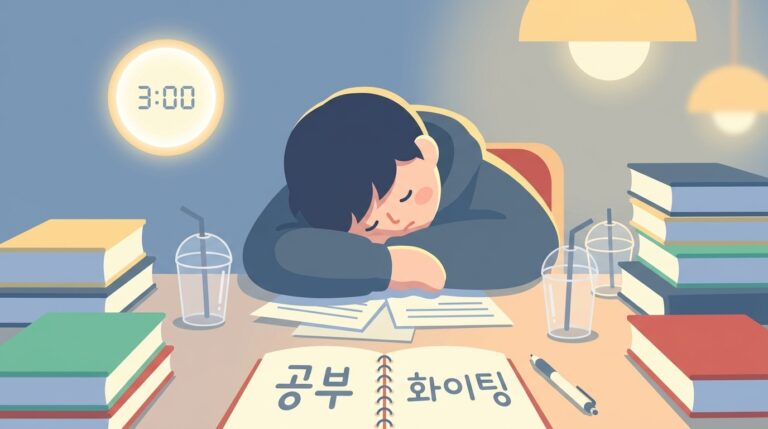
Picture this: It’s 3:00 AM in a 24-hour study cafe near Sinchon, the heart of Seoul’s university district. The only sounds are the rapid tapping of keyboards, the scribbling of highlighters, and the occasional, deeply exhausted sigh. On almost every desk, you’ll spot the unofficial sponsor of Korean midterms: a massive, half-empty cup of Iced Americano with condensation dripping down its sides.
If you’ve ever watched a Korean campus drama like Weightlifting Fairy Kim Bok-joo or Cheese in the Trap, you know exactly what I’m talking about. But here’s the secret: when Korean students are pulling an all-nighter, they don’t just say “I’m tired.” They speak a whole different dialect of survival, caffeine, and dramatic desperation.
If you only use textbook phrases like “저는 피곤합니다” (I am tired), you’ll sound like a robot in a room full of zombies. Let’s upgrade your Korean to B1 level with the real, raw expressions Koreans use when they’re running on zero sleep and 100% caffeine.
Phase 2: Core Expressions Deep Dive
1. 벼락치기(를) 하다
- Pronunciation: [byeorakchigi] – The ‘chigi’ sounds like the ‘chigg’ in ‘chigger’, bouncy and quick.
- Meaning: (Literal) Lightning striking / (Real nuance) Cramming for an exam at the very last minute.
- K-Culture Moment: You’ll hear this echoing in university hallways the day before midterms. Someone asks, “Did you study?” and the inevitable reply is, “Nope, I’m doing byeorakchigi tonight.”
- Editor’s Insight: This word perfectly captures the panic of last-minute studying. Just like lightning strikes suddenly and intensely, your brain is getting shocked with a whole semester’s worth of information in one night.
- Situation Spectrum:
- Casual with friends: ✅
- Coworkers (about a project): ⚠️ (Use cautiously, it implies you procrastinated)
- Professors: 🚫 (Never tell your professor you crammed!)
- 🤔 Think About It: Why do you think Koreans equate last-minute studying with a natural disaster like lightning? Does your native language have a dramatic metaphor for cramming?
2. 밤(을) 새우다 / 밤새다
- Pronunciation: [bameul saeuda] / [bamsaeda] – ‘sae’ sounds like ‘say’.
- Meaning: (Literal) To make the night dawn / (Real nuance) To stay up all night.
- K-Culture Moment: In K-Pop fandoms, fans use this when they stay up all night streaming a new music video or waiting for concert ticketing. In college, it’s the default state during exam week.
- Editor’s Insight: Grammatically, “밤을 새우다” is the correct form (I stayed up all night), but in daily life, everyone shortens it to the verb “밤새다” (어제 밤샜어 – I stayed up all night yesterday).
- Situation Spectrum:
- Casual with friends: ✅
- Coworkers: ✅
- Professors/Bosses: ✅ (If conjugated politely: 밤을 새웠습니다)
- 🤔 Think About It: Koreans often use the noun form “밤샘” (an all-nighter) like an event. “오늘 밤샘각이야” (Looks like an all-nighter tonight). Why is overworking or over-studying sometimes worn as a badge of honor in Korean society?
3. 커피 수혈이 시급해
- Pronunciation: [keopi suhyeol-i sigeuphae] – ‘suhyeol’ sounds like ‘soo-hyul’.
- Meaning: (Literal) A coffee blood transfusion is urgent / (Real nuance) I desperately need coffee to survive right now.
- K-Culture Moment: This is Peak Korean Office/College Life slang. You’ll see this phrase all over Instagram stories accompanied by a photo of a mega-sized coffee cup at 9 AM.
- Editor’s Insight: This is a fantastic B1-level expression to show off. By comparing drinking coffee to receiving a medical blood transfusion, you’re humorously exaggerating your exhaustion. It shows a deep understanding of Korean wit.
- Situation Spectrum:
- Casual with friends: ✅
- Coworkers (same level): ✅
- Bosses/Elders: 🚫 (Too dramatic/slangy)
- 🤔 Think About It: South Korea consumes an astronomical amount of coffee. Why has coffee become less of a leisurely drink and more of a “survival potion” in modern Korean culture?
Phase 3: Textbook vs. Real Korean
[Situation 1: Expressing Extreme Exhaustion]
* 📖 Textbook Korean: 저는 공부를 많이 해서 아주 피곤합니다. (I studied a lot, so I am very tired.)
* 🗣️ Real Korean: 아, 피곤해 죽겠어. 어제 밤샜어. (Ah, I’m dying of tiredness. I pulled an all-nighter yesterday.)
* 💡 Why the difference?: Koreans love the suffix “-아/어 죽겠다” (to death) to express extremes (starving to death, tired to death, happy to death). It adds emotional flavor!
[Situation 2: Getting Ready for a Long Night]
* 📖 Textbook Korean: 저는 오늘 커피를 마시고 밤에 잠을 자지 않겠습니다. (I will drink coffee today and not sleep at night.)
* 🗣️ Real Korean: 오늘 밤샘각이야. 일단 아아부터 수혈하자. (It’s an all-nighter angle tonight. Let’s get an iced americano transfusion first.)
* 💡 Why the difference?: Efficiency! “각” (angle) is slang for “it looks like [something] will happen,” and “아아” (Ah-Ah) is the universal abbreviation for Iced Americano.
Phase 4: Cultural Context — K-Culture Deep Dive
4-1. Non-Verbal Elements: The Art of the “Nunchi” Sigh
When pulling an all-nighter, body language speaks volumes. A deep, heavy sigh (한숨) while staring blankly at a laptop screen is the universal signal for “My brain has melted.” However, thanks to Nunchi (social awareness), if your friend sighs, you shouldn’t say, “Are you tired?” Instead, you quietly push a piece of chocolate or a can of energy drink toward their desk. That is true Korean affection.
4-2. The “Ah-Ah” (Iced Americano) Phenomenon
In Korean dramas and real life, you will notice people carrying plastic cups filled with dark liquid and ice—even in the dead of winter (얼죽아: Freezing to death but still Iced Americano). During exam week, the “Ah-Ah” isn’t just a beverage; it’s a prop that signifies “I am working hard.” If you want to blend in at a Korean university, ordering a Venti-sized Iced Americano with an extra shot is your rite of passage.
Phase 5: Real-Life Roleplay Scenario
Setting: It’s 2:30 AM at a 24-hour study cafe near Hongik University. You and your Korean classmate are preparing for tomorrow’s brutal Korean History midterm. Empty coffee cups litter the desk.
Characters:
* YOU: A foreign exchange student trying to survive midterms.
* Ji-hoon (22): Your Korean classmate. He looks like a zombie.
Dialogue:
Ji-hoon: 하아… (한숨) 아직 반도 못 봤어. 넌 좀 했어?
(Haa… ajik bando mot bwasseo. neon jom haesseo?)
[Sigh… I haven’t even reviewed half of it. Did you do a lot?]
YOU: 아니, 나도 지금 머리가 안 돌아가.
(Ani, nado jigeum meoriga an doraga.)
[No, my brain isn’t working right now either.]
(🎭 Stage Direction: You massage your temples)
Ji-hoon: 우리 오늘 밤새야겠다. 진짜 피곤해 죽겠네.
(Uri oneul bamsaeyagetda. Jinjja pigonhae jukgenne.)
[We’re gonna have to stay up all night today. I’m really dying of tiredness.]
🔀 Your Turn! How should you respond?
* A) “저는 피곤합니다. 자고 싶습니다.” (Very formal and stiff)
* B) “나도! 우리 커피 수혈 좀 하고 올까?”
* C) “그럼 시험 포기해!”
✅ Best Choice: B — “Me too! Should we go get a coffee transfusion?” This uses the perfect B1 slang (커피 수혈) and shows empathy. It’s exactly how a Korean college student would respond.
⚠️ Choice C Analysis: “Then give up on the exam!” is a bit too harsh, even as a joke, when someone is genuinely stressed!
Ji-hoon: 오, 콜! 1층 편의점 가서 몬스터나 커피 사오자. 내가 쏠게!
(O, kol! ilcheung pyeonijeom gaseo monseuteona keopi saoja. Naega ssolge!)
[Oh, deal! Let’s go to the convenience store on the 1st floor and buy a Monster (energy drink) or coffee. My treat!]
Phase 6: 10-Second Shadowing Drill
Master the intonation! In Korean, when you are tired, your pitch should drop, and you should elongate the vowels to sound genuinely exhausted.
😩 아… / 진짜 피곤해 / 죽~겠어. / 커피 수혈이 / 시~급해!
(A… / jinjja pigonhae / juk~gesseo. / keopi suhyeoli / si~geuphae!)
“Ah… I’m really dying of tiredness. I urgently need a coffee transfusion!”
Pro-tip: Let out a little sigh before you say “아…” (Ah…) for maximum dramatic effect.
Phase 7: K-Culture Mini Dictionary
| Korean Word | Romanization | English | Context |
|---|---|---|---|
| 벼락치기 | byeorakchigi | Cramming | The act of studying at the absolute last minute. |
| 스터디카페 | seuteodikape | Study Cafe | Paid, quiet spaces with desks and wifi, highly popular for studying. |
| 아아 | a-a | Iced Americano | The lifeblood of modern Koreans. Short for 아이스 아메리카노. |
| 얼죽아 | eoljuga | Eol-juk-a | Slang for “Even if I freeze to death, Iced Americano.” |
| 밤샘 | bamsaem | All-nighter | Often used with ‘-각’ (bam-saem-gak) meaning “looks like an all-nighter.” |
Phase 8: Traveler & Night Owl Survival Kit
Even if you aren’t taking exams, you might find yourself awake late at night in Korea, suffering from jet lag or enjoying the Seoul nightlife. Here is how you survive the late-night coffee run.
🆘 Survival Phrases for Late-Night Coffee
* 🇰🇷 “아이스 아메리카노 샷 추가해 주세요.” (aiseu amerikanho syat chugahae juseyo.)
* 🗣️ Meaning: “Please add an extra espresso shot to the Iced Americano.”
* 📍 Where to use: Megacoffee, Compose Coffee, Ediya, or any 24-hour cafe.📌 Editor’s Travel Note
* Where to go at 3 AM?: If traditional cafes are closed, head to a “무인 카페” (Unmanned Cafe/Robot Cafe) or any convenience store (CU, GS25). Convenience store pouch coffees poured over an ice cup are cheap, delicious, and a cultural staple!
* Library etiquette: If you visit a Korean library or study cafe, absolutely zero talking is allowed. Even the clicking sound of a mouse is frowned upon! Use “무소음 마우스” (silent mice).
Phase 9: Critical Thinking — “One Step Deeper”
🧠 Think Deeper: Food & Identity (The Culture of ‘Ppalli-Ppalli’ and Caffeine)
Why does Korea have a cafe on literally every corner, and why is “Coffee Transfusion” a common phrase? It ties deeply into the hyper-competitive nature of Korean society (from intense university entrance exams to fast-paced corporate life) and the famous Ppalli-Ppalli (Hurry, Hurry) culture. Coffee, specifically the fast-to-make, quick-to-drink Iced Americano, is no longer just a luxury bean water; it is the fuel required to keep up with the extreme pace of Korean society. By drinking an “Ah-Ah,” Koreans are physically manifesting their dedication to working hard and staying alert.
💬 Your Turn: Does your culture treat coffee as a relaxing luxury or a survival tool for work/study? Share in the comments!
Phase 10: FAQ & Avoiding Misunderstandings
Q: Can I tell my Korean professor “밤새워 공부해서 죽겠습니다” (I stayed up all night studying so I’m dying)?
No! While “죽겠다” (dying of…) is incredibly common among friends and close coworkers, it is considered too emotional and slangy for formal situations. To a professor, politely say: “어제 밤을 새워서 조금 피곤합니다” (I stayed up all night yesterday, so I am a little tired).
Q: Is doing “벼락치기” (Cramming) seen as a good thing?
It’s relatable, but not respected. It implies you played around until the last minute. Friends will laugh and relate, but don’t brag about it in a job interview!
❌ Common Mistake: Translating “I need coffee” literally as “저는 커피가 필요합니다.” (Grammatically fine, but sounds like a robot).
✅ Do This Instead: Use “아, 커피 땡긴다” (Ah, I’m craving coffee) or “커피 수혈 시급해” (Urgent coffee transfusion needed) for a much more natural, native-like B1 flow!
Phase 11: Summary & Action Items
One-Liner Summary: When the Korean study grind hits, skip the textbook “I’m tired” and embrace the dramatic “밤샜어” (stayed up all night) and “커피 수혈” (coffee transfusion).
Action Mission:
* 🥉 Bronze: Look in the mirror, let out a deep sigh, and say “피곤해 죽겠어!”
* 🥈 Silver: Text your Korean friend or language exchange partner: “요즘 바빠? 커피 수혈 필요하면 말해!” (Are you busy lately? Tell me if you need a coffee transfusion!)
* 🥇 Gold: Go to a Korean cafe, order an “Ah-Ah” with an extra shot (샷 추가), and conquer your day!
* 📚 K-Culture Mission: Next time you watch a Korean university drama, pay close attention to the study scenes. I guarantee you will spot someone sighing over an Iced Americano and complaining about “벼락치기.”
Did you learn something new today? Let me know in the comments what your go-to late-night study snack is! 👇
Phase 12: Quiz — Interactive Challenge
1. Situational Judgment: You and your friend are at the library at 1 AM. Your friend looks like they are falling asleep on their textbook. What is the most natural thing to say?
* A) 너는 번개가 치고 있어. (Lightning is striking you.)
* B) 커피 수혈하러 갈래? (Do you want to go get a coffee transfusion?)
* C) 너는 죽겠습니다. (You will die.)
2. True or False – K-Culture Edition:
* Korean students usually prefer hot lattes when pulling all-nighters to keep warm. (True / False)
🚨 Click here for the answers!
1. Answer: B. This is the perfect use of the “coffee transfusion” slang. A is a literal (and incorrect) translation of cramming, and C is grammatically incorrect and slightly threatening!
2. Answer: False. Koreans are famous for “얼죽아” (Eol-juk-a), meaning they will drink Iced Americanos even if they freeze to death. Cold drinks are preferred to keep you awake!
Frequently Asked Questions (FAQ)
Q: What does "벼락치기(를) 하다" mean in Korean and how do you pronounce it?
A: In Korean, "벼락치기(를) 하다" is pronounced [byeorakchigi] and means: (Literal) Lightning striking / (Real nuance) Cramming for an exam at the very last minute.
Q: What does "밤(을) 새우다 / 밤새다" mean in Korean and how do you pronounce it?
A: In Korean, "밤(을) 새우다 / 밤새다" is pronounced [bameul saeuda] and means: (Literal) To make the night dawn / (Real nuance) To stay up all night.
Q: What does "커피 수혈이 시급해" mean in Korean and how do you pronounce it?
A: In Korean, "커피 수혈이 시급해" is pronounced [keopi suhyeol-i sigeuphae] and means: (Literal) A coffee blood transfusion is urgent / (Real nuance) I desperately need coffee to survive right now.







