

Phase 1: Empathy (Immersive Open)
Greeting! I’m your Daily Hangul editor.
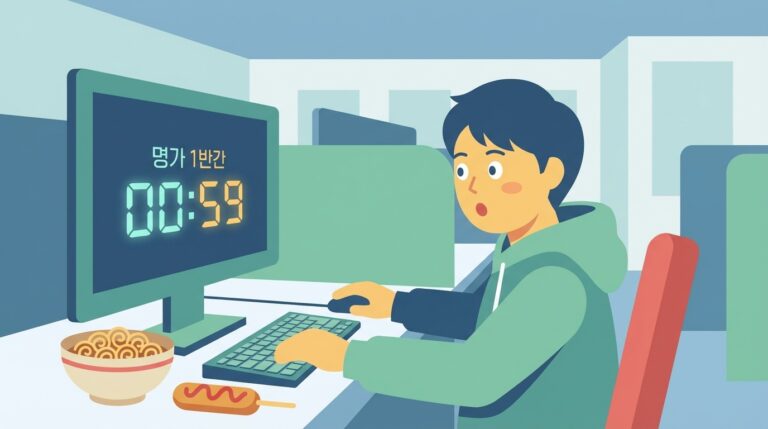
Imagine this: You are sitting in a dimly lit, neon-accented room in Hongdae. Your hands are flying across the keyboard. You’re watching a thrilling K-Drama episode or maybe surviving a fierce match in League of Legends. You’ve just clicked ‘Order’ on your screen for a steaming bowl of PC Bang Ramyeon and an iced Americano. Life is good.
Then, suddenly, a robotic voice announces through your headset: “10 minutes remaining.”
Panic sets in. Your screen turns gray. You need more time, but how do you say it? Do you yell at the staff? Do you slam coins on the desk?
If you don’t know the unique vocabulary of a Korean PC Bang (PC Cafe), you might lose your game, miss the climax of your drama, or worse—lose your seat! But don’t worry. As your veteran tutor and local guide, I’m here to teach you the ultimate insider phrases so you can recharge your time seamlessly and keep gaming (or eating) like a true Korean local.
(Note: This guide is based on real struggles from foreign students who thought they could just say “More time please” in English!)
Phase 2: Deep Dive into Key Expressions
Let’s look at the top 3 expressions you need to survive the time-limit countdown.
1. 시간 좀 충전할게요. (I’d like to add some time.)
- Pronunciation: si-gan jom chung-jeon-hal-ge-yo. (The ‘으’ in ‘충’ doesn’t exist here, but ‘충’ sounds like a sharp ‘choong’, and ‘전’ sounds like ‘jeon’ in ‘John’.)
- Meaning: Literal: I will recharge time. / Real nuance: I want to put more money on my PC time.
- K-Culture Moment: In older dramas, high school students would slap a 1,000 won bill on the counter and yell this. Nowadays, you mostly say this to yourself while tapping the screen of an automated Kiosk.
- Editor’s Insight: The word 충전 (recharge) is magic in Korea. You don’t just recharge phone batteries; you recharge your transit card (T-money), your PC Bang account, and even your energy after a long day!
- Situation Spectrum:
- Casual with friends: ✅ (충전할게!)
- Semi-formal to staff: ✅ (충전할게요)
- Formal: 🚫 (Not necessary in a PC Bang)
- 🤔 Think About It: Why does the Korean language treat ‘time’ (시간) as something you ‘recharge’ (충전) like a battery? How does this reflect the fast-paced, efficiency-driven lifestyle of modern Korea?
2. 비회원으로 할게요. (I’ll do it as a non-member.)
- Pronunciation: bi-hoe-won-eu-ro hal-ge-yo. (The ‘으’ in ‘으로’ sounds like the disgusted sound you make when stepping in gum.)
- Meaning: Literal/Real: I will proceed as a non-member.
- K-Culture Moment: When you visit a PC Bang for a quick hour just to print concert tickets for your favorite K-Pop idol, you don’t want to make an account. You just grab a non-member card!
- Editor’s Insight: PC Bangs have two pricing tiers. Members (회원) get it cheaper, but requires a Korean ID or phone number. Tourists usually use Non-member (비회원) tickets.
- Situation Spectrum:
- Casual: 🚫 (You don’t say this to friends)
- Semi-formal to staff/Kiosk: ✅
- Formal: 🚫
- 🤔 Think About It: Membership culture is huge in Korea, from cafes to PC Bangs. Do you prefer signing up for everything for a discount, or paying a little extra for convenience?
3. 자리 이동할 수 있어요? (Can I move seats?)
- Pronunciation: ja-ri i-dong-hal su i-sseo-yo?
- Meaning: Literal/Real: Is it possible to move my seat?
- K-Culture Moment: You walk in with your friend to play games together, but the only empty seats are far apart. You log in, wait for someone to leave, and then ask the staff to transfer your remaining time to the new seat next to your friend!
- Editor’s Insight: This requires a bit of ‘Nunchi’ (reading the room). Don’t just physically move! Your time is tied to the computer number.
- Situation Spectrum:
- Casual: 🚫
- Semi-formal to staff: ✅
- Formal: 🚫
Phase 3: Textbook vs. Real Korean
Let’s see how textbook Korean compares to what you’ll actually hear at 2 AM in a PC Bang.
[Situation 1: Adding Time]
* 📖 Textbook Korean: 제 컴퓨터 사용 시간을 연장하고 싶습니다. (I would like to extend my computer usage time.)
* 🗣️ Real Korean: 여기 2시간 충전이요! (Two hours recharge here!) or 그냥 키오스크에서 할게요. (I’ll just do it at the kiosk.)
* 💡 Why the difference?: Efficiency is king in Korea. In a noisy gaming cafe, short nouns + “이요/요” is the ultimate polite yet fast way to communicate.
[Situation 2: Paying for a Friend]
* 📖 Textbook Korean: 제가 친구의 요금도 함께 지불하겠습니다. (I will pay for my friend’s fee together.)
* 🗣️ Real Korean: 내 것도 같이 충전해 줘. (Recharge mine together too – to a friend.)
* 💡 Why the difference?: Friends in a PC Bang use extremely casual language (Banmal). Paying for each other is a sign of close friendship (Jeong).
Bottom Note: For B1 (Intermediate) learners, using
-할게요(I will do) and-해 주세요(Please do) is the perfect balance of polite and natural.
Phase 4: Cultural Context — K-Culture Deep Dive
4-1. Non-verbal Elements & Nunchi
In a modern PC Bang, Nunchi (눈치) dictates that you look for the glowing machine first. Do not walk up to the staff cooking Ramyeon and shout, “Excuse me!” Most PC Bangs are automated. Find the Kiosk (키오스크). Also, when leaving, it’s good manners to place your trash on your tray so the staff can clean up easily.
4-2. K-Food Connection: The Gourmet PC Bang
Let’s be real. Half the people in a PC Bang aren’t even gaming; they’re eating! The PC Bang has evolved into a high-tech restaurant.
– The Culture: You order directly from your computer screen. You can order hotdogs, dumplings, iced tea, and the iconic “PC Bang Ramyeon” (which somehow always tastes better than at home).
– The Phrase: When your time is running out, you might also want to order food. Just remember: Food is paid for at your seat when the staff delivers it, but Time must be recharged at the kiosk!
– Critical View: Why do Koreans eat while gaming? It’s the ultimate manifestation of “Bbali-bbali” (hurry-hurry) culture. Maximizing leisure time by combining gaming and dining into one highly efficient experience.
Phase 5: Real-Life Roleplay Scenario
Setting: Friday 9 PM. A massive, neon-lit PC Bang in Sinchon. The sound of rapid keyboard clicking fills the air. You and your Korean colleague, Min-su, are playing an intense co-op game.
Characters:
– YOU: An expat working in Seoul, B1 Korean learner. You just got a “5 minutes remaining” warning.
– Min-su (32): Your friendly Korean coworker who invited you here.
(Dialogue)
Min-su: 아, 나 시간 다 돼간다. 충전해야겠다.
(a, na si-gan da dwae-gan-da. chung-jeon-hae-ya-get-da.)
[Ah, my time is almost up. I should recharge.]
YOU: 어? 저도 5분 남았어요!
(eo? jeo-do o-bun na-ma-sseo-yo!)
[Huh? I only have 5 minutes left too!]
Min-su: 그래? 내가 키오스크 다녀올게. 너 로그인 아이디가 뭐야?
(geu-rae? nae-ga ki-o-seu-keu da-nyeo-ol-ge. neo ro-geu-in a-i-di-ga mwo-ya?)
[Really? I’ll go to the kiosk. What’s your login ID?]
YOU: 저는 비회원 카드로 로그인했어요.
(jeo-neun bi-hoe-won ka-deu-ro ro-geu-in-hae-sseo-yo.)
[I logged in with a non-member card.]
Min-su: 아, 비회원 카드 번호 불러줘. 만 원 충전하면 되지?
(a, bi-hoe-won ka-deu beon-ho bul-leo-jwo. man won chung-jeon-ha-myeon doe-ji?)
[Ah, tell me the non-member card number. 10,000 won recharge is enough, right?]
🔀 Your Turn! How do you respond?
– A) 네, 만 원어치 충전해 주세요. 제가 돈 드릴게요! (Polite, but a bit textbook.)
– B) 아뇨, 제 시간은 제가 충전할게요! (Too defensive, ruins the mood.)
– C) 우와, 대박! 민수 씨가 쏘는 거예요? 잘 쓸게요! (A bit too presumptuous for a coworker!)✅ Best Choice: A — Reason: In Korea, when someone offers to run an errand, it’s polite to accept but immediately offer to pay your share (unless they explicitly say they are treating you: “내가 쏠게”). Add “돈 드릴게요” (I’ll give you the money) to be a considerate coworker!
(Continuing with A)
YOU: 네, 만 원어치 충전해 주세요. 제가 돈 드릴게요!
(ne, man won-eo-chi chung-jeon-hae ju-se-yo. je-ga don deu-ril-ge-yo!)
[Yes, please recharge 10,000 won worth. I’ll give you the money!]
Min-su: 에이, 됐어. 오늘 피시방은 내가 쏜다!
(e-i, dwae-sseo. o-neul pi-si-bang-eun nae-ga sson-da!)
[Hey, forget it. The PC Bang is on me today!]
YOU: 헐… 감사합니다! 그럼 제가 라면 쏠게요!
(heol… gam-sa-ham-ni-da! geu-reom je-ga ra-myeon ssol-ge-yo!)
[Wow… thank you! Then I’ll treat us to Ramyeon!]
(🎭 Stage Direction: Min-su smiles and walks to the kiosk while you happily open the food menu on your screen.)
👑 K-Culture Bonus Roleplay: The Kiosk Struggle
You are at the Kiosk. You scan your Non-member card, but the screen is entirely in Korean.
YOU: 저기요… 이거 영어 지원 되나요? (Excuse me… does this support English?)
Staff: 아, 오른쪽 위에 언어 변경 버튼 누르시면 돼요! (Ah, just press the language change button on the top right!)
YOU: 아! 찾았어요. 감사합니다. (Ah! Found it. Thank you.)
Phase 6: 10-Second Shadowing Drill
Let’s practice the panic moment when you need to recharge immediately! Focus on the pauses (/) and the urgent yet polite intonation.
🥺 저기요! / 제 컴퓨터 / 시간 좀 / 충전해 주시겠어요? (jeo-gi-yo! / je keom-pyu-teo / si-gan jom / chung-jeon-hae ju-si-ge-sseo-yo?)
Tip: Say it like you are trying to save your game character’s life!
Phase 7: K-Culture Mini Dictionary
| Korean | Romanization | English | Context/Meaning |
|---|---|---|---|
| 충전 | chungjeon | Recharge | Used for batteries, transit cards, and PC Bang time. |
| 회원/비회원 | hoewon / bihoewon | Member / Non-member | Member gets cheaper rates. Tourists usually use non-member. |
| 키오스크 | kioseukeu | Kiosk | The automated machine where you pay for time. |
| 먹거리 | meokgeori | Food/Snacks | The tab on the PC screen where you order food. |
| 시간 차감 | sigan chagam | Time deduction | If you order expensive food using your PC time instead of cash, your remaining time is deducted! |
Phase 8: Traveler’s Survival Kit
Even if you’re just traveling to Korea, a PC Bang is a great place to rest, charge your phone, print a document, or eat a cheap meal. Here are your survival phrases:
🆘 Survival Phrase TOP 3
– 🇰🇷 “키오스크가 어디에 있어요?” (ki-o-seu-keu-ga eo-di-e i-sseo-yo?)
– 🗣️ Meaning: Where is the kiosk?
– 🇰🇷 “프린트 할 수 있어요?” (peu-rin-teu hal su i-sseo-yo?)
– 🗣️ Meaning: Can I print here? (Look for “Print Cafe” or ask first, as not all PC Bangs have printers anymore).
– 🇰🇷 “비회원 카드 어디 있어요?” (bi-hoe-won ka-deu eo-di i-sseo-yo?)
– 🗣️ Meaning: Where are the non-member cards? (Usually piled up next to the kiosk).📌 Editor’s Travel Note
– Don’t just turn off the PC! If you are a member, click “로그아웃” (Log out) to save your remaining time for your next visit.
– Payment: Most kiosks only accept Credit Cards (카드) or Cash (현금, usually 1,000, 5,000, 10,000 won bills).
Phase 9: Critical Thinking Corner — “A Step Deeper”
Media vs Reality: The Silent PC Bang
If you watch old Korean movies or dramas, you’ll see characters yelling across a smoky room, “Ajeossi! One hour recharge!” and tossing coins. Today, that reality is entirely dead. Modern Korean PC Bangs are highly digitalized, pristine, smoke-free environments (with dedicated glass smoking booths). The language has shifted from verbal shouting to silent touchscreen interactions. The staff are now essentially chefs, preparing gourmet food. The “recharge” language still exists, but it’s a silent transaction between you and the machine.
💬 Your Turn: Does your country have internet cafes? Have they evolved into food or tech hubs like in Korea, or did they disappear with smartphones? Share your thoughts in the comments!
Phase 10: FAQ & Avoiding Misunderstandings
Q: Can I pay for my game time at my seat?
Maybe! Some modern PC Bangs let you recharge time directly from the screen using a credit card (KakaoPay, Samsung Pay). But cash usually requires walking to the Kiosk.
Q: Can I ask the staff to add time for me?
Generally, no. If you hand cash to the staff, they will politely point you to the Kiosk. They are too busy cooking dumplings!
❌ Common Mistake #1: Leaving without logging out.
✅ Do this instead: Always click ‘사용 종료’ (End session) or ‘로그아웃’ (Log out) on your screen. If you just pull the plug or walk away, your time will keep running until it hits zero!❌ Common Mistake #2: Assuming you must be a member to enter.
✅ Do this instead: Just grab a shiny plastic ‘비회원’ (Non-member) card from the front desk, go to the kiosk, type the number on the card, and insert your money.
Phase 11: Summary & Action Items
One-Liner Summary: To survive a Korean PC Bang, grab a non-member card, find the Kiosk, and remember the magic word: “충전” (Recharge)!
Action Mission 3 Steps:
– 🥉 Bronze (Solo): Say “시간 좀 충전할게요” out loud 3 times pretending your screen just flashed red.
– 🥈 Silver (Online): Find a YouTube vlog of a “Korean PC Bang Food Tour” and try to spot the Kiosk!
– 🥇 Gold (Real Life): Visit a PC Bang in Korea, grab a non-member card, recharge 2 hours, and order a Ramyeon directly from your computer!
What’s your favorite game to play, or what food would you order in a PC Bang? Let me know below!
Phase 12: Quiz — Interactive Challenge
1. Situational Judgment: You are at a PC Bang and want to add 2 hours of time. You don’t have an account. What is the most natural step?
A) Yell “사장님, 연장해 주세요!” at the front desk.
B) Grab a non-member card, go to the Kiosk, and pay for 2 hours.
C) Hand your credit card to the person sitting next to you.
2. Fill in the Blank:
Korean time is running out. I need to ____________ it!
“시간 좀 ( )할게요!”
3. True or False – K-Culture Edition:
If you buy a 10-hour membership at a PC Bang, you must play for 10 hours straight. (T / F)
(Answers)
Click to reveal answers!
1. B – Kiosks and non-member cards are the standard for tourists! A is outdated, C is just weird.
2. 충전 (chungjeon) – Recharge!
3. False (F) – As long as you log out, your remaining time is saved to your account forever!
Frequently Asked Questions (FAQ)
Q: What does "시간 좀 충전할게요. (I'd like to add some time.)" mean in Korean and how do you pronounce it?
A: In Korean, "시간 좀 충전할게요. (I'd like to add some time.)" is pronounced [si-gan jom chung-jeon-hal-ge-yo. (The '으' in '충' doesn't exist here, but '충' sounds like a sharp 'choong', and '전' sounds like 'jeon' in 'John'.] and means: Literal: I will recharge time. / Real nuance: I want to put more money on my PC time.
Q: What does "비회원으로 할게요. (I'll do it as a non-member.)" mean in Korean and how do you pronounce it?
A: In Korean, "비회원으로 할게요. (I'll do it as a non-member.)" is pronounced [bi-hoe-won-eu-ro hal-ge-yo. (The '으' in '으로' sounds like the disgusted sound you make when stepping in gum.] and means: Literal/Real: I will proceed as a non-member.
Q: What does "자리 이동할 수 있어요? (Can I move seats?)" mean in Korean and how do you pronounce it?
A: In Korean, "자리 이동할 수 있어요? (Can I move seats?)" is pronounced [ja-ri i-dong-hal su i-sseo-yo?] and means: Literal/Real: Is it possible to move my seat?







