

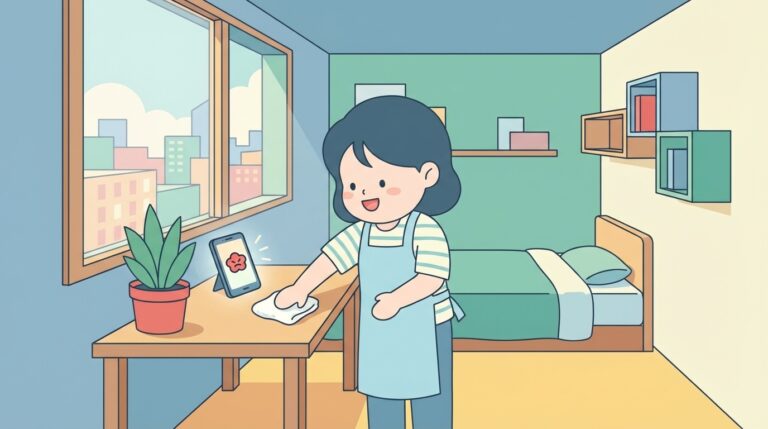
Phase 1: Empathy & The “Achoo!” Moment
Hello there! Daily Hangul Editor here. 👋
Picture this: You’re watching a classic K-Drama. The handsome, slightly arrogant CEO walks into the female lead’s humble rooftop apartment (옥탑방). What’s the first thing he does? He slowly runs his index finger over her bookshelf, inspects the thick layer of grey dust, and clicks his tongue in disapproval. Or maybe you’ve seen the typical K-Drama mom bursting into her kid’s messy room, slapping them on the back, and aggressively throwing open the windows to “get the dust out.”
Dusting and cleaning might seem like a boring chore, but in Korea, dealing with dust—especially ‘Fine Dust’ (미세먼지)—is an everyday survival skill, a conversational icebreaker, and a huge part of modern culture.
If you live in Korea, share an Airbnb with a Korean friend, or even just visit during the spring, knowing how to talk about dust (and how to clean it) will instantly make you look like a seasoned local. Let’s grab our cleaning supplies and dive in! ✨
Phase 2: Core Expressions — Let’s Get Cleaning!
Here are the 3 essential phrases you need for dusting and cleaning. We’re keeping it A2-friendly, focusing on what Koreans actually say.
1. 먼지 좀 털어줄래? (Can you dust a bit?)
- Pronunciation: Meon-ji jom teo-reo-jul-lae? [sound guide: meon-ji sounds like ‘mon-jee’, teo-reo sounds like ‘tuh-ruh’ with a soft R]
- Meaning: Literal = “Will you shake off the dust a little?” / Real nuance = “Can you dust the furniture?”
- K-Culture Moment: It’s Saturday morning. Your Korean roommate hands you a duster while they grab the vacuum. It’s a casual request to divide the chores.
- Editor’s Insight: The verb 털다 (teolda) literally means “to shake off” or “to brush off.” In Korea, we historically dusted by taking blankets or mats outside and literally beating the dust out of them!
- Situation Spectrum:
- Close Friends/Roommates (Casual): ✅ (Perfect)
- Co-workers (Semi-formal): ⚠️ (Add ~요 at the end: 털어주실래요?)
- Boss/Elders (Formal): 🚫 (Too direct. Better to say: 제가 먼지를 닦겠습니다 – I will wipe the dust.)
- 🤔 Think About It: Why do Koreans use the word “shake off” for dusting? How do people traditionally clean dust in your country?
2. 물티슈로 닦을게. (I’ll wipe it with a wet wipe.)
- Pronunciation: Mul-ti-syu-ro da-kkeul-gge. [sound guide: mul = ‘mool’ (water), ti-syu = tissue]
- Meaning: Literal = “I will wipe with a water-tissue.” / Real nuance = “I’ll wipe down the dust with wet wipes.”
- K-Culture Moment: You’re at a BBQ restaurant, and the table feels a bit greasy or dusty. You tell your friend this before wiping the table for both of you.
- Editor’s Insight: This is crucial! In modern Korea, we rarely use feather dusters. Because fine dust (미세먼지) is dangerous to breathe in, we prefer to 닦다 (wipe) it away with a damp cloth or a wet wipe so the dust doesn’t fly into the air.
- Situation Spectrum:
- Casual: ✅
- Semi-formal: ⚠️ (Add ~요: 닦을게요)
- Formal: ⚠️ (Say: 물티슈로 닦겠습니다)
- 🤔 Think About It: Korea is the land of the “Mul-tisyu” (wet wipe). You can find them everywhere. Why do you think wet wipes became so universally loved in Korean daily life?
3. 환기 좀 시키자. (Let’s air out the room.)
- Pronunciation: Hwan-gi jom si-ki-ja. [sound guide: hwan-gee (rhymes with swan-gee)]
- Meaning: Literal = “Let’s do some ventilation.” / Real nuance = “Let’s open the windows and air this place out.”
- K-Culture Moment: It’s cleaning day. Before doing anything else, a Korean parent will throw open the living room windows and say this. You must ventilate when you dust!
- Editor’s Insight: Koreans are obsessed with ‘환기’ (ventilation). Even in the dead of winter, Koreans will open the windows for 10 minutes to “change the air” while cleaning.
- Situation Spectrum:
- Casual: ✅
- Semi-formal: ⚠️ (Add ~요: 시킬까요?)
- Formal: 🚫 (Use respectful suggestion: 환기하는 게 어떨까요?)
- 🤔 Think About It: Is throwing the windows open in the middle of winter common in your culture, or do people prefer to keep the heat trapped inside?
Phase 3: Textbook vs. Real Korean
Let’s see how the textbook phrases compare to what you’ll actually hear in a Seoul apartment.
[Situation 1: Pointing out a dusty shelf]
* 📖 Textbook: 책상에 먼지가 많습니다. (There is a lot of dust on the desk.)
* 🗣️ Real Korean: 헐, 여기 먼지 대박. (Whoa, the dust here is crazy/daebak.)
* 💡 Why the difference?: “대박” (Daebak – awesome/crazy) is the ultimate filler word for any extreme situation, good or bad!
[Situation 2: Telling someone you’ll clean the dust]
* 📖 Textbook: 제가 먼지를 제거하겠습니다. (I will remove the dust.)
* 🗣️ Real Korean: 내가 쓱 닦을게! (I’ll just give it a quick wipe!)
* 💡 Why the difference?: The sound-word “쓱” (sseuk) mimics the sound of wiping something quickly. Koreans love using onomatopoeia for efficiency and cuteness.
(Bottom Note: For A2 level, using “닦을게요” [I will wipe it] instead of “제거할게요” [I will remove it] instantly makes your Korean sound much more natural!)
Phase 4: Cultural Context — K-Culture Deep Dive
4-1. The Non-Verbal “Nunchi” of Dusting
When someone starts cleaning or dusting around you, it’s a Nunchi (눈치) test. Nunchi is the Korean art of reading the room. If your older roommate or co-worker starts wiping down dust, you shouldn’t just sit there watching TV! Jump up, grab a wet wipe, and ask: “제가 뭐 도와드릴까요?” (Is there anything I can help with?).
4-2. The “Mise-munji” (Fine Dust) Phenomenon
If you want to bond with a Korean, just complain about the fine dust.
* “오늘 미세먼지 너무 심하지 않아요?” (Isn’t the fine dust so bad today?)
In Korea, checking the fine dust app (like MiseMise) is as common as checking the weather forecast. If the app shows a red or black angry face (Bad/Very Bad), you do not open the windows to ventilate (환기), and you definitely don’t dust by shaking things out. You run the air purifier (공기청정기) and use a wet mop!
Phase 5: Real-Life Roleplay Scenario
Setting: Saturday afternoon, 2:00 PM. The sun is shining into your shared apartment in Hongdae. Your Korean roommate, Minho (25, neat, friendly but a bit nagging today), is holding a duster.
Characters:
– YOU: A foreign student surviving midterms, currently lying on the sofa.
– Minho: Your Korean roommate.
Dialogue:
Minho: 아, 날씨 좋다! 우리 오늘 대청소할까? 🧹
(A, nalssi jota! Uri oneul daecheongsohalkka?)
[Translation: Ah, the weather is great! Should we do a big spring cleaning today?]
YOU: 대청소? 오늘? 😅
(Daecheongso? Oneul?)
[Translation: Big cleaning? Today?]
Minho: 응! 거실에 먼지가 너무 많아. 내가 청소기 돌릴게.
(Eung! Geosire meonjiga neomu mana. Naega cheongsogi dollilge.)
[Translation: Yeah! There’s so much dust in the living room. I’ll run the vacuum.]
Minho: 너는 저기 선반 먼지 좀 털어줄래?
(Neoneun jeogi seonban meonji jom teo-reo-jul-lae?)
[Translation: Can you dust that shelf over there?]
🔀 Your Turn! How do you reply?
– A) “싫어. 나중에 할게.” (No. I’ll do it later.)
– B) “오케이! 내가 물티슈로 닦을게!” (Okay! I’ll wipe it with a wet wipe!)
– C) “먼지 대박! 도망가자!” (Dust is crazy! Let’s run away!)✅ Best Choice: B — Why: It shows great teamwork (눈치)! You acknowledged the request and offered the most Korean way of dusting: using a wet wipe (물티슈).
⚠️ Choice A Analysis: Saying “싫어” (No/I hate it) is too blunt and might hurt Minho’s feelings, leading to an awkward living situation.
Minho: 오, 센스 있네! 창문 열고 환기부터 시키자.
(O, senseu inne! Changmun yeolgo hwangibuteo sikija.)
[Translation: Oh, you’ve got sense! Let’s open the windows and ventilate first.]
(🎭 Stage Direction: Minho throws open the window and hands you a pack of wet wipes.)
Phase 6: 10-Second Shadowing Drill
Let’s practice the rhythm! Pay attention to the pauses (/) and the emotion.
- 😤 (Determined) 먼지가 / 너무 많아! (Meonjiga / neomu mana!) -> There’s too much dust!
- 😊 (Helpful) 내가 / 물티슈로 / 쓱~ 닦을게. (Naega / multisyuro / sseuk~ dakkeulge.) -> I’ll wipe it quickly with a wet wipe.
- 😷 (Stuffy) 오늘 / 환기 / 꼭 시키자. (Oneul / hwangi / kkok sikija.) -> Let’s definitely air out the room today.
Phase 7: K-Culture Mini Dictionary
| Korean | Romanization | English | Cultural Context |
|---|---|---|---|
| 미세먼지 | mise-meonji | Fine dust | Airborne particulate matter. A major daily concern in Korea, especially in spring. |
| 물티슈 | mul-ti-syu | Wet wipes | The ultimate Korean cleaning tool. Used for faces, tables, floors, and dusting! |
| 대청소 | dae-cheong-so | Spring/Deep cleaning | Usually done on weekends. Involves loud vacuums, open windows, and wiping everything. |
| 눈치 | nun-chi | Social sense | The ability to “read the room” (e.g., offering to clean when others are cleaning). |
Phase 8: Traveler Survival Kit (Dust & Cleaning Edition)
Even if you aren’t doing chores, you’ll encounter “wiping” and “dusting” situations while traveling, especially at restaurants!
🆘 Survival Phrases for Travelers
– 🇰🇷 “여기 좀 닦아주세요.” (Yeogi jom da-kka-ju-se-yo.)
– 🗣️ Pronunciation: Yuh-gee jom dah-kkah-joo-seh-yo.
– 📍 Where to use: At a restaurant, if your table has sticky spots, grease, or dust.
– 💡 Pro Tip: Don’t just point; use an open hand to gesture to the table politely!
- 🇰🇷 “물티슈 있어요?” (Mul-ti-syu i-sseo-yo?)
- 📍 Where to use: Asking for a wet wipe at a street food stall (포장마차) to clean your hands or a dusty seat.
📌 Editor’s Travel Note
– The Table Drawer: In many Korean restaurants, you don’t even need to ask! Look under the side of your table. You will often find a hidden drawer containing spoons, chopsticks, napkins, and sometimes even packaged wet wipes (물티슈)!
Phase 9: Critical Thinking — “One Step Deeper”
🧠 Think Deeper: Media vs. Reality (The Cleanliness Culture)
If you watch K-Dramas, Korean houses look spotless. The floors shine, and there’s not a speck of dust. In reality, maintaining this level of cleanliness in modern Korea requires constant battle against Mise-munji (fine dust). This is why Korean homes almost always have an air purifier (공기청정기) humming in the corner and a strict “no shoes inside” rule. The Korean language evolved to match this: instead of just “dusting” (which throws dust in the air), the culture shifted entirely toward “wiping with a damp cloth” (닦다) to trap the toxic particles. Language adapts to protect our health!
💬 Your Turn: Does your country have a specific season or weather event (like Korea’s fine dust season) that forces everyone to clean their houses differently? Share in the comments!
Phase 10: FAQ & Avoiding Mistakes
- Q: Can I say “방을 닦아주세요” (Please wipe the room) to a hotel maid?
- A: Yes! But it specifically means mopping the floor or wiping surfaces. If you want the room general-cleaned, say “청소해 주세요” (Please clean the room).
- Q: My Korean friend said “입을 털다” (Shake off the mouth). Are they cleaning their mouth?
- A: No! 🤣 “입을 털다” is a funny slang phrase that means “to talk a lot” or “to brag/gossip.” Don’t hand them a wet wipe!
❌ Common Mistake #1: Using “먼지를 털다” (shake off dust) when talking about cleaning a computer screen or a glass table.
✅ Do this instead: Use “닦다” (to wipe). 먼지를 털다 implies hitting or brushing something (like a rug or a jacket). For screens and tables, we wipe (닦다)!
Phase 11: Summary & Action Items
One-Liner Summary: When dealing with dust in Korea, remember: we don’t just shake it off (털다), we wipe it away with a wet wipe (물티슈로 닦다) while ventilating the room (환기)!
🚀 Action Mission 3 Steps:
– 🥉 Bronze (Solo): Look at a dusty surface in your house and say out loud: “먼지 대박! 닦을게!” (Dust is crazy! I’ll wipe it!)
– 🥈 Silver (Online): Check your local weather app. Is it dusty today? Write in your language and Korean (환기 시키자 / 시키지 말자) in our learning community.
– 🥇 Gold (Real-world): Next time you are at a Korean restaurant, find the wet wipe (물티슈) or ask the waiter for one using today’s phrase!
📺 K-Culture Mission:
Turn on a K-Drama today. I guarantee that within 3 episodes, you will see a scene where a character is angrily wiping down a table or enthusiastically vacuuming to relieve stress. Point at the screen and shout: “청소!” (Cleaning!)
Phase 12: Quiz — Interactive Challenge
1. Situational Judgment:
You are sharing a dorm with a Korean student. It’s spring, and the fine dust (미세먼지) warning on the app is glowing dark red. What should you do before dusting the room?
– A) Open all the windows wide to let the fresh air in (환기 시키자).
– B) Keep the windows closed, turn on the air purifier, and use a wet wipe (물티슈).
(Answer: B! Never ventilate when the fine dust level is severe!)
2. Fill in the Blank:
Friend: “아, 여기 테이블에 삼겹살 기름이 너무 많아.”
(Ah, there is too much pork belly grease on this table.)
YOU: “잠시만, 내가 ________로 닦을게!”
(Wait, I will wipe it with a ________!)
– A) 먼지 (Dust)
– B) 청소기 (Vacuum)
– C) 물티슈 (Wet wipe)
(Answer: C. Wet wipes are the lifesavers of Korean BBQ!)
3. True or False — K-Culture Edition:
“In Korea, people prefer to dust their indoor furniture using a large feather duster rather than wiping it with a damp cloth.”
(Answer: False. Due to fine dust concerns, wiping (닦다) with a damp cloth or wet wipe is much preferred!)
Frequently Asked Questions (FAQ)
Q: What does "먼지 좀 털어줄래? (Can you dust a bit?)" mean in Korean and how do you pronounce it?
A: In Korean, "먼지 좀 털어줄래? (Can you dust a bit?)" is pronounced [Meon-ji jom teo-reo-jul-lae? [sound guide: meon-ji sounds like 'mon-jee', teo-reo sounds like 'tuh-ruh' with a soft R] and means: Literal = "Will you shake off the dust a little?" / Real nuance = "Can you dust the furniture?"
Q: What does "물티슈로 닦을게. (I'll wipe it with a wet wipe.)" mean in Korean and how do you pronounce it?
A: In Korean, "물티슈로 닦을게. (I'll wipe it with a wet wipe.)" is pronounced [Mul-ti-syu-ro da-kkeul-gge. [sound guide: mul = 'mool' (water] and means: Literal = "I will wipe with a water-tissue." / Real nuance = "I'll wipe down the dust with wet wipes."
Q: What does "환기 좀 시키자. (Let's air out the room.)" mean in Korean and how do you pronounce it?
A: In Korean, "환기 좀 시키자. (Let's air out the room.)" is pronounced [Hwan-gi jom si-ki-ja. [sound guide: hwan-gee (rhymes with swan-gee] and means: Literal = "Let's do some ventilation." / Real nuance = "Let's open the windows and air this place out."






