

Hello! I’m your Lead Editor at Daily Hangul.
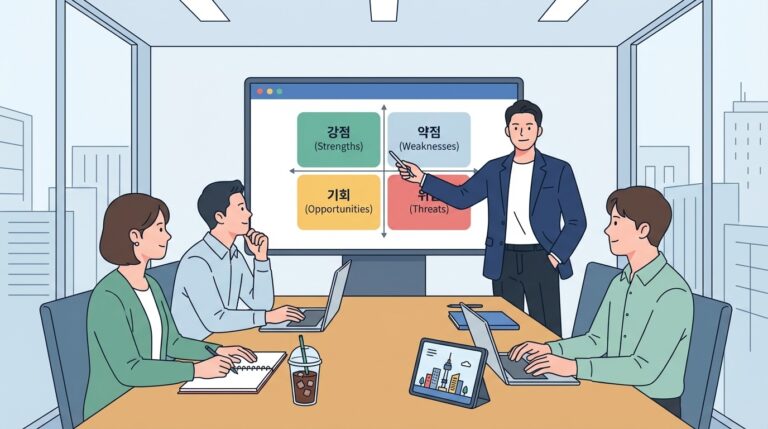
Imagine this: You are watching a sleek K-Drama set in a towering corporate office in Gangnam. The tension is palpable. The young, brilliant analyst stands before the board of directors. A laser pointer dances across a SWOT analysis slide. They point out a critical flaw in the company’s strategy. Silence falls. The Chairman’s eyes narrow. Did the analyst just commit career suicide, or did they use the exact right phrasing to save face while delivering harsh truths?
If you’re operating at a C2 (Advanced/Proficient) level in Korean, you already know that translating “weakness” directly to “약점 (yak-jeom)” in a high-stakes strategy meeting might sound less like a professional critique and more like a personal attack. Business Korean is an intricate dance of diplomacy, hierarchy, and Nunchi (눈치).
Today, we are going deep into Business Strategy: Evaluating Corporate Competitiveness through a SWOT Analysis. This guide is crafted from real-world experiences of foreign executives and expats who have successfully navigated the boardrooms of Pangyo (Korea’s Silicon Valley) and Yeouido. Let’s upgrade your boardroom Korean so you can command the room like a true insider.
Phase 2: Core Expressions Deep Dive
When presenting a SWOT (Strengths, Weaknesses, Opportunities, Threats) analysis, the words you choose dictate your professional weight.
1. 핵심 역량 (Strengths)
- Pronunciation: [haek-sim yeok-ryang] Sounds like ‘heck-seem yuhk-ryang’
- Meaning: Literal: Core competency. Real nuance: Our absolute, undeniable competitive weapon.
- K-Culture Moment: You’ll hear this constantly in Korean tech startups. When an investor asks, “Why should we fund you?” the founder leans in and says, “우리의 핵심 역량은… (Our core competency is…)”
- Editor’s Insight: At a C2 level, skip the basic “장점” (good points). “역량” implies capability and power. It sounds analytical and heavy.
- Situation Spectrum:
- Casual with friends: 🚫 (Too rigid)
- Semi-formal / Coworkers: ✅
- Formal / Board of Directors: ✅
- 🤔 Think About It: Why do Korean businesses love the word ‘핵심’ (core)? It reflects the “Ppalli-ppalli” (hurry up) culture—cut through the noise, what is the absolute center of our power?
2. 보완해야 할 점 (Weaknesses)
- Pronunciation: [bo-wan-hae-ya hal jjeom] Sounds like ‘bo-wahn-heh-ya hal jjum’
- Meaning: Literal: Points that need to be supplemented. Real nuance: Our weaknesses, politely repackaged to avoid hurting the CEO’s pride.
- K-Culture Moment: In a performance review, a Korean manager will rarely say, “You are bad at this.” They will say, “이 부분은 보완이 필요하겠네요” (This area needs supplementing).
- Editor’s Insight: Using “약점” (weakness) can make people defensive. “보완하다” (to supplement/compensate) shifts the focus from a flaw to an actionable task. It is the ultimate face-saving corporate term.
- Situation Spectrum:
- Casual with friends: ⚠️ (A bit stiff)
- Semi-formal / Coworkers: ✅
- Formal / Board of Directors: ✅
- 🤔 Think About It: In your culture, is it preferred to be painfully direct about business flaws, or is the blow softened? How does the Korean concept of ‘체면’ (Face/Reputation) dictate this phrasing?
3. 틈새 시장을 공략하다 (Opportunities)
- Pronunciation: [teum-sae si-jang-eul gong-ryak-ha-da] Sounds like ‘teum-seh shee-jang-eul gong-ryak-ha-da’
- Meaning: Literal: To attack the crevice market. Real nuance: To aggressively target a niche market.
- K-Culture Moment: Imagine a dynamic marketing team late at night, ordering spicy Tteokbokki. The team lead slams the desk: “대기업이 안 하는 틈새 시장을 공략해야 돼!” (We need to target the niche market the conglomerates are ignoring!)
- Editor’s Insight: “공략하다” (to attack/capture) is actually a military term. Korean corporate jargon heavily borrows from military strategy, reflecting its historically top-down, aggressive growth era (the Miracle on the Han River).
- Situation Spectrum:
- Casual with friends: ⚠️
- Semi-formal / Coworkers: ✅
- Formal / Board of Directors: ✅
4. 진입 장벽 (Threats)
- Pronunciation: [jin-ip jang-byeok] Sounds like ‘jin-eep jang-byuk’
- Meaning: Literal & Real nuance: Barriers to entry.
- Editor’s Insight: When discussing threats (위협 요인), a mature analyst doesn’t just say “the competitors are scary.” They analyze the “진입 장벽이 높다/낮다” (barriers to entry are high/low). It shows you understand the structural risks.
Phase 3: Textbook vs. Real Korean (C2 Edition)
Let’s elevate your phrasing from a textbook learner to a seasoned C-level executive.
[Situation 1: Pointing out a lack of funds as a weakness]
* 📖 Textbook Korean: 우리의 약점은 돈이 부족하다는 것입니다. (Our weakness is that we lack money. – Too direct, almost childish)
* 🗣️ Real Korean: 현재 자금 유동성 확보가 가장 시급한 과제입니다. (Currently, securing cash liquidity is our most urgent task.)
* 💡 Why the difference?: Sino-Korean words (한자어) like ‘유동성’ (liquidity) and ‘시급한 과제’ (urgent task) act as a linguistic suit and tie, projecting authority and objectivity.
[Situation 2: Suggesting we seize an opportunity]
* 📖 Textbook Korean: 이것은 우리에게 좋은 기회니까 빨리 해야 합니다. (This is a good opportunity for us so we must do it fast.)
* 🗣️ Real Korean: 이 모멘텀을 살려서 선점 효과를 누려야 합니다. (We must keep this momentum alive to enjoy the first-mover advantage.)
* 💡 Why the difference?: Business in Korea loves Konglish (‘모멘텀’ – momentum) mixed with high-level strategy terms (‘선점 효과’ – preemption effect). It sounds sharp and contemporary.
Phase 4: Cultural Context — K-Culture Deep Dive
4-1. The Non-Verbal Nunchi in the Boardroom
When presenting a SWOT analysis, where you stand and where you look matters as much as what you say.
* Eye Contact: Do not stare down the most senior person (the Chairman/CEO) continuously. In Western cultures, unwavering eye contact shows confidence; in Korea, it can be interpreted as a challenge. Sweep the room, and offer a respectful, slightly lowered gaze when answering a direct, tough question from the top boss.
* The Power of Pauses: If pointing out a severe “Threat” (위협), a slight pause and a subtle intake of breath (the classic “쓰읍…”) shows that you understand the gravity of the negative news before delivering it.
4-2. K-Drama vs. Reality: The Chaebol Trope
If you’ve watched Itaewon Class or Reborn Rich, you’ve seen the classic corporate showdowns. A young protagonist boldly insults the Chairman’s strategy in front of the whole board.
* The Reality Check: In a real Korean conglomerate (대기업), doing this will get you swiftly removed from the project. Disagreement must be wrapped in deference. You don’t say, “Your strategy is wrong.” You say, “말씀하신 방향성에 전적으로 동의합니다만, 리스크 헷지(Hedge) 차원에서 한 가지 첨언하자면…” (I completely agree with your direction, but to hedge our risks, if I may add one point…)
Phase 5: Live Roleplay Scenario
Setting: Friday, 4:00 PM. A sleek meeting room in a tech startup in Pangyo. The air conditioning is on full blast, and iced Americanos sweat on the glass table.
Characters:
* YOU: The newly hired Foreign Strategy Lead. You need to prove your worth without stepping on toes.
* Director Choi (최 이사): 45 years old, sharp, slightly impatient, values data over feelings.
* Min-su (민수): 32 years old, your peer, supportive but cautious.
Dialogue:
Director Choi: 자, 이번 신규 앱 론칭 SWOT 분석 결과 들어봅시다. 솔직하게 우리 상황이 어떤가요? 📊
(Ja, ibeon singyu aep ronching SWOT bunseok gyeolgwa deureobopsida. Soljikage uri sanghwangi eotteongayo?)
(Alright, let’s hear the SWOT analysis results for the new app launch. Honestly, what is our situation?)
YOU: 네, 먼저 우리의 핵심 역량은 압도적인 데이터 분석 알고리즘입니다. 경쟁사 대비 뚜렷한 강점이죠.
(Ne, meonjeo uriui haeksim yeokryangeun apdojeogin deiteo bunseok algorijeumimnida. Gyeongjengsa daebi tturyeotan gangjeomijyo.)
(Yes, first, our core competency is our overwhelming data analysis algorithm. It is a clear strength compared to competitors.)
Min-su: 맞습니다. 하지만 마케팅 예산이 부족한 게 걱정입니다.
(Matseumnida. Hajiman maketing yesani bujokan ge geokjeongimnida.)
(That’s right. However, I’m worried about the lack of marketing budget.)
Director Choi: (Frowning slightly) 예산 부족? 그럼 론칭을 미뤄야 하나?
(Yesan bujok? Geureom ronchingeul mirwoya hana?)
(Lack of budget? Then should we delay the launch?)
🔀 Your Turn! How do you respond to Director Choi?
– A) “네, 제 생각에는 약점이니까 미루는 게 좋습니다.” (Yes, in my opinion, it’s a weakness so it’s better to delay.)
– B) “아닙니다. 예산 부족은 보완해야 할 점이지만, 틈새 시장을 공략하면 승산이 있습니다!”
– C) “대박! 미루면 절대 안 돼요. 무조건 고(Go) 하죠!”✅ Best Choice: B — “No. The lack of budget is an area for improvement, but if we target a niche market, we have a winning chance!” You respectfully disagree (“아닙니다”), soften the negative (“보완해야 할 점”), and pivot to an opportunity (“틈새 시장 공략”).
⚠️ Choice A Analysis: Too passive and uses the blunt word “약점”.
⚠️ Choice C Analysis: “대박” and “무조건 고” are way too informal for a strategy meeting with a Director.
Phase 6: 10-Second Shadowing Drill
Command the room with this high-level strategy sentence. Focus on the pauses (/) and the confident, steady intonation.
😤 단호하고 전문적으로 (Firmly and professionally)
현재 상황에서 / 우리의 핵심 역량을 극대화하고 / 리스크를 최소화하는 전략이 / 반드시 필요합니다.
(hyeon-jae sang-hwang-e-seo / u-ri-ui haek-sim yeok-ryang-eul geuk-dae-hwa-ha-go / ri-seu-keu-reul choe-so-hwa-ha-neun jeol-ryak-i / ban-deu-si pi-ryo-ham-ni-da.)
“In the current situation, a strategy that maximizes our core competencies and minimizes risks is absolutely necessary.”
Phase 7: K-Culture Mini Dictionary (Boardroom Edition)
| Korean | Romanization | English | Context |
|---|---|---|---|
| 눈치 | nunchi | Social intelligence / Reading the room | Crucial when presenting threats or weaknesses to senior management. |
| 상석 | sang-seok | Seat of honor | The seat furthest from the door, facing the entrance. Always reserved for the CEO/Director. |
| 품의서 | pum-ui-seo | Approval document | After your SWOT pitch, this is the document drafted to get official budget approval. |
| 피드백 | pi-deu-baek | Feedback | Often used in Korean business (Konglish). “피드백 주시죠” (Please give your feedback). |
| 팩트폭행 | paek-teu-pok-haeng | Fact-bombing / Brutal honesty | Slang. When an analyst’s SWOT is so accurate and brutal that it hurts the team’s feelings. Use only jokingly with close peers! |
Phase 8: Business Traveler Survival Kit
Even if you’re just flying into Seoul for a 3-day executive offsite, you need to navigate these meetings flawlessly.
🆘 Survival Phrases for the Strategy Room
– 🇰🇷 “제가 한 가지 첨언해도 되겠습니까?” (jega han gaji cheomeonhaedo doegetseumnikka?)
– 🗣️ If I may add one comment? (The most polite way to interrupt or add a point).
– 🇰🇷 “말씀하신 방향성에 전적으로 동의합니다.” (malsseumasin banghyangseonge jeonjeogeuro dong-ihamnida.)
– 🗣️ I completely agree with the direction you mentioned. (Always start with this before offering a counter-strategy!).
– 🇰🇷 “이 부분에 대한 구체적인 레퍼런스가 있을까요?” (i bubune daehan guchejeogin repeoreonseuga isseulkkayo?)
– 🗣️ Do we have a specific reference for this part? (A highly professional way to ask for proof without saying “Are you sure?”).📌 Editor’s Corporate Travel Note
– Business Cards: Always give and receive business cards with two hands. Take a moment to read it before putting it on the table in front of you. Never shove it directly into your pocket!
– After the Meeting (회식): The SWOT analysis doesn’t end in the boardroom. The real consensus often happens during the after-work dinner (Hoesik) over Soju and Samgyeopsal.
Phase 9: Critical Thinking — “A Step Deeper”
Language & Power (언어와 권력): The Gatekeeping of “Hanja” (Sino-Korean)
Notice how almost all advanced business terms in Korean (역량, 보완, 공략, 유동성) are derived from Chinese characters (Hanja), rather than pure native Korean words? In Korean corporate culture, vocabulary is a metric of professionalism and education. Using high-level Hanja-based words establishes a subtle power dynamic—it signals that you are an educated insider capable of abstract, strategic thought. For a foreign C2 learner, mastering these Sino-Korean business terms is the ultimate key to breaking through the “glass ceiling” of being seen merely as a ‘guest’ and being respected as a ‘peer’.
💬 Your Turn: Does your native language have a specific “corporate dialect” that sounds completely different from everyday speech? How do people react to those who don’t know the jargon? Share in the comments!
Phase 10: FAQ & Avoiding Mistakes
Q: If the CEO suggests a terrible idea during the “Opportunities” discussion, can I say “그건 아닙니다” (That’s not right)?
* A: Absolutely NOT. Direct contradiction to a superior is a major faux pas. Use the “Yes, but…” framework: “좋은 아이디어이십니다. 다만 리스크 측면에서 보면…” (That is a great idea. However, looking at it from a risk perspective…)
Q: Do I use “요” or “다/까” in a presentation?
* A: For a formal SWOT presentation, exclusively use the formal “~습니다/비니다/까” (Habshio-che). Once the Q&A becomes conversational, you can sprinkle in “~요” (Haeyo-che), but keep it professional.
❌ Common Mistake #1: Translating “In my opinion” as “내 생각에는” or “제 생각에는” during a formal pitch. It sounds subjective and a bit weak.
✅ Do This Instead: Use “제가 보기에는…” (From what I can see…) or “당사의 분석에 따르면…” (According to our analysis…).
Phase 11: Summary & Action Items
One-Liner Summary: To master the Korean boardroom, wrap your sharpest strategic critiques in the elegant velvet of advanced Sino-Korean vocabulary and Nunchi.
Action Mission 3 Steps:
– 🥉 Bronze (Solo): Read the 4 core expressions out loud in front of a mirror, using your most serious “CEO” face.
– 🥈 Silver (Online): Go to LinkedIn, find a Korean business article, and leave a comment using “핵심 역량” or “보완해야 할 점”.
– 🥇 Gold (Real World): In your next Korean class or language exchange, propose a mock business meeting and present a 1-minute SWOT analysis of your favorite Korean brand!
K-Culture Mission: Watch an episode of the K-Drama “Misaeng” (Incomplete Life) or “Start-Up”. Pay close attention to the boardroom scenes. Can you spot when they use formal data-driven language versus emotional appeals?
Phase 12: Interactive Quiz
1. Situational Judgment: You are presenting the “Weaknesses” of your company to the strict VP. Which phrasing is most appropriate?
– A) 우리 회사는 마케팅이 진짜 별로예요. (Our company’s marketing really sucks.)
– B) 당사의 마케팅 전략은 보완해야 할 점이 많습니다. (Our marketing strategy has many points that need to be supplemented.)
– C) 마케팅 팀이 약점입니다. (The marketing team is the weakness.)
2. Fill in the Blank:
“경쟁사가 없는 _________ 시장을 공략해야 합니다.”
(We must target the _______ market where there are no competitors.)
– Hint: The Korean word for ‘niche’.
3. True or False (K-Culture Edition):
When a superior asks a tough question about your presentation, maintaining intense, unblinking eye contact while answering shows the highest level of respect and confidence in Korea. (T/F)
(Answers: 1: B, 2: 틈새 (teum-sae), 3: False – intense eye contact can be seen as aggressive/defiant; a respectful gaze is preferred.)
Did you survive the boardroom? Let me know in the comments which expression made you feel the most like a K-Drama CEO!
Frequently Asked Questions (FAQ)
Q: What does "핵심 역량 (Strengths)" mean in Korean and how do you pronounce it?
A: In Korean, "핵심 역량 (Strengths)" is pronounced [haek-sim yeok-ryang] and means: Literal: Core competency. Real nuance: Our absolute, undeniable competitive weapon.
Q: What does "보완해야 할 점 (Weaknesses)" mean in Korean and how do you pronounce it?
A: In Korean, "보완해야 할 점 (Weaknesses)" is pronounced [bo-wan-hae-ya hal jjeom] and means: Literal: Points that need to be supplemented. Real nuance: Our weaknesses, politely repackaged to avoid hurting the CEO's pride.
Q: What does "틈새 시장을 공략하다 (Opportunities)" mean in Korean and how do you pronounce it?
A: In Korean, "틈새 시장을 공략하다 (Opportunities)" is pronounced [teum-sae si-jang-eul gong-ryak-ha-da] and means: Literal: To attack the crevice market. Real nuance: To aggressively target a niche market.
Q: What does "진입 장벽 (Threats)" mean in Korean and how do you pronounce it?
A: In Korean, "진입 장벽 (Threats)" is pronounced [jin-ip jang-byeok] and means: Literal & Real nuance: Barriers to entry.







