

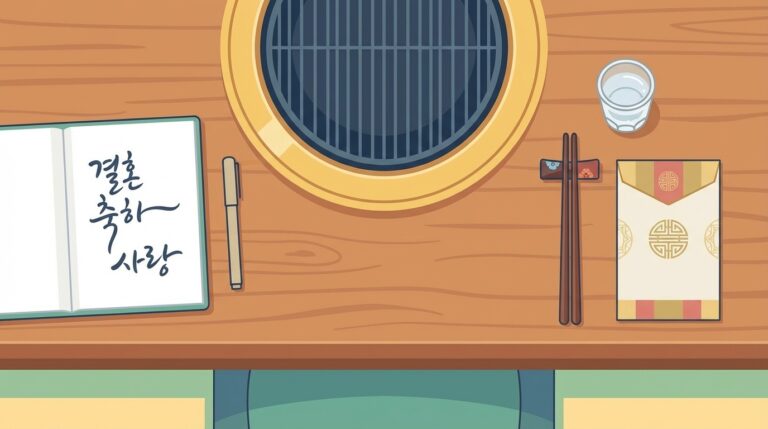
Phase 1: 공감 (The Immersive Open)
Hello! I’m the lead editor of Daily Hangul, your veteran Korean tutor and local culture navigator.
Imagine this: It’s Friday evening. You are sitting at a bustling Korean BBQ restaurant with your coworkers. The grill is sizzling, and soju glasses are clinking. Suddenly, your Korean coworker pulls out a beautiful, thick paper envelope from their bag and slides it across the table toward you. They look a bit shy but proud.
“What is this? A bonus?” you wonder.
No, it’s a 청첩장 (Cheongcheopjang)—a wedding invitation! In Korea, giving out wedding invitations isn’t just about dropping a card in the mail. It is a full-fledged cultural event, often involving a free meal, lots of congratulations, and a specific set of unwritten rules. If you don’t know the cultural context, you might simply say “Thanks,” put it in your bag, and accidentally create an awkward silence!
Don’t worry. As a tutor who has seen many expats freeze in this exact moment, I’m here to guide you. This post will give you the exact A1-level “survival phrases” to navigate this heartwarming K-Culture moment perfectly.
Phase 2: 핵심 표현 심층 분석 (Core Expressions)
1. 결혼 축하해요! (Congratulations on your marriage!)
- Pronunciation: [gyeolhon chukahaeyo!] + [Gyull-hone Choo-kah-hae-yo!] (‘Choo’ sounds like a train, and ‘kah’ is like a crow’s caw.)
- Meaning: Literal: Marriage congratulations! / Real nuance: “Oh my gosh, congratulations on your wedding!”
- K-Culture Moment: You will hear this everywhere—from the BBQ gathering where the invitation is given, to the actual wedding hall (예식장). It’s the ultimate, bulletproof greeting.
- Editor’s Insight: Forget complex grammar. At the A1 level, if you only remember one word, just say “축하해요! (Congratulations!)” with a big smile. Adding “결혼 (marriage)” just makes it more specific.
- Situation Spectrum:
- 친구 사이(Casual): ✅ (Drop the ‘yo’: 결혼 축하해!)
- 직장 동료(Semi-formal): ✅
- 직장 상사·어른(Formal): ⚠️ (Use formal ending: 결혼 축하드립니다)
- 🤔 Think About It: Why is a simple “Congratulations” enough in Korea? In Korean culture, shared joy is expressed more through presence, sharing food, and practical gifts like congratulatory money (축의금) than through long, wordy speeches. Does your culture prefer long toasts or practical gifts?
2. 청첩장 감사합니다! (Thank you for the invitation!)
- Pronunciation: [cheongcheopjang gamsahamnida!] + [Chung-chup-jahng Gahm-sah-hahm-ni-dah!]
- Meaning: Literal: Wedding invitation thank you! / Real nuance: “Thank you so much for inviting me.”
- K-Culture Moment: As soon as they hand you the envelope, this is your immediate response.
- Editor’s Insight: Koreans love it when foreigners know specific cultural words. By explicitly saying “청첩장” instead of just “card,” you instantly sound like someone who respects Korean culture!
- Situation Spectrum:
- 친구 사이(Casual): ✅
- 직장 동료(Semi-formal): ✅
- 직장 상사·어른(Formal): ✅
- 🤔 Think About It: Even though Korea is hyper-digital and everyone uses mobile invitations (모바일 청첩장), handing out a physical paper invitation is still considered the ultimate sign of respect.
3. 잘 먹겠습니다! (I will eat well!)
- Pronunciation: [jal meokgetseumnida!] + [Jahl Muck-get-seum-ni-dah!]
- Meaning: Literal: I will eat well. / Real nuance: “Thank you for treating us to this wonderful meal!”
- K-Culture Moment: When a Korean couple gives out wedding invitations, they pay for the meal or drinks. This is called 청첩장 모임 (Invitation Gathering).
- Editor’s Insight: You might think this is just a standard phrase before eating, but here, it doubles as “Thank you for treating me!”
- Situation Spectrum:
- 친구 사이(Casual): ✅ (잘 먹을게!)
- 직장 동료(Semi-formal): ✅
- 직장 상사·어른(Formal): ✅
Phase 3: 교과서 vs 진짜 한국어 (Textbook vs. Real Korean)
[Reacting to the surprising news]
* 📖 Textbook Korean: 당신의 결혼 소식을 들어서 정말 기쁩니다. (I am so happy to hear the news of your marriage.)
* 🗣️ Real Korean: 진짜요? 우와 대박! 축하해요! (Really? Wow, awesome! Congratulations!)
* 💡 Why the difference?: Textbook Korean is grammatically perfect but emotionally stiff. Real Korean relies heavily on energetic reactions (리액션). “대박 (Daebak)” instantly shows genuine surprise.
[Complimenting the couple’s photo on the invitation]
* 📖 Textbook Korean: 사진이 매우 아름답습니다. (The photo is very beautiful.)
* 🗣️ Real Korean: 우와, 사진 너무 예뻐요! (Wow, the photo is so pretty!)
* 💡 Why the difference?: “너무 (too much)” was originally only for negative things, but modern Koreans use it constantly to mean “very” or “so” in an enthusiastic way.
Bottom Note: At the A1 (Absolute Beginner) level, don’t worry about long sentences. Focus on positive reactions. A happy “우와! (Wow!)” plus “축하해요!” is all you need!
Phase 4: 문화적 맥락 — K-Culture 딥다이브
4-1. The Non-Verbal Etiquette (비언어적 요소)
When your friend hands you the 청첩장, never grab it with one hand! Always reach out with both hands to receive it, and take a moment to actually open it and look at the photo inside. Complimenting the design is an unwritten rule. This shows Nunchi (눈치)—the emotional intelligence to recognize that they spent a lot of time picking out that card.
4-2. K-Food Connection: The “Treating” Culture
In Western cultures, friends often pay for the bride and groom during pre-wedding parties. In Korea, it’s the opposite. The couple will gather groups of friends at nice restaurants (like K-BBQ or Italian bistros) and pay for everyone’s meal while handing out invitations.
* Critical Perspective: Why do they do this? In Korean culture, feeding someone is the ultimate display of affection and sharing joy. A wedding announcement without sharing food feels cold. However, modern Koreans sometimes feel the financial burden of these gatherings, leading to a trend of smaller, intimate meetups.
Phase 5: 실전 롤플레이 시나리오 (Interactive Roleplay)
Setting: Friday night, 7:00 PM. A lively Korean BBQ restaurant in Gangnam. Smoke is rising from the grill.
Characters:
* YOU: An expat working in Seoul. You are a beginner in Korean.
* Min-su (32): Your friendly Korean coworker who loves to joke around.
Dialogue:
Min-su: (Clears throat, taking out an envelope) 여러분, 저 다음 달에 결혼해요.
(yeoreobun, jeo daeum dare gyeolhonhaeyo.)
[Everyone, I’m getting married next month.]
(🎭 Stage Direction: Min-su hands you the beautiful envelope with both hands.)
YOU: 우와, 진짜요?
(uwa, jinjjayo?)
[Wow, really?]
Min-su: 네, 여기 청첩장이에요.
(ne, yeogi cheongcheopjangieyo.)
[Yes, here is the wedding invitation.]
YOU: 청첩장 감사합니다! 우와… 사진 너무 예뻐요.
(cheongcheopjang gamsahamnida! uwa… sajin neomu yeppeoyo.)
[Thank you for the invitation! Wow… the photo is so pretty.]
Min-su: 부끄럽네요. 시간 괜찮으시면 꼭 와주세요.
(bukkeureomneyo. sigan gwaenchaneusimyeon kkok wajuseyo.)
[I’m shy. Please come if you have time.]
YOU: 네! 결혼 축하해요!
(ne! gyeolhon chukahaeyo!)
[Yes! Congratulations on your marriage!]
Min-su: 고마워요. 오늘 고기는 제가 쏠게요! 많이 드세요.
(gomawoyo. oneul gogineun jaega ssolgeyo! mani deuseyo.)
[Thank you. I’m treating you to the meat today! Eat a lot.]
🔀 Your Turn! How should you respond when Min-su says he is paying?
– A) “아니에요, 제 몫은 제가 낼게요!” (No, I will pay for my share!)
– B) “우와! 잘 먹겠습니다!” (Wow! I will eat well!)
– C) “왜요?” (Why?)✅ Best Choice: B — Reason: In a Cheongcheopjang Moim, the host takes pride in treating you. Trying to split the bill (Dutch pay) here might actually ruin the celebratory mood!
⚠️ Choice A & C Analysis: Insisting on paying (A) is polite normally, but a faux pas here. Asking “Why?” (C) makes you look clueless about Korean culture!
Bonus Roleplay: Getting to the Wedding Hall
(Fast forward to the wedding day. You are in a taxi.)
YOU: 기사님, 강남 예식장으로 가주세요.
(gisanim, gangnam yesikjangeuro gajuseyo.)
[Driver, please go to the Gangnam Wedding Hall.]
Driver: 네, 알겠습니다.
(ne, algetseumnida.)
[Yes, understood.]
Phase 6: 10초 섀도잉 드릴 (10-Second Shadowing Drill)
Let’s practice the energy! Read this out loud.
😊 우와~ / 진/짜/요? / 결/혼/ / 축~~~하/해/요!
(uwa~ / jin/jja/yo? / gyeol/hon/ / chuk~~~ha/hae/yo!)
(Smile broadly, act pleasantly surprised, and stretch the ‘축’ slightly for enthusiasm!)
Phase 7: K-Culture 미니 사전 (Mini Dictionary)
| 한국어 | Romanization | English | Context |
|---|---|---|---|
| 청첩장 | cheongcheopjang | Wedding Invitation | The physical card. A symbol of official invitation. |
| 축의금 | chuguigeum | Congratulatory Money | You give crisp cash in an envelope instead of wedding gifts! |
| 하객 | hagaek | Wedding Guest | The people attending the wedding. |
| 한턱내다 | hanteoknaeda | To treat (someone) | What the bride/groom does when handing out invitations. |
Phase 8: 여행자 서바이벌 키트 (Traveler’s Survival Kit)
Even if you live in Korea, navigating to a wedding venue feels like traveling! Korean wedding halls (예식장) are massive complexes.
🆘 Survival Phrases for the Wedding Day
- 🇰🇷 “ATM이 어디에 있어요?” (ATM-i eodie isseoyo?)
- 🗣️ Pronunciation: [A-T-M-ee uh-dee-eh iss-uh-yo?]
- 📍 Where to use: Wedding hall lobby.
- 💡 Pro Tip: You MUST bring cash for the 축의금. If you forgot, ask for the ATM!
🇰🇷 “식장이 몇 층이에요?” (sikjangi myeot cheungieyo?)
- 🗣️ Pronunciation: [Sik-jang-ee myut cheung-ee-eh-yo?]
- 📍 Where to use: Elevator banks at the venue. (What floor is the wedding hall?)
📌 Editor’s Travel Note
– Useful Apps: KakaoMap or Naver Map. Google Maps does not work well for walking in Korea!
– Dress Code: Do NOT wear a white dress or all-white outfit. White is strictly reserved for the bride.
Phase 9: 비판적 사고 코너 — “한 발 더 깊이” (A Step Deeper)
Food & Identity: The Shared Joy of a Meal
Why do Koreans insist on buying you a heavy meal just to give you a piece of paper? In Korean culture, the act of eating together (식구 – meaning family, literally “mouths that eat together”) is deeply tied to community identity. To share one’s joy without sharing a meal feels incomplete. By feeding their friends, the couple is saying, “You are part of my community, and I want you to share in my happiness physically and emotionally.”
💬 Your Turn: In your culture, who usually pays for the food during pre-wedding celebrations? Let us know in the comments!
Phase 10: FAQ & 오해 방지 (Avoiding Common Mistakes)
- Q: “Can I just send a text saying congratulations?”
- A: No/Maybe. If they handed you the physical invitation in person, you must congratulate them face-to-face. A text later is considered cold.
- Q: “Do I need to buy a blender for the couple?”
- A: NO! Korea does not have a “Wedding Registry” culture. You prepare cash (축의금) in a white envelope. For colleagues, 50,000 KRW to 100,000 KRW is standard.
- Q: “I am older than my coworker. Do I still use formal language?”
- A: Yes! If you are at the A1 level, always stick to the
-요ending (축하해요). It is safe and respectful.
- A: Yes! If you are at the A1 level, always stick to the
❌ 흔한 실수 #1 (Common Mistake): Offering to pay for your meal at the 청첩장 모임.
✅ 이렇게 하세요 (Do this instead): Accept the meal graciously. Your “payment” to them will be the cash gift you give on their actual wedding day!
Phase 11: 요약 및 액션 아이템 (Summary & Action)
- One-Liner Summary: Accept the wedding invitation with two hands, say “결혼 축하해요!”, and thank them for the free meal with “잘 먹겠습니다!”
🔥 Action Mission 3단계
* 🥉 Bronze (Alone): Practice saying “우와! 결혼 축하해요!” in front of the mirror 3 times.
* 🥈 Silver (Online): Write “청첩장 감사합니다” in your Korean language journal today.
* 🥇 Gold (Real Life): Next time someone pays for your meal, loudly say “잘 먹겠습니다!”
💌 K-Culture Mission: Search for “한국 결혼식 브이로그 (Korean Wedding Vlog)” on YouTube today. Notice the envelope table at the entrance where people hand over their cash gifts!
Phase 12: 퀴즈 — 인터랙티브 챌린지 (Interactive Quiz)
1. Situational Judgment: Min-su hands you his wedding invitation at a cafe and pays for your coffee. What is the most natural A1-level response?
A) 당신의 결혼을 승인합니다. (I approve of your marriage.)
B) 왜 저한테 주세요? (Why are you giving this to me?)
C) 우와, 결혼 축하해요! 잘 마시겠습니다! (Wow, congratulations! I will drink well!)
2. True or False – K-Culture Edition: “If a Korean friend gives you a wedding invitation, you must immediately buy them a toaster as a gift.”
True or False?
3. Fill in the Blank: When reaching out to take the physical invitation from your friend, you should use ( _______ ) hands.
(Scroll down for answers!)
(Answers: 1. C / 2. False – You give cash! / 3. Both)
Frequently Asked Questions (FAQ)
Q: What does "결혼 축하해요! (Congratulations on your marriage!)" mean in Korean and how do you pronounce it?
A: In Korean, "결혼 축하해요! (Congratulations on your marriage!)" is pronounced [gyeolhon chukahaeyo!] and means: Literal: Marriage congratulations! / Real nuance: "Oh my gosh, congratulations on your wedding!"
Q: What does "청첩장 감사합니다! (Thank you for the invitation!)" mean in Korean and how do you pronounce it?
A: In Korean, "청첩장 감사합니다! (Thank you for the invitation!)" is pronounced [cheongcheopjang gamsahamnida!] and means: Literal: Wedding invitation thank you! / Real nuance: "Thank you so much for inviting me."
Q: What does "잘 먹겠습니다! (I will eat well!)" mean in Korean and how do you pronounce it?
A: In Korean, "잘 먹겠습니다! (I will eat well!)" is pronounced [jal meokgetseumnida!] and means: Literal: I will eat well. / Real nuance: "Thank you for treating us to this wonderful meal!"






