

Phase 1: Empathy & K-Culture Cold Open
Hello! This is the Daily Hangul Editor. 👋
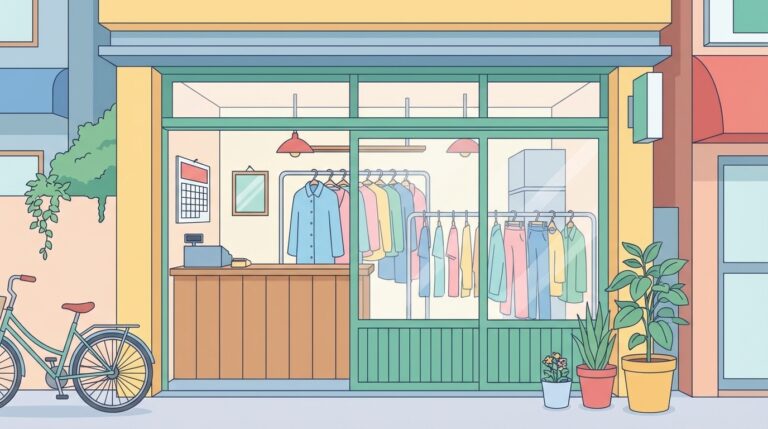
Picture this: You’re watching a cozy slice-of-life K-Drama. The main character, after a chaotic dinner involving a little too much soju and a clumsy pork belly spill, takes their favorite winter coat to the local neighborhood dry cleaner (세탁소 – setakso). The ajusshi (middle-aged man) behind the counter inspects the stain, clicks his tongue, takes the coat, and scribbles something on a tiny paper tag.
But wait—if you were in that situation, how would you know when to go back? If you just walk away in silence, your clothes might sit there for weeks!
For many expats and travelers in Korea, the local setakso is a lifesaver. But dropping off your clothes is only half the battle. You need to know how to ask the golden question: “When can I pick it up?”
Don’t worry! This guide is based on real questions from beginners who stood awkwardly in front of a Korean dry cleaner, pointing at the calendar. Let’s make sure you sound like a local!
Phase 2: Core Expressions Deep Dive
1. 언제 찾으러 와요? (When do I come to pick it up?)
- Pronunciation: eon-je cha-jeu-reo wa-yo? [uhn-jeh / cha-juh-ruh / wa-yo?]
- Meaning:
- Literal: When (언제) to find (찾으러) come (와요)?
- Real Nuance: When should I come pick this up?
- K-Culture Moment: You’ll hear this exact phrasing not just at the dry cleaner, but also at shoe repair shops, bakeries (for custom cakes), and even pharmacies when a prescription is out of stock.
- Editor’s Insight: For A1 learners, this sentence might look a bit long, but it has a great rhythm. Just remember “언제” (When). If you forget the rest, just saying “언제요?” (When?) while pointing at your clothes will get the job done!
- Situation Spectrum:
- Casual (Friends): ✅ (Drop the ‘요’: 언제 찾으러 와?)
- Semi-formal (Store owners): ✅ (Perfect!)
- Formal (Strict business/Elders): ⚠️ (Better to use “언제 찾으러 올까요?”)
- 🤔 Think About It: Notice the verb 찾다 (chat-da). It primarily means “to find.” In Korean, when you pick up your laundry, withdraw money from a bank, or claim lost luggage, you use “to find.” Why do you think Koreans conceptualize retrieving your own belongings as “finding” them again?
2. 언제 돼요? (When will it be ready?)
- Pronunciation: eon-je dwae-yo? [uhn-jeh / dweh-yo?]
- Meaning:
- Literal: When does it become (done)?
- Real Nuance: When will it be ready?
- K-Culture Moment: This is the ultimate “hurry up, palli-palli” survival phrase in Korea. Waiting for a table at a cafe? “언제 돼요?” Waiting for food delivery? “언제 돼요?”
- Editor’s Insight: If “언제 찾으러 와요?” is too long to memorize, memorize this one! It is short, natural, and universally understood.
- Situation Spectrum:
- Casual (Friends): ✅
- Semi-formal (Store owners): ✅
- Formal (Strict business/Elders): ⚠️
- 🤔 Think About It: The verb 되다 (to become/to be possible) is the duct tape of the Korean language. It fixes everything! What is a multi-purpose verb in your native language?
Phase 3: Textbook vs. Real Korean
[Asking when it’s done]
* 📖 Textbook Korean: 언제 제 옷을 찾으러 올 수 있습니까? (When can I come to pick up my clothes?)
* 🗣️ Real Korean: 언제 돼요? (When is it ready?)
* 💡 Why the difference?: Koreans love efficiency and speed (palli-palli culture). Long sentences are often chopped down to their absolute core meaning in daily transactions.
[Giving your contact info for the pickup tag]
* 📖 Textbook Korean: 제 전화번호는 010-1234-5678 입니다. (My phone number is 010-1234-5678.)
* 🗣️ Real Korean: 뒷번호 5678이요. (Last digits 5678.)
* 💡 Why the difference?: To save time, local shops often only need the last 4 digits of your phone number to tag your clothes.
Bottom Note: For A1 beginners, don’t stress about full sentences. Nailing the keyword with a polite “~요” (yo) at the end is all you need to be a polite customer!
Phase 4: Cultural Context — K-Culture Deep Dive
4-1. Non-Verbal Cues (The Eye Contact Rule)
When you hand over your clothes, the owner will likely focus entirely on the garment, checking for stains and fabric tags. Don’t force deep eye contact! In Korean service culture, focusing on the task (inspecting the clothes quickly) is more important than small talk. Also, hand over your clothes and receive your receipt with two hands (or one hand supporting the other arm) to show basic politeness.
4-2. The “Setakso” in K-Dramas vs. Reality
If you watch K-Dramas like Reply 1988 or modern slice-of-life shows, the neighborhood setakso is often portrayed as a hub for local gossip. The owner seems to know everyone’s secrets!
While old-school dry cleaners still exist in residential alleyways, reality is changing. Nowadays, many young Koreans use “Coin Wash” (코인 세탁방) for laundry or app-based pick-up services like Laundrygo. However, for suits, silk, and heavy winter padding (패딩 – padding), the neighborhood ajusshi is still the ultimate master.
Phase 5: Real-Life Roleplay Scenario
Setting: Saturday morning, 10:00 AM. You are at a small, steam-filled neighborhood dry cleaner. An old radio is playing Trot music in the background. You want to drop off your winter coat before heading out for a cafe tour in Hongdae.
Characters:
– YOU: An expat trying to survive winter in Korea.
– Ajusshi (Owner): A friendly man in his 60s wearing an apron, holding an iron.
Dialogue:
YOU: 사장님, 안녕하세요! 이거 드라이클리닝 해주세요. 🧥
(sa-jang-nim, an-nyeong-ha-se-yo! i-geo deu-ra-i-keul-li-ning hae-ju-se-yo.)
[Hello, boss! Please dry clean this.]
Ajusshi: 네, 두고 가세요.
(ne, du-go ga-se-yo.)
[Yes, just leave it there.]
(🎭 Stage Direction: He barely looks up from his ironing board.)
YOU: 저기… 언제 찾으러 와요? 🕒
(jeo-gi… eon-je cha-jeu-reo wa-yo?)
[Excuse me… When do I come pick it up?]
Ajusshi: 수요일에 오세요. 전화번호 뒷자리?
(su-yo-il-e o-se-yo. jeon-hwa-beon-ho dwit-ja-ri?)
[Come on Wednesday. Last digits of your phone number?]
🔀 Your Turn! How do you reply?
– A) “제 이름은 제임스입니다.” (My name is James.)
– B) “1234요!” (1234!)
– C) “전화가 없습니다.” (I don’t have a phone.)✅ Best Choice: B — Just say the last 4 digits of your phone number with “요” at the end!
⚠️ Choice A Analysis: Giving your name isn’t wrong, but he specifically asked for your phone number digits (뒷자리 – last digits) to write on the tag.
Phase 6: 10-Second Shadowing Drill
Practice these sentences. Follow the slashes (/) for natural pausing!
- 🤔 Curious: 저기… / 이거 / 언제 돼요?
(jeo-gi… / i-geo / eon-je dwae-yo?) - 😊 Polite: 사장님, / 언제 찾으러 / 와요?
(sa-jang-nim, / eon-je cha-jeu-reo / wa-yo?)
Phase 7: K-Culture Mini Dictionary
| Korean | Romanization | English | Context |
|---|---|---|---|
| 세탁소 | setakso | Dry Cleaner | The local neighborhood laundry shop. |
| 사장님 | sajangnim | Boss / Owner | The safest, most polite way to address a shop owner. |
| 드라이 | deurayi | Dry Cleaning | Konglish! Just say “드라이 해주세요” (Please dry it). |
| 수선 | suseon | Alteration / Repair | Many dry cleaners also hem pants and fix zippers. |
| 뒷자리 | dwit-jari | Last digits | Usually refers to the last 4 numbers of your phone. |
Phase 8: Traveler Survival Kit
Even if you are just traveling to Korea for a week, you might spill kimchi stew on your favorite shirt! Here is your emergency kit.
🆘 Survival Phrases for the Dry Cleaner
1. 🇰🇷 “얼룩 빼주세요.” (eol-luk ppae-ju-se-yo.)
– 🗣️ Meaning: Please remove the stain.
2. 🇰🇷 “얼마예요?” (eol-ma-ye-yo?)
– 🗣️ Meaning: How much is it?
3. 🇰🇷 “언제 돼요?” (eon-je dwae-yo?)
– 🗣️ Meaning: When will it be ready?📌 Editor’s Travel Note
– Apps: Search “세탁소” (Setakso) on KakaoMap or Naver Map.
– Coin Laundry: If you just need to wash regular clothes, search “코인 세탁방” (Coin Setak-bang). They are open 24/7 and have English instructions!
– Pre-payment: Traditional dry cleaners usually ask you to pay when you drop the clothes off (선불 – seonbul), not when you pick them up. Have your card ready!
Phase 9: Critical Thinking Corner — “One Step Deeper”
Media vs. Reality: The Romanticized Neighborhood
In Korean dramas, the local dry cleaner, the convenience store owner, and the restaurant ajumma are often portrayed as extended family members who know all the neighborhood gossip. While this Jeong (정 – deep emotional connection) still exists in older neighborhoods, modern Korean society is becoming highly digital and privatized. Many young people now prefer “untact” (non-face-to-face) laundry apps where you leave your clothes outside your door at midnight, and they are returned clean the next day.
💬 Your Turn:
Do you prefer the warm (but sometimes nosy) human interaction of a local shop, or the silent efficiency of a mobile app? Share your thoughts in the comments!
Phase 10: FAQ & Avoiding Misunderstandings
Q: Can I use “언제 찾으러 와요?” to an older shop owner?
Yes! As long as you include the magic politeness particle “요” (yo) at the end, it is perfectly polite for an A1 learner to use.
Q: Do I need to give them a tip for fast service?
No! There is absolutely no tipping culture in Korea. Giving a tip might actually confuse the owner. If you are really thankful, saying “감사합니다” (Thank you) with a bright smile is more than enough.
❌ Common Mistake: Losing the tiny paper tag!
✅ How to fix it: Korean dry cleaners will give you a tiny, easy-to-lose paper receipt with a date on it. Put it in your wallet immediately. If you lose it, they can still find your clothes using your phone number, but it takes much longer!
Phase 11: Summary & Action Items
One-Liner Summary: To find out when your clothes will be clean, just ask: “언제 찾으러 와요?” or simply “언제 돼요?”
Action Mission:
– 🥉 Bronze (Solo): Say “언제 찾으러 와요?” out loud 3 times right now.
– 🥈 Silver (Online): Find a picture of a Korean “세탁소” on Google Images and imagine walking in to say the phrase.
– 🥇 Gold (Real Life): If you are in Korea, take a jacket you need cleaned to the local setakso and use this exact phrase!
K-Culture Mission:
The next time you watch a modern-day K-Drama, look closely at the background of the street scenes. I guarantee you will spot a sign that says “세탁” (Laundry) or a small delivery motorcycle with clothes hanging on the back!
Phase 12: Quiz — Interactive Challenge
1. Situational Judgment:
You just dropped off your coat. You want to ask when it will be ready, but you forgot “찾으러 와요”. What is the best short alternative?
– A) 얼마예요? (How much is it?)
– B) 언제 돼요? (When is it ready?)
– C) 안녕하세요? (Hello?)
2. True or False – K-Culture Edition:
In Korea, it is customary to give a 10% tip to the dry cleaner if they remove a very bad stain. (True / False)
(Answers: 1. B / 2. False! Tipping is not practiced in Korea.)
Frequently Asked Questions (FAQ)
Q: What does "언제 찾으러 와요? (When do I come to pick it up?)" mean in Korean and how do you pronounce it?
A: In Korean, "언제 찾으러 와요? (When do I come to pick it up?)" is pronounced [eon-je cha-jeu-reo wa-yo? [uhn-jeh / cha-juh-ruh / wa-yo?] and means: Literal: When (언제) to find (찾으러) come (와요)?
Q: What does "언제 돼요? (When will it be ready?)" mean in Korean and how do you pronounce it?
A: In Korean, "언제 돼요? (When will it be ready?)" is pronounced [eon-je dwae-yo? [uhn-jeh / dweh-yo?] and means: Literal: When does it become (done)?







