

Phase 1: Empathy (The K-Drama Cold Open)
Hello! I’m your Head Editor at Daily Hangul.
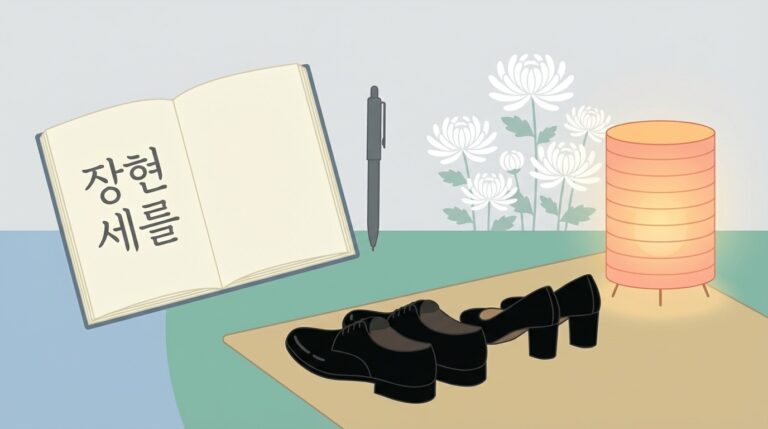
Imagine this scene: You’re watching a K-Drama. The main character, dressed in a sharp black suit, rushes into the basement of a hospital. The atmosphere is heavy. There are white chrysanthemums everywhere, and people are eating spicy red soup in the corner. Then, the protagonist walks into a small room, kneels, and bows deeply to a framed photo, and then does a mutual bow with a person wearing a black suit and a white armband.
Have you ever wondered what exactly is going on, and what you would do if you were invited to a Korean funeral?
Funerals are one of the most culturally intense experiences you can have in Korea. As a foreigner, the fear of making a mistake in such a sensitive situation can be paralyzing. “Do I say ‘I’m sorry’?” “How many times do I bow?” “Wait, why is everyone drinking Soju?”
Don’t worry. I’ve guided many expats through exactly this situation. Today, we are going to learn the silent but profound language of Korean funeral etiquette (장례식장 예절) and how to respectfully bow to the chief mourner (상주). By the end of this guide, you will know exactly how to show your support like a true local.
Phase 2: Core Expressions & Deep Dive
At an A2 level, you do not need to memorize long, complicated speeches. In a Korean funeral, silence is golden, and a few sincere words carry immense weight.
1. 얼마나 상심이 크십니까
- Pronunciation: Eolmana sangsimi keusimnikka [Uhl-ma-na sang-shi-mi koo-shim-nee-kka]
- Sound-alike guide: Think of the ‘eu’ sound as the disgusted sound you make when stepping in gum.
- Meaning: (Literal) How big must your heartbreak be? / (Real nuance) I am so sorry for your loss; my deepest condolences.
- K-Culture Moment: After you finish your bows, you face the chief mourner. You don’t say “Hello.” You look at them with a gentle, sad expression and softly say this phrase before stepping back.
- Editor’s Insight: This is the most standard, respectful phrase you can say to the grieving family. It acknowledges their pain directly without forcing toxic positivity.
- Situation Spectrum:
- Close Friends (Casual): ⚠️ (A bit too formal; for friends, we use simpler words)
- Co-workers (Semi-formal): ✅
- Boss/Elders (Formal): ✅
- 🤔 Think About It: In English, we say “I am sorry.” But in Korean, this phrase focuses entirely on the other person’s feelings (“How big is your sorrow?”). How does this reflect the Korean cultural value of prioritizing the group/other over the self?
2. 삼가 고인의 명복을 빕니다
- Pronunciation: Samga goinui myeongbogeul bimnida [Sam-ga go-ee-nui myung-bo-geul bim-nee-da]
- Meaning: (Literal) I respectfully pray for the bliss of the deceased in the next world. / (Real nuance) May they rest in peace.
- K-Culture Moment: You will see this written on the white envelopes containing condolence money. It’s often written on flower wreaths (화환) outside the funeral hall.
- Editor’s Insight: It’s a bit of a tongue twister! For A2 learners, you don’t necessarily need to speak this out loud. It is mostly used in writing or formal announcements. If you write this on an envelope, you are instantly a cultural insider.
- Situation Spectrum:
- Written on envelopes/texts: ✅
- Spoken to close friends: 🚫
- Spoken at formal funerals: ✅
- 🤔 Think About It: Notice the word ‘고인’ (the deceased). Korean uses specific, respectful nouns for people who have passed away. Does your language have a polite equivalent for ‘dead’?
3. 좋은 곳으로 가셨을 겁니다
- Pronunciation: Joeun goseuro gasyeosseul geomnida [Jo-eun go-seu-ro ga-shyuh-sseul geom-nee-da]
- Meaning: (Literal) They must have gone to a good place. / (Real nuance) They are in a better place now.
- K-Culture Moment: When sitting at the tables eating Yukgaejang, comforting a colleague whose grandmother passed away.
- Editor’s Insight: This is a warm, comforting phrase. The ‘시’ (syeo) adds an honorific tone, showing respect to the person who passed away.
- Situation Spectrum:
- Comforting a friend/colleague: ✅
- Writing on the main envelope: ⚠️
Phase 3: Textbook vs. Real Korean
[Greeting the Mourner]
* 📖 Textbook Korean: 안녕하세요. (Annyeonghaseyo – Hello / Are you in peace?)
* 🗣️ Real Korean: (Silence) or “얼마나 상심이 크십니까.”
* 💡 Why is it different?: Asking “Are you in peace?” to someone who just lost a family member is considered tone-deaf. Silence is a sign of deep empathy.
[Expressing Condolences]
* 📖 Textbook Korean: 나의 애도를 표합니다. (I express my condolences – sounds like a translated UN document).
* 🗣️ Real Korean: 좋은 곳으로 가셨을 겁니다. (They must have gone to a better place).
* 💡 Why is it different?: Korean daily speech favors emotional warmth over clinical, translated vocabulary.
Bottom Note: At an
A2 (Beginner)level, if you forget every phrase out of nervousness, just bow in silence. Your silent respect and presence speak louder than perfect grammar.
Phase 4: K-Culture Deep Dive
4-1. The Non-Verbal Language of Bowing (맞절)
Bowing at a funeral is a strict choreography.
1. The Incense: Walk up, light one stick of incense (or place a chrysanthemum), and step back.
2. The 2.5 Bows: Face the portrait of the deceased. You must do two full, deep bows to the floor (절 – jeol), followed by one half-bow (standing, bending slightly). Why two? One bow is for the living (like on New Year’s), two are for the deceased.
3. The Mutual Bow (맞절): Turn to the chief mourner (상주) wearing the black suit and armband. You both do one full bow to the floor at the same time.
4. The Nunchi: After the bow, you exchange brief words (or silence), take two steps backward (never turning your back immediately), and then turn to leave.
4-2. K-Food Connection: Yukgaejang & Soju
Have you noticed in K-Dramas that funeral halls look like restaurants? After bowing, you are guided to a dining area. The family serves you 육개장 (Yukgaejang – Spicy Beef Soup) and boiled pork.
– Why Red Soup? Traditionally, the red color of the chili was believed to ward off evil spirits (액운).
– Why eat? Eating the food provided by the family is a way of accepting their hospitality and comforting them.
– Critique: Why do Koreans stay up all night drinking Soju at a funeral? It’s not a party; it’s a deeply rooted communal duty. The goal is to ensure the grieving family is never left alone in the dark.
Phase 5: Real-Life Roleplay Scenario
Setting: Friday night, 9:00 PM. The basement funeral hall of Seoul National University Hospital. The air smells of incense and spicy soup. You are wearing a black suit. You’ve just arrived to pay respects to your Korean colleague Min-su, whose father passed away.
Characters:
– YOU: An expat working in Seoul, a bit nervous but wanting to show support.
– Min-su (32): Your usually cheerful colleague, now wearing a black suit with two black stripes on his white armband. He looks exhausted.
Dialogue:
(You walk in, sign the guestbook, and hand over your white envelope. You take off your shoes and enter the main room. You complete your two and a half bows to the portrait. You turn to Min-su for the mutual bow (맞절).)
(🎭 Stage Direction: You and Min-su both bow deeply to the floor and stand back up.)
Min-su: (With a tired, sad smile) 와주셔서 감사합니다…
(Wajusyeoseo gamsahamnida…)
[Thank you for coming…]
🔀 Your Turn! How do you reply?
– A) “안녕하세요! 오랜만이에요!” (Annyeonghaseyo! Oraenmanieyo!)
– B) “얼마나 상심이 크십니까…”
– C) “아버지가 왜 돌아가셨어요?” (Abeojiga wae doragasyeosseoyo?)
✅ Best Choice: B — “얼마나 상심이 크십니까…” (How great your sorrow must be). It is perfectly respectful, empathetic, and culturally accurate.
⚠️ Choice A Analysis: NEVER say “Hello (Are you at peace?)” or “Long time no see” in a bright tone at a funeral.
🚫 Choice C Analysis: Asking how the person died is considered extremely rude and intrusive in Korean culture, especially right at the altar.
(You sit at a table, and Min-su brings over a bottle of Soju and glasses.)
Min-su: 바쁘실 텐데 와주셔서 정말 고마워요. 한잔 받으세요.
(Bappeusil tende wajusyeoseo jeongmal gomawoyo. Hanjan badeuseyo.)
[Thank you so much for coming when you must be busy. Let me pour you a glass.]
Phase 6: 10-Second Shadowing Drill
Practice this phrase with a soft, slow, and solemn tone.
😢 얼마나 / 상심이 / 크십니까... (eolmana / sangsimi / keusimnikka...)
(Lower your voice slightly. Pause at the slashes. Do not smile when saying this.)
Phase 7: K-Culture Mini Dictionary
| Korean | Romanization | English | Context |
|---|---|---|---|
| 빈소 | binso | Funeral room | The specific room where the altar and portrait are set up. |
| 상주 | sangju | Chief mourner | The main family member (often eldest son/spouse) organizing the funeral, wearing the armband. |
| 조의금 | joeuigeum | Condolence money | Money given in a white envelope to help cover funeral costs. Usually 50,000 or 100,000 KRW. |
| 육개장 | yukgaejang | Spicy beef soup | The traditional soup served to guests at a funeral hall. |
| 맞절 | matjeol | Mutual bow | Bowing to the floor simultaneously with the chief mourner. |
Phase 8: Traveler Survival Kit
Even as a traveler, you might need to buy an envelope for a local friend, or ask for directions to the hospital.
🆘 Survival Phrases
– 🇰🇷 “장례식장이 어디예요?” (jangnyesikjang-i eodiyeyo?)
– 🗣️ English Guide: [Jang-nye-shik-jang-ee uh-dee-ye-yo?]
– 📍 Context: Asking the hospital reception where the funeral hall is.
- 🇰🇷 “조의금 봉투 있어요?” (joeuigeum bongtu isseoyo?)
- 🗣️ English Guide: [Jo-ui-geum bong-too ee-sseo-yo?]
- 📍 Context: Asking a convenience store worker for a condolence envelope.
📌 Editor’s Travel Note
– Finding Envelopes: Every convenience store (CU, GS25, 7-Eleven) in Korea sells specific white envelopes for funerals (조의금 봉투) and weddings (축의금 봉투). Make sure you buy the one with black Chinese characters for funerals, NOT the one with pink/gold for weddings!
– Dress Code: If you are traveling and don’t have a suit, dark, muted colors (navy, dark grey, black) with no flashy logos are acceptable.
Phase 9: Critical Thinking — “One Step Deeper”
Food & Identity: The Comfort of Shared Meals
In many Western cultures, a funeral is a solemn, quiet event lasting a few hours, followed perhaps by a brief reception. In Korea, funerals last for three days (삼일장), and the dining tables are just as important as the altar. Eating Yukgaejang together, pouring drinks for the grieving family, and staying up late chatting is the ultimate expression of Korean Jeong (정 – deep emotional connection). It shows that life goes on, and the community will physically surround the family so they don’t have to face the darkness alone.
💬 Your Turn: How long do funerals last in your culture? Is there a specific food you eat to comfort the grieving family? Let me know in the comments!
Phase 10: FAQ & Common Mistakes
Q: “Can I say ‘I’m sorry’ (미안합니다) in Korean at a funeral?”
No. “미안합니다” implies that you did something wrong (like stepping on someone’s toe). It does not mean “I feel sympathy” in Korean. Use “얼마나 상심이 크십니까” instead.
Q: “I can’t bow to the floor because of my religion. What do I do?”
It is completely fine! Simply stand, bow your head deeply (a 45-degree angle), close your eyes for a moment of silent prayer, and then do a slight standing bow to the mourner. Koreans are very understanding of different religious practices.
❌ Common Mistake #1: Saying “안녕하세요” (Annyeonghaseyo)
NEVER say hello at a funeral. It translates to “Are you in peace?”—which they clearly are not.❌ Common Mistake #2: Clinking glasses (Cheers)
While you drink Soju at the funeral, you must never clink glasses (건배 – Geonbae). Pour the drink respectfully, but drink quietly.❌ Common Mistake #3: Writing your name in red ink
Writing a living person’s name in red ink is a bad omen in Korea. Use a black pen when signing the guestbook or your envelope!
Phase 11: Summary & Action Items
- One-Liner Summary: At a Korean funeral, wearing black, doing the mutual bow (맞절), and offering quiet, sincere words like “얼마나 상심이 크십니까” is the ultimate sign of respect.
-
Action Mission 3 Stages:
- 🥉 Bronze (Solo): Look in the mirror and practice saying “얼마나 상심이 크십니까” with a solemn, empathetic expression.
- 🥈 Silver (Online): Find an image of a Korean condolence envelope on Google and try writing “삼가 고인의 명복을 빕니다” on a piece of paper.
- 🥇 Gold (Real-world): Next time you watch a K-Drama, spot the funeral scene and identify the chief mourner (상주) by their armband!
- K-Culture Mission: Search “My Mister funeral scene” (나의 아저씨 장례식) on YouTube. Observe the silence, the bowing, and how the characters eat together. It will perfectly visualize everything you learned today!
Phase 12: Quiz — Interactive Challenge
1. Situational Judgment: You arrive at the funeral hall. You see your friend, the chief mourner, who looks devastated. What is the very first thing you say?
– A) “안녕하세요!”
– B) Nothing. You wait to do the mutual bow first.
– C) “미안합니다.”
2. True or False — K-Culture Edition:
– “It is polite to clink Soju glasses at a funeral to cheer up the family.” (T/F)
3. Fill in the Blank:
– “얼마나 ______이 크십니까…” (Hint: heartbreak/sorrow)
(Toggle for Answers)
- B – Always perform the bows first before speaking. And remember, no “Annyeonghaseyo!”
- False – Never clink glasses at a funeral.
- 상심 (Sangsim)
How did you do? Understanding these deep cultural moments makes you not just a Korean speaker, but a true friend to Korean people. See you in the next lesson!
Frequently Asked Questions (FAQ)
Q: What does "얼마나 상심이 크십니까" mean in Korean and how do you pronounce it?
A: In Korean, "얼마나 상심이 크십니까" is pronounced [Eolmana sangsimi keusimnikka [Uhl-ma-na sang-shi-mi koo-shim-nee-kka] and means: (Literal) How big must your heartbreak be? / (Real nuance) I am so sorry for your loss; my deepest condolences.
Q: What does "삼가 고인의 명복을 빕니다" mean in Korean and how do you pronounce it?
A: In Korean, "삼가 고인의 명복을 빕니다" is pronounced [Samga goinui myeongbogeul bimnida [Sam-ga go-ee-nui myung-bo-geul bim-nee-da] and means: (Literal) I respectfully pray for the bliss of the deceased in the next world. / (Real nuance) May they rest in peace.
Q: What does "좋은 곳으로 가셨을 겁니다" mean in Korean and how do you pronounce it?
A: In Korean, "좋은 곳으로 가셨을 겁니다" is pronounced [Joeun goseuro gasyeosseul geomnida [Jo-eun go-seu-ro ga-shyuh-sseul geom-nee-da] and means: (Literal) They must have gone to a good place. / (Real nuance) They are in a better place now.






