
Skip to content
Daily Hangul

📺 How to Speak K-Variety: Master the Secret Language of Mukbang & Cookbang!
📺 How to Speak K-Variety: Master the Secret Language of Mukbang & Cookbang! - Daily Hangul

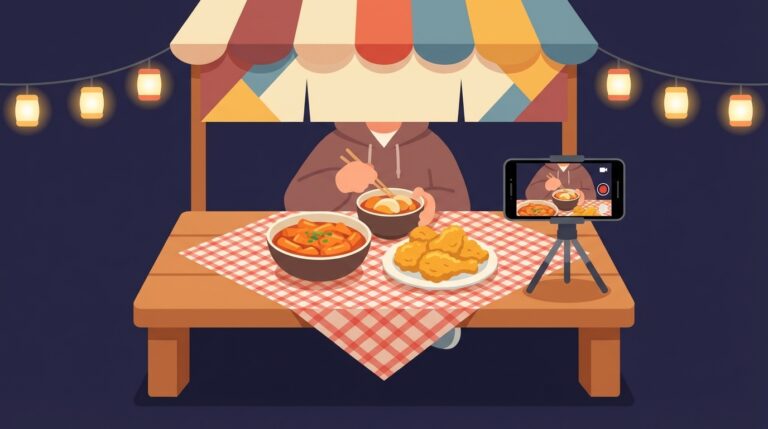
Phase 1: Empathy & Immersion\n\n안녕하세요! I am the Senior Editor of Daily Hangul, your local culture navigator and veteran tutor.\n\nImagine this: You are watching your favorite Korean variety show—maybe it is I Live Alone or a chaotic episode of Going Seventeen. The cast is sitting around a sizzling table of Korean BBQ or ordering late-night delivery. The host takes a massive bite, their eyes widen in pure ecstasy, and a huge caption pops up on screen: “미쳤다!” or “완전 겉바속촉!” You check the English subtitles, and it just says, “It is delicious.” \n\nWait, what? Is that it? \n\nIf you have ever felt like the subtitles were hiding the true flavor of the moment, you are not alone. As a B2 learner, you already know your basic grammar, but textbook Korean will not help you survive a Mukbang (eating show) or Cookbang (cooking show). Knowing these expressions is the secret sauce that takes your Korean from “polite student” to “cultural insider.” \n\nThis guide is crafted from real questions asked by my upper-intermediate students who wanted to understand the witty, mouth-watering banter on K-TV. Let’s dig in!\n\n—\n\n### Phase 2: Core Expressions Deep Dive\n\n> ### 1. 겉바속촉 (Crispy and Moist)\n>\n> – Pronunciation: [geot-ba-sok-chok] \n> Sound analogy: Think of ‘geot’ like ‘gut’, ‘ba’ like ‘bah’, ‘sok’ like ‘soaked’, and ‘chok’ like ‘choke’ (but softer!).\n> – Meaning: Literal = Outside crispy, inside moist. / Real nuance = The absolute highest compliment for fried food or pastries. \n> – K-Culture Moment: Picture a YouTuber eating Korean fried chicken (치킨). They bite into a golden drumstick. The ASMR crunch fills your ears. They close their eyes and whisper, “와… 겉바속촉 제대로예요.” (Wow… the geot-ba-sok-chok is real.)\n> – Editor’s Insight: This is a four-syllable abbreviation (줄임말). Koreans LOVE shortening phrases to describe food textures efficiently. It is not just about taste; texture (식감) is equally crucial in Korean food culture.\n> – Situation Spectrum: \n> – Casual with friends: ✅\n> – Semi-formal (co-workers): ⚠️ (Okay during a casual team dinner)\n> – Formal (boss/elders): 🚫 (Stick to “정말 맛있네요”)\n> – 🤔 Think About It: Why does the Korean language have so many specific words for food textures (like 쫄깃쫄깃 – chewy, 바삭바삭 – crispy)? What does this say about what Koreans value in a dining experience?\n\n> ### 2. 식감이 미쳤어요 (The texture is crazy)\n>\n> – Pronunciation: [sik-ga-mi mi-chyeo-sseo-yo]\n> Sound analogy: ‘Sik’ like ‘sick’, ‘gam’ like ‘bubblegum’. ‘Mi-chyeot’ sounds like ‘me’ + ‘chat’.\n> – Meaning: Literal = The texture went crazy. / Real nuance = The texture is unbelievably amazing.\n> – K-Culture Moment: On a travel variety show, idols visit a traditional market, trying spicy rice cakes (Tteokbokki). One member chews it, looks at the camera in shock, and yells, “와, 이 떡 식감 미쳤다!”\n> – Editor’s Insight: In modern Korean, “미쳤다” (crazy) is used just like “insane” or “sick” in English slang—it means something is incredibly good. It is the ultimate expression of passion.\n> – Situation Spectrum: \n> – Casual with friends: ✅\n> – Semi-formal: 🚫\n> – Formal: 🚫 (Never use “미쳤다” in front of your boss!)\n> – 🤔 Think About It: Calling something “crazy” implies it breaks the rules of normalcy. Have you noticed how much emotion Koreans express when they eat delicious food? \n\n> ### 3. 완전 밥도둑이에요 (It’s a total rice thief)\n>\n> – Pronunciation: [wan-jeon bap-do-duk-i-e-yo]\n> Sound analogy: ‘Bap’ like ‘Bob’, ‘do’ like ‘dough’, ‘duk’ like ‘duck’.\n> – Meaning: Literal = A complete rice thief. / Real nuance = A side dish so delicious and savory that it makes you eat bowl after bowl of rice without realizing it.\n> – K-Culture Moment: A celebrity chef on a Cookbang introduces their secret recipe for Ganjang Gejang (soy sauce marinated crab). The panel tastes it, immediately asks for a bowl of rice, and declares, “이거 진짜 밥도둑이네!”\n> – Editor’s Insight: This phrase beautifully captures the essence of a Korean meal, where plain white rice is the canvas, and highly seasoned side dishes (banchan) are the paint. \n> – Situation Spectrum: \n> – Casual with friends: ✅\n> – Semi-formal: ✅\n> – Formal: ✅ (Older generations love this phrase too!)\n> – 🤔 Think About It: “Thief” usually has a negative connotation. Why is it the highest praise for a side dish here? \n\n—\n\n### Phase 3: Textbook vs. Real Korean\n\n[Expressing that food is delicious and spicy]\n* 📖 Textbook Korean: 아주 맵고 맛있습니다. (Aju maep-go masit-seum-ni-da.) – Very spicy and delicious.\n* 🗣️ Real Korean: 와, 맛있게 맵네! (Wa, mas-it-ge maem-ne!) – Wow, it’s deliciously spicy! \n* 💡 Why is it different?: Koreans do not just eat spicy food for the pain; they look for a balance of savory sweetness and heat. “Deliciously spicy” acknowledges that perfect balance.\n\n[Showing you are completely full]\n* 📖 Textbook Korean: 배가 많이 부릅니다. (Bae-ga mani bu-reum-ni-da.) – My stomach is very full.\n* 🗣️ Real Korean: 배 터질 것 같은데 계속 들어가요. (Bae teo-jil geot gat-eun-de gye-sok deu-reo-ga-yo.) – I feel like my stomach will explode, but it keeps going in.\n* 💡 Why is it different?: In Mukbang culture, emphasizing that the food is so good you are willing to ignore being full is a huge compliment to the chef.\n\n> Bottom Note: For B2 learners, using phrases like “맛있게 맵네” or “계속 들어가요” makes you sound incredibly natural without crossing the line into overly aggressive slang.\n\n—\n\n### Phase 4: Cultural Context — K-Culture Deep Dive\n\n#### 4-1. Non-Verbal Communication: The “Mukbang Nod”\nLanguage is not just spoken. When you eat something amazing in Korea, try the “Mukbang Nod.” Close your eyes slightly, chew slowly, cover your mouth with one hand (if you are still chewing), and give a deep, slow nod while going, “음 (Mmm).” This non-verbal cue signals to the person who cooked or bought the food that you are in culinary heaven. Korean Nunchi (social awareness) dictates that your reaction to food affects the mood of the whole table.\n\n#### 4-2. The “Eating Professor” (먹교수) on K-Variety\nIn Korean variety shows, there is often a designated “Mukbang expert”—someone who knows exactly how to pair foods (e.g., eating cold noodles wrapped in grilled meat). They take eating very seriously. Food in Korea is deeply communal. Even on screen, watching someone eat a hearty meal provides a sense of shared joy. When a celebrity eats well (먹방 요정), the public loves them more because it shows authenticity and a lack of pretense.\n\n—\n\n### Phase 5: Real-Life Roleplay Scenario\n\nSetting: Friday night, 7 PM at a famous K-BBQ restaurant in Hongdae you saw on TV. The place is filled with smoke, the sound of sizzling pork belly, and the clinking of Soju glasses. You are sitting with your Korean co-workers.\n\nCharacters:\n- YOU: A B2 Korean learner on your second month working in Seoul. You love food.\n- Min-su (32): Your friendly Korean senior colleague who takes his BBQ grilling very seriously.\n\nDialogue:\n\nMin-su: 고기 다 익었다! 자, 첫 입은 소금만 찍어서 드셔보세요.\n(Gogi da i-geot-da! Ja, cheot ib-eun so-geum-man jji-geo-seo deu-syeo-bo-se-yo.)\n[The meat is done! Here, try the first bite dipped only in salt.]\n(🎭 Stage Direction: Min-su places a perfectly grilled piece of pork belly on your plate.)\n\nYOU: 오, 감사합니다! 음… 와! 진짜 부드러워요.\n(O, gam-sa-ham-ni-da! Eum… Wa! Jin-jja bu-deu-reo-wo-yo.)\n[Oh, thank you! Mmm… Wow! It’s really soft.]\n\nMin-su: 그쵸? 여기가 요즘 방송 나와서 난리 난 곳이에요.\n(Geu-chyo? Yeo-gi-ga yo-jeum bang-song na-wa-seo nal-ri nan go-si-e-yo.)\n[Right? This place is going crazy lately because it was on TV.]\n\nYOU: 어쩐지 식감이 진짜 좋네요. 겉바속촉 제대로예요!\n(Eo-jjeon-ji sik-gam-i jin-jja jon-ne-yo. Geot-ba-sok-chok je-dae-ro-ye-yo!)\n[No wonder the texture is so good. The outside is totally crispy and inside is moist!]\n\nMin-su: 오~ 겉바속촉! 한국말 진짜 잘하시네요. 자, 이번엔 쌈장 찍어서 상추쌈 하나 싸 드릴게요.\n(O~ Geot-ba-sok-chok! Han-gung-mal jin-jja jal-ha-si-ne-yo. Ja, i-beon-en ssam-jang jji-geo-seo sang-chu-ssam ha-na ssa deu-ril-ge-yo.)\n[Oh~ Geot-ba-sok-chok! Your Korean is really good. Here, this time I’ll make you a lettuce wrap (Ssam) with ssamjang.]\n(🎭 Stage Direction: Min-su hands you a massive lettuce wrap.)\n\n> 🔀 Your Turn! How do you respond?\n> – A) “너무 커요. 안 먹을래요.” (Too big. I won’t eat it.)\n> – B) “입 터질 것 같은데 도전해 볼게요!” (I feel like my mouth will explode, but I’ll challenge it!)\n> – C) “저 혼자 먹을 수 있습니다.” (I can eat by myself.)\n>\n> ✅ Best Choice: B — Reason: In Korean food culture, giving someone a Ssam (wrap) is a sign of affection. Accepting a big wrap with a playful exaggeration (“my mouth will explode”) matches the lively Mukbang energy!\n> ⚠️ Choice A & C Analysis: ‘A’ sounds rude. ‘C’ completely misses the communal bonding aspect of sharing food.\n\n—\n\n### Phase 6: 10-Second Shadowing Drill\n\nPractice your pronunciation and rhythm! Follow the slashes (/) for pauses.\n\n😲 와, / 이거 진짜 / 겉바속촉 / 제대로다!\n(wa, / i-geo jin-jja / geot-ba-sok-chok / je-dae-ro-da!)\nEmotion Tag: Amazed, eyes wide, looking at the food like it’s a masterpiece.\n\n—\n\n### Phase 7: K-Culture Mini Dictionary\n\n| 한국어 (Korean) | Romanization | English | Cultural Context |\n|—|—|—|—|\n| 먹방 | Mukbang | Eating broadcast | A global phenomenon originating in Korea. It’s not just about eating a lot; it’s about the sounds (ASMR) and visual pleasure. |\n| 쿡방 | Cookbang | Cooking broadcast | Shows focusing on the cooking process. Often features celebrity chefs sharing “golden recipes.” |\n| 단짠단짠 | Dan-jjan-dan-jjan | Sweet-salty-sweet-salty | The ultimate addictive flavor loop. E.g., eating salty fries with a sweet milkshake. |\n| 맵찔이 | Maep-jjil-i | Spicy-food weakling | A cute, slightly teasing slang for someone who cannot handle spicy food at all. |\n| 꿀조합 | Kkul-jo-hap | Honey combination | A perfect pairing of two different foods (like Ramyeon and Kimbap). |\n\n—\n\n### Phase 8: Traveler’s Survival Kit\n\nVisiting Korea and want to hit up the spots you saw on K-Variety shows? Save these phrases!\n\n> 🆘 Survival Expression #1\n> – 🇰🇷 “여기 방송에 나온 메뉴가 뭐예요?” (yeo-gi bang-song-e na-on me-nyu-ga mwo-ye-yo?)\n> – 🗣️ Meaning: What is the menu item that appeared on TV here?\n> – 📍 Where to use: Any restaurant with TV show posters on the window.\n\n> 🆘 Survival Expression #2\n> – 🇰🇷 “덜 맵게 해 주실 수 있나요?” (deol maep-ge hae ju-sil su in-na-yo?)\n> – 🗣️ Meaning: Can you make it less spicy?\n> – 📍 Where to use: When ordering Tteokbokki or Jjamppong.\n\n> 📌 Editor’s Travel Note\n> – Finding Spots: Use Naver Map or KakaoMap, not Google Maps. Search “[TV Show Name] 맛집” (e.g., “나혼자산다 맛집”) to find places visited by celebrities!\n> – Ordering: If a restaurant doesn’t have an English menu, look around and point to what others are eating, or show a screenshot from the variety show.\n\n—\n\n### Phase 9: Critical Thinking — “One Step Deeper”\n\nFood & Identity: Why are Koreans obsessed with watching others eat?\n\n> 🧠 Think Deeper:\n> In modern Korea, there is a rapid rise in one-person households (1인 가구). Traditionally, Korean dining is highly communal—sharing side dishes and eating from the same stew pot (찌개). As more young people eat alone (혼밥), Mukbangs and variety shows act as a digital dining companion. The host isn’t just eating; they are eating with the viewer. The loud chewing, the exaggerated reactions like “미쳤다”—it creates a virtual table of shared warmth and alleviates modern loneliness.\n>\n> 💬 Your Turn: Does your culture have a strong tradition of “communal eating”? How do people in your country react to the trend of eating alone? Share your thoughts in the comments!\n\n—\n\n### Phase 10: FAQ & Avoiding Misunderstandings\n\nQ: Can I say “이거 미쳤어요!” (This is crazy!) to the restaurant owner?\n- Maybe, but be careful. If it is a trendy, youthful spot or a casual street vendor, they will love it! But if you are at a traditional, high-end restaurant run by an older generation, stick to “정말 훌륭합니다” (It is truly excellent). \n\nQ: Is it okay to ask for more side dishes (banchan) like they do on TV?\n- Yes! In most standard Korean restaurants, banchan is unlimited. Just politely raise your hand and say, “사장님, 여기 반찬 좀 더 주세요!” (Boss, a little more side dishes here please!)\n\n> ❌ Common Mistake: Being too blunt when you don’t like the food.\n> – Avoid saying “맛없어요” (It tastes bad) directly to a Korean friend who took you to their favorite spot.\n> – ✅ Do this instead: Say “제 입맛에는 좀 맵네요/안 맞네요” (It’s a bit spicy/doesn’t quite fit my palate). It softens the blow by putting the blame on your tastebuds, not the food!\n\n—\n\n### Phase 11: Summary & Action Items\n\nOne-Liner Summary: To speak like a K-Variety insider, focus on the texture (겉바속촉), the addictive quality (밥도둑), and do not be afraid to passionately express your joy (식감 미쳤다)!\n\nAction Mission 3 Steps:\n- 🥉 Bronze (Solo): Stand in front of a mirror, take a bite of your lunch, and dramatically whisper “와… 겉바속촉.”\n- 🥈 Silver (Online): Find a Mukbang video on YouTube and leave a comment: “진짜 맛있게 드시네요! 완전 밥도둑!”\n- 🥇 Gold (Real Life): Visit a local Korean restaurant, order fried chicken or pork belly, and use one of today’s expressions with your friends or the staff!\n\n📺 K-Culture Mission: Watch a clip of any Korean eating show today. Count how many times they mention the “texture” (식감) of the food!\n\nEngagement: What is your ultimate “밥도둑” (Rice Thief) from your own home country? Let me know below!\n\n—\n\n### Phase 12: Quiz — Interactive Challenge\n\n1. Situational Judgment: \nYou are at a formal dinner with the CEO of your Korean partner company. The Hanwoo (Korean beef) is incredible. What should you say?\n- A) 대표님, 이 고기 폼 미쳤는데요?!\n- B) 대표님, 고기가 정말 부드럽고 맛있습니다.\n(Answer: B. Save ‘미쳤다’ for your peers!)\n\n2. Fill in the Blank: \nKorean fried chicken is famous for being crispy outside and juicy inside. It is the definition of ( ).\n(Answer: 겉바속촉)\n\n3. True or False – K-Culture Edition: \nIt is considered rude to make “mmm” sounds or express loud joy while eating in a casual Korean setting.\n(Answer: False. In casual settings and especially on TV, expressing vocal pleasure shows you appreciate the meal!)

Prefer to study this lesson in Japanese? 日本語版で読む →
Share Lesson
X / Twitter

コメントを残す

メールアドレスが公開されることはありません。 ※ が付いている欄は必須項目です

SHIBA

Most Read Lessons

Popular · Top 3




