

Hello! Daily Hangul Editor here.
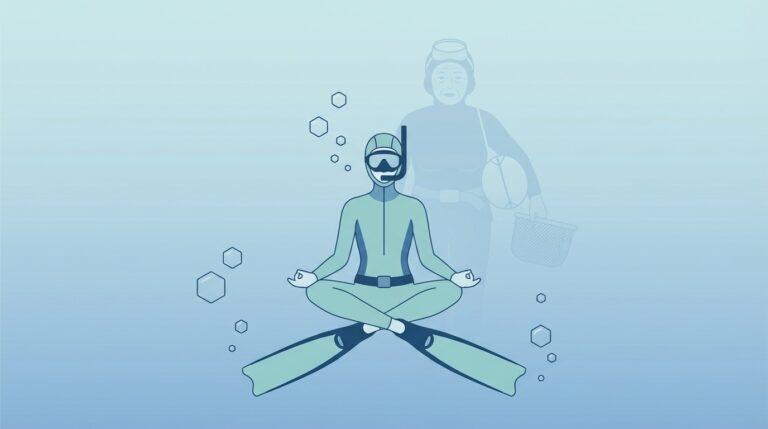
Picture this: You are watching a K-Drama set on Jeju Island. The protagonist dives deep into the cerulean waters, mirroring the legendary Haenyeo (traditional female divers). Total silence. No scuba tanks, just one deep breath and absolute mental control.
In modern Korea, where the hyper-fast ppalli-ppalli (hurry up) culture rules the bustling streets of Seoul, descending into a 26-meter deep pool (like the famous K26 in Gapyeong) on a weekend has become the ultimate form of rebellion for young professionals. It is about finding absolute stillness in the chaos.
But if you plan to join a Korean freediving Donghohoe (hobby club)—which is the best way to dive in Korea—textbook Korean won’t cut it. You need to understand the highly specific jargon, a mix of Konglish and traditional terms, and the nuanced ways Koreans talk about relaxation, tension, and limits. Today, we are diving deep into the advanced vocabulary of freediving and breathing techniques.
This guide is crafted for C1 learners who want to go beyond basic survival Korean and truly integrate into local sports communities.
Phase 2: Core Expressions Deep Dive
Let’s look at the crucial expressions that bridge physical breathing and mental state.
1. 호흡을 가다듬다
- Pronunciation: [hoheubeul gadadeumda] + [ho-heub-eul ga-da-deum-da]
- Meaning: Literal: To trim/adjust one’s breathing. Real Nuance: To steady one’s breathing / To collect oneself mentally and physically.
- K-Culture Moment: This isn’t just for sports. Before a K-pop idol steps onto the stage for a comeback performance, or before a character in a drama walks into a hostile boardroom, the subtitle might say “takes a deep breath,” but the Korean script says hoheubeul gadadeumda. In freediving, it refers to the crucial preparation phase (Breathe-up) before descending.
- Editor’s Insight: Gadadeumda means to arrange or put things in order. By pairing it with breath, it implies a deliberate, conscious effort to regain control over your autonomic nervous system. It sounds highly sophisticated and mindful.
- Situation Spectrum:
- Casual (with dive buddy): ✅
- Semi-formal (with instructor): ✅
- Formal (interviews/literature): ✅
- 🤔 Think About It: Why do Koreans use a verb typically associated with “arranging objects” (gadadeumda) for something as invisible as breathing? What does this say about the Korean approach to mind-body connection?
2. 몸에 힘을 빼다 (이완하다)
- Pronunciation: [mome himeul ppaeda (iwanhada)] + [mo-me hi-meul ppae-da]
- Meaning: Literal: To take the strength out of the body. Real Nuance: To relax completely. (Iwanhada is the formal/technical term for relaxation).
- K-Culture Moment: If you take any sports lesson in Korea—swimming, golf, or freediving—you will hear “몸에 힘 빼세요” (Take the strength out of your body) a thousand times. Koreans naturally carry a lot of tension, perhaps due to the highly competitive society and the constant need to read the room (nunchi).
- Editor’s Insight: Fighting the water makes you sink; fighting your breath consumes oxygen. In Korean society, sometimes fighting the flow creates more friction. Iwan (relaxation) is the ultimate goal of modern freedivers escaping city stress.
- Situation Spectrum:
- Casual: ✅
- Semi-formal: ✅
- Formal: ⚠️ (Use 이완하다 in academic/technical contexts)
- 🤔 Think About It: Does your language have a direct translation for “taking the strength out”? Why might this phrase be more effective coaching than simply saying “relax”?
3. 이퀄(라이징) 터지다
- Pronunciation: [ikwol(raijing) teojida] + [ee-kwol teo-ji-da]
- Meaning: Literal: Equalizing bursts/pops. Real Nuance: Successfully clearing the pressure in your ears.
- K-Culture Moment: Korean hobby communities love abbreviating technical terms. “Equalizing” becomes “이퀄” (E-kwol). When you finally manage the Frenzel maneuver and your ears pop open, Koreans describe it dynamically as teojida (to burst/explode into success), similar to how they say “포텐 터지다” (potential bursts/peaks).
- Editor’s Insight: This is pure insider slang. Using this immediately signals you are an experienced diver, not a tourist.
- Situation Spectrum:
- Casual: ✅
- Semi-formal: ✅
- Formal: 🚫
Phase 3: Textbook vs. Real Korean
- 📖 Textbook Korean: 압력 평형을 하십시오. (Please perform pressure equalization.)
- 🗣️ Real Korean: 이퀄 안 되면 무리하지 말고 바로 올라오세요. (If your ‘equal’ doesn’t work, don’t push it and come right up.)
- 💡 Why the difference?: Technical terms are usually Konglish abbreviations in the field. Also, “무리하지 마세요” (Don’t overdo it) is a staple phrase showing care in Korean sports culture.
-
📖 Textbook Korean: 숨을 깊게 들이마시세요. (Inhale deeply.)
- 🗣️ Real Korean: 자, 최종 호흡 갈게요. (Alright, let’s go for the final breath.)
- 💡 Why the difference?: Using “~갈게요” (I/we will go) is a highly common colloquial marker to announce the start of an action or phase in group settings.
Phase 4: Cultural Context — K-Culture Deep Dive
4-1. Non-Verbal Communication: Nunchi Underwater
In freediving, communication is heavily non-verbal. The “OK” hand signal is universal, but the Korean concept of Nunchi (reading the room/situation) is vital for dive buddies. You must constantly observe your buddy’s facial tension and finning rhythm. If you sense they are pushing past their limit (한계점), a good Korean buddy will intervene before they even signal.
4-2. The Original Freedivers: Haenyeo and Sumbisori
If you dive in Korea, you must know about the Haenyeo of Jeju Island—registered as UNESCO Intangible Cultural Heritage. Unlike modern freedivers who use sophisticated recovery breathing, Haenyeo use a unique, ancient technique called 숨비소리 (Sumbisori).
When they surface after an exhausting dive to harvest abalone, they forcefully expel the built-up carbon dioxide, creating a distinct, sharp whistling sound. It is often described in Korean literature as the “sound of crossing the threshold between life and death.” Modern freedivers hold their breath for “healing” and sport, but for Haenyeo, holding their breath is an intense act of survival and supporting their families.
Phase 5: Real-Life Roleplay Scenario
Setting: A humid Saturday morning at K26 pool in Gapyeong. The echoing sounds of splashing and instructors yelling fill the air. You are paired with a local Korean freediving club for line training.
Characters:
– YOU: An advanced freediver visiting Korea.
– Min-ho (34): Your Korean dive buddy and club leader. Friendly, but very strict about safety protocols.
Dialogue:
Min-ho: 오늘 컨디션 어때요? 수심 탈 준비 됐어요? 🌊
(oneul keondisyeon eottaeyo? susim tal junbi dwaesseoyo?)
[How is your condition today? Ready to ride the depth?]
YOU: 네, 조금 피곤하긴 한데 괜찮아요.
(ne, jogeum pigonhagin hande gwaenchayo.)
[Yes, I’m a bit tired but it’s okay.]
Min-ho: 무리하면 블랙아웃 와요. 몸에 힘 완전히 빼고, 준비호흡 길게 가져가세요.
(murihamyeon beullaegaut wayo. mome him wanjeonhi ppaego, junbihoheup gilge gajyeogaseyo.)
[If you push too hard, you’ll blackout. Take all the tension out of your body and take your prep-breathing long.]
YOU: 알겠습니다. 이퀄라이징 체크 한 번만 할게요.
(algetseumnida. ikwollaijing chekeu han beonman halgeyo.)
[Understood. Let me just check my equalizing once.]
(🎭 Stage Direction: You pinch your nose and gently equalize)
Min-ho: (Nods) 좋아요. 제가 버디 봐줄 테니까, 한계점 오면 참지 말고 턴하세요.
(joayo. jaega beodi bwajul tenikka, hangyejeom omyeon chamji malgo teonhaseyo.)
[Good. I’ll be your buddy, so if you reach your limit, don’t hold it in and turn around.]
🔀 Your Turn! How do you respond?
– A) “걱정 마세요. 저 숨 엄청 잘 참아요!” (Don’t worry. I hold my breath really well!)
– B) “네, 욕심 안 내고 다녀올게요. 잘 부탁드립니다.” (Yes, I won’t be greedy and will be right back. Please take care of me.)
– C) “알았어요. 빨리 끝내죠.” (Got it. Let’s finish this quickly.)✅ Best Choice: B — Insight: In Korean sports culture, expressing humility (욕심 안 내다 – not being greedy) and requesting care (잘 부탁드립니다) is the gold standard for C1 level etiquette. It builds immense trust.
⚠️ Choice A Analysis: Sounds arrogant. Safety is paramount, and overconfidence is frowned upon.
⚠️ Choice C Analysis: Too blunt and dismissive of the buddy’s care.
Phase 6: 10-Second Shadowing Drill
Focus on the smooth pacing to mimic the feeling of relaxation.
😊 호흡을 / 천~천히 가다듬고, / 몸에 힘을 / 완전히 빼보세요.
(hoheubeul / cheon~cheonhi gadadeumgo, / mome himeul / wanjeonhi ppaeboseyo.)
[Steady your breathing / ve~ry slowly, / and completely take the tension / out of your body.]
Phase 7: K-Culture Mini Dictionary
| Korean | Romanization | English | Context |
|---|---|---|---|
| 숨비소리 | sumbisori | Haenyeo’s whistle | The vital breathing sound of Jeju Haenyeo when surfacing. |
| 물멍 | mulmeong | Zoning out at water | A popular relaxation trend: staring blankly at water to clear the mind. |
| 버디 | beodi | Buddy | The universal diving partner, but heavily emphasized in Korean safety regulations. |
| 동호회 | donghohoe | Hobby club | The primary way Koreans socialize around sports. Very organized and community-driven. |
| 수심 타다 | susim tada | To ride the depth | Slang for diving deep down the line. |
Phase 8: Traveler Survival Kit
If you plan to visit a deep pool in Korea (like K26, K60, or Deep Station), you MUST know these.
🆘 Survival Expressions
– 🇰🇷 “수면 휴식 시간 얼마나 가질까요?” (sumyeon hyusik sigan eolmana gajilkkayo?)
– 🗣️ Meaning: How much surface interval time should we take?
– 🇰🇷 “자격증 확인 부탁드립니다.” (jagyeokjeung hwagin butakdeurimnida.)
– 🗣️ Meaning: Please check my certification card. (Essential at the counter).
– 🇰🇷 “다리에 쥐가 났어요.” (darie jwiga nasseoyo.)
– 🗣️ Meaning: I have a cramp in my leg.📌 Editor’s Travel Note
– Strict Rules: Korean dive pools are incredibly strict about the buddy system. You cannot enter the pool alone, even if you are an elite instructor. You must book with a certified buddy.
– Booking: Pools often require advance reservations via their localized apps or websites, which can be tricky without a Korean phone number. Try to join a local Donghohoe via Instagram or Kakao Open Chat beforehand!
Phase 9: Critical Thinking — “One Step Deeper”
Tradition vs. Modernity: The Meaning of the Breath
🧠 Think Deeper:
The juxtaposition of water sports in Korea is fascinating. For centuries, the Haenyeo endured freezing waters and held their breath past their physical limits out of pure necessity to feed their families. The ocean was a harsh, unforgiving workplace. Today, stressed urbanites pay premium fees to visit indoor deep pools, holding their breath to find “healing” and escape the pressures of modern society. What was once a painful struggle for survival has transformed into the ultimate luxury of mental relaxation.💬 Your Turn: Does your culture have a traditional survival practice that has evolved into a modern hobby or wellness trend? Share it in the comments!
Phase 10: FAQ & Avoiding Misunderstandings
Q: Can I use Konglish terms like ‘프리폴’ (Freefall) or ‘덕다이브’ (Duck dive) with Korean instructors?
Yes! In fact, it is preferred. Korean freediving communities heavily utilize English terminology. Trying to translate them into pure Korean might actually cause confusion.
Q: Is it okay to touch a sea turtle if I go freediving in Jeju?
Absolutely not. Touching marine life is strictly regulated and frowned upon in the Korean diving community. Always practice the “눈으로만 보세요” (Look only with your eyes) rule.
❌ Common Mistake:
Using “숨을 죽이다” (sumeul jukida) instead of “숨을 참다” (sumeul chamda).
✅ How to fix it:
Sumeul chamda means voluntarily holding your breath (like in sports). Sumeul jukida (literally “killing your breath”) means to hold your breath out of fear, suspense, or hiding (like watching a scary K-Drama). Don’t tell your instructor you are “killing your breath”!
Phase 11: Summary & Action Items
- One-Liner Summary: Mastering advanced Korean freediving jargon means balancing Konglish technical terms with the cultural etiquette of humility and safety.
-
Action Mission:
- 🥉 Bronze: Stand in front of a mirror, take a deep breath, and say “몸에 힘 빼자” (Let’s relax the body) to yourself.
- 🥈 Silver: Search
#프리다이빙(Freediving) on Instagram and try to read the Korean captions. You’ll spot terms like 이퀄 and 물멍 immediately. - 🥇 Gold: Next time you are doing any physical activity, tell your Korean friend, “호흡 좀 가다듬을게요” before starting.
- K-Culture Mission: Watch a documentary or YouTube video about the Jeju Haenyeo. Listen closely—can you hear the distinct Sumbisori when they surface?
What’s the hardest part about relaxing for you? Let me know in the comments below!
Phase 12: Interactive Challenge Quiz
1. Situational Judgment: You are doing line training. You descend to 10 meters, but your right ear won’t pop. What is the most natural thing to tell your buddy when you surface?
– A) 귀에 압력이 안 맞습니다. (The pressure in my ear is not matching.)
– B) 오른쪽 이퀄이 안 터졌어요. (The right ‘equal’ didn’t pop.)
– C) 숨이 너무 벅차요. (I’m too out of breath.)
(Drop down for answer)
Check Answer
Answer: B. This uses the highly natural, native jargon (이퀄 and 터지다). A is too textbook, and C describes a different problem entirely.
2. True or False – K-Culture Edition: “In Korea, if you are a certified Master Freediver, you are allowed to practice solo in deep pools like K26.”
(Drop down for answer)
Check Answer
False. Korean safety regulations in diving pools are extremely strict. The buddy system is mandatory regardless of your certification level.
Frequently Asked Questions (FAQ)
Q: What does "호흡을 가다듬다" mean in Korean and how do you pronounce it?
A: In Korean, "호흡을 가다듬다" is pronounced [hoheubeul gadadeumda] and means: Literal: To trim/adjust one's breathing. Real Nuance: To steady one's breathing / To collect oneself mentally and physically.
Q: What does "몸에 힘을 빼다 (이완하다)" mean in Korean and how do you pronounce it?
A: In Korean, "몸에 힘을 빼다 (이완하다)" is pronounced [mome himeul ppaeda (iwanhada] and means: Literal: To take the strength out of the body. Real Nuance: To relax completely. (Iwanhada is the formal/technical term for relaxation).
Q: What does "이퀄(라이징) 터지다" mean in Korean and how do you pronounce it?
A: In Korean, "이퀄(라이징) 터지다" is pronounced [ikwol(raijing] and means: Literal: Equalizing bursts/pops. Real Nuance: Successfully clearing the pressure in your ears.







