

Phase 1: Empathy (Immersive Opening)
Hello! I’m your lead editor and tutor at Daily Hangul.
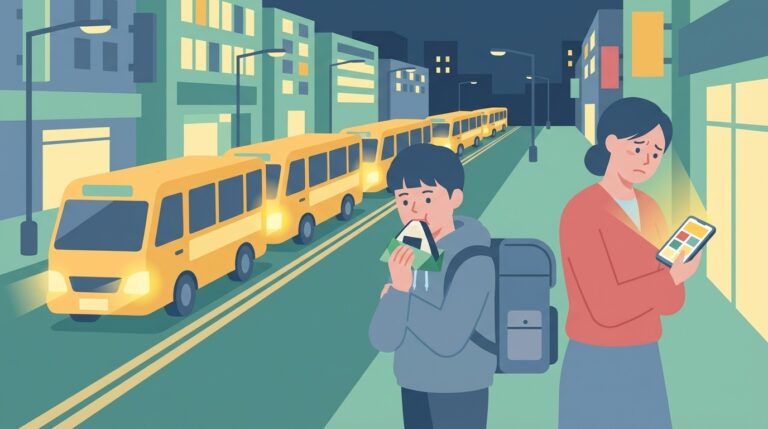
Imagine this: It’s 10:00 PM on a Tuesday in Daechi-dong, Seoul’s most notorious education hub. The streets are suddenly paralyzed. A massive fleet of yellow mini-buses lines up with military precision, and exhausted teenagers spill out of high-rise buildings, grabbing a triangle kimbap from the CU convenience store before hopping onto their next ride. If you’ve ever watched the K-Drama SKY Castle or Crash Course in Romance, you know exactly what I’m talking about.
But when a Korean friend sighs over a cup of coffee and says, “우리 애 요즘 학원 뺑뺑이 돌려요” (I’m making my kid run the hagwon treadmill), they aren’t just giving you a schedule update. They are sharing a profound cultural anxiety.
At the C2 level, you aren’t just learning to order a coffee; you’re learning to read the minds of Korean society. If you don’t understand the hyper-competitive world of Korean parenting (육아) and the complex feelings about a child’s happiness (행복), a massive part of modern Korean culture will remain a mystery to you. This guide is built from the countless deep conversations I’ve had with my advanced expat students navigating the Korean school system. Let’s dive in.
Phase 2: Deep Dive into Core Expressions
1. 학원 뺑뺑이 (Hagwon Bbaeng-bbaengi)
- Pronunciation: [hagwon ppaeng-ppaeng-i] (The ‘ppaeng’ sounds like the sharp, bouncing ‘peng’ sound a pinball makes when it violently hits a bumper.)
- Meaning: Literal: Hagwon spinning/lottery. Real nuance: The endless, exhausting cycle of sending a child to multiple after-school academies back-to-back.
- K-Culture Moment: Picture a mother in a trendy Mok-dong cafe. She looks exhausted, staring at a spreadsheet of her 8-year-old’s schedule: English at 2 PM, Math at 4 PM, Taekwondo at 6 PM, Piano at 8 PM. She sighs and says, “어휴, 나도 뺑뺑이 그만 돌리고 싶다” (Ugh, I want to stop this treadmill too).
- Editor’s Insight: This phrase carries a heavy dose of self-deprecation. “뺑뺑이” originally refers to a spinning wheel or a grueling repetitive task in the military. Parents use it to acknowledge the absurdity of the system, even as they participate in it.
- Situation Spectrum:
- Casual with friends (Casual): ✅
- Co-workers with kids (Semi-formal): ⚠️ (Only if you are close)
- Formal/Teachers (Formal): 🚫
- 🤔 Think About It: Why do Korean parents use a military-like term to describe their child’s education? Does your language have a word for collective parental anxiety?
2. 치맛바람 (Chimatbaram)
- Pronunciation: [chi-mat-bba-ram] (‘chi’ like cheese, ‘mat’ like mat, ‘bba-ram’ sounds like a swift gust of wind).
- Meaning: Literal: The swish of a skirt. Real nuance: Overzealous, aggressive maternal influence in a child’s education or school politics.
- K-Culture Moment: When the class president’s mother buys premium beef lunchboxes for the entire teaching staff, other moms whisper, “저 집 치맛바람 장난 아니야” (That family’s skirt-swish is no joke).
- Editor’s Insight: This word is culturally loaded and highly gendered. It paints a picture of a mother running around so frantically to secure her child’s success that her skirt creates a gust of wind. It’s often used critically by those who feel overwhelmed by such mothers.
- Situation Spectrum:
- Gossip among friends (Casual): ✅
- General social commentary (Semi-formal): ✅
- To the mother herself (Formal): 🚫 (Never do this!)
- 🤔 Think About It: How does language reflect the societal expectation that fathers earn money while mothers are entirely responsible for academic success?
3. 선행학습 (Seonhaenghakseup)
- Pronunciation: [seon-haeng-hak-sseup] (Glide the ‘n’ and ‘h’ smoothly: sun-hang-hak-seup).
- Meaning: Literal: Prior-action learning. Real nuance: Advanced learning/Pre-studying (e.g., a 3rd grader learning 6th-grade math).
- K-Culture Moment: In Crash Course in Romance, mothers fight tooth and nail to get their middle school kids into the “Medical School Prep” track, which teaches high school calculus.
- Editor’s Insight: This isn’t slang; it’s a formal educational term, but it dictates the entire rhythm of Korean youth. The paradox is that if everyone is doing ‘advanced learning’, it just becomes the new baseline.
- Situation Spectrum:
- Discussing with friends (Casual): ✅
- Parent-teacher conferences (Formal): ✅
- News and media (Formal): ✅
- 🤔 Think About It: If a child is always learning the future curriculum, when do they get to live in the present?
Phase 3: Textbook vs. Real Korean
[Describing a Busy Child’s Schedule]
* 📖 Textbook Korean: 우리 아이는 방과 후 수업을 많이 듣습니다. (My child takes many after-school classes.)
* 🗣️ Real Korean: 우리 애 요즘 학원 뺑뺑이 돌리느라 얼굴 볼 시간도 없어요. (I’m running my kid on the hagwon treadmill so much I don’t even have time to see their face.)
* 💡 Why the difference?: Textbooks state facts; real Korean expresses the emotional toll and the frantic pace of the system using vivid metaphors.
[Describing an Overly Involved Mother]
* 📖 Textbook Korean: 그 어머니는 교육열이 아주 높습니다. (That mother has a very high fever for education.)
* 🗣️ Real Korean: 거기는 치맛바람이 세서 웬만한 멘탈로는 버티기 힘들어요. (The skirt-swish there is so strong, it’s hard to survive with an average mentality.)
* 💡 Why the difference?: “교육열” (education fever) is objective. “치맛바람” captures the intimidating, cliquish social dynamics among parents.
Bottom Note: At the C2 level, you should be able to seamlessly switch between the objective vocabulary (선행학습) and the social slang (뺑뺑이) depending on who you are talking to.
Phase 4: Cultural Context — K-Culture Deep Dive
4-1. Non-verbal Elements & ‘Nunchi’ (눈치)
When Korean parents discuss their children’s education, Nunchi is everything. If someone complains about their child’s expensive English hagwon, you must read the room. Are they actually complaining, or are they subtly boasting (humblebragging) about their financial ability to send their kid there? Often, a heavy sigh and a shake of the head accompany these boasts. Do not simply reply, “Then why don’t you make them quit?” That shows a severe lack of Nunchi!
4-2. K-Drama & K-Travel Connection
If you want to witness this culture firsthand, take a walk down the Daechi-dong Hagwon Street (대치동 학원가) in Gangnam between 9:30 PM and 10:30 PM. It is a surreal travel experience. You will see traffic officers directing luxury sedans and yellow buses. This is the exact setting of dramas like SKY Castle and Green Mothers’ Club. The underlying theme of these dramas always comes back to one question: “Is the child actually happy? (애는 진짜 행복한가요?)”
Notice the contrast: The parents are eating premium omakase while discussing tutors, but the children are standing in convenience stores eating 1,500 KRW triangle kimbap (삼각김밥) because they only have 15 minutes between classes. This food culture perfectly encapsulates the tragic irony of the system.
Phase 5: Real-Life Roleplay Scenario
Setting: Friday morning, 10:30 AM. A chic brunch cafe in Mok-dong (another elite education district in Seoul). You are sitting with three local Korean mothers. The tables are close together, and you can hear whispers of “math tutors” and “English scores” from every direction.
Characters:
– YOU: An expat professional living in Seoul with a 6-year-old child. You are trying to navigate the system without losing your mind.
– Ji-yeon (38): A “veteran” local mom. Her child is 8, and she knows everything about every hagwon.
Dialogue:
Ji-yeon: (Sighing and cutting her avocado toast)
휴, 우리 민준이 다음 달부터 수학 선행학습 학원 레벨테스트 봐야 하는데, 벌써부터 스트레스네요.
(Hyu, uri Minjuni daeum dalbuteo suhak seonhaenghakseup hagwon lebel-teseuteu bwaya haneunde, beolsseobuteo seuteureseuneyo.)
[Ugh, my Min-jun has to take a level test for the advanced math academy next month. I’m already stressed.]
YOU:
벌써 수학 선행이요? 민준이 이제 초등학교 1학년 아니에요?
(Beolsseo suhak seonhaeng-iyo? Minjuni ije chodeunghakgyo ir학년 anieyo?)
[Advanced math already? Isn’t Min-jun only in 1st grade?]
Ji-yeon:
에이, 대치동이나 목동에서는 1학년 때 3학년 거 안 하면 바보 취급 당해요. 저도 뺑뺑이 그만 돌리고 싶은데, 남들 다 하니까 불안해서…
(Ei, daechidong이나 mokdong-eseoneun ir학년 ttae sam학년 geo an hamyeon babo chwigeup danghaeyo. Jeodo ppaengppaeng-i geuman dolligo sipeunde, namdeul da hanikka buranhaeseo…)
[Oh please, in Daechi-dong or Mok-dong, if you aren’t doing 3rd-grade math in 1st grade, you’re treated like a fool. I want to stop the treadmill too, but everyone else is doing it, so I get anxious…]
🔀 Your Turn! How do you respond?
– A) “그래도 아이의 행복이 제일 중요하죠. 학원 다 끊으세요!” (But the child’s happiness is the most important. Quit all the hagwons!)
– B) “맞아요, 한국 교육 시스템 진짜 문제예요.” (You’re right, the Korean education system is a real problem.)
– C) “아, 엄마들 치맛바람 때문에 정말 피곤하시겠어요. 그래도 민준이는 잘 따라가나 봐요?”
(Ah, you must be so exhausted because of all the moms’ skirt-swish. But it seems Min-jun is keeping up well?)✅ Best Choice: C — Why? You show deep cultural empathy using the advanced vocabulary (치맛바람), validate her exhaustion, and end with a subtle compliment about her son (keeping up well). This is elite C2 Nunchi!
⚠️ Choice A Analysis: Too preachy. Telling a Korean parent to “just quit” ignores the immense societal pressure they are under. It might come off as arrogant.
⚠️ Choice B Analysis: Complaining about the “system” is okay, but doing it too bluntly as a foreigner might make locals defensive.
Phase 6: 10-Second Shadowing Drill
Let’s practice the ultimate C2 phrase when discussing this topic. Focus on the intonation!
😔 솔직히 / 애가 행복한 게 / 먼저 아닌가요?
(soljikhi / aega haengbokhan ge / meonjeo aningayo?)
[Honestly, isn’t the child’s happiness the priority?]
Tips: Drop your shoulders on soljikhi, pause slightly for dramatic effect, and let your voice gently rise at the end with genuine concern.
Phase 7: K-Culture Mini Dictionary
| Korean | Romanization | English | Contextual Meaning |
|---|---|---|---|
| 영유 | yeong-yu | English Kindergarten | Short for 영어 유치원 (English Kindergarten). A massive status symbol. Costs as much as college tuition. |
| 돼지 엄마 | dwaeji eomma | Pig Mom | A highly influential mother in an education district who controls information and creates study groups. Treat her like a mafia boss of academics. |
| 수능 | suneung | CSAT | The College Scholastic Ability Test. The singular day in November that dictates a Korean teenager’s destiny. Flights are literally grounded so kids can focus on the listening exam. |
| 기러기 아빠 | gireogi appa | Goose Dad | A father who stays in Korea to work and send money, while the mother and children live abroad (usually US/Canada/UK) for the child’s English education. |
Phase 8: Traveler Survival Kit (Daechi-dong Night Owl Edition)
Even if you don’t have kids, visiting a Hagwon district is a fascinating sociological tour. Here are survival tips if you find yourself in Daechi-dong or Mok-dong at night.
🆘 Survival Phrases #1
– 🇰🇷 “이 근처에 늦게까지 하는 카페 있나요?” (i geuncheo-e neutgekkaji haneun kape innayo?)
– 🗣️ English Guide: Is there a cafe open late around here?
– 📍 Where to use: Asking around 10 PM. (Note: Many cafes in Hagwon districts are packed with parents waiting for their kids!)🆘 Survival Phrases #2
– 🇰🇷 “학원 버스 조심하세요!” (hagwon beoseu josimhaseyo!)
– 🗣️ English Guide: Watch out for the hagwon buses!
– 📍 Where to use: A friendly warning, or something you’ll hear from traffic guards as swarms of yellow buses pull over unpredictably.📌 Editor’s Travel Note
– Navigating 10 PM: Avoid driving near Daechi Station (Line 3) at exactly 10:00 PM. Hagwons are legally required to end at 10 PM, creating a sudden, massive traffic jam of parents picking up their kids.
– The Food Scene: Look for places selling “Cup-bap” (cup rice) or gourmet toast. These quick, hearty meals are the lifeblood of busy students.
Phase 9: Critical Thinking Corner — “One Step Deeper”
Language & Power: The Paradox of “Happiness”
🧠 Think Deeper:
In Korean parenting, the word “행복” (happiness) is heavily loaded. Parents often justify the grueling “학원 뺑뺑이” (hagwon treadmill) by saying, “나중에 다 너 행복하라고 이러는 거야” (I’m doing this all for your future happiness). However, the language of the present is filled with vocabulary of survival and warfare: 선행 (advanced), 경쟁 (competition), 생존 (survival). This creates a linguistic and psychological paradox where present misery is the accepted currency for future happiness. As a C2 learner, when you hear a parent use the word ‘행복’, realize that it’s rarely about joy in the moment; it’s almost always tied to socio-economic security and success.💬 Your Turn: How is the concept of a child’s “happiness” expressed in your culture? Is it tied to academic success or something else? Share your thoughts in the comments!
Phase 10: FAQ & Avoiding Misunderstandings
Q: Can I joke about “치맛바람” (skirt-swish) with a Korean mother I just met?
No! While it’s a common term, it has a negative, gossipy nuance. You can use it to describe a general situation (“요즘 대치동 치맛바람이 대단하다면서요?”), but never direct it at the person you are talking to.
Q: If a parent says their kid is “going to hagwon”, do they mean martial arts and piano?
At a young age (5-8), yes. But past age 9, “hagwon” almost exclusively means intense academic cram schools (Math, English, Essay writing).
❌ Common Mistake #1: Assuming “교육열” (Education fever) is always a compliment.
✅ Do this instead: While Korea is proud of its high education standards, hyper-competition is a massive social burden. Express sympathy and understanding rather than blind admiration. Say: “교육열이 대단하네요. 부모님들도 아이들도 정말 고생이 많겠어요.” (The education fever is incredible. The parents and kids must be working so hard.)
Phase 11: Summary & Action Items
- One-Liner Summary: Understanding terms like Hagwon bbaeng-bbaengi and Chimatbaram unlocks the deep-seated anxieties and competitive spirit of Korean parenting, where present sacrifice is viewed as the down payment for a child’s future happiness.
-
Action Mission 3 Steps:
- 🥉 Bronze (Solo): Read the phrases “학원 뺑뺑이” and “치맛바람” out loud three times, focusing on the strong double consonants (ㅃ, ㅉ).
- 🥈 Silver (Online): Go to a K-Drama forum or YouTube video about SKY Castle and drop a comment using the word 선행학습 (Pre-learning).
- 🥇 Gold (Real World): The next time a Korean friend mentions their kid’s busy schedule, gently ask, “혹시 학원 뺑뺑이 때문에 피곤하신 거 아니에요?” (Are you perhaps tired from the hagwon treadmill?)
- K-Culture Mission: Watch the first episode of SKY Castle or Crash Course in Romance. Pay attention to how the parents speak to each other—notice the fake politeness layered over intense competitiveness!
-
Engagement: Have you ever experienced or witnessed a culture with similar “education fever”? Let’s chat in the comments!
Phase 12: Interactive Quiz
1. Situational Judgment:
Your Korean coworker, Mr. Kim, looks exhausted. He says, “My wife signed our 7-year-old up for three more English academies.” What is the most C2-appropriate, culturally empathetic response?
– A) 와, 영어를 진짜 잘하겠네요! (Wow, they’ll be great at English!)
– B) 아유, 아내분 치맛바람이 장난 아니네요. (Wow, your wife’s skirt-swish is no joke.)
– C) 아이고, 애기 학원 뺑뺑이 돌리느라 부모님이 더 힘드시겠어요. (Oh man, the parents must be having a harder time running the kid on the hagwon treadmill.)
Answer: C. It shows deep empathy for the parents’ struggle using high-level native slang. B is highly insulting to his wife! A is too naive.
2. True or False — K-Culture Edition:
In Korean hagwon districts, the streets are usually completely quiet by 10 PM because children go to sleep early.
Answer: False! 10 PM is rush hour in places like Daechi-dong because the law forces hagwons to close at exactly 10 PM, causing thousands of kids to pour onto the streets simultaneously.
3. Fill in the Blank:
To describe a mother who aggressively controls the academic paths of children in the neighborhood, locals jokingly refer to her as a [ ______ ] 엄마.
Answer: 돼지 (Pig). 돼지 엄마 (Pig Mom).
Frequently Asked Questions (FAQ)
Q: What does "학원 뺑뺑이 (Hagwon Bbaeng-bbaengi)" mean in Korean and how do you pronounce it?
A: In Korean, "학원 뺑뺑이 (Hagwon Bbaeng-bbaengi)" is pronounced [hagwon ppaeng-ppaeng-i] and means: Literal: Hagwon spinning/lottery. Real nuance: The endless, exhausting cycle of sending a child to multiple after-school academies back-to-back.
Q: What does "치맛바람 (Chimatbaram)" mean in Korean and how do you pronounce it?
A: In Korean, "치맛바람 (Chimatbaram)" is pronounced [chi-mat-bba-ram] and means: Literal: The swish of a skirt. Real nuance: Overzealous, aggressive maternal influence in a child's education or school politics.
Q: What does "선행학습 (Seonhaenghakseup)" mean in Korean and how do you pronounce it?
A: In Korean, "선행학습 (Seonhaenghakseup)" is pronounced [seon-haeng-hak-sseup] and means: Literal: Prior-action learning. Real nuance: Advanced learning/Pre-studying (e.g., a 3rd grader learning 6th-grade math).






