

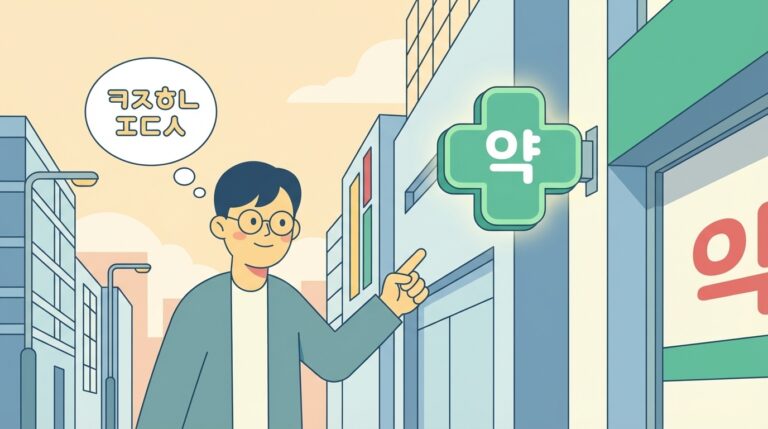
Phase 1: Empathy (Immersive Opening)
Hello! I’m your Daily Hangul Editor, your local Korean friend and culture navigator.
Picture this: You are in the middle of Hongdae. The neon lights are flashing, the street buskers are singing the latest K-Pop hits, and you just had the most glorious, spicy Tteokbokki of your life. It was a true K-Food dream… until your stomach starts staging a protest. Or maybe you’ve been walking around Seoul all day, and your feet are covered in blisters.
You open your map app, but finding the right place in a sea of Korean signs feels impossible. You need medicine. You need help. But how do you ask without playing an awkward game of charades with a stranger on the street?
If you don’t know the magic phrase we are learning today, you might just suffer in silence in your hotel room. But if you do, you’ll unlock instant help from kind locals and experience the magic of Korean pharmacies! Everything you read here today is based on real SOS calls I’ve received from my beginner students visiting Korea.
Phase 2: Core Expressions Deep Dive
Let’s master the most essential survival phrases for your health in Korea. Since you are an absolute beginner (A1), we will keep it short, sweet, and incredibly practical.
1. 약국 어디예요?
- Pronunciation: [yak-guk eo-di-ye-yo?] -> Sounds like: “Yak (like the animal) – gook (rhymes with book) / Oh – D – yay – yo?”
- Meaning: Where is the pharmacy? (Literal: Pharmacy where is it?)
- K-Culture Moment: In K-Dramas, when someone is sick, the male lead usually runs out into the night to find a green cross sign. That glowing green or red cross is the universal sign for a ‘약국’ (Pharmacy) in Korea!
- Editor’s Insight: ‘어디예요’ is the ultimate traveler’s Swiss Army knife. Just put ANY place you want to go in front of it! Restroom? 화장실 어디예요? Subway? 지하철 어디예요? It feels polite yet straight to the point.
- Situation Spectrum:
- Friends (Casual): ⚠️ (Friends would use ‘어디야?’)
- Strangers/Clerks (Semi-formal): ✅ (Perfect!)
- Elders/Boss (Formal): ⚠️ (It’s okay, but there’s a more formal way)
- 🤔 Think About It: In English, we usually ask, “Excuse me, do you know where the pharmacy is?” In Korean, we just say, “Pharmacy, where is it?” Why do you think Korean drops the “do you know” part? (Hint: Korean values getting straight to the point while maintaining politeness through the ending ‘-요’).
2. 머리 아파요
- Pronunciation: [meo-ri a-pa-yo] -> Sounds like: “Muh-ree / ah-pah-yo” (‘ah’ like saying ‘ah’ at the dentist, ‘pah’ like papa).
- Meaning: I have a headache. (Literal: Head hurts.)
- K-Culture Moment: You know that classic K-Drama trope where the angry mother-in-law ties a white cloth around her head and lies down when she gets stressed? She’s experiencing ‘머리 아파요’. But instead of a cloth, you can just go to the pharmacy!
- Editor’s Insight: Just like ‘어디예요’, you can put any body part in front of ‘아파요’ (It hurts). Stomach hurts? 배 아파요 (bae a-pa-yo).
- Situation Spectrum:
- Friends (Casual): ⚠️ (Drop the ‘요’ -> 머리 아파)
- Pharmacist/Doctor (Semi-formal): ✅
3. 약 주세요
- Pronunciation: [yak ju-se-yo] -> Sounds like: “Yak / joo-say-yo”
- Meaning: Please give me medicine.
- K-Culture Moment: Whether you are buying concert tickets or ordering K-BBQ, ‘주세요’ (Please give me) is the magic word that gets things done in Korea.
- Editor’s Insight: When you walk into the pharmacy, pointing to your head and saying “머리 아파요, 약 주세요” is a complete, perfect sentence that will get you exactly what you need.
Phase 3: Textbook vs. Real Korean
Let’s see how real people talk on the streets of Seoul.
[Situation 1: Asking for directions]
* 📖 Textbook Korean: 실례하지만 약국이 어디에 있습니까? (Excuse me, where might the pharmacy be located?)
* 🗣️ Real Korean: 저기요, 약국 어디예요? (Excuse me, pharmacy where?)
* 💡 Why the difference?: Modern Koreans value ‘빨리빨리’ (Pali-Pali, speed/efficiency). The textbook version sounds like a news anchor; the real version sounds like a busy but polite pedestrian.
[Situation 2: Expressing your pain]
* 📖 Textbook Korean: 저는 두통이 있습니다. (I possess a headache.)
* 🗣️ Real Korean: 머리 아파요. (Head hurts.)
* 💡 Why the difference?: Textbooks often use formal Hanja (Chinese-root) words like 두통 (headache), but in daily life, native Korean words like 머리 (head) + 아파요 (hurts) are much more natural and emotional.
Phase 4: Cultural Context — K-Culture Deep Dive
4-1. Non-verbal Cue: The “Excuse Me” Bow
When you stop someone on the street to ask “약국 어디예요?”, don’t just stare them down! Give a slight nod of your head (about 15 degrees) while saying “저기요” (Excuse me). It shows respect. Also, remember Nunchi (눈치)—try not to stop someone who is sprinting to catch a bus!
4-2. K-Food Connection: The Legendary “Sohwaje”
Let’s be honest. If you come to Korea, you are going to eat. A lot. Samgyeopsal, fried chicken, spicy stews… Sometimes, your stomach can’t handle it. In Korea, there is a massive culture around 소화제 (Sohwaje – Digestion Medicine).
Instead of just pills, Korean pharmacies sell tiny brown glass bottles of herbal digestion drinks (like Gas Whal Myung Su). They taste like fizzy herbal tea and work magic! If you overeat, just walk into a pharmacy, rub your stomach, and say, “소화제 주세요” (Sohwaje juseyo).
Phase 5: Real-life Roleplay Scenario
Setting: A chilly Friday night in Hongdae. You’ve been walking for 4 hours, and your new trendy sneakers just gave you a terrible blister. You need a band-aid, but you can’t find a pharmacy on your map.
Characters:
– YOU: A tourist experiencing the pain of fashion.
– Min-su: A friendly local university student waiting for his friends.
Dialogue:
(You spot Min-su looking at his phone.)
🔀 Your Turn! How do you get his attention?
– A) “Hello!” (In English)
– B) “저기요!” (Jeogiyo! – Excuse me!)
– C) “야!” (Ya! – Hey!)✅ Best Choice: B — “저기요” is the polite way to get a stranger’s attention.
⚠️ Choice C Analysis: NEVER say “야!” to a stranger. It’s incredibly rude and only used to yell at close friends or enemies in K-Dramas!
YOU: 저기요… 약국 어디예요?
(Jeogiyo… yak-guk eo-di-ye-yo?)
[Excuse me… where is the pharmacy?]
Min-su: 아! 약국이요? 저기 편의점 옆에 있어요.
(Ah! Yak-guk-i-yo? Jeo-gi pyeon-ui-jeom yeop-e isseo-yo.)
[Ah! Pharmacy? It’s over there next to the convenience store.]
(🎭 Stage Direction: Min-su points down the street to a glowing green cross)
YOU: 감사합니다!
(Gam-sa-ham-ni-da!)
[Thank you!]
(You walk into the pharmacy. The pharmacist looks at you.)
Pharmacist: 어서 오세요.
(Eo-seo o-se-yo.)
[Welcome.]
YOU: 밴드 주세요.
(Baen-deu ju-se-yo.)
[Band-aids, please.]
Pharmacist: 네, 여기 있습니다.
(Ne, yeo-gi it-seum-ni-da.)
[Yes, here you go.]
Phase 6: 10-Second Shadowing Drill
Practice this until it flows naturally. Pay attention to the pauses (/) and the emotion!
🥺 (Looking slightly lost)
저기요, / 약국 / 어디예요?
(jeo-gi-yo / yak-guk / eo-di-ye-yo?)
🤕 (Rubbing your head)
머리 / 아파요. / 약 / 주세요.
(meo-ri / a-pa-yo. / yak / ju-se-yo.)
Phase 7: K-Culture Mini Dictionary
| Korean | Romanization | English | Cultural Context |
|---|---|---|---|
| 눈치 | nunchi | Social sense | The ability to read the room. Crucial when asking strangers for help! |
| 약국 | yak-guk | Pharmacy | Look for the ‘약’ sign or a green/red cross. |
| 소화제 | so-hwa-je | Digestion medicine | A must-have after a heavy K-BBQ session. Often comes in small liquid bottles. |
| 박카스 | bak-ka-seu | Bacchus | Korea’s national energy drink. Often bought in boxes at pharmacies to give as gifts to tired coworkers in K-Dramas! |
Phase 8: Traveler’s Survival Kit
🆘 Survival Phrases for the Pharmacy
– 🇰🇷 “소화제 주세요.” (so-hwa-je ju-se-yo)
– 🗣️ Digestion medicine, please.
– 📍 Use when: You ate too much spicy K-Food.
- 🇰🇷 “밴드 있어요?” (baen-deu isseo-yo?)
- 🗣️ Do you have band-aids?
- 📍 Use when: You get blisters from walking around Seoul.
🇰🇷 “살려주세요!” (sal-lyeo-ju-se-yo!)
- 🗣️ Save me!
- 📍 Use when: ONLY in a real extreme emergency. (You hear this in K-Drama thrillers!)
📌 Editor’s Travel Note
– Late Night Emergencies: Pharmacies usually close around 7-8 PM. If you need basic medicine (painkillers, band-aids, digestion drinks) at 2 AM, go to any Convenience Store (CU, GS25, 7-Eleven)! They have a small medical section near the counter.
– Customized Pouches: Don’t be surprised if the Korean pharmacist gives you your medicine in tiny, customized paper pouches for Morning, Noon, and Night. It’s a unique Korean medical service!
Phase 9: Critical Thinking Corner — “One Step Deeper”
🧠 Think Deeper: Food & Identity
Why are digestion drinks (소화제) so universally loved and heavily marketed in Korea? It is deeply connected to the “Pali-Pali” (hurry hurry) culture. In Korea’s rapid economic growth period, people had to eat fast to get back to work. Also, Korean dining is communal—sharing large pots of stew and grilling meat together. In the excitement of sharing food and making sure no one is left out, overeating is almost a sign of a good time! The little bottle of Sohwaje is basically the cultural band-aid for Korea’s passionate love affair with communal eating.
💬 Your Turn: Do you have a specific “go-to” remedy for overeating in your home country? Share it in the comments!
Phase 10: FAQ & Avoiding Misunderstandings
Q: Can I just point to where it hurts instead of talking?
Yes! Body language is universal. Pointing to your stomach and saying “아파요 (a-pa-yo)” is 100% acceptable and effective.
Q: Can I use “어디예요” to older people?
Yes, because it ends in ‘-요’, it is polite. However, if you are asking a very elderly person or a police officer, adding “죄송하지만…” (Sorry, but…) at the beginning makes it perfectly respectful.
❌ Common Mistake #1: Asking for a “병원” (Hospital) when you just have a minor headache.
✅ Do this instead: Go to a “약국” (Pharmacy). If you ask for a hospital, locals might get very worried and try to call an ambulance for you!
Phase 11: Summary & Action Items
One-Liner Summary: To survive a minor health hiccup in Korea, just find the ‘약’ sign and ask: “약국 어디예요?”
Action Mission:
– 🥉 Bronze (Solo): Stand in front of your mirror, hold your head dramatically like a K-Drama actor, and say “머리 아파요” 3 times.
– 🥈 Silver (Online): Go to Google Street View, drop yourself in Gangnam, and try to find a pharmacy sign with the green cross or ‘약’.
– 🥇 Gold (Real Life): Next time you are in Korea (or at a Korean supermarket), buy a bottle of Bacchus or Sohwaje and say “이거 주세요” (Please give me this)!
Phase 12: Interactive Quiz
1. You just ate 3 servings of Samgyeopsal and feel incredibly full. You walk into a pharmacy. What do you say?
A) 밴드 주세요 (Baen-deu ju-se-yo)
B) 약국 어디예요 (Yak-guk eo-di-ye-yo)
C) 소화제 주세요 (So-hwa-je ju-se-yo)
2. True or False: If it is 3:00 AM and you have a headache, you cannot buy any medicine because pharmacies are closed.
(Answers)
1. C! You need that magical digestion drink! (A is for band-aids, B is asking where the pharmacy is).
2. False! You can buy basic over-the-counter medicine like painkillers at 24/7 convenience stores in Korea.
Frequently Asked Questions (FAQ)
Q: What does "약국 어디예요?" mean in Korean and how do you pronounce it?
A: In Korean, "약국 어디예요?" is pronounced [yak-guk eo-di-ye-yo?] and means: Where is the pharmacy? (Literal: Pharmacy where is it?)
Q: What does "머리 아파요" mean in Korean and how do you pronounce it?
A: In Korean, "머리 아파요" is pronounced [meo-ri a-pa-yo] and means: I have a headache. (Literal: Head hurts.)
Q: What does "약 주세요" mean in Korean and how do you pronounce it?
A: In Korean, "약 주세요" is pronounced [yak ju-se-yo] and means: Please give me medicine.







