

Phase 1: Empathy (The K-Culture Cold Open)
Hello! It’s your Daily Hangul Editor.
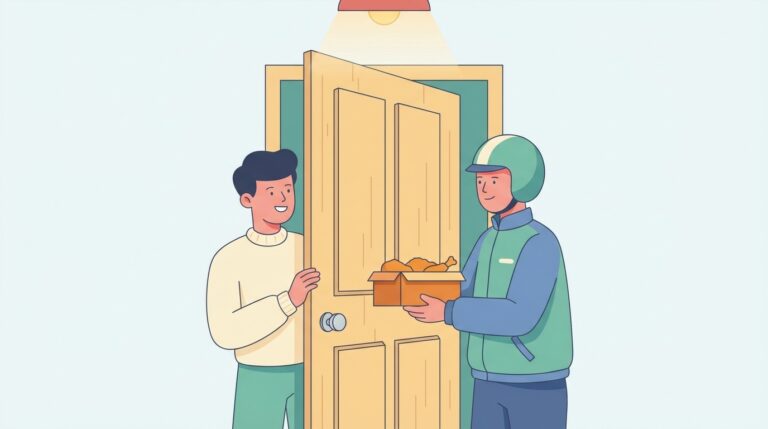
You’ve definitely seen this in a K-Drama. It’s midnight. The protagonist is stressed, so they order a spicy midnight snack. The doorbell rings—Ding-dong! They open the door, take the plastic bag of food, give a quick nod, mutter a short phrase, and the delivery rider vanishes into the night like a ninja.
But what exactly did they say?
If you’re living in or visiting Korea, ordering food delivery (Baedal) is practically a rite of passage. But many beginner learners freeze when the door opens. Do you say “Thank you”? Do you bow? Do you need to tip them?
Don’t worry! This guide is based on real questions from my students who panicked when their fried chicken arrived. By the end of this post, you’ll be receiving your food like a true Seoulite!
Phase 2: Deep Dive into Core Expressions
Here are the absolute must-know phrases when receiving your delivery.
1. 수고하세요 (Good work / Take care)
- Pronunciation: su-go-ha-se-yo [soo-go-ha-seh-yo]
- Meaning: Literal: “Work hard.” / Real nuance: “Thank you for your effort/hard work.”
- K-Culture Moment: You will hear this everywhere in Korea! When you leave a convenience store, when you get out of a taxi, or when you receive food. It’s the ultimate polite sign-off to service workers.
- Editor’s Insight: English speakers often feel weird saying “work hard” as a goodbye. But in Korea, acknowledging someone’s labor is a beautiful way to show respect. It sounds much more natural than just saying “Goodbye!”
- Situation Spectrum:
- To service workers/Delivery drivers (Casual polite): ✅
- To close friends (Casual): ⚠️ (Friends don’t usually say this to each other unless joking)
- To your boss (Formal): 🚫 (Never say this to someone of higher status! It sounds like you’re giving them an order to work.)
- 🤔 Think About It: Why does the Korean language have a specific phrase just to acknowledge someone’s effort? Does your culture have a similar way to appreciate service workers?
2. 문 앞에 두고 가주세요 (Please leave it by the door)
- Pronunciation: mun a-pe du-go ga-ju-se-yo [moon ah-peh doo-go ga-joo-seh-yo]
- Meaning: Literal: “Place it in front of the door and go.” / Real nuance: “Please just leave it at the door.”
- K-Culture Moment: Since the pandemic, “contactless delivery” (비대면 배달) has become the absolute standard in Korea. If you write this in the delivery app request box, you won’t even have to open the door!
- Editor’s Insight: ‘문’ is door, ‘앞’ is front. If you are too shy to practice your Korean speaking today, this phrase is your best friend.
- Situation Spectrum:
- Delivery App Request Box (Written): ✅
- Speaking through the intercom (Spoken): ✅
- 🤔 Think About It: Korea is extremely safe, so leaving packages or food outside the door is never a problem. People joke that Koreans might steal your umbrella, but they will never touch your delivery package!
3. 맛있게 드세요 (Enjoy your meal)
- Pronunciation: ma-sit-ge deu-se-yo [mah-sheet-geh deu-seh-yo]
- Meaning: Literal: “Eat deliciously.” / Real nuance: “Bon appétit / Enjoy your meal.”
- K-Culture Moment: When the delivery driver hands you the food, they will almost always say this before running to the elevator.
- Editor’s Insight: You don’t say this to the driver. You just need to understand it when they say it to you! Your response? A simple “네, 감사합니다” (Yes, thank you).
- Situation Spectrum:
- Driver to Customer: ✅
- Customer to Driver: 🚫 (They aren’t eating!)
- You to your friends before eating: ✅
Phase 3: Textbook vs. Real Korean
How does real-life delivery compare to the textbooks?
[Saying Goodbye to the Driver]
* 📖 Textbook Korean: 안녕히 가세요. (Please go peacefully / Goodbye.)
* 🗣️ Real Korean: 감사합니다, 수고하세요~ (Thank you, take care~)
* 💡 Why the difference?: “안녕히 가세요” is perfectly fine, but “수고하세요” adds that empathetic touch that recognizes their hard work rushing through Seoul traffic.
[Requesting Where to Put the Food]
* 📖 Textbook Korean: 음식을 여기에 놓아주세요. (Please place the food here.)
* 🗣️ Real Korean: 그냥 문 앞에 놔주세요. (Just leave it by the door, please.)
* 💡 Why the difference?: Real conversations are all about efficiency. Adding ‘그냥’ (just) makes the request sound less demanding and more casual.
Bottom Note: For A2 learners, sticking to “감사합니다! 수고하세요!” with a bright voice is all you need to sound like a local insider!
Phase 4: Cultural Context — K-Culture Deep Dive
4-1. Non-Verbal Cues: The ‘Ppalli-Ppalli’ Dance
When receiving food, don’t expect a long, warm chat. Korea’s “빨리빨리” (Ppalli-ppalli / Hurry-hurry) culture peaks in food delivery. The driver is usually already turning around as they hand you the bag.
* Pro Tip: Accept the bag with two hands (or one hand supporting your other arm) to show respect. A quick, slight bow of the head is perfect. No need for deep eye contact!
4-2. The “Nation of Delivery” (배달의 민족)
In Korean food culture, you can order practically anything—from iced Americanos to a full Korean BBQ set with side dishes (banchan)—straight to the Han River park! The packaging is an art form. Everything comes sealed with little plastic cutters for the film. The culture is built on ultimate convenience and speed, which is why interactions at the door are kept to an absolute minimum.
Phase 5: Real-Life Roleplay Scenario
Setting: Friday night, 8:00 PM. You just ordered Chi-Maek (Chicken and Beer). You hear a quick knock and the intercom buzzes. You open the door.
Characters:
* YOU: A hungry foreigner who wants to practice Korean.
* 기사님 (Driver): Wearing a helmet, holding a heavy bag of fried chicken, and looking at his smartphone for the next address.
Dialogue:
Driver: 배달이요~ 맛있게 드세요!
(baedariyo~ masitge deuseyo!)
[Delivery! Enjoy your meal!]
(🎭 Stage Direction: The driver hands you the bag quickly and takes half a step back toward the elevator.)
🔀 Your Turn! How should you respond?
– A) “저기요! 이름이 뭐예요?” (Excuse me! What’s your name?)
– B) “감사합니다! 수고하세요~” (Thank you! Take care~)
– C) “안녕!” (Bye!)✅ Best Choice: B — You thank them and acknowledge their hard work. It’s polite, quick, and culturally perfect.
⚠️ Choice A Analysis: Do not make small talk! Drivers are racing against the clock. Time is money for them.
⚠️ Choice C Analysis: “안녕” is very informal (Banmal). You must always use polite language (Jondaetmal) with service workers, no matter your age.
Phase 6: 10-Second Shadowing Drill
Practice this until it becomes muscle memory before opening the door!
😊 감-사-합-니-다! / 수-고-하-세-요~
(gam-sa-ham-ni-da! / su-go-ha-se-yo~)
Tip: Say the first part brightly, pause slightly, and let the end of ‘yo’ drag out just a tiny bit as the door closes.
Phase 7: K-Culture Mini Dictionary
| Korean | Romanization | English | Context |
|---|---|---|---|
| 배달 | baedal | Delivery | Korea is often called “The Nation of Baedal.” |
| 기사님 | gisanim | Driver / Rider | The respectful title for delivery riders and taxi drivers. |
| 비대면 | bidaemyeon | Contactless | Used for leaving food at the door without face-to-face interaction. |
| 영수증 | yeongsujeung | Receipt | Drivers might ask “영수증 버려드릴까요?” (Shall I throw away the receipt?). |
| 치맥 | chimaek | Chicken & Beer | The ultimate Friday night delivery combo. |
Phase 8: Traveler Survival Kit
Are you visiting Korea and staying at an Airbnb or hotel? Here is your survival kit!
🆘 Survival Phrases for Ordering
– 🇰🇷 “여기 호수 302호예요.” (yeogi hosu sam-baek-i-ho-ye-yo)
– 🗣️ Meaning: “The room number here is 302.”
– 📍 Where to use: Giving directions to the driver on the phone.
– 💡 Pro Tip: In large hotels, delivery drivers cannot go up to your room. You usually have to go down to the 1st-floor lobby to meet them!📌 Editor’s Travel Note
– Top Apps: Baedal Minjok (Baemin), Yogiyo, and Coupang Eats. Baemin now supports English menus in some areas!
– Tipping Culture: 🚨 NO TIPPING! Delivery fees are already included in your app payment. Trying to hand cash to the driver will only confuse them and delay their next delivery.
Phase 9: Critical Thinking — “One Step Deeper”
Language & Power: Acknowledging Labor
Why do Koreans use phrases like “수고하세요” (Work hard) instead of just “Have a good day”? In Korean society, collective effort and enduring hard work are deeply respected values. By saying “수고하세요,” you are recognizing the physical effort the person is putting into their job. It builds a momentary bridge of empathy between the customer and the worker. It shows that you don’t just see them as a service machine, but as a hardworking individual.
💬 Your Turn: Does your native language have a specific phrase to show respect for someone’s physical labor or service? Let me know in the comments!
Phase 10: FAQ & Common Mistakes
Q: Can I use “수고하세요” to my boss at work?
No! This is a huge mistake for beginners. Telling an older person or your boss to “work hard” sounds arrogant. To an older colleague, say “먼저 들어가보겠습니다” (I will leave first) instead.
Q: The driver is walking away, should I shout “수고하세요”?
Yes! A polite, slightly loud “수고하세요~” to their back as they walk to the elevator is very common and appreciated.
❌ Common Mistake: Trying to hand cash as a tip.
✅ Do This Instead: Just say a warm “감사합니다” and leave a 5-star review on the delivery app. That is the best “tip” you can give a Korean driver!
Phase 11: Summary & Action Items
One-Liner Summary: Be quick, be polite, skip the tip, and say “감사합니다, 수고하세요!”
Your Missions for Today:
* 🥉 Bronze (Solo): Stand in front of your door, open it, and practice saying “수고하세요~” naturally.
* 🥈 Silver (Online): Check a Korean delivery app (like Baemin) and see if you can spot the word “비대면” (Contactless).
* 🥇 Gold (Real Life): Order food tonight! When the driver arrives, use the exact phrase you learned today.
K-Culture Mission: Watch an episode of a K-Drama today. I guarantee you will hear someone say “수고하세요” at least once, either at a restaurant, convenience store, or in an office. Spot it!
Phase 12: Interactive Quiz
1. You are staying in a Seoul Airbnb and ordered pizza. The app asks for delivery instructions. You are in pajamas and don’t want to see anyone. Which phrase should you select?
A) 빨리 오세요 (Come quickly)
B) 문 앞에 두고 가주세요 (Please leave it by the door)
C) 수고하세요 (Good work)
2. True or False: You should prepare a 10% cash tip for the delivery driver.
3. Fill in the blank: When the driver says “_____ 드세요!”, you reply with “감사합니다!”
(Answers: 1. B / 2. False – there is zero tipping culture in Korea! / 3. 맛있게)
Did you survive your first Korean food delivery? Tell me what you ordered in the comments below! 🍗🍜
Frequently Asked Questions (FAQ)
Q: What does "수고하세요 (Good work / Take care)" mean in Korean and how do you pronounce it?
A: In Korean, "수고하세요 (Good work / Take care)" is pronounced [su-go-ha-se-yo [soo-go-ha-seh-yo] and means: Literal: "Work hard." / Real nuance: "Thank you for your effort/hard work."
Q: What does "문 앞에 두고 가주세요 (Please leave it by the door)" mean in Korean and how do you pronounce it?
A: In Korean, "문 앞에 두고 가주세요 (Please leave it by the door)" is pronounced [mun a-pe du-go ga-ju-se-yo [moon ah-peh doo-go ga-joo-seh-yo] and means: Literal: "Place it in front of the door and go." / Real nuance: "Please just leave it at the door."
Q: What does "맛있게 드세요 (Enjoy your meal)" mean in Korean and how do you pronounce it?
A: In Korean, "맛있게 드세요 (Enjoy your meal)" is pronounced [ma-sit-ge deu-se-yo [mah-sheet-geh deu-seh-yo] and means: Literal: "Eat deliciously." / Real nuance: "Bon appétit / Enjoy your meal."






