

Hello! I’m your lead editor from Daily Hangul.
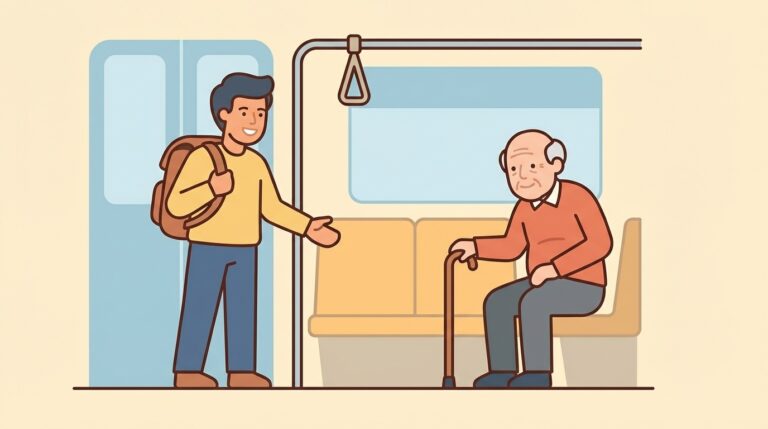
Picture this: You are riding the Seoul Subway Line 2 during rush hour. It’s packed, and you were lucky enough to grab a seat. Suddenly, a sweet-looking Korean grandmother carrying heavy grocery bags boards the train. You immediately want to give her your seat. You stand up, make eye contact, but… your mind goes blank. You end up just awkwardly pointing at the empty seat and smiling while she looks at you in confusion.
Has this happened to you? Don’t worry. This is a classic “foreigner panic” moment in Korea!
Offering your seat on public transit in Korea isn’t just about basic manners; it is a profound display of Jeong (정)—the Korean concept of unspoken warmth, connection, and collective care. If you know the right words and the cultural rhythm behind offering your seat, you won’t just be a polite tourist; you’ll instantly earn the “local insider” badge.
In this guide, built from the real struggles of my A2-level students, we will break down the exact phrases, the “push-and-pull” polite refusals, and the unspoken rules of the Korean subway. Let’s dive in!
Phase 2: Core Expressions Deep Dive
Here are the absolute must-know phrases when giving up your seat.
1. 여기 앉으세요 (Please sit here)
- Pronunciation: [yeo-gi an-jeu-se-yo] ‘yeo-gi’ sounds like ‘yogi’ (like the bear), and ‘an-jeu’ sounds like ‘ahn-juh’.
- Meaning: Sit here, please. (Literal: Here sit please)
- K-Culture Moment: This is the magic phrase. In K-Dramas, you’ll often see the handsome male lead smoothly stand up and say this to a tired student, instantly melting everyone’s hearts.
- Editor’s Insight: You don’t need a long, complicated sentence. Just stand up, gesture to the seat with an open hand, and say this with a warm smile.
- Situation Spectrum:
- Casual (Friends): 🚫 (Too polite, use “여기 앉아” instead)
- Semi-formal (Strangers/Elders): ✅
- Formal (Boss): ✅
- 🤔 Think About It: Why is it more natural to say “Sit here” rather than “Would you like my seat?” in Korean? Korean culture favors direct but polite action over hypothetical questions when showing Jeong.
2. 아니에요, 괜찮아요 (No, it’s okay)
- Pronunciation: [a-ni-e-yo, gwaen-chan-a-yo] ‘gwaen-chan-a-yo’ is the holy grail of Korean phrases, meaning “I’m fine” or “It’s okay.”
- Meaning: No, really, I’m fine.
- K-Culture Moment: When you offer your seat, the elderly person will almost always say this first. They will wave their hands and tell you to stay seated.
- Editor’s Insight: This is the “polite refusal.” They aren’t actually rejecting your offer; they just don’t want to feel like a burden to a young person. You must insist one more time!
- Situation Spectrum:
- Casual: ⚠️ (Use “아니야 괜찮아”)
- Semi-formal/Formal: ✅
- 🤔 Think About It: In your culture, if someone says “No, thank you,” do you ask again, or do you accept their first answer? In Korea, offering twice is the golden rule of Jeong.
3. 저 곧 내려요 (I’m getting off soon)
- Pronunciation: [jeo got nae-ryeo-yo] ‘got’ sounds like ‘goat’ without the ‘a’.
- Meaning: I am getting off (the train/bus) soon.
- K-Culture Moment: This is the ultimate “white lie” of Korean transit. Even if your stop is 10 stations away, saying this removes the guilt from the person taking your seat.
- Editor’s Insight: If an elder keeps refusing your seat because they feel bad, drop this line. They will instantly feel relieved and sit down. It’s a masterclass in Korean Nunchi (social tact).
- Situation Spectrum:
- Semi-formal/Formal (Strangers): ✅
Phase 3: Textbook vs. Real Korean
Let’s see how native speakers actually talk on the subway compared to what your grammar book says.
[Offering your seat]
* 📖 Textbook Korean: 제 자리에 앉으십시오. (Please sit in my seat.)
* 🗣️ Real Korean: (Standing up) 여기 앉으세요! (Please sit here!)
* 💡 Why the difference?: “~십시오” is incredibly formal, like a news anchor. In daily life, “~세요” is perfectly polite and much warmer.
[When they refuse, but you want to insist]
* 📖 Textbook Korean: 아닙니다. 당신이 앉으셔야 합니다. (No. You must sit.)
* 🗣️ Real Korean: 에이~ 아니에요. 앉으세요! (Ey~ No, it’s fine. Please sit!)
* 💡 Why the difference?: Adding a little “에이~ (Ey~)” softens the tone, making it sound friendly rather than aggressive. And NEVER use “당신” (you) to a stranger in real life!
Bottom Note: Keep it short and sweet. Actions (standing up) speak louder than perfect grammar here!
Phase 4: Cultural Context — K-Culture Deep Dive
4-1. Non-verbal Communication
When offering a seat, your body language is 80% of the message.
– The Open Palm: Never point at the empty seat with one finger. Gesture toward it with your whole hand, palm facing up.
– The Nunchi Game: Don’t stare intensely at the person. Stand up, make brief eye contact, gesture, and then slightly look away or step aside so they don’t feel pressured.
4-2. K-Travel Connection: The Hierarchy of Subway Seats
If you travel to Seoul, you must understand the geography of a subway car.
– 노약자석 (Priority Seating): Located at the very ends of every train car. These are strictly for the elderly, disabled, or injured. Survival Tip: Even if the train is 100% full and these seats are empty, young people do not sit there.
– 임산부 배려석 (Pink Seats for Pregnant Women): Usually located in the middle of the train cars. They are bright pink. While technically anyone can sit there and yield when a pregnant woman boards, the modern social rule is just to leave them empty.
Phase 5: Real-Life Role-play Scenario
Let’s put you in the hot seat.
- Setting: Wednesday, 6 PM. Seoul Subway Line 4. The train is packed with commuters heading home. You are sitting down, reading a webtoon on your phone.
- Characters:
- YOU: A foreign student who has been in Korea for 2 months.
- Grandpa (할아버지): An elderly Korean man holding a cane, looking a bit tired.
(🎭 Stage Direction: The train doors open. Grandpa walks in and stands near you. You make eye contact.)
YOU: (Standing up quickly and gesturing to the seat)
할아버지, 여기 앉으세요! 😊
(ha-ra-beo-ji, yeo-gi an-jeu-se-yo!)
[Grandpa, please sit here!]
Grandpa: (Waving his hands)
아유, 괜찮아. 학생 앉아.
(a-yu, gwaen-chan-a. hak-saeng an-ja.)
[Oh, it’s okay. Student, you sit.]
🔀 Your Turn! How do you respond?
– A) “아, 네! 감사합니다!” (Ah, yes! Thank you! – and sit back down)
– B) “아니에요, 저 곧 내려요. 앉으세요!” (No, I’m getting off soon. Please sit!)
– C) “왜요? 힘들어 보이시는데…” (Why? You look tired…)✅ Best Choice: B — By saying you are getting off soon (even if you aren’t), you remove the burden from him.
⚠️ Choice A Analysis: If you just sit right back down after one refusal, the Grandpa might secretly think you lack Jeong! It’s a cultural dance.
⚠️ Choice C Analysis: Pointing out that he looks tired can be a bit too direct and borderline impolite to an elder.
YOU: (Smiling and stepping back)
아니에요, 저 곧 내려요. 앉으세요!
(a-ni-e-yo, jeo got nae-ryeo-yo. an-jeu-se-yo!)
[No, I’m getting off soon. Please sit!]
Grandpa: (Sitting down with a relieved sigh)
아이고… 고마워요.
(a-i-go… go-ma-wo-yo.)
[Oh my… thank you.]
(🎭 Stage Direction: You grab a handrail and smile, feeling like a true Seoulite.)
Phase 6: 10-Second Shadowing Drill
Practice these lines out loud. Pay attention to the pauses (/) and the emotion!
😊 (Brightly, offering the seat)
여기 / 앉으세요!
(yeo-gi / an-jeu-se-yo!)
🥺 (Gently insisting)
아니에요 / 저 / 곧 내려요.
(a-ni-e-yo / jeo / got nae-ryeo-yo.)
Phase 7: K-Culture Mini Dictionary
| 한국어 | Romanization | English | Context |
|---|---|---|---|
| 양보 | yangbo | Yielding / Concession | The act of giving up your seat or place for someone else. |
| 노약자석 | noyakjaseok | Priority Seating | The seats at the ends of subway cars reserved for elders and the disabled. |
| 임산부 배려석 | imsanbu baeryeoseok | Pregnant Women Seat | The pink seats. ‘배려’ means consideration. |
| 정 | jeong | Affection / Bond | The deep emotional connection and care Koreans feel for one another. |
Phase 8: Traveler’s Survival Kit
Navigating Korean public transit? Keep these expressions handy!
🆘 Survival Expression #1: When navigating crowds
– 🇰🇷 “잠시만요!” (jam-si-man-yo!)
– 🗣️ Sound-alike: Jahm-shee-mahn-yo!
– 📍 Where to use: When you need to get off a crowded bus or subway.
– 💡 Pro Tip: Don’t just say “Excuse me” in English. Say “잠시만요” while gently sliding past people. They will part like the Red Sea!🆘 Survival Expression #2: Confirming your train
– 🇰🇷 “이거 명동 가나요?” (i-geo Myeong-dong ga-na-yo?)
– 📍 Where to use: Asking a local if the train goes to your destination.
📌 Editor’s Travel Note:
– Must-have App: KakaoMetro or Naver Map. Google Maps does not work well for walking/transit directions in Korea!
– T-Money Card: You can buy this transit card at any convenience store. You cannot tap your foreign credit card directly on the subway turnstiles in Korea.
Phase 9: Critical Thinking — “One Step Deeper”
Language & Power vs. Social Harmony
To Western eyes, the strict age hierarchy in Korea can seem rigid. Why must the young always yield to the old? However, if you look deeper into Jeong culture, this hierarchy is actually a system of mutual care. By giving up your seat to an elder, you are acknowledging their years of hard work for society. In return, elders often display Jeong by paying for younger people’s meals or, as you might see on buses, offering to hold your heavy backpack on their lap if you are standing. It’s an unspoken social contract: respect is exchanged for care.
💬 Your Turn: Does your culture have a strong tradition of giving up seats for elders? How do people usually react when offered a seat? Share in the comments!
Phase 10: FAQ & Common Mistakes
Q: Someone looks pregnant, but I’m not 100% sure. Should I offer my seat?
A: This is a global dilemma! In Korea, pregnant women can get a small pink badge for their bags from the government. If you see the badge, definitely offer. If you aren’t sure, the safest bet is just to stand up, pretend you are getting off soon, and walk away from the seat. Let them naturally take it!
Q: Can I offer to hold someone’s bag on the bus?
A: Yes! If you are sitting on a crowded bus and a student or elder is standing in front of you with a heavy bag, you can say, “가방 이리 주세요” (Give me your bag). It is a beautiful, very traditional Korean gesture!
❌ Common Mistake: Saying “당신 자리 여기예요” (Your seat is here).
✅ Do This Instead: “당신” (You) is considered rude when speaking to strangers. Completely drop the word “you” and just say “여기 앉으세요” (Please sit here).
Phase 11: Summary & Action Items
One-Liner Summary: To offer your seat like a local, just smile, gesture with an open hand, and say “여기 앉으세요!” (Please sit here!).
Action Mission:
– 🥉 Bronze (Solo): Stand in front of your mirror, do the open-palm gesture, and say “여기 앉으세요” three times.
– 🥈 Silver (Online): Watch a Seoul subway walking tour on YouTube and spot the Pink Seats (임산부 배려석) and Priority Seats (노약자석).
– 🥇 Gold (Real World): The next time you are on public transit—wherever you live—offer your seat to someone using the Korean “white lie” mindset (pretending you don’t mind standing) to show Jeong.
Phase 12: Interactive Quiz
1. You are on the subway and want to give your seat to an elderly woman. What is the most natural thing to say?
– A) 제 자리에 앉으십시오.
– B) 당신, 여기 앉으세요.
– C) 할머니, 여기 앉으세요!
2. True or False: If the train is completely packed, it is totally fine for a healthy 20-year-old to sit in the 노약자석 (Priority Seating at the ends of the train) as long as they get up when an elder boards.
3. Fill in the blank: The elderly man refused your seat because he felt bad. You want to politely insist by saying, “No, I’m getting off soon.”
“아니에요, 저 곧 ( ______ ).”
(Answers: 1. C / 2. False – young people generally leave these empty regardless of crowds / 3. 내려요)
Frequently Asked Questions (FAQ)
Q: What does "여기 앉으세요 (Please sit here)" mean in Korean and how do you pronounce it?
A: In Korean, "여기 앉으세요 (Please sit here)" is pronounced [yeo-gi an-jeu-se-yo] and means: Sit here, please. (Literal: Here sit please)
Q: What does "아니에요, 괜찮아요 (No, it's okay)" mean in Korean and how do you pronounce it?
A: In Korean, "아니에요, 괜찮아요 (No, it's okay)" is pronounced [a-ni-e-yo, gwaen-chan-a-yo] and means: No, really, I'm fine.
Q: What does "저 곧 내려요 (I'm getting off soon)" mean in Korean and how do you pronounce it?
A: In Korean, "저 곧 내려요 (I'm getting off soon)" is pronounced [jeo got nae-ryeo-yo] and means: I am getting off (the train/bus) soon.







