Phase 1: Empathy & K-Culture Cold Open
Hello! I’m your Daily Hangul Editor.
Picture this: You’ve just arrived in Korea. You’re thrilled. You’ve ordered your favorite K-Beauty skincare and the latest K-Pop albums from Coupang (Korea’s Amazon). The next day, you have a mountain of brown delivery boxes. You happily carry them down to the apartment basement and toss them into the recycling bin, feeling like a responsible global citizen.
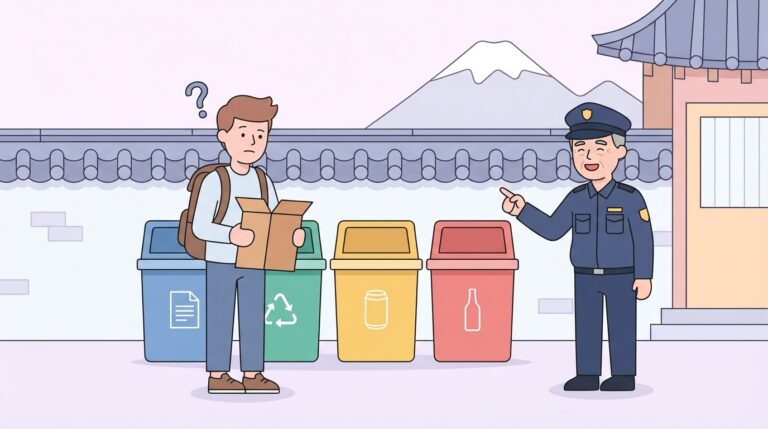
Suddenly, the Ajeossi (security guard) runs over, waving his hands and shouting something that sounds like “Bakseu!!!” You freeze. What did you do wrong? In your home country, throwing a box in the bin is enough. But in Korea? Oh, you just committed a major recycling faux pas.
Welcome to Bunlisugeo (분리수거)—Korea’s ultra-strict, highly organized recycling system. If you’re staying at an Airbnb or living in a Korean apartment, you must know how to flatten your cardboard boxes. If you don’t, you might become the talk of the building!
Don’t worry! Based on the panicked questions of hundreds of my foreign students, I’ve prepared this survival guide. Let’s learn the exact words you need to survive the Korean recycling area and earn an approving nod from the building manager.
Phase 2: Core Phrases Deep Dive
1. 박스 접어주세요. (Please flatten the box.)
- Pronunciation: [bak-seu jeo-beo-ju-se-yo] / Think: ‘box’, then ‘joe-bow-ju-say-yo’
- Meaning: (Literal) Please fold the box. / (Real Nuance) Flatten that cardboard right now!
- K-Culture Moment: You’ll hear this from convenience store clerks when they kindly ask you to flatten the box you brought your groceries in, or from the security guard at your apartment. On variety shows like I Live Alone, you constantly see celebrities meticulously stomping on boxes to flatten them before taking out the trash.
- Editor’s Insight: The word jeobeo means ‘fold’. In Korea, space is precious. An unflattened box takes up too much room in the communal bin, which is why people get so stressed about it!
- Situation Spectrum:
- Casual (To a friend helping you move): ✅ 박스 접어! (bakseu jeobeo!)
- Semi-formal (To an Airbnb host/security guard): ✅ 박스 접을까요? (bakseu jeobeulkkayo? – Should I flatten the box?)
- Formal (At a fancy office): ⚠️ 박스를 접어주시겠어요? (bakseureul jeobeojusigesseoyo?)
- 🤔 Think About It: Why does Korea care so much about saving space in the trash? Think about how dense cities like Seoul are. Does your country have strict rules about trash volume?
2. 테이프 떼세요. (Remove the tape.)
- Pronunciation: [te-i-peu tte-se-yo] / Think: ‘tape’, then ‘ttay-say-yo’
- Meaning: (Literal) Take off the tape. / (Real Nuance) Tape is plastic, not paper! Separate it!
- K-Culture Moment: You’re taking out the trash, and a kindly neighborhood Ajumma points at your box and clicks her tongue. She peels off a piece of clear packing tape you forgot to remove. In Korea, paper and plastic (tape/shipping labels) must be completely separated.
- Editor’s Insight: The ‘tte’ sound is strong! It sounds like you are peeling something off with force.
- Situation Spectrum:
- Casual: ✅ 테이프 떼 (teipeu tte)
- Formal/Polite: ✅ 테이프 떼세요 (teipeu tteseyo)
- 🤔 Think About It: Koreans even remove the plastic labels from water bottles before recycling. It requires a lot of personal effort for the public good.
3. 어디에 버려요? (Where do I throw this?)
- Pronunciation: [eo-di-e beo-ryeo-yo] / Think: ‘uh-dee-eh’, then ‘bow-ryo-yo’
- Meaning: (Literal) Where do I throw away? / (Real Nuance) I’m lost, please show me the right bin!
- K-Culture Moment: You’re standing in front of 7 different colored bins at your officetel. One says 종이 (Paper), another says 비닐 (Vinyl/Plastic wrap). You hold up your flattened box, look at a local with puppy-dog eyes, and ask this magical question.
- Editor’s Insight: This is the ultimate A1 survival phrase. You can use it for boxes, coffee cups, or anything you need to throw away.
- Situation Spectrum:
- Universal: ✅ (Safe for strangers, guards, and clerks!)
Phase 3: Textbook vs. Real Korean
[When asking about recycling rules]
* 📖 Textbook Korean: 재활용품은 어떻게 분리수거해야 합니까? (How should I separate the recyclables?)
* 🗣️ Real Korean: 이거 어디에 버려요? (Where do I throw this?)
* 💡 Why the difference?: Textbook Korean is too formal and long. In a busy trash area, people just point and give quick, efficient directions.
[When telling someone to flatten a box]
* 📖 Textbook Korean: 상자를 평평하게 만들어 주십시오. (Please make the box flat.)
* 🗣️ Real Korean: 박스 꾹꾹 밟으세요! (Stomp on the box!)
* 💡 Why the difference?: Koreans love using descriptive sound/action words like kkuk-kkuk (the sound of pressing down firmly). Plus, we usually just stomp on boxes to flatten them quickly!
Phase 4: Cultural Context — K-Culture Deep Dive
4-1. Non-Verbal Communication (Nunchi at the Trash Bin)
When you’re at the recycling station, use your Nunchi (눈치)—your ability to read the room. If you see locals breaking down boxes, taking off tape, and neatly stacking them, don’t just toss yours on top and run. Mirror their behavior. If the security guard is watching, make sure to make eye contact, bow slightly (a quick head nod), and show him that you are actively peeling the tape off. It shows respect for Korean community rules!
4-2. The K-Drama Trope: The “Sseul-se-gwon” Romance
In K-Dramas, the garbage disposal area is surprisingly… romantic? It’s a classic trope: the main characters live in the same apartment building. Late at night, wearing comfortable sweatpants, a hoodie, and their trusty “samseon” (three-striped) slippers, they bump into each other while taking out the trash and flattening boxes.
Critical View: While dramas make taking out the trash look like a cute opportunity for a midnight date, reality is a bit smellier and much more stressful if you don’t separate your plastics from your papers correctly!
Phase 5: Interactive Roleplay Scenario
Setting: Tuesday night, 9 PM. You are staying at an Airbnb in Mapo-gu, Seoul. You have three large Coupang boxes from your recent shopping spree. You carry them down to the basement recycling area (Bunlisugeo-jang).
Characters:
– YOU: A first-time traveler to Korea, trying to be a good guest.
– Ajeossi (60s): The building’s security guard. He is strict about the rules but has a warm heart if you try your best.
Dialogue:
YOU: (Tossing the unflattened boxes into the big paper bin and turning around to leave.)
Ajeossi: 학생! 학생! 잠깐만! ✋
(Haksaeng! Haksaeng! Jamkkanman!)
[Student! Student! Wait a minute!]
(🎭 Stage Direction: Ajeossi runs over, pointing at your boxes with a flashlight.)
YOU: 네? 무슨 일이에요? 😳
(Ne? Museun irieyo?)
[Yes? What’s the matter?]
Ajeossi: 박스 그냥 버리면 안 돼요! 박스 접어주세요.
(Bakseu geunyang beorimyeon an dwaeyo! Bakseu jeobeojuseyo.)
[You can’t just throw the boxes away! Please flatten the boxes.]
YOU: 아… 죄송해요. 제가 몰랐어요.
(A… joesonghaeyo. Jega mollasseoyo.)
[Oh… I’m sorry. I didn’t know.]
Ajeossi: 괜찮아요. 외국인이에요? 자, 여기 테이프 떼세요.
(Gwaenchanayo. Oeguginieyo? Ja, yeogi teipeu tteseyo.)
[It’s okay. Are you a foreigner? Here, take off the tape.]
YOU: 테이프요? 아, 플라스틱이라서요?
(Teipeuyo? A, peullaseutigiraseoyo?)
[The tape? Oh, because it’s plastic?]
Ajeossi: 맞아요. 그리고 박스는 발로 꾹꾹 밟아요.
(Majayo. Geurigo bakseuneun ballo kkukkkuk balbayo.)
[Right. And step on the boxes firmly with your feet.]
(🎭 Stage Direction: You peel off the tape and stomp on the boxes to make them completely flat.)
YOU: 이렇게요? 이제 어디에 버려요?
(Ireokeyo? Ije eodie beoryeoyo?)
[Like this? Where do I throw it now?]
Ajeossi: 저기 종이 칸에 넣으세요. 아이고, 잘하네!
(Jeogi jongi kane neoeuseyo. Aigo, jalhane!)
[Put it in the paper section over there. Oh my, you’re doing great!]
YOU: 감사합니다 아저씨! 안녕히 계세요~ 🙇♂️
(Gamsahamnida ajeossi! Annyeonghi gyeseyo~)
[Thank you, sir! Goodbye~]
🔀 Your Turn! Decision Point:
When the Ajeossi stops you and tells you to flatten the box, how should you react?
– A) “Why? It’s just a box.” (왜요? 그냥 박스잖아요.)
– B) “Oh, sorry! How do I do it?” (아, 죄송해요! 어떻게 해요?)
– C) Just run away back to your room.✅ Best Choice: B — Acknowledging the mistake and asking for help is the fastest way to win a Korean elder’s heart. They love teaching polite foreigners the ropes!
⚠️ Choice A Analysis: Arguing about community rules is highly frowned upon in Korea. It shows a lack of nunchi and respect for collective harmony.
Phase 6: 10-Second Shadowing Drill
Let’s practice the most important survival sentence! Follow the pacing marks (/) and try to mimic the emotion.
🥺 아저씨, / 박스 / 어디에 / 버려요?
(ajeossi, / bakseu / eodie / beoryeoyo?)
Excuse me sir, / the box / where / do I throw it?
Phase 7: K-Culture Mini Dictionary
| Korean | Romanization | English | Context |
|---|---|---|---|
| 분리수거 | bunlisugeo | Recycling / Trash Separation | Korea’s strict waste sorting system. A must-know word for anyone living in Korea! |
| 경비 아저씨 | gyeongbi ajeossi | Security Guard (Sir) | The unsung heroes of Korean apartments. They manage parking, packages, and… the trash area! |
| 종량제 봉투 | jongnyangje bongtu | Standardized Garbage Bag | You CANNOT throw regular trash in plastic grocery bags. You must buy these specific bags at the convenience store! |
| 택배 | taekbae | Delivery Service | Korea’s insanely fast delivery culture. It’s the reason you’ll have so many boxes to flatten! |
Phase 8: Traveler Survival Kit
Staying at an Airbnb in Seoul? You absolutely need these phrases when dealing with your trash!
🆘 Survival Phrases for the Trash Area
– 🇰🇷 “일반 쓰레기는 어디에 버려요?” (ilban sseuregineun eodie beoryeoyo?)
– 🗣️ Meaning: Where do I throw the general (non-recyclable) trash?
– 🇰🇷 “종량제 봉투 주세요.” (jongnyangje bongtu juseyo)
– 🗣️ Meaning: Please give me a standardized garbage bag. (Say this at the convenience store!)
– 🇰🇷 “이거 플라스틱이에요?” (igeo peullaseutigieyo?)
– 🗣️ Meaning: Is this plastic?📌 Editor’s Travel Note
– Trash Bags: Every district in Seoul (e.g., Gangnam, Hongdae/Mapo) has its own specific colored garbage bag. You must buy them at a local convenience store and use them for “general waste.”
– Food Waste: Food waste (음식물 쓰레기) is separated entirely! Do NOT put food inside your cardboard boxes!
Phase 9: Critical Thinking — “One Step Deeper”
Community vs. Individualism: Why is Korea so strict about trash?
🧠 Think Deeper:
When you are forced to peel tape off a cardboard box and stomp it flat in the freezing cold Korean winter, you might wonder, “Why am I doing this?” Korea’s Bunlisugeo system is a perfect reflection of Korean collectivism. Because the country is small, mountainous, and incredibly densely populated, waste management is a matter of national survival. It’s less about the individual’s convenience and more about everyone doing their small, slightly annoying part to keep the community functioning. When you flatten a box, you aren’t just saving space; you are actively participating in Korean society’s unspoken contract of mutual consideration.💬 Your Turn: How does your country handle recycling? Is it a collective community effort, or mostly handled by large machines after you throw it away? Share in the comments!
Phase 10: FAQ & Avoiding Mistakes
Q: “Can I just leave my boxes inside my Airbnb room when I check out?”
A: NO! Unless your host specifically told you it’s okay, leaving a mountain of unflattened trash is considered very rude in Korea. Always check the host’s instructions about Bunlisugeo.
Q: “Do I really need to remove the shipping label with my address on it?”
A: Yes! Not only because it’s usually made of non-recyclable sticker paper, but also for your own privacy. Koreans always rip off the Taekbae (delivery) labels to protect their personal information.
❌ Common Mistake #1: Throwing pizza boxes with grease and food stains into the paper recycling.
✅ Do This Instead: If paper/cardboard is heavily stained with food or grease, it is NO LONGER recyclable. It must go into the general waste bag (종량제 봉투).
Phase 11: Summary & Action Items
💡 One-Liner Summary: Always remove the tape and stomp your boxes flat before saying, “Ajeossi, 어디에 버려요?” (Where do I throw this?).
Action Mission 3 Steps:
– 🥉 Bronze (Solo): Grab an empty box at home, stomp on it, and confidently declare: “박스 접어주세요!” (bakseu jeobeojuseyo!)
– 🥈 Silver (Online): Comment below with the Korean word for ‘Recycling’ that you learned today!
– 🥇 Gold (Real-world): Next time you stay in Korea, buy a jongnyangje bongtu at the convenience store and successfully sort your trash without getting scolded by the security guard!
🎬 K-Culture Mission: Watch an episode of a Korean reality show like I Live Alone (나 혼자 산다) and spot the scene where they take out their delivery boxes. Notice how flat they make them!
Phase 12: Interactive Quiz
Q1. You are at the recycling area holding a box. The Ajeossi yells “테이프 떼세요!” (teipeu tteseyo!). What should you do?
A) Run away quickly.
B) Stomp on the box immediately.
C) Peel off the clear packing tape.
D) Ask him for more tape.
Q2. True or False – K-Culture Edition:
You can throw your leftover pizza (food waste) inside the flattened pizza box and put it in the paper recycling bin.
Q3. Fill in the Blank:
If you don’t know which bin to use, you should ask:
“이거 _________ 버려요?” (igeo _________ beoryeoyo?)
(Answers: Q1 – C, Q2 – False! Food waste must be separated and greasy boxes go to general trash, Q3 – 어디에)
Frequently Asked Questions (FAQ)
Q: What does "박스 접어주세요. (Please flatten the box.)" mean in Korean and how do you pronounce it?
A: In Korean, "박스 접어주세요. (Please flatten the box.)" is pronounced [bak-seu jeo-beo-ju-se-yo] and means: (Literal) Please fold the box. / (Real Nuance) Flatten that cardboard right now!
Q: What does "테이프 떼세요. (Remove the tape.)" mean in Korean and how do you pronounce it?
A: In Korean, "테이프 떼세요. (Remove the tape.)" is pronounced [te-i-peu tte-se-yo] and means: (Literal) Take off the tape. / (Real Nuance) Tape is plastic, not paper! Separate it!
Q: What does "어디에 버려요? (Where do I throw this?)" mean in Korean and how do you pronounce it?
A: In Korean, "어디에 버려요? (Where do I throw this?)" is pronounced [eo-di-e beo-ryeo-yo] and means: (Literal) Where do I throw away? / (Real Nuance) I'm lost, please show me the right bin!