

Phase 1: Empathy (Immersive Open)
Hello, language enthusiasts! This is your Lead Editor at Daily Hangul.
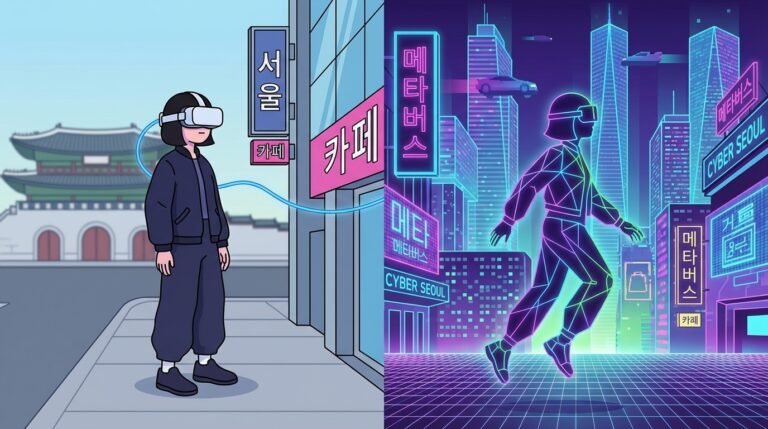
Imagine this: You are at a sleek, neon-lit PC Bang (PC방) in the heart of Gangnam at 10 PM. You’re not just playing a simple MMORPG; you are attending a virtual BLACKPINK concert alongside millions of other avatars, or perhaps you’re negotiating a piece of digital real estate on a metaverse platform. You hear a Korean gamer next to you say, “아, 내 부캐 구찌 입히려고 또 현질했네.” The subtitles in your brain might translate this as “Ah, I spent money again to dress my alt character in Gucci.”
But is that really all there is to it? For advanced (C2) learners, translating the words isn’t enough; you need to decode the socio-cultural shift. South Korea is at the bleeding edge of the gaming industry merging with the metaverse. The boundaries between who we are offline and who we are online are rapidly dissolving. If you don’t grasp the nuanced vocabulary of this digital frontier, you’re missing out on a massive chunk of modern Korean discourse.
This guide is crafted from real late-night discussions with Korean tech developers, hardcore gamers, and K-Pop fans navigating this new universe. Let’s dive into the language of Korea’s digital revolution!
Phase 2: Core Expressions Deep Dive
1. 부캐 (bu-kae) & 본캐 (bon-kae)
- Pronunciation: [boo-kae] / [bon-kae] (Think of ‘boo’ like a ghost, and ‘kae’ like the start of ‘cat’. ‘Bon’ sounds like ‘bone’.)
- Meaning: Literal: Secondary Character / Main Character. Real nuance: Your alternate persona (Metaverse/Online self) vs. Your real, everyday identity.
- K-Culture Moment: This gaming terminology has completely infiltrated mainstream Korean media. You’ll see top celebrities debuting under a “부캐” (an alter ego) to perform different genres of music without damaging their “본캐” image. In the metaverse, your 부캐 isn’t just an avatar; it’s a legitimate extension of your identity.
- Editor’s Insight: At a C2 level, you should use this to describe societal phenomena. It’s not just for gaming anymore; people use it to describe their weekend hobbies versus their corporate jobs.
- Situation Spectrum:
- Casual (Close friends): ✅
- Semi-formal (Tech/Marketing colleagues): ✅
- Formal (Traditional corporate bosses): ⚠️ (May require context)
- 🤔 Think About It: Why has Korean society embraced the concept of “부캐” so enthusiastically? Could it be a psychological escape from the rigid expectations and “눈치” (nunchi) required of their “본캐” in real-world society?
2. 현질하다 (hyeon-jil-ha-da)
- Pronunciation: [hyuhn-jeel-ha-da] (hyuhn rhymes with ‘bun’, jeel sounds like ‘Jill’)
- Meaning: Literal: To do a cash action. Real nuance: To spend real-world fiat currency on virtual goods or in-game microtransactions.
- K-Culture Moment: In a K-Drama featuring a tech startup, the CEO might look at their metaverse platform’s revenue and say, “유저들이 자발적으로 현질하게 만들어야지!” (We need to make users voluntarily spend real cash!).
- Editor’s Insight: Originally a slightly derogatory slang term among gamers, it has now become standard vernacular in discussing the digital economy, virtual real estate, and digital fashion (like buying a digital Dior bag for your Zepeto avatar).
- Situation Spectrum:
- Casual (Close friends): ✅
- Semi-formal (Co-workers): ⚠️ (Acceptable in tech/gaming sectors)
- Formal (Elders/Bosses): 🚫
- 🤔 Think About It: As the metaverse economy grows, “현질” is transforming from “wasting money on a game” to “investing in digital assets.” How does language evolve to legitimize new economic behaviors?
3. 세계관에 과몰입하다 (se-gye-gwan-e gwa-mol-ip-ha-da)
- Pronunciation: [seh-gyeh-gwan-eh gwa-mo-reep-ha-da]
- Meaning: Literal: To become over-immersed in a worldview. Real nuance: To deeply engage with and buy into the fictional universe or lore of a game, idol group, or metaverse.
- K-Culture Moment: This is the absolute core of modern K-Pop (think aespa’s Kwangya) and K-Gaming. Fans don’t just consume music or play levels; they analyze the lore. If someone is acting exactly like their avatar in a virtual meeting, a coworker might laugh and say, “세계관에 너무 과몰입하신 거 아니에요?” (Aren’t you a bit too immersed in the universe?).
- Editor’s Insight: “과몰입” is a trendy, high-level vocabulary word used to describe intense passion or empathy. It can be used playfully or analytically.
- Situation Spectrum:
- Casual (Close friends): ✅
- Semi-formal (Co-workers): ✅
- Formal (Elders/Bosses): ⚠️
- 🤔 Think About It: Does “과몰입” blur the line between reality and fiction too much, or is it the ultimate form of modern digital entertainment?
Phase 3: Textbook vs. Real Korean
[Situation 1: Describing a virtual space to a colleague]
* 📖 Textbook: 저는 요새 가상 현실 세계에서 시간을 많이 보냅니다. (I spend a lot of time in the virtual reality world lately.)
* 🗣️ Real Korean: 요즘 제 본캐보다 메타버스 부캐 삶이 더 바빠요. (Lately, my metaverse alt’s life is busier than my main character’s.)
* 💡 Why the difference?: The real Korean version reflects the modern philosophical shift where the virtual avatar (부캐) is treated as a living, breathing schedule, rather than just a “game” you play.
[Situation 2: Reacting to someone spending money on digital fashion]
* 📖 Textbook: 게임 옷을 사기 위해 돈을 썼군요. (You spent money to buy game clothes.)
* 🗣️ Real Korean: 아바타한테 명품 입히려고 시원하게 현질하셨네요! (You coolly dropped cash to dress your avatar in luxury goods!)
* 💡 Why the difference?: “시원하게 현질하다” implies spending money boldly and without hesitation, capturing the casual yet highly monetized nature of the metaverse.
Bottom Note: At the
C2level, sounding native isn’t about using the most complex grammar; it’s about using the exact cultural idiom that fits the zeitgeist of the industry.
Phase 4: Cultural Context — K-Culture Deep Dive
4-1. Non-Verbal Elements: Virtual ‘Nunchi’ (눈치)
Even when the boundary between the metaverse and gaming blurs, Korean social hierarchy remains surprisingly resilient. When interacting in virtual spaces (like a company meeting in Gather Town or a VR Chat room), Koreans will still use their avatars to bow. The concept of 눈치 (Nunchi – reading the room) applies even in pixels. If a senior manager’s avatar enters the virtual room, the younger employees’ avatars will immediately stop dancing or running around and use the “respectful bow” emote. The technology changes, but the cultural DNA remains.
4-2. K-Culture Connections: K-Pop & Digital Idols
The gaming and metaverse fusion is nowhere more evident than in K-Pop. Consider groups like aespa, who have digital avatar counterparts (ae-aespa), or virtual-only idol groups like MAVE:.
- The Critical View: This creates a fascinating linguistic paradox. Fans interact with AI or digital avatars using deeply affectionate, real-world Korean honorifics and slang. Fans will write, “우리 애들 너무 고생했어” (Our kids worked so hard) to a group of pixels. It forces us to ask: If the emotional connection is real, does it matter that the entity is virtual? This blurs the line between playing a game and experiencing a parasocial relationship.
Phase 5: Real-Life Roleplay Scenario
Setting: Friday afternoon, 3 PM. You are at a sleek tech-hub cafe in Seongsu-dong (성수동) with Min-su, a Lead Developer for a major Korean gaming company. You are discussing the beta launch of their new metaverse platform over iced Americanos.
Characters:
– YOU: A foreign tech consultant who understands both the Western and Korean tech landscapes. (Fluent, C2 level).
– Min-su (34): Lead Developer. Passionate, uses a lot of industry slang, treats you like a respected peer.
Dialogue:
Min-su: 이번 메타버스 플랫폼 테스트 해보셨어요? 반응이 꽤 괜찮더라고요.
(Ibeon metabuseu peullaetpom teseuteu haebosyeosseoyo? Baneung-i kkoae gwaenchan-teoragoyo.)
[Did you try the metaverse platform test this time? The response has been pretty good.]
YOU: 네, 해봤어요. 특히 아바타 커스터마이징이 완전 디테일하던데요?
(Ne, haebwasseoyo. Teukhi abata keoseuteomaijing-i wanjeon diteilhadeondeyo?)
[Yes, I tried it. The avatar customizing, in particular, was incredibly detailed.]
Min-su: 맞아요. 유저들이 자기 ‘부캐’에 얼마나 진심인지 아니까, 그 부분에 투자를 많이 했죠.
(Majayo. Yujeodeul-i jagi ‘bukae’e eolmana jinsiminji anikka, geu bubun-e tujareul mani haetjyo.)
[Exactly. We know how sincere users are about their ‘alt characters,’ so we invested a lot in that part.]
YOU: 경제 시스템도 흥미롭더라고요. 가상 부동산 거래가 활발하던데.
(Gyeongje siseutemdo heungmiropdeoragoyo. Gasang budongsan georaega hwalbalhadeonde.)
[The economic system was interesting too. Virtual real estate transactions were quite active.]
Min-su: (Laughs) 네, 유저들이 게임 퀘스트는 안 하고 땅 사려고 벌써부터 엄청 현질하고 난리도 아니에요.
(Ne, yujeodeul-i geim kweseuteuneun an hago ttang saryeogo beolsseobuteo eomcheong hyeonjilhago nanrido anieyo.)
[Yeah, users aren’t even doing the game quests; they’re already going crazy spending real cash to buy land.]
🔀 Your Turn! How should you respond to Min-su?
– A) “게임에 돈을 너무 많이 쓰는 건 위험합니다.” (Spending too much money on games is dangerous. – Too dry and textbook.)
– B) “저도 좋은 자리 하나 잡으려고 과몰입 중이에요!” (I’m over-immersing myself to grab a good spot too! – Witty, shows high-level cultural understanding.)
– C) “대박! 현질 최고!” (Awesome! Cash spending is the best! – Too casual for a professional tech discussion.)✅ Best Choice: B — Reason: Using the term “과몰입 중이에요” (I am currently over-immersing) jokingly shows that you completely understand the psychological draw of the metaverse. It builds incredible rapport with a Korean tech professional.
Min-su: (Laughing out loud) 아, 진짜요? 나중에 저희 메타버스 안에서 이웃사촌 하는 거 아닙니까?
(A, jinjjayo? Najung-e jeohui metabuseu aneseo iutsachon haneun geo animnikka?)
[Ah, really? Aren’t we going to end up being neighbors inside our metaverse later?]
(🎭 Stage Direction: Min-su takes a sip of his coffee, visibly impressed by your grasp of the culture.)
Phase 6: 10-Second Shadowing Drill
Master the rhythm and intonation of this advanced sentence. Pay attention to the pauses (/)!
😤 단호하게 (Firmly/Analytically)
요즘은 / 단순한 게임을 넘어서, / 가상현실 속 부캐의 삶이 / 경제적 가치를 창출하는 시대입니다.
(Yojeumeun / dansunhan geimeul neomeoseo, / gasanghyeonsil sok bukae-ui salmi / gyeongjejeok gachireul changchulhaneun sidaeeumnida.)
[Nowadays, moving beyond simple games, it is an era where the life of an alt-character in virtual reality generates economic value.]
Phase 7: K-Culture Mini Dictionary (Metaverse Edition)
| 한국어 | Romanization | English | 맥락 설명 (Context) |
|---|---|---|---|
| 본캐 | bonkae | Main Character | One’s true, real-life identity or primary occupation. |
| 부캐 | bukae | Alt Character | An alter ego, side hustle, or metaverse avatar. |
| 현질 | hyeonjil | Microtransactions / Pay-to-win | Spending real fiat currency on digital/virtual assets. |
| 과몰입 | gwamorip | Over-immersion | Being deeply invested in a fictional lore or digital universe. |
| 세계관 | segyegwan | Universe / Lore | The fictional background and rules governing a game or idol group. |
| 눈치 | nunchi | Social situational awareness | The ability to read the room, applied even to virtual avatar behavior. |
Phase 8: Traveler Survival Kit (Digital & Reality Edition)
For a C2 learner visiting Korea to experience its world-class gaming and tech infrastructure, you’ll likely visit a premium PC Bang (like T1 Base Camp) or VR Cafe.
🆘 Survival Expressions for High-End PC Bangs
– 🇰🇷 “회원가입은 어디 키오스크에서 하나요?” (hoewongaipeun eodi kioseukeueseo hanayo?)
– 🗣️ English: “Which kiosk do I use to sign up for a membership?”
– 📍 Where to use: PC Bang entrances.
– 💡 Pro Tip: Korean PC Bangs require you to create an account at a machine before sitting down. You top up your time (시간 충전) with a card or cash.
- 🇰🇷 “자리에서 음식 주문해도 되죠?” (jarieseo eumsik jumunhaedo doejyo?)
- 🗣️ English: “I can order food from my seat, right?”
- 💡 Pro Tip: Modern PC Bangs are essentially gourmet restaurants. You order everything via the PC interface, and it’s delivered straight to your desk!
📌 Editor’s Travel Note
– App to Download: If you want to see the Korean metaverse in action, download ZEPETO before you arrive. It’s heavily used by Gen Z in Korea to visit virtual pop-up stores of real Korean brands.
– Tech Etiquette: Even in a loud PC Bang, taking business calls or yelling excessively on voice chat (unless in a designated soundproof room) is considered bad nunchi.
Phase 9: Critical Thinking — “한 발 더 깊이” (Think Deeper)
Media vs Reality: The Psychology of the ‘Bu-Kae’ (부캐)
Why is South Korea the epicenter of the metaverse and digital avatars? From an analytical standpoint, it’s deeply tied to the immense societal pressure of real life. In Korea, your “본캐” (Main Character) is bound by strict hierarchical rules based on age, job title, and societal expectations. You must use honorifics, bow to seniors, and constantly exercise nunchi.
However, in the metaverse, behind the mask of a “부캐”, these rules are temporarily suspended. A junior office worker can become a wealthy digital real estate tycoon or a flamboyant virtual idol, communicating freely without the heavy burden of real-world status. The metaverse isn’t just a technological advancement in Korea; it is a profound socio-cultural pressure valve.
💬 Your Turn: Does your culture have a strict division between an “offline self” and an “online persona”? Do you feel freer when interacting through an avatar? Share your thoughts in the comments using advanced Korean phrasing!
Phase 10: FAQ & Avoiding Faux Pas
Q: “If I meet someone in a Korean metaverse game, can I use 반말 (casual language) since we are avatars?”
– Maybe, but be careful. While the metaverse is more relaxed, Koreans usually stick to 존댓말 (polite language) when meeting a stranger’s avatar for the first time. They will explicitly agree to drop the honorifics by asking, “말 편하게 해도 될까요?” (May I speak comfortably?). Assuming casual speech too early can still be considered rude, even in VR!
Q: “Is ‘현질’ considered a bad word?”
– Yes and No. Ten years ago, it meant you were cheating or wasting money. Today, in tech and gaming, it’s a standard term for digital monetization. However, avoid using it in highly formal corporate presentations (use “인앱 결제” – In-app purchase – instead).
❌ Common Mistake #1: Treating “Metaverse” simply as “Playing a game” (게임을 하다).
✅ Do This Instead: At a C2 level, express it as participating in a digital ecosystem. Use verbs like “가상 세계에 참여하다” (participate in the virtual world) or “메타버스에 접속하다” (connect to the metaverse).
Phase 11: Summary & Action Items
One-Liner Summary: To master Korea’s digital discourse, you must understand that the line between gaming and reality has vanished; your avatar (부캐) and your digital spending (현질) are now legitimate extensions of real-world identity and economy.
Action Mission:
– 🥉 Bronze: Say the words “본캐” and “부캐” out loud, associating them with your job vs. your hobby.
– 🥈 Silver: Leave a comment on a Korean YouTube video about gaming or tech, using the word “과몰입” (e.g., “저도 이 게임 세계관에 과몰입 중입니다!”).
– 🥇 Gold (Real Life): Next time you discuss tech or gaming with a Korean friend, ask them: “요새 키우는 부캐 있어요?” (Do you have an alt-character you’re raising lately?).
K-Culture Special Mission: Download a Korean metaverse app (like Zepeto or ifland) and observe how Korean users interact. Pay attention to how polite language is used even between cartoon avatars!
Phase 12: Quiz — Interactive Challenge
1. Situational Judgment: You are presenting a marketing strategy to a Korean gaming company. You want to explain that users are spending heavily on avatar clothing. Which sentence is the most appropriate for this formal setting?
– A) 유저들이 옷에 현질을 미친듯이 합니다.
– B) 유저들의 가상 아바타 꾸미기 관련 인앱 결제가 증가하고 있습니다.
– C) 부캐한테 돈을 많이 쓰네요.
Toggle for Answer:
Answer: B. Since it’s a formal presentation, the slang “현질” (A) or “부캐” (C) might be too casual depending on the board members. “인앱 결제” (In-app purchase) is the safest professional term, even though A and C are what they say at the dinner after the meeting!
2. True or False – K-Culture Edition:
“In Korean virtual spaces, users completely ignore age and status, and nobody uses polite language (존댓말).”
Toggle for Answer:
False. While it offers more anonymity, the ingrained culture of polite language (존댓말) is still the default for strangers meeting in Korean metaverse spaces until they mutually agree to speak casually.
How did you do? Welcome to the future of Korean language. Until next time, keep leveling up your “부캐” at Daily Hangul! 😊
Frequently Asked Questions (FAQ)
Q: What does "부캐 (bu-kae) & 본캐 (bon-kae)" mean in Korean and how do you pronounce it?
A: In Korean, "부캐 (bu-kae) & 본캐 (bon-kae)" is pronounced [boo-kae] and means: Literal: Secondary Character / Main Character. Real nuance: Your alternate persona (Metaverse/Online self) vs. Your real, everyday identity.
Q: What does "현질하다 (hyeon-jil-ha-da)" mean in Korean and how do you pronounce it?
A: In Korean, "현질하다 (hyeon-jil-ha-da)" is pronounced [hyuhn-jeel-ha-da] and means: Literal: To do a cash action. Real nuance: To spend real-world fiat currency on virtual goods or in-game microtransactions.
Q: What does "세계관에 과몰입하다 (se-gye-gwan-e gwa-mol-ip-ha-da)" mean in Korean and how do you pronounce it?
A: In Korean, "세계관에 과몰입하다 (se-gye-gwan-e gwa-mol-ip-ha-da)" is pronounced [seh-gyeh-gwan-eh gwa-mo-reep-ha-da] and means: Literal: To become over-immersed in a worldview. Real nuance: To deeply engage with and buy into the fictional universe or lore of a game, idol group, or metaverse.






