

Phase 1: Empathy & K-Culture Cold Open
Hello! I’m the lead editor of Daily Hangul, your veteran tutor and local cultural navigator.
Picture this K-Drama scene: The male lead waits under a streetlamp, holding a beautiful bouquet of flowers. The camera zooms in, and… wait, are those dried flowers? Yes! In Korea, giving flowers isn’t just for Valentine’s Day. It’s a huge part of the dating culture, celebrating “100 Days,” “Rose Day,” or just a random Friday.
But fresh flowers die quickly. That’s why dried flowers (and preserved flowers) have become incredibly popular in Korea. They perfectly match that cozy, vintage “K-Cafe aesthetic” and last for months!
Imagine walking into a trendy flower shop in Yeonnam-dong. You want to buy a beautiful dried flower bouquet for your friend, your partner, or even just to decorate your Airbnb. You walk in, the shop owner smiles at you, and suddenly… your mind goes blank.
Don’t worry! Today, we are going to learn exactly how to ask for dried flowers in a Korean flower shop, naturally and confidently, just like a local. This guide is based on real questions from beginners (A2 level) who wanted to survive the Korean flower shops!
Phase 2: Core Expressions Deep Dive
Here are the 3 magic phrases you need to survive a Korean flower shop.
1. 드라이 플라워 있어요?
- Pronunciation: deurayi peullau-eo isseoyo? [Sound-alike: dry flow-er ees-so-yo?]
- Meaning: Do you have dried flowers?
- K-Culture Moment: You walk into a flower shop. Instead of looking around awkwardly, you make eye contact with the florist and ask this. It instantly shows you know exactly what you want.
- Editor’s Insight: Yes, it’s Konglish (Korean English)! While there is a native word (말린 꽃), 99% of modern flower shops use the English term “드라이 플라워.”
- Situation Spectrum:
- Casual (Friends): ✅ (있어?)
- Semi-formal (Clerks): ✅ (있어요?)
- Formal (Boss/Elders): ⚠️ (Add “사장님” – Boss – at the beginning)
- 🤔 Think About It: Why do Koreans use so many English words for lifestyle trends? Does your language borrow English words for trendy items too?
2. 오래가는 꽃 추천해 주세요.
- Pronunciation: ore-ganeun kko-cheu-ro juseyo. [Sound-alike: oh-ray-ga-neun kkot-cheu-ro joo-say-yo.]
- Meaning: Literal: “Give me flowers that go a long time.” / Real nuance: “Please recommend long-lasting flowers.”
- K-Culture Moment: You want flowers, but you don’t want them to die before you fly back home. This is the perfect phrase to ask the florist to use their expertise.
- Editor’s Insight: Koreans love practicality combined with beauty. “추천해 주세요” (Please recommend) is a lifesaver phrase you can use in cafes, restaurants, and shops!
- Situation Spectrum:
- Casual (Friends): 🚫 (A friend wouldn’t sell you flowers)
- Semi-formal (Clerks): ✅
- Formal (Boss/Elders): ✅
- 🤔 Think About It: Koreans love asking experts for “추천” (recommendations). Why do you think trusting the owner’s choice is so common in Korea?
3. 예쁘게 포장해 주세요.
- Pronunciation: yeppeuge pojang-he juseyo. [Sound-alike: yep-peu-ge po-jang-hay joo-say-yo.]
- Meaning: Please wrap it beautifully.
- K-Culture Moment: In K-Dramas, even a single rose is wrapped in beautiful, crisp paper with a ribbon. Packaging (포장) is a huge deal in Korea!
- Editor’s Insight: Never skip this step! If you just buy the flowers, they might just wrap it in a simple newspaper or plastic. By saying this, they will make it Instagram-ready.
- Situation Spectrum:
- Casual: 🚫
- Semi-formal (Clerks): ✅
- Formal: 🚫
- 🤔 Think About It: Why is “wrapping” (포장) considered just as important as the gift itself in Korean culture?
Phase 3: Textbook vs Real Korean
Let’s see how real Koreans speak compared to a textbook.
[Looking for Dried Flowers]
* 📖 Textbook Korean: 건조된 꽃을 판매합니까? (Do you sell dried flowers? – Very robotic)
* 🗣️ Real Korean: 사장님, 혹시 드라이 플라워 있어요? (Boss, by any chance, do you have dried flowers?)
* 💡 Why the difference?: “혹시” (by any chance) is a magical softening word Koreans use to sound polite and less demanding. Also, “사장님” (Boss) is the universal polite way to call a shop owner!
[Asking for a Recommendation]
* 📖 Textbook Korean: 어떤 꽃이 좋습니까? (Which flower is good?)
* 🗣️ Real Korean: 선물할 건데, 알아서 예쁘게 해 주세요. (It’s for a gift, please make it pretty however you see fit.)
* 💡 Why the difference?: “알아서 해 주세요” (Please take care of it / do as you see fit) shows absolute trust in the florist’s artistic skills.
Phase 4: Cultural Context — K-Culture Deep Dive
4-1. Non-verbal Nunchi (눈치) in Flower Shops
When buying dried flowers in Korea, there is one major rule: Do NOT touch them! Dried flowers are extremely fragile. Instead of picking them up to inspect them, gently point at them and ask the florist. Using your “Nunchi” (social sense) here will make the shop owner love you.
4-2. The K-Romance Connection: Anniversary Culture
Why are flower shops everywhere in Seoul? Because of the intense Anniversary Culture (기념일)! Couples celebrate 100 days, 200 days, 300 days, and 1 year. There’s also “Rose Day” (May 14th) and “Pepero Day” (Nov 11th). Giving dried flowers is popular because they symbolize “unchanging, everlasting love.” In many romantic K-Dramas, the male lead gives dried flowers so the female lead can keep them in her room forever as a memory.
Phase 5: Real-Life Roleplay Scenario
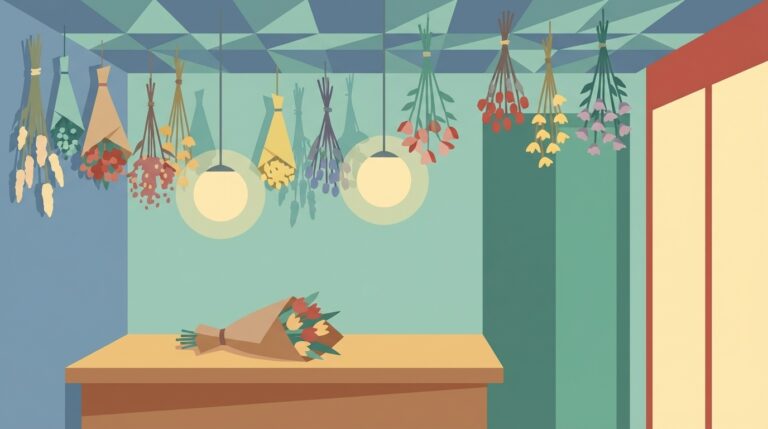
Setting: It’s Friday, 5 PM. You are in Yeonnam-dong (Hongdae). You walk into a beautifully lit flower shop that smells like eucalyptus. The walls are covered in colorful dried flowers.
Characters:
– YOU: A traveler looking for a gift to take back to your Airbnb.
– Florist (사장님): A friendly local florist in her 30s.
Dialogue:
Florist: 어서 오세요~ 찾으시는 거 있으세요? 🌸
(eoseo oseyo~ chajeusineun geo isseuseyo?)
[Welcome~ Are you looking for anything specific?]
(🎭 Stage Direction: The florist is trimming some fresh roses but looks up with a smile.)
YOU: 안녕하세요. 혹시 드라이 플라워 있어요?
(annyeonghaseyo. hoksi deurayi peullau-eo isseoyo?)
[Hello. By any chance, do you have dried flowers?]
Florist: 네, 저쪽 벽에 있는 게 다 드라이 플라워예요.
(ne, jeojjok byeoge inneun ge da deurayi peullau-eoyeyo.)
[Yes, everything on that wall over there are dried flowers.]
YOU: 우와, 다 예쁘네요! 오래가는 꽃 추천해 주세요.
(uwa, da yeppeuneyo! ore-ganeun kkot chucheonhe juseyo.)
[Wow, they are all pretty! Please recommend long-lasting flowers.]
Florist: 그럼 이 안개꽃은 어때요? 색깔도 안 변하고 오래가요.
(geureom i an-gekkocheun eotteyo? sekkaldo an byeonhago ore-gayo.)
[Then how about this baby’s breath? The color doesn’t change and it lasts a long time.]
🔀 Your Turn! How should you respond?
– A) 싫어요. 다른 거 주세요. (I hate it. Give me something else.)
– B) 아, 좋네요! 그걸로 주세요. (Ah, it’s nice! I’ll take that one.)
– C) 이거 얼마 깎아줄 수 있어요? (How much can you discount this?)✅ Best Choice: B — “그걸로 주세요” (I’ll take that one) is the most natural and polite way to accept a recommendation.
⚠️ Choice A & C Analysis: Choice A is incredibly rude. If you don’t like it, you should say “다른 꽃도 볼 수 있을까요?” (Could I see other flowers?). Choice C is bad Nunchi; you generally do not haggle in trendy boutique shops!
YOU: 아, 좋네요! 그걸로 주세요. 예쁘게 포장해 주세요!
(a, jonneyo! geugeollo juseyo. yeppeuge pojang-he juseyo!)
[Ah, it’s nice! I’ll take that one. Please wrap it beautifully!]
Florist: 네, 선물용이세요?
(ne, seonmul-yong-iseyo?)
[Yes, is it for a gift?]
YOU: 네, 친구한테 줄 거예요.
(ne, chin-gu-hante jul geoyeyo.)
[Yes, I will give it to a friend.]
Florist: 알겠습니다. 금방 해 드릴게요~
(algesseumnida. geumbang he deurilgeyo~)
[Understood. I’ll get it done right away~]
Phase 6: 10-Second Shadowing Drill
Let’s practice! Follow the intonation marks (/) and match the emotion.
😊 밝게 (Brightly): 사장님, / 혹시 / 드라이 플라워 / 있어요?
(sajangnim, / hoksi / deurayi peullau-eo / isseoyo?)
🥺 부탁하며 (Politely requesting): 선물할 건데, / 예쁘게 / 포장해 주세요!
(seonmulhal geonde, / yeppeuge / pojang-he juseyo!)
Phase 7: K-Culture Mini Dictionary
| Korean | Romanization | English | Cultural Context |
|---|---|---|---|
| 사장님 | sajangnim | Boss / Shop Owner | The most common, polite way to call staff in a small shop or restaurant. |
| 포장 | pojang | Wrapping / Takeout | Koreans love pretty wrapping for gifts. In food, it means “to-go.” |
| 기념일 | ginyeomil | Anniversary | Couples celebrate every 100 days. Flower shops thrive on these days! |
| 안개꽃 | an-gekkot | Baby’s Breath | A very popular flower in Korea to dry and dye into pastel colors. |
| 썸 | sseom | Talking / Fling stage | The ambiguous stage before dating. Giving small dried flowers during “sseom” is very cute! |
Phase 8: Traveler’s Survival Kit
Are you traveling to Seoul? Here is your survival kit for shopping!
🆘 Survival Phrases TOP 3
1. 🇰🇷 “이거 얼마예요?” (igeo eolmayeyo?) – How much is this?
2. 🇰🇷 “카드로 계산할게요.” (kadeuro gyesanhalgeyo.) – I will pay by card.
3. 🇰🇷 “영수증은 버려주세요.” (yeongsujeung-eun beoryeojuseyo.) – Please throw away the receipt.💡 Pro Tip: If you can’t understand the price they say, just hand them your phone with the calculator app open. They will type the price for you!
📌 Editor’s Travel Note
– Finding a flower shop: Open KakaoMap or Naver Map and search for “꽃집” (kkot-jip).
– Cash vs Card: Korea is a cashless society! 99.9% of places, including small flower shops, prefer credit cards.
– Tipping: There is absolutely NO tipping culture in Korea. If you try to tip the florist for a beautiful wrap job, they will run out of the store to give your money back!
Phase 9: Critical Thinking Corner — “한 발 더 깊이”
🧠 Think Deeper: Korean in the Global Era (언어와 글로벌화)
Why do Koreans say “드라이 플라워” (Dry Flower) instead of the perfectly good Korean phrase “말린 꽃” (Dried flower)? As Korea rapidly modernized and embraced global cafe and boutique cultures, English words (Konglish) became associated with being “trendy,” “modern,” and “aesthetic.” A traditional herbalist might sell “말린 약초” (dried herbs), but a hipster florist in Hongdae sells “드라이 플라워.” This shows how language adapts to create a specific cultural vibe.
💬 Your Turn: Does your native language use English words to make things sound more “trendy” or “modern”? Share your thoughts in the comments!
Phase 10: FAQ & Mistake Prevention
Q1. Can I use “주세요” (give me) to older people? Isn’t it too demanding?
Yes, you can! In Korean, adding “~아/어 주세요” makes it a polite request. It means “Please do this for me.” It is perfectly polite to use with shop owners!
Q2. Should I bow when entering a flower shop?
A slight head nod while saying “안녕하세요” (Hello) is perfect. You don’t need a full 90-degree bow.
❌ Common Mistake #1: Picking up the dried flowers to smell them.
✅ Do this instead: Dried flowers often have no scent, and they easily crumble. Point with your finger or whole hand and say “이거요” (This one).❌ Common Mistake #2: Calling the florist “당신” (You).
✅ Do this instead: Never use “당신”! Always say “사장님” (Boss/Owner).
Phase 11: Summary & Action Items
- One-Liner Summary: Use “드라이 플라워 있어요?” to check for dried flowers, and always ask them to “예쁘게 포장해 주세요” for that perfect K-drama aesthetic!
-
Action Mission 3 Steps:
- 🥉 Bronze (Solo): Stand in front of a mirror and practice saying “예쁘게 포장해 주세요!” with a bright smile.
- 🥈 Silver (Online): Go to Google Maps or KakaoMap, find a flower shop in Seoul, look at their photos, and imagine yourself pointing at a bouquet and saying “이거 얼마예요?”
- 🥇 Gold (Real Life): Visit a local flower shop (or any shop!) and try using “추천해 주세요!” (Please recommend!).
K-Culture Mission: Watch an episode of the K-Drama Goblin (도깨비) or Crash Landing on You, and spot the scenes where flowers are given. Notice how they are wrapped!
Did you enjoy this lesson? What kind of flowers are popular in your country? Let me know in the comments below!
Phase 12: Quiz — Interactive Challenge
1. Situational Judgment: You want the florist to make the bouquet look Instagram-ready. What do you say?
– A) 빨리 해 주세요. (Do it quickly.)
– B) 예쁘게 포장해 주세요. (Please wrap it beautifully.)
– C) 안개꽃 있어요? (Do you have baby’s breath?)
2. True or False – K-Culture Edition: In Korea, if the florist does an amazing job wrapping your flowers, you should give them a 10% tip. (T/F)
3. Fill in the Blank:
사장님, 혹시 _____(Dried flowers)_____ 있어요?
👀 Click here for Answers!
1. B (A is rude, C is asking for a specific flower.)
2. False! There is no tipping culture in Korea.
3. 드라이 플라워 (deurayi peullau-eo)
Frequently Asked Questions (FAQ)
Q: What does "드라이 플라워 있어요?" mean in Korean and how do you pronounce it?
A: In Korean, "드라이 플라워 있어요?" is pronounced [deurayi peullau-eo isseoyo? [Sound-alike: dry flow-er ees-so-yo?] and means: Do you have dried flowers?
Q: What does "오래가는 꽃 추천해 주세요." mean in Korean and how do you pronounce it?
A: In Korean, "오래가는 꽃 추천해 주세요." is pronounced [ore-ganeun kko-cheu-ro juseyo. [Sound-alike: oh-ray-ga-neun kkot-cheu-ro joo-say-yo.] and means: Literal: "Give me flowers that go a long time." / Real nuance: "Please recommend long-lasting flowers."
Q: What does "예쁘게 포장해 주세요." mean in Korean and how do you pronounce it?
A: In Korean, "예쁘게 포장해 주세요." is pronounced [yeppeuge pojang-he juseyo. [Sound-alike: yep-peu-ge po-jang-hay joo-say-yo.] and means: Please wrap it beautifully.






