

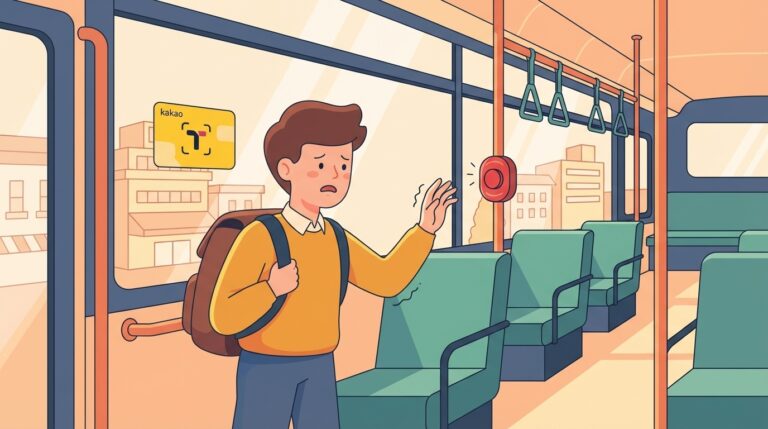
Phase 1: Empathy (The “Wait, I need to get off!” Moment)
Hello there! Daily Hangul Editor here.
Picture this: You are watching a K-Drama. The main character is on a bus, staring dreamily out the window while a beautiful OST plays in the background. Someone romantically reaches over them to press the stop bell.
Now, let’s talk about reality. You are on Bus 143 in Gangnam during rush hour. The bus is zooming down the street like a Formula 1 car. Your map app says “Arriving soon.” There is a wall of people between you and the exit. The red stop bell feels like it’s a mile away. If you don’t press that bell or say something, you are going to the next city!
Riding a Korean bus is an adventure, and pressing the bell (벨 누르기) is the climax of that adventure. If you don’t know the right phrases, you might miss your stop or end up doing an awkward mime routine. But don’t worry! This guide is based on the actual survival stories of my students. Let’s turn you into a Korean bus pro!
Phase 2: Core Phrases Deep Dive
Here are the top 3 phrases you need when getting off a Korean bus.
1. 내려요! (I’m getting off!)
- Pronunciation: nae-ryeo-yo! [Sounds like: nay-ryo-yo!]
- Meaning: Literal: “I go down.” / Real nuance: “Wait! I’m getting off!”
- K-Culture Moment: The bus has stopped, but you were stuck in the back. The driver starts to close the doors. You shout this phrase across the bus. Suddenly, the doors pop back open like magic.
- Editor’s Insight: This phrase sounds like an emergency button. It’s short, urgent, but still polite because it ends with the magic ‘yo’ (요). Don’t whisper it; say it from your chest!
- Situation Spectrum:
- Casual with friends: ✅
- To a bus driver: ✅
- Formal business meeting: 🚫
- 🤔 Think About It: Why do Koreans say “go down” (내려요) instead of “go out” for getting off a bus? It comes from the days when buses and trains had high steps. Does your language use “go down” or “go out”?
2. 잠시만요~ (Excuse me, coming through!)
- Pronunciation: jam-si-man-yo~ [Sounds like: jahm-shee-mahn-yo~]
- Meaning: Literal: “Just a moment.” / Real nuance: “Please let me pass, I need to get to the door!”
- K-Culture Moment: You are parting the Red Sea of passengers in a packed morning commute. As you say this, Koreans will instinctively twist their bodies sideways to let you pass.
- Editor’s Insight: Forget the dictionary translation of “Excuse me.” This is the ultimate crowd-moving spell. Drag out the last syllable (“yooo~”) to sound friendly and less aggressive.
- Situation Spectrum:
- Passing strangers: ✅
- To coworkers: ✅
- To the boss: ⚠️ (Depends on the tone)
- 🤔 Think About It: In Korea, physical space in public transport is tight, so light bumping is accepted. Why is “Just a moment” used instead of “I’m sorry” when bumping through a crowd?
3. 아저씨, 문 열어주세요! (Sir, please open the door!)
- Pronunciation: a-jeos-si, mun yeo-reo-ju-se-yo! [Sounds like: ah-juh-shee, moon yuh-ruh-joo-say-yo!]
- Meaning: Literal: “Middle-aged man, please open the door!” / Real nuance: “Driver, please open the door!”
- K-Culture Moment: You pressed the bell, but the back door didn’t open. Panic sets in. You shout this, and the driver immediately realizes his mistake.
- Editor’s Insight: “Ajeossi” is a friendly but respectful way to address male drivers. Combine it with this phrase, and you sound like a true Seoulite.
- Situation Spectrum:
- To bus/taxi drivers: ✅
- To young shop staff: 🚫
- 🤔 Think About It: Calling strangers “Ajeossi” (uncle/sir) or “Imo” (aunt) shows how Koreans use family terms for societal connections.
Phase 3: Textbook vs. Real Korean
Books teach you formal grammar, but buses wait for no one. Efficiency is key!
[Situation 1: Pushing through a crowded bus]
* 📖 Textbook Korean: 실례합니다. (sil-lye-ham-ni-da – Excuse me.)
* 🗣️ Real Korean: 잠시만요~ 내릴게요! (jam-si-man-yo~ nae-ril-ge-yo! – Just a moment, I’m getting off!)
* 💡 Why the difference?: “실례합니다” sounds too formal, like you are interrupting a business meeting. “잠시만요” is the accepted social cue for moving through crowds.
[Situation 2: Telling the driver you are getting off]
* 📖 Textbook Korean: 저는 다음 정류장에서 하차하겠습니다. (I will alight at the next stop.)
* 🗣️ Real Korean: 아저씨, 내려요! (Ahjussi, getting off!)
* 💡 Why the difference?: Korean buses move fast. You need a phrase that can be shouted quickly before the door closes!
Bottom Note: For A1 beginners, don’t worry about complex grammar on the bus. Volume and timing are more important than perfect sentences!
Phase 4: Cultural Context — K-Culture Deep Dive
4-1. Non-verbal Secrets: The Art of “Nunchi”
In Korea, you do not wait for the bus to come to a complete stop before getting up. This is where Nunchi (눈치 – the ability to read the room) comes in. If your stop is next, you must press the bell immediately, stand up while the bus is still moving, and hover near the back door. If you wait until the bus stops, the driver assumes no one is getting off and will drive away!
4-2. K-Culture Connection: The “Palli-Palli” Survival
If you watch K-Dramas, you might see characters having deep, emotional conversations on the bus. In reality, public transport in Korea is driven by the Palli-Palli (빨리빨리 – Hurry, Hurry) culture. It’s highly efficient, incredibly fast, and very safe, but it requires you to be alert. Also, remember the golden rule of Korean buses: Tap your T-money card when getting ON, and tap it again when getting OFF!
Phase 5: Real-Life Roleplay Scenario
Scenario A: The Gangnam Rush Hour Escape
- Setting: Friday night, 7:00 PM. Bus 143 near Gangnam Station. The bus is packed like a can of sardines. You are standing in the middle, and your stop is coming up.
- Characters:
- YOU: A foreigner who really wants to eat Korean BBQ at Gangnam Station.
- Ahjumma: A friendly but sturdy older lady standing right in front of the exit door.
- Driver: Focused on the road, wearing a Bluetooth headset.
Dialogue:
(Automated Voice): 이번 정류장은… 강남역 입니다. (Next stop is… Gangnam Station.)
(Stage Direction: You reach out and press the red stop bell. DING-DONG!)
YOU: (Tapping the Ahjumma’s shoulder slightly)
잠시만요, 내릴게요.
(jam-si-man-yo, nae-ril-ge-yo.)
[Excuse me, I will get off.]
Ahjumma: 아유, 사람 많네. 이쪽으로 와요.
(a-yu, sa-ram man-ne. i-jjog-eu-ro wa-yo.)
[Oh my, so many people. Come this way.]
(Stage Direction: The bus stops. You tap your card: BEEP! You step down, but suddenly the door starts closing before you are fully out!)
🔀 Your Turn! What do you shout to the driver?
– A) “안녕히 계세요!” (Goodbye!)
– B) “실례합니다!” (Excuse me!)
– C) “아저씨! 문 열어주세요! 내려요!” (Sir! Open the door! Getting off!)✅ Best Choice: C — You need to be loud and clear! The driver will immediately open the door.
⚠️ Choice A & B Analysis: Saying “Goodbye” while trapped in the door is hilarious but unhelpful. “Excuse me” is too quiet and formal for an emergency.
Scenario B: The Lost Tourist (Bonus)
YOU: (To the driver before getting on) 아저씨, 이거 명동 가요?
(a-jeos-si, i-geo myeong-dong ga-yo? – Sir, does this go to Myeongdong?)
Driver: 네, 타세요!
(ne, ta-se-yo! – Yes, get on!)
Phase 6: 10-Second Shadowing Drill
Let’s practice your bus survival phrases. Read them aloud, following the pauses and emotions!
- 🥺 (Apologetically) 잠시만요~ / 지나갈게요~ (jam-si-man-yo~ / ji-na-gal-ge-yo~)
- 😤 (Loud & Urgent!) 아저씨! / 저 / 내려요!! (a-jeos-si! / jeo / nae-ryeo-yo!!)
- 😊 (Politely) 문 / 열어주세요. (mun / yeo-reo-ju-se-yo.)
Phase 7: K-Culture Mini Dictionary
| Korean | Romanization | English | Cultural Context |
|---|---|---|---|
| 하차벨 | hacha-bel | Stop Bell | The red buttons located on the poles and walls of the bus. Press before your stop! |
| 교통카드 | gyotong-kadeu | Transit Card | T-money card. The holy grail of Korean travel. Works on buses, subways, and taxis. |
| 하차입니다 | hacha-imnida | “You have alighted” | The machine says this when you tap your card on the way out. |
| 환승입니다 | hwanseung-imnida | “Transfer” | The machine says this if you transfer within 30 minutes. It means your ride is discounted! |
Phase 8: Traveler Survival Kit
🆘 Survival Phrases for the Bus
– 🇰🇷 “이거 [장소] 가요?” (i-geo [Place] ga-yo?) – Does this go to [Place]?
– 🇰🇷 “[장소]에서 내려주세요.” ([Place]-e-seo nae-ryeo-ju-se-yo) – Please let me off at [Place].
– 🇰🇷 “카드 찍었어요.” (ka-deu jji-geo-sseo-yo) – I tapped my card.📍 Where to use: Bus stops, boarding the bus, or explaining card errors to the driver.
📌 Editor’s Travel Note
– Must-have Apps: Google Maps doesn’t work well for walking/buses in Korea. Download Naver Map or KakaoMap!
– The Transfer Rule: You get a free or heavily discounted transfer from bus to subway (or bus to bus) if you tap your card when getting off. ALWAYS tap out!
Phase 9: Critical Thinking — “One Step Deeper”
Media vs. Reality: The Fast-Paced Korean Spirit
Have you ever wondered why Korean bus drivers drive so fast, and why passengers rush to the door before the bus even stops? This isn’t just about impatience; it’s a reflection of Korea’s rapid modernization. The “Palli-Palli” (Hurry, Hurry) culture rebuilt a war-torn country into an economic powerhouse in just a few decades. That same speed and efficiency are built into the public transit system. It might feel overwhelming at first, but once you get used to it, you’ll love never having to wait long for a ride!
💬 Your Turn: Does public transportation in your country run on a relaxed schedule, or is it high-speed like Korea? Share in the comments!
Phase 10: FAQ & Avoiding Misunderstandings
- Q: “Is it rude to shout to the bus driver?”
- A: Not in an emergency! If the door is closing on you or you missed your stop because the crowd was too thick, yelling “내려요!” is completely normal and acceptable.
- Q: “Can I ask someone to press the bell for me?”
- A: Yes! If you can’t reach it, just point to the bell and say to the person next to you: “눌러주세요” (nul-leo-ju-se-yo – Please press it).
❌ Common Mistake #1: Saying “실례합니다” (Excuse me) when trying to move through a crowded bus.
✅ Do This Instead: Say “잠시만요~” (Just a moment) or “내릴게요” (I’m getting off). It’s much more natural!
Phase 11: Summary & Action Items
- One-Liner Summary: To survive a Korean bus, stand up early, say “Jam-si-man-yo” to part the crowd, and shout “Nae-ryeo-yo!” if the doors close too fast!
-
Action Mission:
- 🥉 Bronze (Solo): Look in the mirror, pretend you are squished on a bus, and say “잠시만요~” 3 times.
- 🥈 Silver (Online): Find a YouTube video of a “Seoul Bus Ride” and identify the sound of the stop bell.
- 🥇 Gold (Real Life): On your next trip to Korea, confidently use “잠시만요” to navigate through a crowded bus or subway!
- K-Culture Mission: Open KakaoMap or Naver Map, pick a random bus route in Seoul, use the ‘Street View’ feature to look inside a bus stop, and imagine yourself waiting there!
Phase 12: Quiz — Interactive Challenge
1. You need to get off the bus, but three people are blocking the door. What is the most natural thing to say?
– A) 비키세요! (Get out of the way!)
– B) 실례합니다. (Excuse me – formal.)
– C) 잠시만요~ 내릴게요. (Just a moment, getting off.)
(Answer: C! A is too rude, and B is too formal for bus etiquette.)
2. True or False: In Korea, you should stay seated until the bus comes to a complete stop.
(Answer: FALSE. In Korea, you are expected to press the bell and move toward the door while the bus is still approaching the stop!)
3. Fill in the blank: If the back door closes before you get off, shout: “아저씨! ________!”
(Answer: 내려요! / 문 열어주세요!)
Frequently Asked Questions (FAQ)
Q: What does "내려요! (I'm getting off!)" mean in Korean and how do you pronounce it?
A: In Korean, "내려요! (I'm getting off!)" is pronounced [nae-ryeo-yo! [Sounds like: nay-ryo-yo!] and means: Literal: "I go down." / Real nuance: "Wait! I'm getting off!"
Q: What does "잠시만요~ (Excuse me, coming through!)" mean in Korean and how do you pronounce it?
A: In Korean, "잠시만요~ (Excuse me, coming through!)" is pronounced [jam-si-man-yo~ [Sounds like: jahm-shee-mahn-yo~] and means: Literal: "Just a moment." / Real nuance: "Please let me pass, I need to get to the door!"
Q: What does "아저씨, 문 열어주세요! (Sir, please open the door!)" mean in Korean and how do you pronounce it?
A: In Korean, "아저씨, 문 열어주세요! (Sir, please open the door!)" is pronounced [a-jeos-si, mun yeo-reo-ju-se-yo! [Sounds like: ah-juh-shee, moon yuh-ruh-joo-say-yo!] and means: Literal: "Middle-aged man, please open the door!" / Real nuance: "Driver, please open the door!"






