

Advanced C2 Korean: How to Describe Seoul’s Traditional-Meets-Modern Vibe Like a Local
Phase 1: Empathy & The “Seoul” State of Mind
Hello! I’m your Daily Hangul editor.
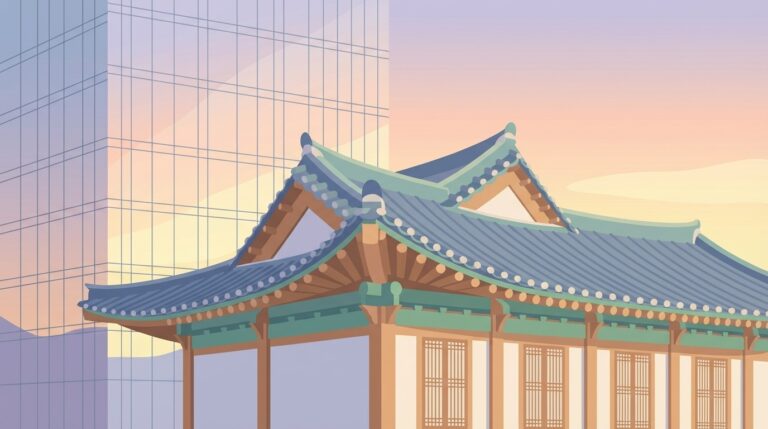
Imagine this: You’re standing at the majestic Gwanghwamun square. Directly in front of you is a grand royal palace from the 14th century, its colorful eaves curving gracefully into the sky. But right behind you? A towering forest of sleek, futuristic glass skyscrapers housing global tech conglomerates.
If you’ve watched K-Dramas like Goblin or Queen of Tears, you know exactly what I’m talking about. The camera pans over a 100-year-old Hanok (traditional house), only to reveal the neon-lit Seoul skyline in the background.
As an advanced (C2) Korean learner, if you point at this breathtaking scene and say, “와, 예뻐요” (Wow, it’s pretty) or “건물이 멋있어요” (The buildings are cool), you’re doing yourself a massive disservice!
Seoul’s architectural DNA is a fascinating clash of rapid modernization and a desperate, beautiful attempt to preserve its history. Today, we are going to learn how to express this complex aesthetic—the harmony of the traditional and the modern—like a true Korean intellectual. Trust me, use these expressions, and your Korean friends will look at you with deep respect.
Phase 2: Core Expressions Deep Dive
Let’s upgrade your architectural vocabulary from textbook basics to poetic fluency.
1. 고즈넉하다
- Pronunciation: go-jeu-neok-ha-da [The ‘eu’ (으) sounds like the sound of disgust you make when stepping in gum; ‘neok’ sounds like ‘knock’ but with an ‘uh’ vowel.]
- Meaning: (Literal) Peacefully quiet and tranquil / (Real nuance) A profound, serene, and almost poetic stillness, usually associated with traditional spaces or nature.
- K-Culture Moment: Picture the female lead in a historical drama walking through a quiet palace courtyard at dusk. That absolute peace? That’s gojeuneok.
- Editor’s Insight: You CANNOT use this word for a quiet library or an empty modern office. It specifically carries a traditional, historical, or natural weight. It’s the “vibe” of an old Hanok village.
- Situation Spectrum:
- Casual with friends: ✅ (e.g., “여기 분위기 완전 고즈넉하다.”)
- Semi-formal/Colleagues: ✅
- Formal/Elders: ✅ (A highly sophisticated word to use anywhere)
- 🤔 Think About It: Why does a hyper-competitive, fast-paced society like Korea have such a specific, elevated word for “peaceful stillness”? Do we crave what we lack the most?
2. 이질적이면서도 조화롭다
- Pronunciation: i-jil-jeok-i-myeon-seo-do jo-hwa-rop-da
- Meaning: (Literal) Heterogeneous yet harmonious / (Real nuance) Contrasting completely in nature, yet beautifully blending together.
- K-Culture Moment: This is the exact phrase art critics and architects use on TV when describing places like Ikseon-dong, where ultra-modern espresso machines sit on top of antique mother-of-pearl tables inside a crumbling Hanok.
- Editor’s Insight: It sounds incredibly intelligent. “이질적” (heterogeneous/alien) implies friction, but “조화롭다” (harmonious) resolves it. It’s the perfect paradox.
- Situation Spectrum:
- Casual with friends: ⚠️ (Might sound a bit too academic for a drunken Friday night)
- Semi-formal/Colleagues: ✅
- Formal/Elders: ✅
- 🤔 Think About It: In many Western architectures, harmony means uniformity (e.g., all buildings in Paris must match). In Korea, harmony often comes from the tension of extreme opposites. Does your culture prefer uniformity or contrast?
3. 옛 정취가 묻어나다
- Pronunciation: yet jeong-chwi-ga mu-deo-na-da
- Meaning: (Literal) Old sentiments rub off / (Real nuance) Exuding a nostalgic, traditional charm or atmosphere.
- K-Culture Moment: You walk into a retro 1980s-themed pojangmacha (street tent), or a cafe that kept the original wooden rafters of a traditional house.
- Editor’s Insight: “묻어나다” literally means something rubs off on you (like wet paint). Here, it’s used metaphorically—the history of the building is “rubbing off” into the atmosphere.
- Situation Spectrum:
- Casual with friends: ✅
- Semi-formal/Colleagues: ✅
- Formal/Elders: ✅
- 🤔 Think About It: Why does Korea have such a massive “Newtro” (New + Retro) trend where young people seek out the “old sentiments” they never even lived through?
Phase 3: Textbook vs. Real Korean
Let’s see how these concepts evolve from the classroom to the streets of Bukchon.
[Describing a renovated Hanok Cafe]
* 📖 Textbook Korean: 이 한옥 카페는 아주 조용하고 아름답습니다. (This Hanok cafe is very quiet and beautiful.)
* 🗣️ Real Korean: 여기 분위기 진짜 고즈넉하고 힙(hip)하지 않아요? 옛것과 새것의 믹스매치가 장난 아니네요. (Isn’t the vibe here so serene and hip? The mix-match of old and new is insane.)
* 💡 Why the difference?: Real Koreans love combining profound traditional vocabulary (고즈넉하다) with modern Konglish slang (힙하다, 믹스매치). The language itself mirrors the architectural blend!
[Admiring the Seoul Skyline]
* 📖 Textbook Korean: 현대 건물과 옛 궁궐이 함께 있습니다. (Modern buildings and old palaces are together.)
* 🗣️ Real Korean: 빌딩 숲 사이에 자리 잡은 고궁이라니, 묘하게 어우러지네요. (A palace nestled in a forest of buildings—it harmonizes strangely well.)
* 💡 Why the difference?: Advanced speakers use metaphors like “빌딩 숲” (forest of buildings) and adverbs like “묘하게” (strangely/mysteriously) to capture the unexpected beauty of the contrast.
Phase 4: Cultural Context — K-Culture Deep Dive
4-1. The Non-verbal “Space”
When commenting on traditional Korean architecture, don’t just rapid-fire your sentences. Traditional Korean aesthetics emphasize 여백의 미 (Beauty of Emptiness). When you say “고즈넉하네요…”, pause. Look up at the 처마 (eaves) curving against the sky. Take a deep breath. Appreciating this architecture requires a slowing down of your nunchi (social sensing)—shifting your focus from reading people to reading the space.
4-2. The K-Drama Trope: Immortals in the Modern City
Think of dramas like My Love from the Star or Tale of the Nine Tailed. The immortal protagonists always live in a house that looks like a modern penthouse on the inside but has elements of a Hanok on the outside, or vice versa.
This isn’t just set design; it’s a visual metaphor for Korea itself. Korea went from a devastating war to a hyper-modern tech superpower in just a few decades. The “old vs. new” trope in dramas directly speaks to the Korean identity crisis: “Are we the hyper-fast modern city, or the slow, wise ancient kingdom?” The answer is: we are both.
Phase 5: Real-Life Roleplay Scenario
Setting: Friday afternoon, 4 PM. You are sitting at a rooftop cafe in Samcheong-dong. To your left, the endless gray sea of Gyeongbokgung Palace’s tiled roofs. To your right, the gleaming steel towers of downtown Jongno. You are having coffee with Ji-won, an architect you met at a networking event.
Characters:
– YOU (The Reader): An expat living in Seoul, highly observant, trying to impress your local friend.
– Ji-won (34): A passionate Korean architect who loves analyzing spaces.
Dialogue:
Ji-won: 이 카페 뷰 진짜 미치지 않았어요? 제가 제일 좋아하는 아지트예요. ☕
(I kape byu jinjja michiji anasseoyo? Jaega jeil joahaneun ajiteuyeyo.)
[Translation: Isn’t the view from this cafe insane? It’s my favorite hideout.]
YOU: 와, 진짜 대박이네요. 궁궐 지붕들이 쫙 펼쳐져 있는 게 너무 예뻐요.
(Wa, jinjja daebagineyo. Gunggwol jibungdeuri jjwak pyeolchyeojeo inneun ge neomu yeppeoyo.)
[Translation: Wow, it’s truly amazing. The palace roofs spread out like this are so beautiful.]
Ji-won: 그쵸? 저기 멀리 보이는 빌딩들이랑 고궁이 같이 있는 걸 보면 기분이 되게 묘해요.
(Geuchyo? Jeogi meolli boineun bildingdeurirang gogungi gachi inneun geol bomyeon gibuni doege myohaeyo.)
[Translation: Right? Looking at the modern buildings far away alongside the ancient palace gives me a really strange/mysterious feeling.]
(🎭 Stage Direction: Ji-won takes a sip of her coffee and looks at you expectantly, waiting to see if you “get” it.)
🔀 Your Turn! How do you respond?
– A) 맞아요. 옛날 건물과 새 건물이네요.
– B) 네, 이질적이면서도 묘하게 조화로운 것 같아요. 옛 정취 한가운데서 현대의 속도감이 느껴진달까요?
– C) 완전 헐랭~ 옛날 감성 폼 미쳤다!✅ Best Choice: B — Why? You are speaking to an architect (semi-formal/professional). Choice B uses high-level C2 vocabulary to perfectly articulate the tension between the “speed of modern times” and “old sentiment.” You will instantly earn her deep respect.
⚠️ Choice A Analysis: Too basic. It kills the philosophical mood.
⚠️ Choice C Analysis: Way too slangy and immature for this deep conversation.
Ji-won: (Eyes widening in surprise) 와… 표현력이 진짜 좋으시네요! 맞아요, ‘이질적이면서도 조화롭다’는 말이 정확해요.
(Wa… pyohyeonnyeogi jinjja joeusineyo! Majayo, ‘ijiljeogimyeonseodo jowaropda’neun mari jeonghakhaeyo.)
[Translation: Wow… your expressive skills are really good! That’s right, ‘heterogeneous yet harmonious’ is the exact phrase.]
YOU: 이 동네 골목골목을 걷다 보면, 되게 고즈넉해서 마음이 편안해지더라고요.
(I dongne golmokgolmogeul geotda bomyeon, doege gojeuneokhaeseo maeumi pyeonanhaejideoragoyo.)
[Translation: Walking through the alleys of this neighborhood, it’s so serene that my mind feels at peace.]
Ji-won: 맞아요. 서울 한복판에 이런 여백의 공간이 있다는 게 참 다행이죠.
(Majayo. Seoul hanbokpane ireon yeobaegui gonggani itdaneun ge cham dahaengijyo.)
[Translation: True. It’s a huge relief that a space of emptiness exists right in the middle of Seoul.]
Phase 6: 10-Second Shadowing Drill
Let’s practice the pacing and tone of an intellectual observation.
😌 빌딩 숲 사이에 / 자리 잡은 고궁이라니... / 이질적이면서도 / 참 조화롭네요.
(bilding sup saie / jari jabeun gogungirani… / ijiljeogimyeonseodo / cham jowaromneyo.)
Emotion tag: Speak slowly, as if you are gazing at a painting. Let the pause (/) do the heavy lifting for the “profound” vibe.
Phase 7: K-Culture Mini Dictionary
| Korean | Romanization | English | Cultural Context |
|---|---|---|---|
| 단청 | dancheong | Traditional coloring | The vibrant red, green, and blue patterns painted on wooden structures of palaces and temples. |
| 처마 | cheoma | Eaves | The curving edges of a Hanok roof, designed scientifically to control sunlight depending on the season. |
| 여백의 미 | yeobaegui mi | Beauty of emptiness | A core concept in Korean traditional art and space—leaving things intentionally empty to let the mind rest. |
| 뉴트로 | nyuteuro | Newtro (New + Retro) | The massive cultural trend of modernizing vintage Korean elements (like 1920s modern boy fashion or Hanok cafes). |
| 젠트리피케이션 | jenteuripikeisyeon | Gentrification | The sad reality of these beautiful harmony zones (like Ikseon-dong); traditional residents are pushed out by trendy cafes. |
Phase 8: Traveler’s Survival Kit
When exploring these architectural “mix-match” neighborhoods (Bukchon, Ikseon-dong, Seochon), you’ll need these specific phrases.
🆘 Survival Phrases for Hanok Villages
– 🇰🇷 “여기 둘러봐도 괜찮은가요?” (yeogi dulleobwado gwaenchaneungayo?)
– 🗣️ English: Is it okay to look around here?
– 📍 Where to use: Hanok villages are often actual residential areas, not just tourist sets!
– 💡 Pro Tip: Bukchon has implemented “quiet times” and “restricted access” areas because of overtourism. Always ask or look for signs before taking photos of someone’s private Hanok.
- 🇰🇷 “이 근처에 뷰 좋은 루프탑 카페 있나요?” (i geuncheoe byu joeun rupeutap kape innayo?)
- 🗣️ English: Are there any rooftop cafes with a good view around here?
📌 Editor’s Travel Note
– Navigating Alleys: Google Maps can be notoriously glitchy in the tiny, maze-like alleys of Ikseon-dong. Use KakaoMap or Naver Map for pinpoint accuracy.
– Footwear: Hanok areas are extremely hilly (especially Bukchon). Leave the heels at home.
Phase 9: Critical Thinking — “One Step Deeper”
Space and Identity: The Trauma of Compressed Modernization
🧠 Think Deeper:
Why is Seoul such a jarring mix of the hyper-modern and the deeply traditional? It’s the result of “압축 성장” (Compressed Growth). Following the Korean War, the country rebuilt itself at a breakneck pace. For decades, “old” meant poverty, so Hanoks were mercilessly torn down to build concrete apartments.
It was only recently, after achieving economic wealth, that Koreans realized they had paved over their identity. The explosion of Hanok cafes and the desperate preservation of palaces isn’t just about “aesthetic beauty.” It’s a psychological attempt to reclaim a lost heritage in a city that moves too fast. The harmony we see today is actually a scar of survival turning into a badge of pride.💬 Your Turn: Does your home country also struggle with balancing modernization and historical preservation? How does your city treat its “old” buildings? Share in the comments!
Phase 10: FAQ & Mistake Prevention
Q: Can I use “고즈넉하다” to describe a quiet modern hotel room?
No! It sounds very awkward. Gojeuneok implies a connection to nature, history, or an organic sense of peace. For a quiet modern hotel, just use “아주 조용하고 아늑해요” (very quiet and cozy).
Q: I see people sitting on the wooden floors (대청마루) of cafes. Do I take my shoes off?
YES. If you step onto the elevated wooden floor (maru) of a Hanok with your shoes on, you will cause absolute panic among the Korean staff. Always check if there’s a shoe rack at the step.
❌ Common Mistake #1: Calling every old building a “Hanok.”
✅ Do this instead: A “Hanok” specifically refers to the traditional wooden homes with tiled (or thatched) roofs. A 1970s brick house is just a “구옥” (old house), not a Hanok!
Phase 11: Summary & Action Items
- One-Liner Summary: To describe Seoul’s architectural magic, look beyond “pretty” and embrace the profound harmony of contrasting worlds with expressions like “이질적이면서도 조화롭다” (heterogeneous yet harmonious).
-
Action Mission:
- 🥉 Bronze: Say “이질적이면서도 참 조화롭네요” out loud three times, perfecting that dramatic pause.
- 🥈 Silver: Leave a comment in Korean on an Instagram reel showing Seoul’s scenery using today’s vocabulary.
- 🥇 Gold: Next time you visit a modern cafe inside a traditional space in Korea, tell the barista: “공간이 옛 정취가 묻어나서 참 좋네요” (I love how the space exudes a traditional charm).
- K-Culture Mission:
Open Google Maps Street View. Drop the pegman right in front of the Gwanghwamun gate. Pan the camera 360 degrees. Take in the palace, then turn around to see the modern skyline. Try describing the feeling out loud in Korean!
Phase 12: Quiz — Interactive Challenge
1. Situational Judgment:
You are at a bustling, loud, neon-lit K-BBQ joint in Gangnam playing loud K-Pop. You want to compliment the vibe. Which word should you AVOID?
– A) 힙하다 (Hip)
– B) 분위기 찢었다 (The vibe is tearing it up/amazing)
– C) 고즈넉하다 (Serene)
2. Fill in the Blank:
빌딩 숲 한가운데 고궁이 있다니, ( _______ )이면서도 묘하게 어우러지네요.
(Hint: Heterogeneous)
3. True or False – K-Culture Edition:
It’s perfectly fine to wander into the courtyards of the Hanoks in Bukchon Hanok Village to take pictures, as they are government-owned museums. (T/F)
(Answers: 1. C / 2. 이질적 / 3. False – They are private residences!)
Frequently Asked Questions (FAQ)
Q: What does "고즈넉하다" mean in Korean and how do you pronounce it?
A: In Korean, "고즈넉하다" is pronounced [go-jeu-neok-ha-da [The 'eu' (으] and means: (Literal) Peacefully quiet and tranquil / (Real nuance) A profound, serene, and almost poetic stillness, usually associated with traditional spaces or nature.
Q: What does "이질적이면서도 조화롭다" mean in Korean and how do you pronounce it?
A: In Korean, "이질적이면서도 조화롭다" is pronounced [i-jil-jeok-i-myeon-seo-do jo-hwa-rop-da] and means: (Literal) Heterogeneous yet harmonious / (Real nuance) Contrasting completely in nature, yet beautifully blending together.
Q: What does "옛 정취가 묻어나다" mean in Korean and how do you pronounce it?
A: In Korean, "옛 정취가 묻어나다" is pronounced [yet jeong-chwi-ga mu-deo-na-da] and means: (Literal) Old sentiments rub off / (Real nuance) Exuding a nostalgic, traditional charm or atmosphere.







