

Phase 1: Empathy & Immersion (Welcome to the K-Drama Romance!)
Hello! I’m your Daily Hangul Editor.
Picture this: You’ve seen it in dozens of K-Dramas. The female lead waits under the cherry blossoms (or outside a snowy convenience store), clutching a perfectly wrapped, slightly crushed box of chocolates. She shyly hands it to the male lead, looking down at her shoes. The subtitles just say, “Here, take this.” But was it really that simple?
Valentine’s Day in South Korea is a massive event, but with a major plot twist—only women give chocolate to men on February 14th! (Men return the favor on ‘White Day’ in March). Whether you want to confess to your Korean crush, or you just want to hand out chocolates to your office coworkers without making things awkward, knowing the exact phrase to use is crucial.
If you use textbook Korean, you might accidentally propose marriage to your boss! Let’s learn the real, insider expressions that will make you sound like a true local.
Phase 2: Deep Dive into Core Expressions
1. 이거 직접 만들었어요.
- Pronunciation: igeo jikjeop mandeureosseoyo. (The ‘eo’ sounds like the ‘u’ in ‘uh-oh’)
- Meaning: Literal: I made this directly. / Real nuance: I put my heart into this for you.
- K-Culture Moment: In Korea, giving DIY (Do-It-Yourself) chocolate is the ultimate green light. If a K-Pop idol mentions they “directly made” cookies for their fans, the fandom goes wild because of the effort it implies.
- Editor’s Insight: Use this only if you actually made it, and only if you want to show strong affection. It’s a very sweet, genuine expression.
- Situation Spectrum:
- Casual (Friends/Crush): ✅
- Semi-formal (Coworkers): ⚠️ (Might be too personal!)
- Formal (Boss/Elders): 🚫
- 🤔 Think About It: Why is DIY culture so highly valued in Korean dating? In a fast-paced society where you can buy anything instantly, giving your time is the highest form of luxury.
2. 오다 주웠어요.
- Pronunciation: oda juwosseoyo. (‘j’ is soft, like ‘ch’ mixed with ‘j’)
- Meaning: Literal: I picked it up on the way. / Real nuance: I bought this for you but I’m too cool/shy to make a big deal out of it.
- K-Culture Moment: This is the classic Tsundere (cold on the outside, warm on the inside) K-Drama line. The guy casually tosses a gift onto the girl’s desk and says, “I picked it up on the way.” It’s a culturally accepted way to show affection without losing your cool.
- Editor’s Insight: This is a playful, slightly sarcastic joke. Do NOT use it with someone you aren’t close to, or they might actually think you found it on the street!
- Situation Spectrum:
- Casual (Friends/Crush): ✅
- Semi-formal (Coworkers): 🚫
- Formal (Boss/Elders): 🚫
- 🤔 Think About It: Koreans often use indirect language to hide embarrassment. Does your language have a funny way to downplay a gift?
3. 당 떨어질 때 드세요.
- Pronunciation: dang tteoreojil ttae deuseyo. (Put a strong accent on the double ‘tt’)
- Meaning: Literal: Eat this when your sugar drops. / Real nuance: Here’s a little snack to keep your energy up at work.
- K-Culture Moment: You’re in a Korean office, it’s 3 PM, and everyone is exhausted. This is the ultimate “safe” phrase to give out Uiri (obligation/loyalty) chocolate to your coworkers without any romantic misunderstandings.
- Editor’s Insight: “당 떨어지다” (sugar drops) is the universal Korean excuse for needing a snack. It shows you are considerate of their hard work.
- Situation Spectrum:
- Casual (Friends): ✅
- Semi-formal (Coworkers): ✅
- Formal (Boss/Elders): ✅
Phase 3: Textbook vs. Real Korean
[Giving Chocolate to Your Crush]
* 📖 Textbook Korean: 당신을 위해 초콜릿을 샀습니다. (I bought chocolate for you.)
* 🗣️ Real Korean: 단 거 좋아해요? 이거 먹어요. (Do you like sweet things? Eat this.)
* 💡 Why is it different?: Koreans rarely use the word “당신” (you) in real life. Asking about their preference first makes the gesture feel more natural and less aggressive.
[Giving Chocolate to Coworkers]
* 📖 Textbook Korean: 나의 직장 동료들에게 초콜릿을 줍니다. (I am giving chocolate to my coworkers.)
* 🗣️ Real Korean: 다 같이 나눠 먹어요~ (Let’s all share and eat this~)
* 💡 Why is it different?: Korean culture emphasizes the collective (“We/Us”). Sharing food together builds team solidarity (Jeong, 정).
Bottom Note: At a B1 level, you don’t need complex grammar to sound fluent. Mastering these natural, everyday phrases will instantly elevate your Korean from “student” to “local.”
Phase 4: Cultural Context — K-Culture Deep Dive
4-1. Non-verbal Cues & Nunchi
When giving chocolate to a boss or elder, always use two hands to pass the box. If you are using the K-Drama “오다 주웠어요” (I picked it up on the way) with a friend, break eye contact and look away slightly to maximize the Tsundere effect!
4-2. The Convenience Store Battlefield (K-Travel & K-Food)
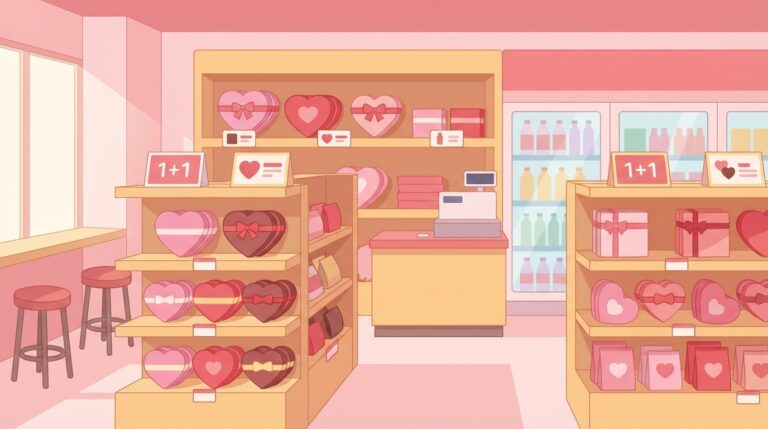
If you visit Korea in February, you will see convenience stores (CU, GS25, 7-Eleven) absolutely explode with giant chocolate baskets decorated with huge teddy bears.
* Pro Tip: While these look amazing, local Koreans know they are often overpriced. For a real, heartfelt gift, Koreans usually go to specialty dessert cafes, or they buy high-quality individual chocolates inside the convenience store using the 1+1 (One plus One) deals!
Phase 5: Real-World Roleplay Scenario
Setting: It’s February 14th, 12:30 PM. You are standing near the coffee machine in your Seoul office breakroom. Your work crush, Min-ho, walks in looking tired after a long meeting.
Characters:
– YOU: A foreign employee who prepared a small, nice box of chocolates.
– Min-ho (29): Your Korean coworker. Friendly, loves iced americanos.
Dialogue:
Min-ho: 아, 오늘 회의 진짜 길었네요. 피곤하다…
(a, oneul hoeui jinjja gireonneyo. pigonhada…)
[Ah, today’s meeting was really long. I’m tired…]
YOU: 민호 씨, 커피 마셔요?
(minho ssi, keopi masyeoyo?)
[Min-ho, are you drinking coffee?]
Min-ho: 네, 당이 떨어져서 단 커피 마시려고요.
(ne, dangi tteoreojyeoseo dan keopi masiryeogoyo.)
[Yeah, my sugar is dropping so I’m going to drink sweet coffee.]
🔀 Your Turn! How do you hand him the chocolate?
– A) “당신을 사랑합니다! 이거 받으세요!” (I love you! Take this!)
– B) “오다 주웠어요. 드세요.”
– C) “마침 저한테 초콜릿이 있어요. 당 떨어질 때 드세요.”✅ Best Choice: C — Reason: Since you are at work, “Eat this when your sugar drops” is the perfect, low-pressure way to show you care. It builds connection without making the office awkward.
⚠️ Choice B Analysis: “I picked it up on the way” is cute, but might be too informal for an office environment unless you two are already very close friends outside of work.
Phase 6: 10-Second Shadowing Drill
Practice your intonation like a K-Drama actor!
🥺 아, 이거 / 제가 직접 / 만들었어요! (a, igeo / jega jikjeop / mandeureosseoyo!)
Emotion: Slightly shy, but proud of your effort.
😤 오다 / 주웠어요. / 단 거 좋아하면 / 드세요. (oda / juwosseoyo. / dan geo joahamyeon / deuseyo.)
Emotion: Cool, aloof, avoiding eye contact.
Phase 7: K-Culture Mini Dictionary
| Korean | Romanization | English | Cultural Context |
|---|---|---|---|
| 화이트데이 | hwaiteudei | White Day | March 14th. Men give candy/gifts to women. |
| 블랙데이 | beullaekdei | Black Day | April 14th. Singles eat Jjajangmyeon (black bean noodles) together to mourn their single status! |
| 썸 | sseom | “Some” / Situationship | The ambiguous dating phase before becoming an official couple. Valentines Day is the perfect time to end the ‘some’ and start dating. |
| 의리 초콜릿 | uiri chokolrit | Loyalty Chocolate | Cheap chocolates given to coworkers/friends out of politeness, not love. |
Phase 8: Traveler’s Survival Kit
If you’re in Korea on Feb 14, you’ll definitely be buying chocolates at a convenience store or mart. Here are the survival phrases you need:
🆘 Survival Phrase #1
– 🇰🇷 “이거 투플러스 원(2+1) 행사 하나요?” (igeo tupeulleoseu won haengsa hanayo?)
– 🗣️ Meaning: Is this buy 2 get 1 free?
– 📍 Where to use: Convenience stores.
– 💡 Pro Tip: Look for the little tags under the price that say 1+1 or 2+1. If you buy a 2+1 item, you MUST bring 3 items to the counter!🆘 Survival Phrase #2
– 🇰🇷 “봉투 필요하세요?” (bongtu piryohaseyo?)
– 🗣️ Meaning: Do you need a plastic bag? (The cashier will ask YOU this).
– 📍 Where to use: Any checkout counter.
– 💡 Pro Tip: Just say “네 (Yes)” or “아니요, 괜찮아요 (No, it’s okay).” Bags usually cost 50 to 100 won.📌 Editor’s Travel Note
Koreans love practical gifts. If you can’t decide what to buy, send a “KakaoTalk Gift (카카오톡 선물하기)”. It’s an app feature where you can send a digital barcode for a coffee and cake set directly to your friend’s chat room. It’s the most modern way to give Valentine’s gifts in Korea!
Phase 9: Critical Thinking — A Step Deeper
Media vs. Reality: The Commercialization of Love
If you watch K-Dramas, it seems like Korean couples celebrate a romantic anniversary every week. And honestly, it’s partially true! Beyond Valentine’s and White Day, there is Pepero Day (Nov 11), Rose Day (May 14), and couples even celebrate their “100th Day Anniversary” (백일).
While this looks deeply romantic on screen, many young Koreans today feel a lot of financial and emotional pressure from these “couple holidays.” As a result, the trend is shifting. Many modern couples agree to skip the expensive commercial baskets and just enjoy a nice meal together instead.
💬 Your Turn: Does your culture have holidays that feel “too commercialized”? How do you usually celebrate Valentine’s Day in your country? Let me know in the comments!
Phase 10: FAQ & Avoiding Mistakes
Q: “Can I give candy on Valentine’s Day in Korea?”
No! This is a huge faux pas. In Korea, February 14th is strictly for Chocolate. Giving candy on this day shows you don’t know the culture. Save the candy for White Day (March 14th)!
Q: “Is it weird for a man to give chocolate to a woman on Feb 14?”
Traditionally, women give to men on Feb 14. However, recently, many people ignore the gender rule and just exchange chocolates on both days. So it’s not weird, just slightly untraditional!
❌ Common Mistake #1: Giving a massive, expensive chocolate basket to a coworker or a casual ‘썸’ (Some).
✅ Do this instead: Give a small, high-quality chocolate bar. Large gifts create ‘부담’ (budam – emotional pressure/burden). In Korean dating culture, keeping things light at the beginning is key!
Phase 11: Summary & Action Items
One-Liner Summary: To master Korean Valentine’s Day, know whether you’re giving romantic “DIY chocolate” (직접 만들었어요) or polite “Sugar-boost chocolate” (당 떨어질 때 드세요)!
Action Mission 3 Steps:
– 🥉 Bronze (Solo): Say “오다 주웠어요” in the mirror with your coolest, most nonchalant K-Drama face.
– 🥈 Silver (Online): Comment below using today’s expressions! Tell us who you would give chocolate to.
– 🥇 Gold (Real Life): Next time you see your Korean friend or language partner looking tired, hand them a sweet treat and say, “당 떨어질 때 드세요!”
Special K-Culture Mission:
Go to YouTube and search for Korean convenience store Vlogs in February. See if you can spot the massive “1+1” and “2+1” chocolate displays!
Phase 12: Quiz — Interactive Challenge
1. Situational Judgment: You are a manager. It’s 4 PM and your team is falling asleep at their desks. You bought some chocolates. What is the most natural thing to say?
– A) 내가 너를 사랑해! (I love you!)
– B) 당 떨어질 때 드세요~ (Eat this when your sugar drops~)
– C) 오다 주웠어요. (I picked it up on the way.)
2. True or False – K-Culture Edition:
In Korea, men traditionally give chocolate to women on February 14th.
3. Fill in the Blank:
If you want to impress someone by showing you put effort into a gift, you should say:
“이거 ______ 만들었어요.” (I made this myself).
(Answers: 1: B, 2: False – Women give to men on Feb 14, 3: 직접)
Frequently Asked Questions (FAQ)
Q: What does "이거 직접 만들었어요." mean in Korean and how do you pronounce it?
A: In Korean, "이거 직접 만들었어요." is pronounced [igeo jikjeop mandeureosseoyo. (The 'eo' sounds like the 'u' in 'uh-oh'] and means: Literal: I made this directly. / Real nuance: I put my heart into this for you.
Q: What does "오다 주웠어요." mean in Korean and how do you pronounce it?
A: In Korean, "오다 주웠어요." is pronounced [oda juwosseoyo. ('j' is soft, like 'ch' mixed with 'j'] and means: Literal: I picked it up on the way. / Real nuance: I bought this for you but I'm too cool/shy to make a big deal out of it.
Q: What does "당 떨어질 때 드세요." mean in Korean and how do you pronounce it?
A: In Korean, "당 떨어질 때 드세요." is pronounced [dang tteoreojil ttae deuseyo. (Put a strong accent on the double 'tt'] and means: Literal: Eat this when your sugar drops. / Real nuance: Here’s a little snack to keep your energy up at work.







