

Phase 1: Empathy (The Cold Open)
Hello, everyone! It’s your lead editor from Daily Hangul.
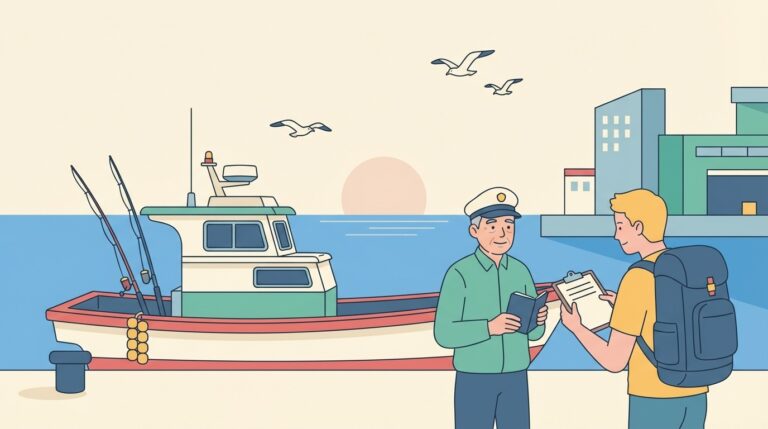
Imagine this: It’s 5:00 AM at a bustling port in Incheon. The salty ocean breeze is blowing, and you’re feeling like the main character in the hit K-Drama Hometown Cha-Cha-Cha. You’ve got your windbreaker on, a cup of mixed coffee (믹스커피) in hand, and you are ready for your very first Korean boat fishing (배낚시) experience.
You walk up to the boat, greet the captain, and he suddenly holds out his hand and says something that completely shatters your K-Drama fantasy. You freeze. You check your pockets. Oh no… you left it at the hotel.
In Korea, boat fishing isn’t just a casual hop-on-and-go activity. Because of strict maritime laws and Coast Guard regulations, no ID means no boat. Period. Today, we are going to dive into the essential Korean expressions you need to successfully book a fishing trip, pass the strict ID checks, and survive the high seas like a true local.
(Note: This guide is based on real panic moments experienced by our B2-level learners at the docks!)
Phase 2: Core Expressions Deep Dive
Let’s look at the absolute must-know phrases before you set sail.
1. 신분증 꼭 지참해 주세요.
- Pronunciation: sinbunjeung kkok jichamhae juseyo. (The ‘으’ in jeung sounds like the disgusted sound you make when stepping in gum!)
- Meaning: Please make sure to bring your ID. (Literal: Please strictly carry your identification card.)
- K-Culture Moment: You will hear this or see it in text messages right after booking a fishing boat on apps like Seonsang24 (선상24). Korean maritime law requires the Coast Guard to verify every passenger’s identity before departure.
- Editor’s Insight: You probably learned 가져오다 (to bring) in your textbook. But in official or business settings (like tours or government regulations), Koreans use the formal Sino-Korean word 지참하다 (to carry/bring with oneself).
- Situation Spectrum:
- Casual text from a friend: ⚠️ (Too formal. A friend would say: 신분증 꼭 챙겨!)
- Text from a booking agency: ✅
- Official notice from the Coast Guard: ✅
- 🤔 Think About It: Why does Korean have so many different words for simple actions like ‘bringing’? How does the use of Sino-Korean words (Hanja) elevate the formality of a sentence compared to pure Korean words?
2. 출항 30분 전까지 모여주세요.
- Pronunciation: chulhang samsipbun jeonkkaji moyeojuseyo.
- Meaning: Please gather 30 minutes before departure.
- K-Culture Moment: Group tours in Korea run on military precision. If a K-Pop concert says doors open at 5 PM, fans are there at 3 PM. If a boat leaves at 6 AM, the captain expects you there at 5:30 AM to write your name on the passenger manifest (승선명부).
- Editor’s Insight: The word 출항 (chulhang) specifically means ‘a boat departing’. If you use 출발 (chulbal – general departure), people will understand, but using ‘출항’ makes you sound like a seasoned angler!
- Situation Spectrum:
- Friends planning a trip: ✅ (We need to gather by…)
- Captain making an announcement: ✅
3. 멀미약 미리 드셨어요?
- Pronunciation: meolmiyak miri deuseosseoyo?
- Meaning: Did you take motion sickness pills in advance?
- K-Culture Moment: Korean Jeong (정 – affection/care) often shows up as health-related questions. Just like “Have you eaten?”, a captain or fellow fisher asking if you took your medicine is their way of looking out for you.
- Editor’s Insight: 멀미 (meolmi) means motion sickness. Add 약 (yak – medicine), and you have motion sickness pills. Notice the honorific 드셨어요 (deuseosseoyo) instead of 먹었어요. It shows respect to the customer.
- Situation Spectrum:
- Speaking to older locals/customers: ✅
- Speaking to a close friend: 🚫 (Use 먹었어? instead)
Phase 3: Textbook vs. Real Korean
Here is how everyday Koreans actually talk at the docks compared to what you learned in class.
[Situation 1: Booking a spot on the boat]
* 📖 Textbook Korean: 이번 주말에 배낚시를 예약하고 싶습니다. (I would like to make a reservation for boat fishing this weekend.)
* 🗣️ Real Korean: 사장님, 이번 주 토요일에 두 자리 있나요? (Boss, do you have two spots this Saturday?)
* 💡 Why the difference?: Koreans value speed and practicality. Asking ‘are there spots?’ (자리 있나요?) gets straight to the point faster than stating your intention to book.
[Situation 2: Showing your ID]
* 📖 Textbook Korean: 제 신분증을 보여드리겠습니다. (I will show you my identification card.)
* 🗣️ Real Korean: 아, 신분증 여기요. (Ah, ID is right here.)
* 💡 Why the difference?: In fast-paced environments like early morning boarding, short fragments ending in ‘~요’ are perfectly polite and much more natural than full, rigid sentences.
Bottom Note: For B2 learners, try replacing overly formal verbs with natural conversational fragments. It instantly makes you sound more fluent!
Phase 4: Cultural Context — K-Culture Deep Dive
4-1. Non-verbal Communication: The Two-Handed Handover
When the captain or Coast Guard officer asks for your ID, do not just toss it or hand it over with one hand while looking at your phone. Always use two hands, or at least support your right elbow with your left hand. This physical gesture of respect is deeply ingrained in Korean culture, especially when handing official documents to someone in charge.
4-2. K-Culture Connection: Variety Shows & K-Food
If you’ve ever watched the hit Korean variety show City Fisherman (도시어부), you know that Korean ajussis (middle-aged men) take fishing incredibly seriously. It’s a battle of pride!
* The Food Factor: The absolute climax of Korean boat fishing is 선상 회 (Seonsang Hoe)—eating the fish you just caught, sliced raw right on the deck. But unlike in Japan or the West where soy sauce is standard, Koreans dip their fresh catch in 초장 (Chojang – sweet and spicy gochujang sauce).
* Critical View: While K-Dramas like Hometown Cha-Cha-Cha show a romantic, peaceful seaside life, real Korean boat fishing is fast, loud, and competitive. The captains yell (out of urgency, not anger) and the waves are rough. Don’t expect a quiet yacht party!
Phase 5: Real-Life Roleplay Scenario
Setting: It’s 5:30 AM at the Incheon South Port. It’s still dark. Seagulls are crying. You are standing in front of a brightly lit fishing boat.
Characters:
* YOU: An expat living in Korea, excited for your first yellowtail (방어) fishing trip.
* Captain Choi (50s): A loud, rugged, but secretly warm-hearted boat captain.
Dialogue:
Captain Choi: 어서 오세요! 예약자 이름이 어떻게 되시죠?
(eoseo oseyo! yeyakja ireumi eotteoke doesijo?)
[Welcome! What is the name under the reservation?]
(🎭 Stage Direction: He holds a clipboard and a flashlight, looking busy.)
YOU: 데이비드입니다. 두 명 예약했어요.
(deibideu-imnida. du myeong yeyakhaesseoyo.)
[It’s David. I booked for two people.]
Captain Choi: 네, 데이비드 씨. 승선명부 작성해 주시고, 신분증 좀 보여주세요.
(ne, deibideu ssi. seungseonmyeongbu jakseonghae jusigo, sinbunjeung jom boyeojuseyo.)
[Yes, David. Please fill out the passenger list and show me your ID.]
🔀 Your Turn! How should you respond?
* A) “여권 사진은 안 되나요? 핸드폰에 있어요.” (Can I use a passport photo? It’s on my phone.)
* B) “아, 깜빡할 뻔했네요. 여기 있습니다.” (Ah, I almost forgot. Here it is.)
* C) “왜 제 신분증을 봐야 합니까?” (Why must you look at my ID?)✅ Best Choice: B. It’s polite, natural, and shows you came prepared.
⚠️ Choice A Analysis: NEVER do this! The Korean Coast Guard requires physical IDs (Alien Registration Card, Passport, or Korean driver’s license). A photo on your phone will get you denied boarding.
🚫 Choice C Analysis: Highly confrontational. It’s a nationwide law, so questioning the captain will just delay everyone and ruin the mood.
Captain Choi: 네, 확인됐습니다. 파도가 좀 높으니까 구명조끼 꼭 입으세요. 멀미약은 미리 드셨죠?
(ne, hwagindoetseumnida. padoga jom nopeunikka gumyeongjokki kkok ibeuseyo. meolmiyageun miri deuseotjyo?)
[Okay, verified. The waves are a bit high, so make sure to wear your life jacket. You took motion sickness pills in advance, right?]
YOU: 네, 아까 먹었어요. 오늘 손맛 좀 볼 수 있을까요?
(ne, akka meogeosseoyo. oneul sonmat jom bol su isseulkkayo?)
[Yes, I took them earlier. Do you think we’ll get a good catch today? (Literal: Can I feel the taste of the hands today?)]
Captain Choi: 하하! 오늘 방어 떼가 들어왔어요. 기대하셔도 좋습니다!
(haha! oneul bangeo ttega deureowasseoyo. gidaehasyeodo josseumnida!)
[Haha! A school of yellowtail came in today. You can look forward to it!]
Phase 6: 10-Second Shadowing Drill
Master this sentence to sound incredibly natural when handing over your ID.
😊 아, / 깜빡할 뻔했네요. / 신분증 / 여기 있습니다!
(Ah, / kkamppak-hal ppeonhaenneyo. / sinbunjeung / yeogi isseumnida!)
Translation: Ah, I almost forgot. Here is my ID!
(Tip: Put a slight emphasis on ‘여기’ (here) while handing it over with two hands!)
Phase 7: K-Culture Mini Dictionary
| Korean | Romanization | English | Cultural Context |
|---|---|---|---|
| 승선명부 | seungseonmyeongbu | Passenger manifest | A mandatory list you must sign before boarding any boat in Korea due to strict maritime laws. |
| 손맛 | sonmat | The thrill of the catch | Literal translation: “Taste of the hands.” It refers to the physical vibration and thrill you feel when a fish bites the line. |
| 선상 회 | seonsang hoe | Boat sashimi | Eating freshly caught fish raw on the boat. A massive part of Korean fishing culture. |
| 눈치 | nunchi | Situational awareness | Moving quickly at the docks and listening to the captain’s instructions so you don’t hold up the group. |
Phase 8: Traveler Survival Kit
If you are traveling to coastal cities like Sokcho, Busan, or Jeju, here are the absolute survival phrases for your maritime adventures.
🆘 Survival Phrase #1: At the Pharmacy
* 🇰🇷 “마시는 멀미약 주세요.” (masineun meolmiyak juseyo.)
* 🗣️ Meaning: Please give me liquid motion sickness medicine.
* 📍 Where to use: Pharmacies near the port.
* 💡 Pro Tip: Koreans prefer liquid motion sickness medicine (often sold in tiny glass bottles) because it absorbs faster than pills!🆘 Survival Phrase #2: On the Boat
* 🇰🇷 “구명조끼 어디 있어요?” (gumyeongjokki eodi isseoyo?)
* 🗣️ Meaning: Where is the life jacket?
* 📍 Where to use: On the boat.
📌 Editor’s Travel Note:
* Valid IDs for Foreigners: You MUST bring your physical ARC (Alien Registration Card) or your Passport. Your home country’s driver’s license or an international driving permit might be rejected by the local Coast Guard.
* Weather Cancellations: If you receive a text saying “기상 악화로 취소되었습니다” (Canceled due to bad weather), don’t argue with the captain. Safety comes first, and full refunds are automatically issued.
Phase 9: Critical Thinking Corner — “One Step Deeper”
Media vs Reality: The Regulated Sea
When we watch K-Dramas, the Korean sea is often portrayed as a place of healing, romance, and freedom. However, the reality of Korean maritime borders is incredibly strict. Why is the Coast Guard checking IDs for a simple hobby fishing trip?
Because South Korea is a peninsula divided by a heavily militarized border, the seas are sensitive zones. The government must track exactly who is on the water at all times to prevent accidents and unauthorized border crossings. The strict ID checks and passenger manifests aren’t just annoying bureaucracy; they are a direct reflection of Korea’s geopolitical reality and a commitment to maritime safety.
🧠 Think Deeper:
Have you ever noticed how geopolitical factors affect everyday hobbies in your country?💬 Your Turn: Are fishing regulations strict in your home country? Do you need an ID or just a fishing license? Share in the comments!
Phase 10: FAQ & Avoiding Misunderstandings
Q: I lost my ARC. Can I show a picture of my passport on my phone?
A: NO. This is the fastest way to get left at the dock. The Coast Guard requires a physical ID.
Q: The captain speaks to me using informal language (반말). Can I use it back?
A: NO. Older Korean men, especially in blue-collar environments like fishing ports, might drop honorifics out of friendliness or a sense of seniority. However, as a younger person or a customer, you should maintain polite form (존댓말) to show respect.
❌ Common Mistake #1: Assuming you can buy a ticket on the spot. Boat fishing in Korea is wildly popular. Most good boats are fully booked weeks in advance via apps like 선상24 or the boat’s Naver Cafe.
Phase 11: Summary & Action Items
- One-Liner Summary: To enjoy Korean boat fishing, book in advance, secure your physical ID, and prepare for the authentic ‘taste of your hands’ (손맛)!
Action Mission:
* 🥉 Bronze (Solo): Practice saying “신분증 꼭 지참해 주세요” out loud until you don’t stumble over the ‘지참’ part.
* 🥈 Silver (Online): Go to YouTube and search “도시어부 방어” (City Fisherman Yellowtail) to see what real Korean boat fishing looks like.
* 🥇 Gold (Real Life): If you are in Korea, go to a pharmacy and practice buying motion sickness pills using our survival phrase!
K-Culture Mission: Watch an episode of a Korean fishing variety show or vlog. Can you spot the moment the captain checks the passenger manifest? Listen closely to hear them yell about the “손맛” (Sonmat)!
Did you find this guide helpful? Drop a 🎣 emoji in the comments if you’re ready to catch some fish in Korea!
Frequently Asked Questions (FAQ)
Q: What does "신분증 꼭 지참해 주세요." mean in Korean and how do you pronounce it?
A: In Korean, "신분증 꼭 지참해 주세요." is pronounced [sinbunjeung kkok jichamhae juseyo. (The '으' in jeung sounds like the disgusted sound you make when stepping in gum!] and means: Please make sure to bring your ID. (Literal: Please strictly carry your identification card.)
Q: What does "출항 30분 전까지 모여주세요." mean in Korean and how do you pronounce it?
A: In Korean, "출항 30분 전까지 모여주세요." is pronounced [chulhang samsipbun jeonkkaji moyeojuseyo.] and means: Please gather 30 minutes before departure.
Q: What does "멀미약 미리 드셨어요?" mean in Korean and how do you pronounce it?
A: In Korean, "멀미약 미리 드셨어요?" is pronounced [meolmiyak miri deuseosseoyo?] and means: Did you take motion sickness pills in advance?







