Phase 1: Empathy (The K-Culture Cold Open)
Hello! Daily Hangul Editor here.
Imagine this: It’s 5:50 AM on a Tuesday. The PC Bang (Internet Cafe) is dead silent, except for the frantic clicking of mice. You glance at the screen next to you. Is this a highly competitive e-sports tournament? Is everyone trying to get front-row VIP tickets to a BTS or Blackpink comeback concert?
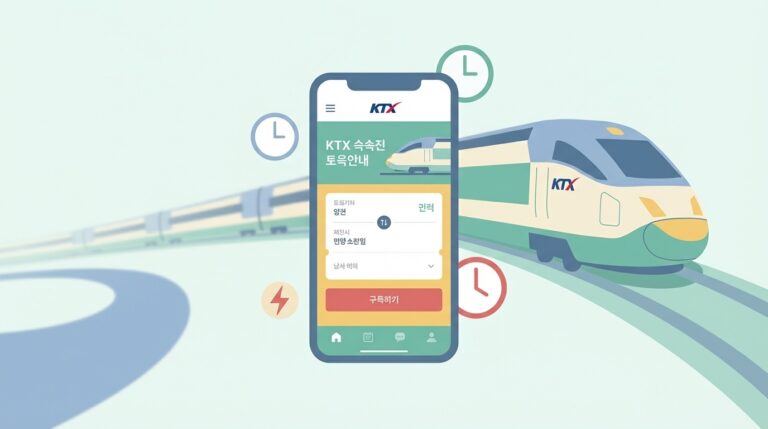
Nope. It’s the week before Chuseok (Korean Thanksgiving), and half of Seoul is trying to book a KTX train ticket to their hometowns.
Welcome to the infamous Korean ‘Ticketing War’ (티켓팅 전쟁). In Korea, buying a high-speed train (KTX or SRT) ticket during major holidays isn’t just a transaction; it’s a survival game. If you’re an expat or an advanced learner (C1 level) living in Korea, you’ve probably realized that textbook phrases like “기차표 한 장 주세요” (One train ticket, please) won’t save you when the app crashes and tickets sell out in 3 seconds.
If you don’t know the insider vocabulary, you might find yourself stuck in Seoul while your friends are enjoying delicious Jeon (Korean pancakes) in Busan. Don’t worry! This guide is based on the actual blood, sweat, and tears of my foreign students who successfully navigated the KTX/SRT app. Let’s dive in!
Phase 2: Core Expressions Deep Dive
1. 예매 대기를 걸다 (To put on the waitlist)
- Pronunciation: [yemae daegireul geolda] + ‘yemae’ sounds like ‘yeah-meh’, and ‘geol’ sounds like the ‘gull’ in seagull.
- Meaning: Literal: To hang a reservation wait. / Real nuance: To put yourself on the waitlist for a sold-out ticket.
- K-Culture Moment: You open the Korail Talk app. Every single train says 매진 (Sold out). But wait! A glimmer of hope: a blue button that says 예매대기. If you click this, the system will notify you if someone cancels their ticket.
- Editor’s Insight: We don’t just ‘apply’ for a waitlist; we ‘hang’ (걸다) it. It implies setting up a trap and waiting for the prey (a canceled ticket) to fall in.
- Situation Spectrum:
- Casual (Friends): ✅
- Semi-formal (Coworkers): ✅
- Formal (Boss/Elders): ⚠️ (Use ‘예매 대기를 신청했습니다’)
- 🤔 Think About It: Why does Korea have such a sophisticated waitlist system right in the app? It reflects the Pali-pali (hurry up) culture and the extreme density of population movement during holidays.
2. 취소표를 줍다 (To snag a canceled ticket)
- Pronunciation: [chwisopyoreul jupda] + ‘chwiso’ sounds like ‘chee-so’, ‘jup’ sounds like ‘joop’ (rhymes with loop).
- Meaning: Literal: To pick up a canceled ticket. / Real nuance: To successfully snatch a ticket someone else refunded at the very last minute.
- K-Culture Moment: This expression is heavily borrowed from K-Pop fandoms. When fans furiously refresh the ticketing page at 2 AM to find a seat someone gave up, they call it ‘picking up’ a ticket. We use the exact same slang for SRT/KTX tickets!
- Editor’s Insight: It carries a sense of luck, agility, and victory. You didn’t just buy it; you hunted and scavenged it.
- Situation Spectrum:
- Casual: ✅
- Semi-formal: ⚠️ (A bit too colloquial for a formal report)
- Formal: 🚫
- 🤔 Think About It: Notice how ‘줍다’ (to pick up from the ground) implies the ticket is a rare item dropped by someone else. Does your language have a similar gaming-like metaphor for buying things?
3. 입석이라도 끊다 (To buy at least a standing ticket)
- Pronunciation: [ipseogirado kkeunta] + ‘ipseok’ sounds like ‘ip-suck’. ‘kkeunta’ sounds like ‘ggeun-ta’.
- Meaning: Literal: To cut even a standing-room ticket. / Real nuance: I am so desperate that I will stand for 3 hours on the train just to get there.
- K-Culture Moment: The day before the holiday. All waitlists are full. Your only option is to go to the station physically and beg the staff for an Ipseok (Standing ticket). You’ll be sitting on your suitcase in the aisle between train cars, leaning against the toilet door.
- Editor’s Insight: We use the verb ‘끊다’ (to cut) for buying tickets, a leftover term from the old days when paper tickets were physically cut or punched by the conductor.
- Situation Spectrum:
- Casual: ✅
- Semi-formal: ✅
- Formal: ✅
- 🤔 Think About It: The willingness to stand for 400km just to eat a meal with the family… What does this say about the importance of family gatherings in Korean culture?
Phase 3: Textbook vs. Real Korean
[Situation 1: Asking if there are tickets left]
* 📖 Textbook: 기차표가 다 팔렸습니까? (Are the train tickets all sold out?)
* 🗣️ Real Korean: 매진됐어요? / 취소표 안 나와요? (Is it sold out? / Are there no canceled tickets popping up?)
* 💡 Why the difference?: Koreans use the Sino-Korean word ‘매진’ (Sold out) heavily. Also, in a high-stress situation, they don’t ask about the status; they ask for the solution (canceled tickets).
[Situation 2: Celebrating a successful booking]
* 📖 Textbook: 저는 기차표를 예약했습니다. (I have reserved a train ticket.)
* 🗣️ Real Korean: KTX 예매 성공! / 티켓팅 뚫었어! (KTX booking success! / I pierced through the ticketing!)
* 💡 Why the difference?: Getting a holiday ticket is viewed as breaching a fortress. Hence the slang ‘뚫다’ (to pierce/break through) is used by younger generations.
(Bottom Note: As C1 learners, using ‘뚫었어!’ or ‘취소표 주웠어’ will instantly make Koreans drop their jaws and treat you like a true local.)
Phase 4: Cultural Context — K-Culture Deep Dive
4-1. Non-Verbal Cues: The ‘Refresh’ Ritual
When someone says they are trying to get a ticket, you will often see them staring intensely at their phone, rapidly tapping the screen, or muttering “새로고침, 새로고침” (Refresh, refresh). Do not interrupt a Korean during the 8:00 AM ticket opening time. The Nunchi (social tact) here is to stay completely silent and perhaps offer them an iced Americano for focus.
4-2. The K-Pop Connection: “Mercenaries” (용병)
Because KTX/SRT holiday booking is exactly like K-Pop concert ticketing (known as 피켓팅 – Piketting, ‘blood ticketing’), the same culture applies. Young people often ask their friends with fast internet or “golden hands” (금손 – someone lucky at booking) to log in simultaneously and help them secure a seat. These helpful friends are called 용병 (Mercenaries).
If you successfully book a KTX ticket for your Korean friend, you are not just a friend; you are their savior.
Phase 5: Real-Life Roleplay Scenario
Setting: Friday, 2:50 PM in the office breakroom. You and your Korean coworker, Minsu, are staring at your phones. The SRT tickets for the Chuseok holiday open in exactly 10 minutes.
Characters:
* YOU: An expat working in Seoul, trying to visit Busan to see a friend.
* Minsu (32): Your friendly Korean coworker, a veteran of ticketing wars who has never failed to visit his hometown.
Dialogue:
Minsu: (Cracking his knuckles) OO씨, 코레일톡 앱 로그인 미리 해뒀죠? 결제 비밀번호도 확인했고요?
(OO-ssi, you logged into the Korail Talk app in advance, right? Checked your payment password too?)
YOU: 네, 다 해놨어요. 근데 벌써 심장이 뛰네요.
(Yes, everything is set. But my heart is already racing.)
Minsu: 3시 정각 되면 바로 ‘조회하기’ 눌러야 돼요. 대기열 뜬다고 절대 새로고침 누르면 안 됩니다! 튕겨요!
(When it hits exactly 3 PM, you must press ‘Search’. Even if the waiting queue pops up, absolutely NEVER press refresh! You’ll bounce out!)
(🎭 Stage Direction: The clock strikes 3:00 PM. You both furiously tap your screens. 3 minutes pass in agonizing silence…)
Minsu: 아싸! 저는 부산행 오후 2시 표 뚫었습니다! OO씨는요?
(Yes! I pierced through and got the 2 PM ticket to Busan! What about you?)
YOU: 앗… 저는 ‘잔여석 없음’이라고 뜨는데 어떡하죠?
(Oops… Mine says ‘No remaining seats’, what do I do?)
🔀 Your Turn! How should you respond to this crisis?
* A) “다 팔렸네요. 그냥 이번 명절은 서울에 있어야겠어요.” (It’s all sold out. I guess I’ll just stay in Seoul this holiday.)
* B) “일단 예매 대기 걸어놓고, 새벽에 취소표 좀 주워봐야겠어요.”
* C) “민수씨 표 저한테 파시면 안 돼요?” (Can you sell your ticket to me, Minsu?)✅ Best Choice: B — “I’ll put it on the waitlist for now, and try to pick up a canceled ticket at dawn.” This is the ultimate veteran response! It shows you understand the system. Minsu will respect you immensely.
⚠️ Choice A Analysis: A bit defeatist. Real Koreans don’t give up that easily.
🚫 Choice C Analysis: Never mess with a Korean’s holiday train ticket. That is grounds for ending a friendship! (Just kidding, but seriously, don’t ask.)
Phase 6: 10-Second Shadowing Drill
Let’s practice the victory phrase!
😤 아! (Ah!) / 😌 취소표 (chwisopyo) / 새로고침하다가 (saerogochimhadaga) / 😭 겨우 하나 (gyeou hana) / 🤩 주웠어요! (juwosseoyo!)
- Meaning: Ah! I was refreshing for a canceled ticket and barely picked one up!
- Intonation Tip: Start with an exhausted sigh on “아!”, build up the tension, and emphasize “주웠어요!” with pure, unadulterated joy.
Phase 7: K-Culture Mini Dictionary
| Korean | Romanization | English | Cultural Context |
|---|---|---|---|
| 피켓팅 | piketting | Blood-ticketing | A portmanteau of ‘피’ (blood) and ‘ticketing’. Used for K-pop concerts and holiday train bookings. |
| 귀성길 | gwiseonggil | Journey to hometown | The massive traffic jam/migration out of Seoul before the holiday. |
| 귀경길 | gwigyeonggil | Journey back to Seoul | The journey returning to the capital after the holiday. |
| 금손 | geumson | Golden hands | A slang for someone who is incredibly lucky or skilled at booking tickets. |
| 새로고침 | saerogochim | Refresh (F5) | The act of refreshing a webpage. The lifeline of ticketing. |
Phase 8: Traveler’s Survival Kit
Even if it’s not a holiday, booking KTX/SRT can be tricky. Here are your absolute survival phrases for the train station.
🆘 Survival Phrases TOP 3
1. 🇰🇷 “가장 빠른 부산행 기차 몇 시에 있어요?” (gajang ppareun busanhaeng gicha myeot sie isseoyo?)
* 🗣️ Meaning: What time is the fastest train heading to Busan?
2. 🇰🇷 “입석도 매진이에요?” (ipseokdo maejinieyo?)
* 🗣️ Meaning: Are the standing tickets sold out too?
3. 🇰🇷 “타는 곳이 몇 번 홈이에요?” (taneun gosi myeot beon homieyo?)
* 🗣️ Meaning: Which platform is the boarding area?📌 Editor’s Travel Note
* Apps: Download Korail Talk (for KTX) and SRT Play (for SRT). They are separate trains!
* Foreign Cards: The official English Korail website accepts foreign credit cards without the messy Korean authentication system (공인인증서). Use the website if the app gives you a headache!
* KTX vs SRT: KTX leaves from Seoul Station (central Seoul). SRT leaves from Suseo Station (Gangnam area) and is slightly cheaper and faster. Choose based on where your hotel is!
Phase 9: Critical Thinking — “One Step Deeper”
Family & Identity: The Great Holiday Migration
Have you ever wondered why millions of Koreans willingly subject themselves to the “ticketing war” and 8-hour traffic jams just to eat a meal in their hometowns?
This phenomenon, often called 명절 대이동 (The Great Holiday Migration), is deeply rooted in the Confucian value of Hyo (효 – Filial Piety) and ancestral rites (Charye). In the past, missing a holiday gathering was considered a severe disrespect to the family elders. However, Korean society is rapidly changing! Today, a new trend called 역귀성 (Reverse Migration) is growing, where parents travel up to Seoul to visit their busy working children, avoiding the worst traffic.
💬 Your Turn: Does your country have a specific holiday where everyone travels home at the exact same time? How do people survive the transportation chaos? Let us know in the comments!
Phase 10: FAQ & Mistake Prevention
Q: “If I have a standing ticket (입석), can I sit in an empty seat?”
* Yes, BUT: You can sneakily sit in an empty seat, but the moment the actual ticket holder boards at the next station, you must immediately stand up and yield the seat with a polite “Ah, sorry!” (아, 죄송합니다).
Q: “Can I use the Korail Pass during Seollal or Chuseok?”
* NO! This is a huge trap for travelers. The unlimited tourist Korail Pass is generally invalid or highly restricted during the official Seollal and Chuseok holiday periods. Always check the blackout dates!
❌ Common Mistake #1: Showing up at Seoul Station on the morning of Chuseok hoping to buy a ticket at the counter.
✅ How to fix it: Holiday tickets are sold one month in advance during a special designated 2-day period online. You must check the news or Korail notices a month prior!
Phase 11: Summary & Action Items
- One-Liner Summary: Booking a holiday train in Korea is a battlefield; survive by mastering words like 예매 대기 (Waitlist) and 취소표 (Canceled tickets).
Action Mission 3 Steps:
* 🥉 Bronze: Say “취소표 주웠어요!” out loud 3 times with a victorious fist pump.
* 🥈 Silver: Download the Korail Talk app and change the language settings to practice reading the UI (매진, 예매, 잔여석).
* 🥇 Gold: Next time you travel, deliberately try booking a ticket via the Korean app interface instead of the English one!
K-Culture Mission:
Search for “KTX 명절 예매 뉴스” (KTX Holiday Booking News) on YouTube. Look at the footage of people at Seoul Station or PC Bangs. Can you spot the tension?
Did you ever experience a ticketing war in Korea? Share your survival stories in the comments below!
Phase 12: Interactive Challenge (Quiz)
1. Situational Judgment:
You are checking the Korail app to go to Busan tomorrow. Everything is red and says ‘매진’. What is the smart, native-level move to make?
* A) Walk to Seoul station right now.
* B) Click ‘예매대기’ (Waitlist) and wait for a notification.
* C) Give up and walk to Busan.
2. True or False – K-Culture Edition:
“You can simply tap your T-money (subway card) to ride the KTX, just like a regular subway.”
3. Fill in the Blank:
“아침부터 계속 앱을 ( ) 했는데, 결국 표를 못 구했어요.”
(I kept doing _____ to the app since morning, but couldn’t get a ticket in the end.)
(Answers: 1. B, 2. False! You must buy a specific seat/train ticket. T-money is only for local transit, 3. 새로고침 – Refresh)
Frequently Asked Questions (FAQ)
Q: What does "예매 대기를 걸다 (To put on the waitlist)" mean in Korean and how do you pronounce it?
A: In Korean, "예매 대기를 걸다 (To put on the waitlist)" is pronounced [yemae daegireul geolda] and means: Literal: To hang a reservation wait. / Real nuance: To put yourself on the waitlist for a sold-out ticket.
Q: What does "취소표를 줍다 (To snag a canceled ticket)" mean in Korean and how do you pronounce it?
A: In Korean, "취소표를 줍다 (To snag a canceled ticket)" is pronounced [chwisopyoreul jupda] and means: Literal: To pick up a canceled ticket. / Real nuance: To successfully snatch a ticket someone else refunded at the very last minute.
Q: What does "입석이라도 끊다 (To buy at least a standing ticket)" mean in Korean and how do you pronounce it?
A: In Korean, "입석이라도 끊다 (To buy at least a standing ticket)" is pronounced [ipseogirado kkeunta] and means: Literal: To cut even a standing-room ticket. / Real nuance: I am so desperate that I will stand for 3 hours on the train just to get there.