

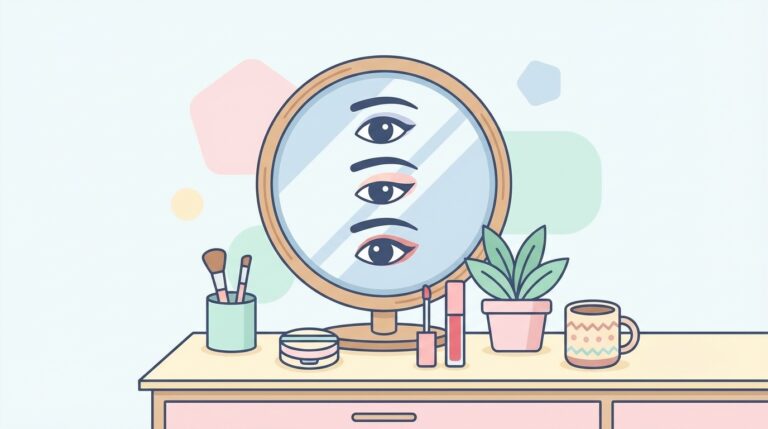
Phase 1: Empathy (Welcome to the K-Beauty Talk!)
Hello! This is your Daily Hangul Editor, your local Korean friend and veteran tutor.
Picture this: You are watching a K-Drama. The main character is sitting in front of a mirror, looking closely at their eyes. Or maybe you’re watching a K-Pop makeup tutorial on YouTube, and the idol says, “Today, I’ll show you makeup for monolids.” If you’ve been exploring K-Culture, you’ve probably noticed that Koreans pay a lot of attention to eye shapes—specifically, whether someone has a “double eyelid” or not.
For absolute beginners (A1), describing appearances might seem scary. But knowing how to talk about eyes isn’t just about beauty; it unlocks a whole new level of understanding K-Pop beauty standards and K-Drama tropes! Plus, the grammar we learn today is the ultimate survival tool: “I have [Noun].”
Let’s dive into the fascinating world of Korean eye shapes and learn how to describe them like a true insider. Don’t worry, I’ve got your back!
Phase 2: Deep Dive into Core Expressions
1. 쌍꺼풀이 있어요. (I have double eyelids.)
- Pronunciation: ssang-kkeo-pu-ri i-sseo-yo / [ssang-kkuh-poo-ree ee-suh-yo]
- Meaning: I have double eyelids. (Or: He/She has double eyelids).
- Sound Guide: The ‘쌍(ssang)’ requires a tight, strong ‘ss’ sound—like the hissing of a snake!
- K-Culture Moment: You’re at a makeup store like Olive Young, trying to find an eyeshadow palette. The staff might ask about your eye shape to recommend the best colors.
- Editor’s Insight: The word 쌍(ssang) means “double” or “pair.” 꺼풀(kkeo-pul) means “layer” or “skin.” So, it literally translates to “double-layered skin.”
- Situation Spectrum:
- Casual with friends: ✅ (You can just drop the ‘요’ and say 쌍꺼풀이 있어)
- Semi-formal (Coworkers): ✅
- Formal (Elders): ✅
- 🤔 Think About It: In Korean grammar, we use “이/가 있어요” to say “I have [X]” or “There is [X].” Why do you think Korean uses the same verb for possession and existence?
2. 쌍꺼풀이 없어요. (I don’t have double eyelids.)
- Pronunciation: ssang-kkeo-pu-ri eop-seo-yo / [ssang-kkuh-poo-ree uhp-suh-yo]
- Meaning: I don’t have double eyelids (I have monolids).
- Sound Guide: ‘없어요(eop-seo-yo)’ sounds like ‘up-suh-yo’.
- K-Culture Moment: Think of K-Pop idols known for their fierce, chic monolid looks (like BTS Jimin or ITZY Yeji). Fans love praising their unique eye shapes!
- Editor’s Insight: While having double eyelids was the traditional beauty standard, having NO double eyelids is incredibly popular right now for giving a “chic and unique” vibe.
- Situation Spectrum:
- Casual with friends: ✅
- Semi-formal (Coworkers): ✅
- Formal (Elders): ✅
Phase 3: Textbook vs Real Korean
[Describing Monolids]
* 📖 Textbook Korean: 저는 쌍꺼풀이 없습니다. (I do not have double eyelids. – Very formal)
* 🗣️ Real Korean: 저 무쌍이에요. (I am “mussang.”)
* 💡 Why the difference?: Koreans love abbreviating! “무(Mu)” means “None/Zero” (from Chinese characters) and “쌍(ssang)” is short for double eyelids. Put them together, and you get 무쌍 (Mussang – Monolid)! It’s a trendy, positive slang widely used on YouTube and TV.
[Describing Big Eyes]
* 📖 Textbook Korean: 눈이 큽니다. (The eyes are big.)
* 🗣️ Real Korean: 눈 진짜 커요! (Eyes are really big!)
* 💡 Why the difference?: In spoken Korean, adding “진짜 (jin-jja / really)” makes your reaction sound 100 times more natural and enthusiastic.
Bottom Note: For A1 beginners, sticking to “쌍꺼풀이 있어요(I have double eyelids)” and “무쌍이에요(I am monolid)” is perfect. It’s polite but sounds incredibly natural!
Phase 4: Cultural Context — K-Culture Deep Dive
4-1. Non-verbal Cue: Eye Contact in Korea
When talking about eyes, remember this: In many Western cultures, strong, unbroken eye contact shows confidence. In Korea, staring directly into an elder’s or a senior’s eyes without blinking can be seen as challenging or aggressive (we call this “눈싸움” – eye-fighting!). It’s best to maintain a soft gaze, occasionally looking slightly down, to show respect.
4-2. The “Mussang” (Monolid) Boom in K-Pop & K-Drama
Years ago, K-Dramas often featured characters getting double eyelid surgery as a rite of passage. But today? The trend has completely shifted!
Actors like Kim Go-eun (Goblin) and Park So-dam (Parasite) have made “무쌍” (monolids) a symbol of natural, expressive beauty. In the K-Pop fandom, having monolids is often described as having “매력” (mae-ryeok / unique charm). If you go to a fan meeting, you might hear fans screaming, “Your eyes are so charming!” rather than just focusing on classic big eyes.
Phase 5: Real-Life Roleplay Scenario
Setting: A trendy, pastel-toned cafe in Yeonnam-dong. You are having an iced Americano with your Korean friend, Min-su. You are looking at a magazine featuring a famous K-Pop idol.
Characters:
– YOU: A beginner Korean learner, huge K-Pop fan.
– Min-su (28): Your friendly Korean language exchange partner.
Dialogue:
Min-su: 우와, 이 아이돌 눈 정말 예쁘네요. ✨
(Uwa, i aidol nun jeongmal yeppeuneyo.)
[Wow, this idol’s eyes are really pretty.]
YOU: 맞아요. 매력 있어요.
(Majayo. Maeryeok isseoyo.)
[Right. They have charm.]
Min-su: 쌍꺼풀이 없는데 진짜 눈이 커요.
(Ssang-kkeo-pu-ri eom-neunde jinjja nu-ni keoyo.)
[They don’t have double eyelids, but their eyes are really big.]
🔀 Your Turn! How do you reply?
– A) “저는 눈이 없어요.” (I don’t have eyes.)
– B) “맞아요! 완전 매력적인 무쌍이에요!” (Right! It’s a totally charming monolid!)
– C) “쌍꺼풀이 쌍꺼풀이…”✅ Best Choice: B — You used the trendy slang “무쌍 (Mussang)”! Min-su will be so impressed.
⚠️ Choice A Analysis: Big mistake! “눈이 없어요(nu-ni eop-seo-yo)” literally means you are missing your eyeballs! Be careful to say “쌍꺼풀이 없어요(I don’t have double eyelids).”
Phase 6: 10-Second Shadowing Drill
Let’s practice the rhythm! Pay attention to the pauses (/) and the emotion.
- 😊 (Proudly) 저기요, / 저는 / 무쌍이에요!
(jeo-gi-yo, / jeo-neun / mu-ssang-i-e-yo!)
[Excuse me, I am monolid!] -
😯 (Amazed) 우와, / 쌍꺼풀이 / 정~~~말 예뻐요!
(u-wa, / ssang-kkeo-pu-ri / jeong~~~mal yep-peo-yo!)
[Wow, your double eyelids are re~~~ally pretty!]
Phase 7: K-Culture Mini Dictionary
| Korean | Romanization | English | Cultural Context |
|---|---|---|---|
| 쌍꺼풀 | ssang-kkeo-pul | Double eyelid | A major topic in Korean beauty standards. |
| 무쌍 | mu-ssang | Monolid | Trendy slang for having no double eyelids. Highly desired vibe in K-Pop. |
| 매력 | mae-ryeok | Charm/Appeal | Koreans prefer someone who is “매력 있다 (charming)” over just traditionally pretty. |
| 눈 | nun | Eye(s) / Snow | Context matters! It means both eyes and snow. |
Phase 8: Traveler’s Survival Kit
Since we learned “~이/가 있어요 (I have / There is),” let’s use this ultimate A1 grammar hack for your trip to Korea! When shopping at Olive Young or a convenience store, just put the noun before “있어요?”.
🆘 Survival Expression #1: Looking for something
– 🇰🇷 “이거 있어요?” (i-geo i-sseo-yo?)
– 🗣️ Sound guide: [ee-guh ee-suh-yo?]
– 📍 Where to use: K-Beauty stores, convenience stores, restaurants.
– 💡 Pro Tip: Point to a picture on your phone (like an eyeshadow palette) and ask, “이거 있어요?” (Do you have this?). It works 100% of the time!📌 Editor’s Travel Note
– K-Beauty Shopping: When buying eye makeup, staff might use the word “무쌍” (monolid) to recommend specific eyeliners that don’t smudge!
Phase 9: Critical Thinking — “One Step Deeper”
Media vs Reality: The Evolution of Beauty
If you watch early 2000s K-Dramas, big eyes with thick double eyelids were the absolute, unquestioned beauty standard. Many foreigners still hold the stereotype that “all Koreans want double eyelid surgery.” However, reality has evolved rapidly. Today, media and society celebrate diversity. The rise of global K-Pop stars with monolids (무쌍) has redefined Korean beauty, emphasizing self-love and finding one’s unique “vibe” rather than fitting a single mold.
💬 Your Turn: Does your culture have a specific physical trait that is highly talked about? Has that beauty standard changed over the years? Share it in the comments!
Phase 10: FAQ & Avoiding Common Mistakes
Q: Is it rude to comment on someone’s appearance in Korea?
A: It’s a bit complicated! Close Korean friends or older relatives often comment on appearances (e.g., “Did you lose weight?” or “Your eyes look pretty today”). It is meant as affection. However, as a foreigner, it’s safer to stick to general compliments like “멋있어요(You’re cool)” rather than pointing out specific physical traits to strangers.
❌ Common Mistake #1: Mixing up the particles!
Wrong: 쌍꺼풀을 있어요. (X)
Right: 쌍꺼풀이 있어요. (O)
Why? The verb ‘있어요 (to have/exist)’ MUST be paired with the subject particles 이/가, never the object particles 을/를!
Phase 11: Summary & Action Items
One-Liner Summary: Today, we learned how to say “I have double eyelids” (쌍꺼풀이 있어요) and the trendy K-Pop slang for monolids (무쌍).
Your Mission for Today:
* 🥉 Bronze (Solo): Look in the mirror and say your eye shape out loud in Korean! (저는 쌍꺼풀이 있어요 / 저는 무쌍이에요).
* 🥈 Silver (Online): Find a photo of your favorite K-Pop idol or actor. Comment on a fan page: “눈 진짜 예뻐요!” (Eyes are really pretty!).
* 🥇 Gold (Real Life): Next time you watch a K-Drama, listen closely for the word “쌍꺼풀(ssang-kkeo-pul)” or “매력(mae-ryeok)”.
K-Culture Mission: Open YouTube and search “무쌍 메이크업” (Monolid makeup) or “쌍꺼풀 메이크업” (Double eyelid makeup). Even if you don’t wear makeup, watching Korean beauty YouTubers is an amazing way to pick up natural daily vocabulary!
Phase 12: Interactive Quiz Challenge
Let’s test your K-Beauty Korean!
1. You want to tell your Korean friend that your favorite actor has charming monolids. What is the best word to use?
A) 쌍꺼풀 (ssang-kkeo-pul)
B) 무쌍 (mu-ssang)
C) 눈싸움 (nun-ssa-um)
2. Fill in the blank for the ultimate shopping survival phrase: “Do you have this?”
이거 ______요? (i-geo ______-yo?)
3. True or False:
In Korea, having “무쌍” (monolids) is considered unattractive and outdated.
(Answers below!)
…
…
…
Answers:
1. B (무쌍 is the trendy slang for monolids! A means double eyelids, and C means a staring contest.)
2. 있어 (이거 있어요? – Do you have this?)
3. False (Monolids are currently celebrated as very charming and chic in modern K-Culture!)
Did you get them all right? See you in the next Daily Hangul lesson! 😊
Frequently Asked Questions (FAQ)
Q: What does "쌍꺼풀이 있어요. (I have double eyelids.)" mean in Korean and how do you pronounce it?
A: In Korean, "쌍꺼풀이 있어요. (I have double eyelids.)" is pronounced [ssang-kkeo-pu-ri i-sseo-yo / [ssang-kkuh-poo-ree ee-suh-yo] and means: I have double eyelids. (Or: He/She has double eyelids).
Q: What does "쌍꺼풀이 없어요. (I don't have double eyelids.)" mean in Korean and how do you pronounce it?
A: In Korean, "쌍꺼풀이 없어요. (I don't have double eyelids.)" is pronounced [ssang-kkeo-pu-ri eop-seo-yo / [ssang-kkuh-poo-ree uhp-suh-yo] and means: I don't have double eyelids (I have monolids).







