

안녕하세요! 매일한글(Daily Hangul) 에디터입니다.
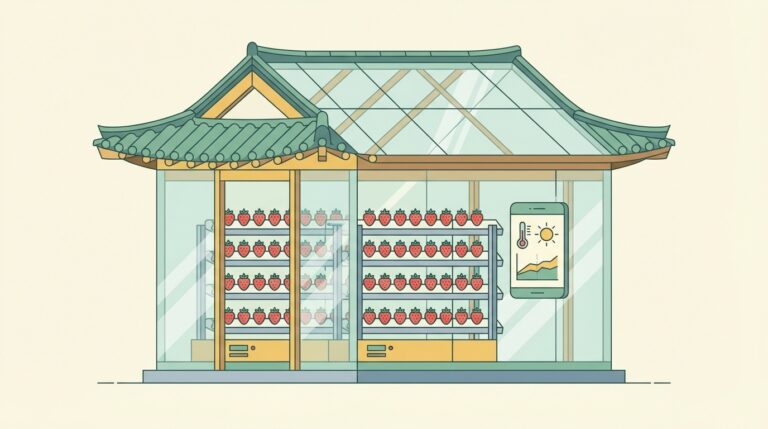
Have you ever watched a K-Drama where the wealthy chaebol CEO visits a massive, futuristic greenhouse controlled entirely by an iPad? Or perhaps you’ve visited Korea in the dead of winter and marveled at how K-BBQ restaurants still serve bottomless plates of crisp, fresh perilla leaves (깻잎)? Or maybe you’ve bitten into a perfectly sweet Korean strawberry (설향, Seolhyang) and wondered, “How is this so perfect?”
The secret isn’t just good soil—it’s Ag-Tech (Agriculture Technology). Korea, a country where 70% of the land is mountainous, has rapidly embraced Smart Farms (스마트 팜) to ensure food security and keep our beloved K-Food culture alive.
At the C2 level, you already know words like 농장 (farm) or 과일 (fruit). Today, we are upgrading your vocabulary to the level of Korean news anchors, Ag-Tech entrepreneurs, and true locals. Let’s dive into the fascinating world of Korean smart farming and food security!
Phase 2: Core Expressions Deep Dive
To talk about agriculture and productivity in Korea like a highly educated native, you need these three powerhouse expressions.
1. 작황 (Crop Condition / Harvest Yield)
- Pronunciation: [jak-hwang] Sounds a bit like “Jacques Wang” said quickly.
- Meaning: (Literal) Crop condition / (Real nuance) The overall success or failure of a season’s harvest.
- K-Culture Moment: You turn on the morning news in your Seoul hotel room. The anchor looks serious: “올해 배추 작황이 부진하여 김장철 물가에 비상이 걸렸습니다.” (Due to the poor cabbage harvest this year, there is an emergency for prices during the Kimchi-making season.)
- Editor’s Insight: This is a high-level Sino-Korean word (作況). Instead of saying “농사가 잘 안 됐다” (farming didn’t go well), professionals and the media use “작황이 좋다/나쁘다”. It immediately signals fluency.
- Situation Spectrum:
- Casual with friends: ⚠️ (A bit too formal, unless discussing the news)
- Professional / Business (Semi-formal): ✅
- News / Academic / Formal: ✅
- 🤔 Think About It: Why does Korean news report on the “작황” of specific vegetables (like cabbage or radish) almost like it’s a national security issue? How deeply is Kimchi tied to the Korean psyche?
2. 금사과 / 금배추 (Gold Apple / Gold Cabbage)
- Pronunciation: [geum-sa-gwa] / [geum-bae-chu] ‘Geum’ rhymes with the ‘gum’ you chew, but round your lips slightly.
- Meaning: (Literal) Gold apple / (Real nuance) Produce that has become insanely expensive due to climate change or poor yields.
- K-Culture Moment: At a trendy brunch cafe in Seongsu-dong, your friend looks at the menu and sighs. “와, 사과 샐러드 가격 봐. 요즘 사과가 아니라 금사과라더니 진짜네.” (Wow, look at the price of the apple salad. They said apples are gold apples these days, and it’s true.)
- Editor’s Insight: “금” (Gold) + Noun is a common prefix to denote hyper-inflation of a specific grocery item. It reflects the immediate anxiety over food security in daily life.
- Situation Spectrum:
- Casual with friends: ✅
- Professional (Semi-formal): ✅ (Great for small talk about the economy)
- Formal: ⚠️ (Better to use “가격 폭등” – price surge in highly formal settings)
- 🤔 Think About It: Does your language have a fun prefix or slang to describe sudden inflation of everyday grocery items?
3. 식량 자급률 (Food Self-Sufficiency Rate)
- Pronunciation: [sing-nyang ja-geum-nyul] Notice the assimilation! ‘sik-ryang’ becomes ‘sing-nyang’.
- Meaning: (Literal & Real) Food self-sufficiency rate.
- K-Culture Moment: You’re in a high-level business meeting with an Ag-Tech startup. The CEO pitches their smart farm technology by saying, “한국의 낮은 식량 자급률을 해결할 열쇠는 스마트 팜입니다.” (The key to solving Korea’s low food self-sufficiency rate is smart farms.)
- Editor’s Insight: Korea imports a vast amount of its food. Discussing this term shows a profound understanding of Korea’s geopolitical and geographical vulnerabilities.
- Situation Spectrum:
- Casual with friends: 🚫 (Too academic)
- Business / Startup Pitch (Semi-formal): ✅
- Formal / Debate: ✅
- 🤔 Think About It: For a country that loves food so much, how does importing so much of it affect national policies?
Phase 3: Textbook vs. Real Korean
Even advanced learners sometimes sound like reading a news script. Let’s bridge the gap between academic and conversational C2 Korean.
[Situation 1: Discussing the benefits of Smart Farms]
* 📖 Textbook: 스마트 팜 기술로 인해 농업 생산성이 크게 향상되었습니다.
* 🗣️ Real Korean: 스마트 팜 도입하고 나서 수확량이 장난 아니게 늘었대요. 1년 내내 제철 과일을 먹을 수 있잖아요.
* 💡 Why the difference?: Even in professional small talk, Koreans mix high-level vocabulary (“도입”, “수확량”, “제철”) with conversational intensifiers (“장난 아니게” – unbelievably) to sound engaged and natural.
[Situation 2: Complaining about grocery prices due to climate]
* 📖 Textbook: 기후 변화로 인해 작황이 부진하여 물가가 상승했습니다.
* 🗣️ Real Korean: 올해 날씨가 미쳐서 과일이 다 금값이에요. 마트 가기가 무섭다니까요.
* 💡 Why the difference?: Emotional hyperbole (“날씨가 미쳐서” – the weather is crazy, “마트 가기가 무섭다” – scared to go to the mart) is the core of Korean venting culture (한탄).
Phase 4: Cultural Context — K-Culture Deep Dive
4-1. Non-Verbal Elements: The Reverence for “농부의 정성” (Farmer’s Dedication)
When discussing food or agriculture in Korea, you must understand the underlying sentiment of 신토불이 (Sintoburi)—the belief that “body and soil are one.” Even when discussing AI-driven smart farms, Koreans still revere the “정성” (sincere effort/care). When someone serves you premium smart-farmed produce, lightly nodding while saying “이거 진짜 귀한 거네요” (This is really precious) shows high-level Nunchi.
4-2. K-Food Connection: The Banchan Economy
Why is Korean Ag-Tech so focused on year-round cultivation (연중 재배)? Because of K-BBQ and Banchan (side dishes)! A Korean restaurant must serve lettuce, perilla leaves, and garlic, regardless of whether there’s a blizzard or a typhoon. If a restaurant charges extra for lettuce due to poor 작황 (yield), customers get upset. Smart farms are literally saving the “free refill” K-Food culture by stabilizing the supply chain against climate change.
Phase 5: Real-Life Roleplay Scenario
Setting: A Friday evening, 7 PM. You are at a premium K-BBQ restaurant in Yeouido. You are having dinner with your Korean business partner from an Ag-Tech startup. The server brings out a beautiful, glowing plate of specialized vegetables.
Characters:
– YOU (The Reader): An expat working in investment/tech, fluent in Korean but always eager to learn local nuances.
– Director Kim (45, Tech Partner): Proud of his company’s smart farm technology, enjoys a good drink and deep conversations.
Dialogue:
Director Kim: 00씨, 이 상추 한번 드셔보세요. 저희 스마트 팜에서 AI로 온도랑 일조량 조절해서 키운 겁니다.
(00-ssi, i sangchu hambeon deuseoboseyo. Jeo-hui seumateu pam-eseo AI-ro ondo-rang iljo-ryang jojeolhaeseo kiun geomnida.)
[00, try this lettuce. We grew it in our smart farm by controlling the temperature and sunlight with AI.]
(🎭 Stage Direction: Director Kim proudly pushes the plate toward you.)
YOU: 와, 잎이 정말 연하고 싱싱하네요! 일반 하우스 재배랑 확실히 다른가요?
(Wa, ipi jeongmal yeonhago singsing-haneyo! Ilban hauseu jaebae-rang hwaksilhi dareungayo?)
[Wow, the leaves are so tender and fresh! Is it definitely different from regular greenhouse cultivation?]
Director Kim: 그럼요. 노지 재배나 일반 비닐하우스는 날씨 영향을 너무 많이 받잖아요. 요즘처럼 기상이변이 심할 때는 작황 예측이 아예 불가능해요.
(Geureomyo. Noji jaebae-na ilban binilhauseu-neun nalssi yeonghyang-eul neomu mani batjanayo. Yojeum-cheoreom gisang-ibyeon-i simhal ttae-neun jak-hwang yecheuk-i aye bulganeunghaeyo.)
[Of course. Open-field or regular vinyl greenhouses are too affected by the weather. These days, with severe climate anomalies, predicting the crop yield is entirely impossible.]
YOU: 맞아요, 뉴스 보니까 요즘 채솟값이 너무 올라서 다들 난리더라고요.
(Majayo, nyuseu bonikka yojeum chaesotgap-i neomu ollaseo dadeul nallideoragoyo.)
[Right, I saw on the news that vegetable prices have skyrocketed recently, and everyone is in an uproar.]
Director Kim: 그래서 스마트 팜이 필수죠. 식량 안보 차원에서도 그렇고요. 자, 고기 익었습니다. 쌈 하나 싸서 드시죠!
(Geuraeseo seumateu pam-i pilsujo. Singnyang anbo chawon-eseodo geureokoyo. Ja, gogi igeotseumnida. Ssam hana ssaseo deusijo!)
[That’s why smart farms are essential. Also from the perspective of food security. Here, the meat is done. Make a wrap and eat!]
🔀 Your Turn! How should you respond to keep the mood great and show your C2 level?
– A) “감사합니다. 식량 자급률 향상에 기여하시는군요!” (Thank you. You are contributing to the improvement of the food self-sufficiency rate!)
– B) “잘 먹겠습니다! 김 이사님 덕분에 오늘 금상추를 다 먹어보네요!” (I will eat well! Thanks to Director Kim, I get to eat ‘gold lettuce’ today!)
– C) “대박! AI 상추라니 짱이에요!” (Awesome! AI lettuce is the best!)✅ Best Choice: B — Why? It perfectly blends respect (“잘 먹겠습니다”), flattery, and high-level cultural slang (“금상추” – gold lettuce, acknowledging how precious/expensive it is).
⚠️ Choice A Analysis: Too stiff and academic for a BBQ setting, even with a business partner. Save “식량 자급률” for the boardroom!
⚠️ Choice C Analysis: “대박” and “짱” are too childish for a 45-year-old Director, especially in a professional setting.
Phase 6: 10-Second Shadowing Drill
Let’s practice the perfect pacing for a professional yet conversational C2 sentence.
😲 요즘은 / 날씨가 하도 변덕스러워서 / 스마트 팜 아니면 / 작황을 예측할 수가 없어요.
(yojeumeun / nalssiga hado byeondeokseureowoseo / seumateu pam animyeon / jak-hwang-eul yecheukal suga eopseoyo.)
“These days, the weather is so fickle that without smart farms, it’s impossible to predict crop yields.”
Tips: Stress “하도” (so much) and clearly pronounce the complex syllable “작황” (jak-hwang).
Phase 7: K-Culture Mini Dictionary (Ag-Tech Edition)
| 한국어 | Romanization | English | Cultural Context |
|---|---|---|---|
| 귀농 | gwinong | Returning to farming | The trend of city dwellers moving to the countryside to farm. Often romanticized in media, but increasingly tech-driven now. |
| 신토불이 | sintoburi | Body and soil are one | A traditional idiom emphasizing the health benefits of eating locally grown, seasonal Korean produce. |
| 노지 재배 | noji jaebae | Open-field cultivation | Farming outdoors without a greenhouse. Highly vulnerable to Korea’s intense monsoons and typhoons. |
| 하우스 수박 | hauseu subak | Greenhouse watermelon | Watermelons grown in winter using heated greenhouses (and now smart farms), a luxury item often bought as a premium gift. |
Phase 8: Traveler Survival Kit (Premium Market Edition)
As a traveler, you might not buy “smart farm software,” but you will encounter smart-farmed premium fruits in places like Shinsegae or Hyundai Department Store food halls.
🆘 Survival Expressions for Premium Fruits
– 🇰🇷 “이거 당도가 어떻게 되나요?” (igeo dangdoga eotteoke doenayo?)
– 🗣️ Meaning: What is the Brix (sweetness level) of this?
– 📍 Where to use: Premium fruit corners. Korean smart farms guarantee specific sweetness levels (Brix/브릭스).
– 💡 Pro Tip: Look for labels that say “고당도” (High sweetness) or “스마트 팜 재배” (Smart farm grown). They make the absolute best gifts if you are visiting a Korean home!📌 Editor’s Travel Note
Fruit in Korea is famously expensive compared to Europe or Southeast Asia. It is often treated as a luxury gift rather than a cheap daily snack. Don’t be shocked by a $20 box of perfect strawberries!
Phase 9: Critical Thinking — “One Step Deeper”
Food & Identity (음식과 정체성)
🧠 Think Deeper:
Korean dining is fundamentally communal. The table is covered in banchan (side dishes) meant to be shared, wrapped in endless layers of leafy greens (ssam culture). But this cultural identity relies on a massive, stable supply of specific vegetables. As climate change brings longer monsoons to the Korean peninsula, traditional farming is failing to keep up. In this context, Smart Farms are not just an economic tool; they are cultural preservation devices. They ensure that the core of Korean identity—generously sharing a table full of fresh greens—doesn’t become an unaffordable luxury of the past.💬 Your Turn: How is technology changing the traditional food supply in your culture? Are there any “traditional” foods that are now mostly grown using advanced tech? Let us know in the comments!
Phase 10: FAQ & Avoiding Misunderstandings
Q: Can I use the word “작황 (jak-hwang)” when buying vegetables at a traditional market (전통시장)?
No! If you say “할머니, 올해 작황이 어떤가요?” (Grandma, how is the crop yield this year?), she might think you are a government inspector or a news reporter! Keep it casual: “올해 농사 잘 됐어요?” (Did farming go well this year?) or “요즘 채솟값이 많이 올랐죠?” (Vegetable prices went up a lot, right?).
❌ Common Mistake #1: Translating “agriculture” directly to “농업 (nongeop)” in daily conversation.
✅ Do this instead: Use “농사 (nongsa – farming)” for manual labor and daily chat, and save “농업 (nongeop – agriculture industry)” for business, economics, or tech discussions.❌ Common Mistake #2: Complaining about fruit prices by saying “너무 비싸요” (Too expensive) in a premium department store.
✅ Do this instead: High prices in these venues are due to strict quality control (often via smart farms). Use the culturally savvy term: “과일이 완전 금값이네요!” (Fruit is totally the price of gold!) to show empathy with the macro-economy rather than just complaining about the tag.
Phase 11: Summary & Action Items
One-Liner Summary: Elevate your Korean by discussing agricultural tech and food security with C2-level terms like 작황 (yield), 금배추 (gold cabbage), and 식량 자급률 (food self-sufficiency).
Action Mission 3 Steps:
– 🥉 Bronze (Solo): Read the 10-second shadowing drill out loud 3 times, focusing on the sophisticated tone.
– 🥈 Silver (Online): Look up “스마트 팜 딸기” (Smart farm strawberry) on Korean YouTube and read the comments. Try to spot words like “당도” or “수확량”.
– 🥇 Gold (Real World): Next time you eat at a K-BBQ restaurant, casually say to your Korean friend, “요즘 채소 작황이 안 좋다던데, 쌈 많이 먹기 눈치 보이네요!” (I heard vegetable yields are bad lately, I feel a bit self-conscious eating too many wraps!).
Phase 12: Interactive Challenge (Quiz)
1. Situational Judgment: You are writing an email to a Korean Ag-Tech company to inquire about their automated greenhouse software. Which sentence is most appropriate?
– A) 당신네 비닐하우스 농사 잘 됩니까?
– B) 귀사의 스마트 팜 기술 도입 후, 작황 개선 데이터가 궁금합니다.
– C) 식량 자급률 때문에 날씨가 미쳤습니다.
2. Fill in the blank:
“물가가 너무 올라서 이제 사과가 아니라 ( ___ )과야.”
(Prices went up so much, it’s not an apple anymore, it’s a [ ___ ]-apple.)
3. True or False – K-Culture Edition:
In Korea, it is considered rude to ask for free refills of side dishes (banchan) at a standard restaurant.
Click to reveal answers!
- B (A is too casual/rude, C makes no logical sense. B perfectly uses C2 business vocabulary: 귀사, 도입, 작황, 개선).
- 금 (Gold) – 금사과 (Gold apple).
- False. Free banchan refills are a core part of Korean dining culture (정)! However, due to recent inflation (금배추), some places are struggling, so leaving uneaten banchan is heavily frowned upon.
Frequently Asked Questions (FAQ)
Q: What does "작황 (Crop Condition / Harvest Yield)" mean in Korean and how do you pronounce it?
A: In Korean, "작황 (Crop Condition / Harvest Yield)" is pronounced [jak-hwang] and means: (Literal) Crop condition / (Real nuance) The overall success or failure of a season's harvest.
Q: What does "금사과 / 금배추 (Gold Apple / Gold Cabbage)" mean in Korean and how do you pronounce it?
A: In Korean, "금사과 / 금배추 (Gold Apple / Gold Cabbage)" is pronounced [geum-sa-gwa] and means: (Literal) Gold apple / (Real nuance) Produce that has become insanely expensive due to climate change or poor yields.
Q: What does "식량 자급률 (Food Self-Sufficiency Rate)" mean in Korean and how do you pronounce it?
A: In Korean, "식량 자급률 (Food Self-Sufficiency Rate)" is pronounced [sing-nyang ja-geum-nyul] and means: (Literal & Real) Food self-sufficiency rate.







