

Phase 1: Empathy (The K-Culture Cold Open)
Hello! I’m the lead editor of Daily Hangul.
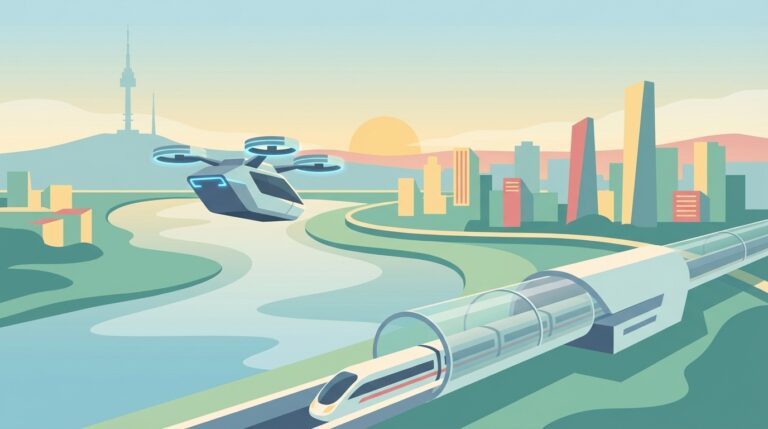
Imagine this: You’re watching a sci-fi K-Drama set in the near future. The protagonist needs to get from Gangnam to Yeouido to stop a corporate takeover. Instead of hopping into a black sedan and getting stuck on the Olympic Expressway, they step onto a rooftop pad and take off in a sleek drone taxi.
But here’s the plot twist—this isn’t just a K-Drama fantasy anymore. South Korea is aggressively pushing for the commercialization of UAM (Urban Air Mobility) and Hyperloop technologies. Whether you’re working at a tech company in Pangyo, chatting with Korean colleagues over iced Americanos, or just watching the Korean news, future mobility is a hot topic.
If you want to move beyond intermediate small talk (like “The weather is nice”) and dive into sophisticated C1-level conversations about tech, society, and the future, you need the right vocabulary. Let’s upgrade your Korean so you can talk about the future like a true local insider!
Phase 2: Core Expressions Deep Dive
1. 상용화되다
- Pronunciation: [sang-yong-hwa-doe-da] + [Sounds like: sang-yong-hwa-dway-da]
- Meaning: Literal: To be commercialized. / Real nuance: When a new tech goes from ‘cool prototype’ to ‘something everyday people can actually buy or use.’
- K-Culture Moment: You’ll hear news anchors use this word constantly when talking about 6G, AI, or drone taxis. In an office setting, asking “When will this be commercialized?” makes you sound incredibly professional.
- Editor’s Insight: This word is a powerhouse for advanced speakers. It turns a casual “when can we use it?” into a polished, executive-level inquiry.
- Situation Spectrum:
- Close Friends (Casual): ⚠️ (A bit too formal, friends might say “언제쯤 탈 수 있대?”)
- Coworkers (Semi-formal): ✅
- Boss/News/Business (Formal): ✅
- 🤔 Think About It: Why does Korean have so many specific Sino-Korean words (Hanja) for business and tech concepts, rather than descriptive phrases? How does this affect the ‘efficiency’ of the language?
2. 출퇴근 지옥에서 해방되다
- Pronunciation: [chul-toe-geun ji-og-e-seo hae-bang-doe-da]
- Meaning: Literal: To be liberated from the commute hell. / Real nuance: To finally escape the soul-crushing traffic jams or packed subway trains during rush hour.
- K-Culture Moment: Anyone who has ridden Seoul’s Subway Line 9 during rush hour (infamously called ‘지옥철’ – Hell Train) understands this in their bones. This is the ultimate emotional selling point for UAM in Korea.
- Editor’s Insight: While ‘상용화되다’ is for your brain, this expression is for your soul. It perfectly captures the collective pain of the Korean working class.
- Situation Spectrum:
- Close Friends (Casual): ✅
- Coworkers (Semi-formal): ✅
- Boss/News/Business (Formal): ⚠️ (A bit emotional for a formal presentation, but great for breaking the ice).
- 🤔 Think About It: “Hell” (지옥) is often attached to everyday struggles in Korea (e.g., 입시 지옥 – entrance exam hell). What does this tell you about the intensity of modern Korean society?
3. 획기적으로 단축하다
- Pronunciation: [hoek-gi-jeog-eu-ro dan-chuk-ha-da]
- Meaning: Literal: To shorten epoch-makingly. / Real nuance: To drastically or dramatically reduce (usually time or distance).
- K-Culture Moment: “Seoul to Busan in 30 minutes via Hyperloop!” This phrase is the holy grail of Korean infrastructure projects, driven by the nation’s infamous ‘Pali-pali’ (hurry up) culture.
- Editor’s Insight: ‘단축하다’ is good, but adding ‘획기적으로’ (groundbreakingly/drastically) elevates your Korean to native-like C1 fluency. It adds exactly the right amount of dramatic flair expected in Korean corporate jargon.
- Situation Spectrum:
- Close Friends (Casual): 🚫 (Too stiff)
- Coworkers (Semi-formal): ✅
- Boss/News/Business (Formal): ✅
Phase 3: Textbook vs. Real Korean
[Talking about travel time]
* 📖 Textbook: 이동 시간이 크게 감소할 것입니다. (Travel time will greatly decrease.)
* 🗣️ Real Korean: 강남까지 10분 컷이에요. (It’s a 10-minute cut to Gangnam.)
* 💡 Why the difference?: Young Koreans love using “-분 컷” (minute cut) from gaming culture to express how fast a task or journey can be completed.
[Talking about a new vehicle]
* 📖 Textbook: 새로운 비행 택시가 도입됩니다. (New flying taxis will be introduced.)
* 🗣️ Real Korean: 조만간 드론 택시 뜬대요. (They say drone taxis will be flying/launched soon.)
* 💡 Why the difference?: ‘뜨다’ literally means ‘to float/fly’, but it’s also slang for ‘to become popular’ or ‘to officially launch’. It’s highly efficient and versatile.
Bottom Note: For C1 learners, knowing both the formal Sino-Korean vocabulary (for presentations) and the trendy slang (for after-work drinks) is the key to true fluency.
Phase 4: Cultural Context — K-Culture Deep Dive
4-1. The Non-verbal “Nunchi” of Future Tech
When discussing new technologies with older executives or traditionalists in Korea, read the room (Nunchi). While younger generations are excited about “drone taxis,” older generations might express concern about safety or the loss of traditional taxi jobs. Acknowledging both sides shows advanced cultural fluency: “편리하겠지만, 규제 문제도 고민해 봐야겠네요” (It will be convenient, but we should also consider the regulatory issues).
4-2. K-Mobility & The ‘Pali-pali’ DNA
Why is Korea at the forefront of testing UAM and Hyperloop (K-UAM Grand Challenge)? It’s rooted in the 빨리빨리 (Pali-pali/Hurry up) culture. In a country where next-day delivery is considered “slow” (Dawn delivery is the norm), spending two hours stuck in traffic between Incheon and Seoul is culturally intolerable. The Hyperloop isn’t just about cool tech; it’s the ultimate evolution of the Korean desire to compress time and space.
Critical View: While this drive for efficiency brought rapid economic growth, it also creates an incredibly high-pressure society. The desire to teleport from Seoul to Busan in 30 minutes reflects a culture that rarely knows how to simply slow down and enjoy the journey.
Phase 5: Real-Life Roleplay Scenario
Setting: Friday afternoon. A hip tech-startup cafe in Pangyo (often called the Silicon Valley of Korea). You are grabbing a coffee with Minsu, a senior developer on your team.
Characters:
– YOU: A foreign tech consultant who closely follows industry trends.
– Minsu (34): Your Korean coworker. Tech-savvy, slightly burned out by his daily commute from Gyeonggi-do.
Dialogue:
Minsu: 아, 오늘 퇴근길 벌써부터 끔찍하네요. 비 와서 차 엄청 막힐 텐데.
(A, oneul toegeun-gil beolsseobuteo kkeumjjikhaneyo. bi waseo cha eomcheong makhil tende.)
[Ah, today’s commute home is already looking terrible. It’s raining, so traffic will be awful.]
YOU: 민수 씨, 한강에서 UAM 시범 운행하는 뉴스 봤어요?
(Minsu ssi, han-gangeseo UAM sibeom unhaenghaneun nyuseu bwasseoyo?)
[Minsu, did you see the news about the UAM test flight over the Han River?]
Minsu: 봤죠! 드론 택시 상용화되면 진짜 당장 탈 거예요.
(Bwatjyo! Deuron taeksi sang-yong-hwadoemyeon jinjja dangjang tal geoyeyo.)
[I saw it! If drone taxis are commercialized, I’m riding one immediately.]
YOU: 요금이 꽤 비쌀 텐데요?
(Yogeumi kkwae bissal tendeyo?)
[The fare will probably be quite expensive though?]
Minsu: 돈이 문제인가요? 제 시간과 정신 건강을 돈으로 사는 셈이죠.
(Doni munje-ingayo? Je sigan-gwa jeongsin geon-gang-eul doneuro saneun semijyo.)
[Is money the issue? It’s practically buying back my time and mental health.]
YOU: 듣고 보니 그렇네요. 이동 시간이 획기적으로 단축될 테니까요.
(Deutgo boni geureonneyo. Idong sigan-i hoekgijeogeuro danchukdoel tenikkayo.)
[Now that I hear that, it makes sense. The travel time will be drastically reduced.]
Minsu: 맞아요. 서울역에서 여기까지 하늘로 오면 15분 컷일걸요?
(Majayo. Seoul-yeogeseo yeogikkaji haneullo omyeon sibobun keosilgeollyo?)
[Right. If you fly from Seoul Station to here, it’d probably be a 15-minute cut.]
🔀 Your Turn! How should you respond?
– A) “15분이면 정말 빠르네요. 기대됩니다.” (Textbook & Safe)
– B) “와, 그럼 민수 씨 이제 출퇴근 지옥에서 완전 해방이네요!” (Empathetic & Natural)
– C) “거짓말! 어떻게 15분 만에 와요?” (A bit too aggressive/rude for a coworker)✅ Best Choice: B — Reason: It uses the C1 phrase ‘출퇴근 지옥에서 해방’ (liberated from commute hell) and shows deep empathy for Minsu’s daily struggle, instantly boosting your camaraderie.
Phase 6: 10-Second Shadowing Drill
Ready to sound like a tech-savvy local? Practice the rhythm and pauses!
😲 와, / UAM이 상용화되면 / 출퇴근 시간이 / 획기적으로 / 줄어들겠네요!
(wa, / UAM-i sang-yong-hwadoemyeon / chul-toe-geun sigan-i / hoekgijeogeuro / jureodeulgenneyo!)
[Wow, if UAM gets commercialized, commute times will be drastically reduced!]
Tone: Bright, impressed, and highly engaged.
Phase 7: K-Culture Mini Dictionary
| Korean | Romanization | English | Context |
|---|---|---|---|
| 모빌리티 | mo-bil-li-ti | Mobility | In Korea, this Konglish term specifically refers to the futuristic tech/startup transport sector (e.g., Kakao Mobility, smart cars). |
| 인프라 | in-peu-ra | Infrastructure | Another common Konglish word. Koreans love discussing if the ‘infra’ is ready for new tech. |
| 시범 운행 | si-beom un-haeng | Trial run / Test drive | Used heavily in news before a technology is fully commercialized. |
| 수도권 | su-do-gwon | Metropolitan area | Seoul, Incheon, and Gyeonggi province. The primary target for UAM to solve dense traffic. |
Phase 8: Traveler Survival Kit (Current & Future)
We might not have Hyperloops just yet, but navigating Korea’s highly advanced current transit system is a must.
🆘 Survival Phrases for K-Transit
– 🇰🇷 “KTX 매진됐나요? 입석이라도 있나요?” (KTX maejindoennayo? Ipseogirado innayo?)
– 🗣️ Meaning: Is the KTX sold out? Are there even standing tickets?
– 📍 Where to use: Seoul Station, Train apps.
– 💡 Pro Tip: During major holidays (Chuseok/Seollal), high-speed trains sell out months in advance. ‘입석’ (standing ticket) is your last resort!📌 Editor’s Travel Note
– Essential Apps: You cannot survive without Kakao T (for taxis and bikes) and Naver Map (Google Maps doesn’t work well for walking/transit in Korea due to security laws).
– The ‘Tag’ Culture: Always tag your T-money card when getting off the bus. If you don’t, you’ll be charged a penalty fee on your next ride, and you’ll ruin the data collection for route optimization!
Phase 9: Critical Thinking — “One Step Deeper”
Global Era Korean: The Konglish Tech Boom
Have you noticed how many tech words in Korean are just English loanwords? Mobility, Drone, Hyperloop, Platform, Smart-city. As Korea aims to lead the global tech market, the corporate language is rapidly blending with English. While this makes it easier for English speakers to catch the context, Korean linguists often debate this.
Is using “모빌리티” (Mobility) instead of a pure Korean word alienating older generations who don’t speak English? Or is it a necessary evolution for a country whose economy relies on global tech exports?
💬 Your Turn: How does your native language handle new technological terms? Do you invent new native words (like the French often do), or do you adopt the English terms? Share your thoughts in the comments!
Phase 10: FAQ & Avoiding Misunderstandings
Q: Can I use “-분 컷” (minute cut) in a business presentation?
A: No. 🚫 Save “10분 컷” for casual chats with coworkers or friends. In a formal presentation, stick to “10분으로 단축됩니다” (It will be shortened to 10 minutes).
Q: What is the difference between 개발 (Development) and 상용화 (Commercialization)?
A: A company might develop (개발하다) a flying car today, but it might take 10 years before it is commercialized (상용화되다) for public use. Using them correctly shows C1-level precision.
❌ Common Mistake: Translating “Flying car” literally to “나는 자동차” (Naneun jadongcha).
✅ Do this instead: Koreans rarely say “나는 자동차.” They use the industry terms 드론 택시 (Drone Taxi) or UAM (유에이엠). Sound like an insider, not a literal dictionary!
Phase 11: Summary & Action Items
One-Liner Summary: Master terms like ‘상용화되다’ and ‘획기적으로 단축되다’ to seamlessly blend into advanced Korean tech and business conversations.
Action Mission 3 Steps:
– 🥉 Bronze (Solo): Read the shadowing sentence out loud 3 times, focusing on the dramatic intonation of ‘획기적으로’.
– 🥈 Silver (Online): Go to a Korean YouTube news video about UAM or Hyperloop, and leave a comment: “빨리 상용화되면 좋겠네요!” (Hope it gets commercialized soon!)
– 🥇 Gold (Real Life): Next time you are stuck in traffic with a Korean friend, sigh and say: “빨리 드론 택시가 상용화돼야 출퇴근 지옥에서 해방될 텐데요.”
K-Culture Mission:
Open Naver Map and look at the route from Incheon Airport to Gangnam. Now imagine cutting that 90-minute drive down to 20 minutes with a drone taxi. Where would you fly to first in Seoul if UAM was launched tomorrow?
Phase 12: Interactive Challenge (Quiz)
1. Situational Judgment: You are presenting a new transit project to the CEO. Which sentence is most appropriate?
– A) 대표님, 이 기술로 이동 시간을 10분 컷으로 만들겠습니다.
– B) 대표님, 이 기술이 상용화되면 이동 시간이 획기적으로 단축될 것입니다.
– C) 대표님, 출퇴근 지옥에서 당장 해방시켜 드릴게요.
2. Fill in the Blank:
“드디어 하늘을 나는 택시가 ___________(상용화/개발) 되어서 일반 시민들도 탈 수 있게 되었습니다.”
3. T/F Culture Quiz:
“If you take a taxi in Korea, it is culturally expected to tip the driver 10-15%.” (True or False?)
(Answers: 1: B (A and C are too slangy/casual for a CEO). 2: 상용화 (Because regular citizens can finally ride it). 3: False! There is no tipping culture in Korea. Just pay the meter fare!)
Frequently Asked Questions (FAQ)
Q: What does "상용화되다" mean in Korean and how do you pronounce it?
A: In Korean, "상용화되다" is pronounced [sang-yong-hwa-doe-da] and means: Literal: To be commercialized. / Real nuance: When a new tech goes from 'cool prototype' to 'something everyday people can actually buy or use.'
Q: What does "출퇴근 지옥에서 해방되다" mean in Korean and how do you pronounce it?
A: In Korean, "출퇴근 지옥에서 해방되다" is pronounced [chul-toe-geun ji-og-e-seo hae-bang-doe-da] and means: Literal: To be liberated from the commute hell. / Real nuance: To finally escape the soul-crushing traffic jams or packed subway trains during rush hour.
Q: What does "획기적으로 단축하다" mean in Korean and how do you pronounce it?
A: In Korean, "획기적으로 단축하다" is pronounced [hoek-gi-jeog-eu-ro dan-chuk-ha-da] and means: Literal: To shorten epoch-makingly. / Real nuance: To drastically or dramatically reduce (usually time or distance).







