

Survive the Hongdae Busking Scene Like a Local 🎸
Phase 1: Welcome to the Streets of Youth
Hello! I’m the Lead Editor of Daily Hangul, your personal guide to the heart of Korea.
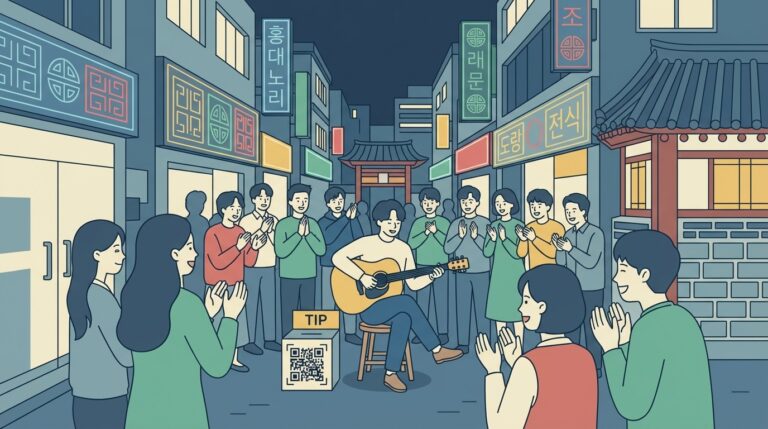
Imagine this: It’s Friday night in Hongdae (홍대). The air smells of sweet tteokbokki and roasted chicken skewers. Neon signs are buzzing overhead, and you find yourself naturally pulled toward a crowd gathered in a circle. In the center, a young artist is strumming an acoustic guitar, singing a heart-wrenching K-Drama OST you definitely heard in Hospital Playlist. Or maybe it’s a dynamic dance crew flawlessly executing a K-Pop cover.
You want to cheer, you want to request a song, and you want to leave a tip. But wait… you don’t have any cash, and the artist is talking to the audience! What do you say? If you just stand there smiling silently, you’re missing out on half the fun. Busking in Korea isn’t just a performance; it’s an interactive conversation.
Let’s dive into the essential phrases that will transform you from a silent bystander to an active participant in Korea’s vibrant street performance culture! (Trust me, these are based on real questions from my students who successfully navigated the Hongdae busking streets!)
Phase 2: Core Expressions Deep Dive
Here are the top phrases you need to connect with Korean street performers.
1. 신청곡 받아주시나요?
- Pronunciation: sincheonggok badajusinayo? (sin-cheong-gok / ba-da-ju-si-na-yo?)
Sound analogy: ‘eo’ sounds like the ‘u’ in ‘up’.- Meaning: Do you take song requests? (Literal: Do you receive requested songs?)
- K-Culture Moment: Many acoustic buskers in Korea love taking requests from the crowd. If you politely raise your hand during a break and ask this, the crowd will eagerly wait to hear what song you choose!
- Editor’s Insight: This phrase sounds extremely polite and respectful. You’re not demanding a song; you’re gently asking if their setup allows for requests.
- Situation Spectrum:
- Casual (Friends): 🚫 (Too formal)
- Performers/Strangers: ✅ (Perfect!)
- Boss/Elders: ⚠️ (Grammatically fine, but contextually rare)
- 🤔 Think About It: Why do Koreans use “받아주시나요” (give me the favor of receiving) instead of a direct “Can I request a song?” How does this reflect the Korean emphasis on considering the other person’s boundaries?
2. 계좌이체 되나요?
- Pronunciation: gyejwa-iche doenayo? (gyeh-jwa-ee-che / dweh-na-yo?)
- Meaning: Can I do a bank transfer?
- K-Culture Moment: You loved the K-Pop dance cover and want to tip. You look for a hat, but there isn’t one. Instead, there’s a small sign with a QR code or a bank account number. Korea is a highly cashless society!
- Editor’s Insight: This is arguably the most practical survival phrase in modern Korea. You can use this at street food stalls, small markets, and yes, for tipping buskers.
- Situation Spectrum:
- Casual: ⚠️ (Just use the app without asking)
- Street Vendors/Buskers: ✅ (Standard phrase)
- Department Stores: 🚫 (They use cards)
- 🤔 Think About It: Tipping isn’t a traditional part of Korean culture (in restaurants, it’s actually discouraged). Why is street performance the one exception, and how has digital banking shaped it?
3. 분위기 찢었다!
- Pronunciation: bunwigi jjijeotda! (boon-wee-gee / jji-jut-da!)
- Meaning: The vibe is insane! / You killed it! (Literal: You tore the atmosphere!)
- K-Culture Moment: A busker hits that impossible high note in an IU song, or the dance crew executes a perfect drop. The crowd goes wild. If you mutter this phrase, the Koreans standing next to you will instantly look at you with deep respect.
- Editor’s Insight: This is B2-level slang magic. It’s the ultimate compliment for a performer, emphasizing that their energy completely dominated the space.
- Situation Spectrum:
- Casual/Crowd reactions: ✅ (Highly recommended)
- Professional formal settings: 🚫 (Never use this at a classical recital!)
- 🤔 Think About It: Slang often uses violent or intense verbs (like “tearing” or “killing”) to express extreme positivity. Does your native language do the same?
Phase 3: Textbook vs. Real Korean
Let’s see how the streets differ from your textbook.
[Praising the Performance]
* 📖 Textbook Korean: 정말 훌륭한 공연입니다. (This is a truly excellent performance.)
* 🗣️ Real Korean: 우와, 음색 미쳤다! (Wow, your vocal tone is crazy!)
* 💡 Why the difference?: Busking is raw and youthful. Using highly formal, textbook vocabulary creates an unnatural distance. “미쳤다” (It’s crazy) is the highest form of casual praise among Korean youth.
[Wanting to Tip]
* 📖 Textbook Korean: 당신에게 돈을 드리고 싶습니다. (I want to give you money.)
* 🗣️ Real Korean: (Just quietly scanning the QR code) / 계좌이체 할게요! (I’ll transfer to your account!)
* 💡 Why the difference?: Directly talking about giving “money” (돈) can feel slightly awkward or transactional. Highlighting the method (account transfer) focuses on the supportive action rather than the cash itself.
[Asking for Social Media]
* 📖 Textbook Korean: 소셜 미디어 아이디가 무엇입니까? (What is your social media ID?)
* 🗣️ Real Korean: 혹시 인스타 하세요? (By any chance, do you do Insta?)
* 💡 Why the difference?: Koreans love using “혹시” (by any chance) to soften a question, making it feel less intrusive.
Bottom Note: At a B2 level, start replacing “너무 좋아요” (very good) with expressive slang like “찢었다” or “미쳤다” when you’re in casual, high-energy environments like a street concert.
Phase 4: Cultural Context — K-Culture Deep Dive
4-1. The Non-Verbal “Nunchi” of Busking
In Korea, eye contact and reaction (호응 – ho-eung) are everything. Korean buskers feed off the audience’s energy. However, due to Nunchi (the subtle art of reading the room), a Korean crowd might initially be quiet or shy. If the performer asks, “Are you guys having fun?”, a simple loud “네!” (Yes!) with enthusiastic clapping breaks the ice. Also, if you’re taking a video, it’s polite to nod and smile if the performer makes eye contact with your camera!
4-2. The K-Pop Connection: From the Streets to the Stage
If you are a K-Pop fan, you already know that the Hongdae busking streets are a legendary training ground. Many famous idols (like members of ATEEZ or former busking groups) honed their skills performing on these very streets.
When you watch a dance cover group, you’ll notice fans executing fanchants perfectly, just like at an actual stadium concert. If you want to praise a performer on their Instagram later, use fan-lingo like: “오늘 무대 최고였어요! 입덕할 것 같아요” (Today’s stage was the best! I think I’m going to become a fan/stan).
Phase 5: Real-Life Roleplay Scenario
Setting: Friday night, 8 PM. You are in the heart of Hongdae’s “Walkable Street” (걷고 싶은 거리). The autumn breeze is crisp. You and your Korean friend, Minho, are watching an acoustic duo sitting on amplifiers, tuning their guitars. The crowd is intimate, about 30 people.
Characters:
– YOU: A B2 Korean learner, currently traveling in Seoul. You love Korean indie music.
– Minho (28): Your local friend, energetic and loves pushing you to practice your Korean.
– Busker (20s): Friendly, holds a guitar, scanning the audience for interactions.
Action!
Busker: 안녕하세요 여러분! 날씨가 많이 쌀쌀하죠? 🥶
(annyeonghaseyo yeoreobun! nalssiga mani ssalsalhajyo?)
Hello everyone! The weather is quite chilly, right?
(🎭 Stage Direction: The busker rubs his hands together and smiles at the front row)
YOU: 네! 진짜 추워요!
(ne! jinjja chuwoyo!)
Yes! It’s really cold!
Minho: 야, 너 리액션 좋다. 계속 해봐.
(ya, neo riaeksyeon jota. gyesok haebwa.)
Hey, your reactions are good. Keep going.
Busker: 분위기 띄울 겸, 혹시 듣고 싶은 노래 있으신 분?
(bunwigi ttuiul gyeom, hoksi deutgo sipeun norae isseusin bun?)
To hype up the mood, anyone have a song they want to hear?
🔀 Your Turn! How do you respond?
– A) (Look away and avoid eye contact like the rest of the shy crowd)
– B) “신청곡 받아주시나요? 폴킴 노래 불러주세요!”
– C) “아무거나 빨리 불러주세요!”✅ Best Choice: B — “Do you take requests? Please sing a Paul Kim song!” It’s polite, clear, and engaging.
⚠️ Choice C Analysis: “Sing anything quickly!” sounds incredibly rude and impatient in Korean.
(Assuming you chose B…)
YOU: 저요! 신청곡 받아주시나요? 폴킴 노래 불러주세요! 🙋
(jeoyo! sincheonggok badajusinayo? polkim norae bulleojuseyo!)
Me! Do you take requests? Please sing a Paul Kim song!
Busker: 오! 폴킴의 ‘너를 만나’ 괜찮으세요? 바로 갈게요.
(o! polkimui ‘neoreul manna’ gwaenchaneuseyo? baro galgeyo.)
Oh! Is Paul Kim’s ‘Me After You’ okay? I’ll go right into it.
(🎭 Stage Direction: The busker sings beautifully. The song ends, and the crowd applauds loudly.)
YOU: 와… 분위기 찢었다! 👏
(wa… bunwigi jjijeotda!)
Wow… the vibe is insane!
Minho: 올~ 한국어 패치 완벽한데? 우리 팁 드리고 가자.
(ol~ hangugeo paechi wanbyeokande? uri tip deurigo gaja.)
Oh~ your Korean patch is perfect! Let’s leave a tip and go.
YOU: 헐, 나 현금 없는데. 계좌이체 되나요?
(heol, na hyeongeum eomneunde. gyejwa-iche doenayo?)
Wait, I don’t have cash. Can I do a bank transfer?
Minho: 저기 팻말 봐. 카카오페이 큐알코드 있어. 찍어!
(jeogi paetmal bwa. kakaopei kyualkodeu isseo. jjigeo!)
Look at the sign over there. There’s a KakaoPay QR code. Scan it!
Phase 6: 10-Second Shadowing Drill
Let’s practice the flow and intonation. Follow the emotion tags and pause where you see the slash (/)!
- 😊 저기요, / 신청곡 / 받아주시나요?
(jeogiyo, / sincheonggok / badajusinayo?) - 😤 와… / 방금 무대 / 진짜 찢었다!
(wa… / banggeum mudae / jinjja jjijeotda!) - 🥺 혹시 / 카카오페이로 / 계좌이체 되나요?
(hoksi / kakaopeiro / gyejwa-iche doenayo?)
Phase 7: K-Culture Mini Dictionary
| Korean | Romanization | English | Contextual Meaning |
|---|---|---|---|
| 호응 | ho-eung | Audience response | Crucial for buskers. Includes clapping, cheering, and answering questions. |
| 팁 박스 | tip bakseu | Tip box | Often an open guitar case, but nowadays heavily features a printed QR code. |
| 직캠 | jikkaem | Fancam | A video recorded directly by a fan. Buskers love it when you upload these and tag them! |
| 입덕 | ipdeok | Becoming a fan | A slang combining ‘enter’ and ‘otaku’. Used when a performance totally wins your heart. |
| 앵콜 | aengkol | Encore | Shout this rhythmically (Aeng-kol! Aeng-kol!) when you want one last song. |
Phase 8: Traveler’s Survival Kit 🎒
🆘 Survival Expression #1
– 🇰🇷 “사진 같이 찍어주실 수 있나요?” (sajin gati jjigeojusil su innayo?)
– 🗣️ English Guide: Could you take a picture with me?
– 📍 Where to use: After the performance ends, while they are packing up.
– 💡 Pro Tip: Wait until they are completely finished with their set. Buskers usually love taking photos with international fans!
📌 Editor’s Travel Note
– Where to find them: Hongdae Walkable Street (Line 2), Sinchon U-Plex square, and Haeundae Beach in Busan.
– Etiquette: Do NOT block the walking path. Korean police occasionally ask crowds to disperse if they block pedestrian traffic.
– Cash vs. Apps: If you are a traveler without a Korean bank account (KakaoPay/Toss), try to carry a few 1,000 or 5,000 KRW bills. Physical tip boxes still exist for tourists!
Phase 9: Critical Thinking — “One Step Deeper”
🧠 Think Deeper: Language & Digitalization of Culture
In many Western cultures, tipping a street performer involves tossing a physical coin or bill into a guitar case—it’s a tangible, immediate exchange. However, in Korea’s highly digitized society, you will often see people standing a few feet away, silently scanning a QR code to transfer money directly into the performer’s bank account.
At first glance, sending money via a banking app might feel cold or transactional. But in Korea, this is an extension of “Jeong” (정 – warmth/connection). Because no one carries cash anymore, performers adapted so that the audience could still support them. The language adapted too: asking “계좌이체 되나요?” (Can I do a bank transfer?) has become a modern expression of appreciation and support, proving that technology doesn’t replace human connection—it just changes how it looks.
💬 Your Turn: How do people support street performers in your country? Do you still use cash, or has it gone digital too? Let us know in the comments!
Phase 10: FAQ & Avoiding Misunderstandings
Q: “Can I film the buskers and post it on YouTube/Instagram?”
Yes! In fact, 99% of buskers in Korea want you to film them. They usually display their Instagram handles clearly on an iPad or sign. However, make sure you don’t aggressively film the faces of the audience members, as Korea has strict portrait rights (초상권) laws.
Q: “Is it okay to use ‘분위기 찢었다’ to the performer’s face?”
Maybe. It is slang. It’s perfectly fine to shout it as a reaction in the crowd, or leave it as an Instagram comment. But if you walk up to them after the show to say hello, it’s safer to say, “공연 너무 잘 봤습니다!” (I really enjoyed the performance!)
❌ Common Mistake #1: Tipping with foreign currency coins.
✅ Do this instead: Coins from other countries cannot be exchanged at banks easily in Korea and are practically useless to the performer. Please use Korean Won or try to set up a tourist-friendly prepaid card that allows transfers (like Namane or WOWPASS).
Phase 11: Summary & Action Items
- One-Liner Summary: Enjoying a Korean busking show is all about energetic reactions (찢었다!) and digital support (계좌이체).
Action Mission 3 Steps:
– 🥉 Bronze (Solo): Practice saying “신청곡 받아주시나요?” out loud with a natural, friendly tone.
– 🥈 Silver (Online): Find a Hongdae busking video on YouTube and leave a comment: “음색 미쳤다! 분위기 찢었다!”
– 🥇 Gold (Real Life): Next time you are in Hongdae or Sinchon, listen to a busker, drop a tip, and ask for their Instagram handle!
🎬 K-Culture Mission:
Search for “Hongdae dance cover” (홍대 댄스커버) on YouTube. Watch how the audience reacts to the beat drops. Can you spot the QR codes or tip boxes near their speakers?
Did you ever experience a busking performance in Korea? Which song did they play? Share your story below! 👇
Phase 12: Quiz — Interactive Challenge
1. Situational Judgment: The acoustic singer asks the crowd if they are having fun. The crowd is a bit quiet. What is the most culturally appropriate thing for you to do to help the performer?
– A) Yell “빨리 다음 노래 해주세요!” (Hurry and play the next song!)
– B) Clap loudly and shout “네! 너무 좋아요!” (Yes! It’s so good!)
– C) Walk up and put money in their hand directly.
💡 Click for Answer & Explanation
Answer: B. Korean buskers thrive on ‘호응’ (response). A loud, cheerful response breaks the awkwardness (Nunchi) and hypes up the crowd. Option A is rude, and Option C interrupts the performance.
2. Fill in the Blank:
“현금이 없는데 혹시 ________ 되나요?” (I don’t have cash, by any chance can I do a bank transfer?)
💡 Click for Answer
Answer: 계좌이체 (gyejwa-iche)
3. True or False — K-Culture Edition:
“In Korea, if a street performer doesn’t have a hat or guitar case out, they do not want to be tipped.”
💡 Click for Answer
Answer: False. They most likely have a small sign with an account number (계좌번호) or a QR code for digital transfers!
Frequently Asked Questions (FAQ)
Q: What does "신청곡 받아주시나요?" mean in Korean and how do you pronounce it?
A: In Korean, "신청곡 받아주시나요?" is pronounced [sincheonggok badajusinayo? (sin-cheong-gok / ba-da-ju-si-na-yo?] and means: Do you take song requests? (Literal: Do you receive requested songs?)
Q: What does "계좌이체 되나요?" mean in Korean and how do you pronounce it?
A: In Korean, "계좌이체 되나요?" is pronounced [gyejwa-iche doenayo? (gyeh-jwa-ee-che / dweh-na-yo?] and means: Can I do a bank transfer?
Q: What does "분위기 찢었다!" mean in Korean and how do you pronounce it?
A: In Korean, "분위기 찢었다!" is pronounced [bunwigi jjijeotda! (boon-wee-gee / jji-jut-da!] and means: The vibe is insane! / You killed it! (Literal: You tore the atmosphere!)







