

Phase 1: Empathy & The K-Culture Cold Open
Hello! I’m your lead editor and tutor at Daily Hangul.
Picture this: You’ve just binge-watched a gripping K-Thriller like Signal or Through the Darkness. Now, you’re walking back to your Airbnb in Seoul late at night. The streetlights flicker. You hear footsteps behind you. You quicken your pace, and they do too. Your heart drops. You need to dial 112 (the Korean police). The dispatcher picks up… but what do you say in Korean without freezing up?
While South Korea is famously one of the safest countries in the world (yes, you can leave your laptop unattended at a cafe!), emergencies can happen anywhere. Knowing how to report a suspicious person isn’t just about language; it’s about giving yourself the ultimate safety net and peace of mind during your travels.
This guide is crafted from real questions asked by solo travelers who wanted that extra layer of confidence. Let’s dive into the essential survival Korean you hope you never need, but will be grateful to know!
Phase 2: Core Expressions Deep Dive
1. 여기 수상한 사람이 있어요.
- Pronunciation: Yeogi susanghan sarami isseoyo. / [‘Yeogi’ sounds like Yogi bear, ‘susanghan’ sounds like sue-sang-hahn]
- Meaning: There is a suspicious person here.
- K-Culture Moment: Imagine a tense drama scene where the protagonist ducks into an alley, covers their mouth, and whispers this exact line into their phone to the police dispatcher.
- Editor’s Insight: Notice how we start with “여기” (Here)? In emergencies, Korean places the location first to grab immediate attention. It sets the stage before delivering the problem.
- Situation Spectrum:
- Casual (Friends): ✅
- Semi-formal (Strangers/Clerks): ✅
- Formal (Police/112): ✅
- 🤔 Think About It: Why does Korean emphasize location (“Here”) so much in emergencies? How does your native language structure an urgent call for help?
2. 누가 계속 저를 따라와요.
- Pronunciation: Nuga gyesok jeoreul ttarawayo. / [Noo-gah gyeh-sok juh-reul tta-ra-wa-yo]
- Meaning: Someone keeps following me.
- K-Culture Moment: This is the classic line used when a character rushes into a brightly lit 24/7 convenience store to escape a stalker.
- Editor’s Insight: “누가” (Someone) and “계속” (continuously) add intense urgency. It’s much more natural than trying to specify “a man” or “a woman” when you are panicked.
- Situation Spectrum:
- Casual: ✅
- Semi-formal: ✅
- Formal: ✅
- 🤔 Think About It: Notice how the subject is just “Someone”? Korean frequently omits specific pronouns. Why is this vagueness actually helpful when you are scared?
3. 빨리 와주세요.
- Pronunciation: Ppalli wajuseyo. / [Ppal-lee wa-joo-seh-yo]
- Meaning: Please come quickly.
- K-Culture Moment: You probably already know “Ppalli-ppalli” (Hurry up!) from K-food delivery culture. In emergencies, this cultural speed translates to life-saving action.
- Editor’s Insight: Even in a panic, we use the polite ending “-juseyo” (please give/do for me). It commands action while maintaining respect for the officer.
- Situation Spectrum:
- Casual: ⚠️ (Use ‘빨리 와!’ for friends)
- Semi-formal: ✅
- Formal: ✅
- 🤔 Think About It: Even in life-or-death situations, Koreans maintain politeness markers. What does this tell you about the ingrained nature of the Korean hierarchy system?
Phase 3: Textbook vs. Real Korean
[Describing the Suspect’s Clothes]
* 📖 Textbook Korean: 이 사람은 검은색 코트를 입고 있습니다. (This person is wearing a black coat.)
* 🗣️ Real Korean: 검은색 패딩 입었어요! (They’re wearing a black long padding!)
* 💡 Why the difference?: The “long padding” (puffer jacket) is the unofficial winter uniform in Korea. It’s the most culturally accurate and common way to describe someone’s outerwear in the winter!
[Asking a Passerby for Help]
* 📖 Textbook Korean: 저를 도와주시겠습니까? (Would you help me?)
* 🗣️ Real Korean: 저기요, 도와주세요! (Excuse me, help me!)
* 💡 Why the difference?: In an emergency, long formalities waste time. Shouting “Jeogiyo!” (Excuse me/Hey!) cuts through the noise and gets immediate attention.
Phase 4: Cultural Context — K-Culture Deep Dive
4-1. Non-verbal Nuance: Survival ‘Nunchi’
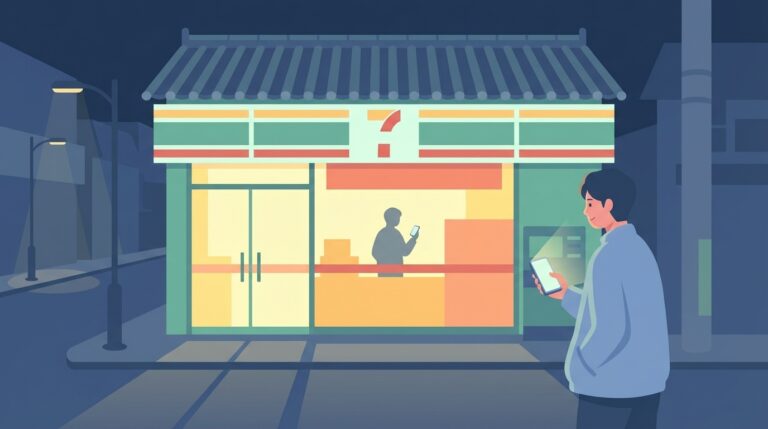
In an emergency, use your 눈치 (Nunchi – situational awareness). Do not make aggressive eye contact with the suspicious person. Instead, scan your surroundings for the nearest 24/7 convenience store (like GS25, CU, or 7-Eleven). These stores are brightly lit, always staffed, and are practically considered safe havens in Korea. Many even have direct emergency buttons to the police behind the counter.
4-2. K-Travel Connection: The Power of CCTV
South Korea is heavily monitored by CCTV (씨씨티비). It is so notoriously safe that locals joke, “The CCTV is watching, so no one steals your laptop.” If you feel unsafe on a street, simply pointing out a CCTV camera or walking purposefully toward a brightly lit store is usually enough to deter any suspicious behavior.
Phase 5: Real-Life Roleplay Scenario
Setting: 11:30 PM, a quiet alley in Hongdae. You are walking back to your guesthouse. Someone has been walking uncomfortably close behind you for three blocks. You duck into a glowing GS25 convenience store and approach the clerk at the counter.
Characters:
– YOU: A traveler seeking safety.
– Ji-hoon (22): The friendly night-shift convenience store clerk.
Dialogue:
YOU: 저기요…
(Jeogiyo…)
[Excuse me…]
Ji-hoon: 네, 어서오세요.
(Ne, eoseooseyo.)
[Yes, welcome.]
YOU: 밖에 수상한 사람이 있어요.
(Bakke susanghan sarami isseoyo.)
[There’s a suspicious person outside.]
Ji-hoon: 네? 밖이요?
(Ne? Bakkiyo?)
[Excuse me? Outside?]
YOU: 누가 계속 저를 따라와요.
(Nuga gyesok jeoreul ttarawayo.)
[Someone keeps following me.]
(🎭 Stage Direction: Ji-hoon immediately stops scanning barcodes and looks out the window, looking concerned.)
Ji-hoon: 헐… 경찰 부를까요?
(Heol… gyeongchal bureulkkayo?)
[OMG… should I call the police?]
YOU: 네, 빨리 와주세요… 아, 아니 불러주세요.
(Ne, ppalli wajuseyo… ah, ani bulleojuseyo.)
[Yes, please come quickly… ah, I mean please call them.]
Ji-hoon: 여기 안쪽에 계세요. 112에 신고할게요.
(Yeogi anjjoge gyeseyo. Il-il-i-e singohalgeyo.)
[Stay inside here. I’ll report it to 112.]
🔀 Your Turn! The police dispatcher asks Ji-hoon to describe the person. Ji-hoon asks you. How do you answer?
– A) “키가 커요.” (They are tall.)
– B) “검은색 패딩 입었고, 마스크 썼어요.” (Black padding, wearing a mask.)
– C) “나쁜 사람이에요!” (They are a bad person!)✅ Best Choice: B — This is highly specific to Korean fashion and current trends, making it incredibly easy for the police to spot them.
⚠️ Choice C Analysis: Saying “Bad person” is too childish and doesn’t give the police actionable information.
Phase 6: 10-Second Shadowing Drill
Practice these lines so they become muscle memory. Pay attention to the pauses (/) and the emotions!
- 😨 Urgent: 여기 / 수상한 사람이 / 있어요! (yeogi / susanghan sarami / isseoyo!)
- 😭 Scared: 누가 계속 / 저를 / 따라와요… (nuga gyesok / jeoreul / ttarawayo…)
- 🙏 Pleading: 제발 / 빨리 / 와주세요! (jebal / ppalli / wajuseyo!)
Phase 7: K-Culture Mini Dictionary
| 한국어 | Romanization | English | Cultural Context |
|---|---|---|---|
| 경찰 | gyeongchal | Police | The general term for police officers. |
| 파출소 | pachulso | Police Substation | Small, neighborhood police stations. Very common and accessible. |
| 편의점 | pyeonuijeom | Convenience Store | Your 24/7 safe zone. GS25, CU, 7-Eleven. |
| 씨씨티비 | ssi-ssi-ti-bi | CCTV | Security cameras. The backbone of Korea’s public safety. |
| 살려주세요 | sallyeojuseyo | Save me! / Help! | Stronger than “Help me” (도와주세요). Use this in extreme danger. |
Phase 8: Traveler’s Survival Kit
🆘 Survival Expression TOP 3
1. 🇰🇷 “경찰 불러주세요!” (Gyeongchal bulleojuseyo!)
– 🗣️ English Guide: gyung-chal bool-luh-ju-se-yo
– 📍 Meaning: Please call the police!
2. 🇰🇷 “도와주세요!” (Dowajuseyo!)
– 🗣️ English Guide: do-wa-ju-se-yo
– 📍 Meaning: Help me!
3. 🇰🇷 “저리 가세요!” (Jeori gaseyo!)
– 🗣️ English Guide: juh-ri ga-se-yo
– 📍 Meaning: Go away!💡 Pro Tip: The bystander effect is real globally. If you need help, point to a specific local! Say “저기 안경 쓴 분, 경찰 불러주세요!” (Excuse me, you with the glasses, call the police!)
📌 Editor’s Travel Note
– Emergency Numbers: 112 for Police. 119 for Fire/Ambulance.
– Apps: Download the ‘Emergency Ready App’ provided by the Korean government.
– Taxis: If you feel unsafe in a late-night taxi, casually call a friend (or pretend to) and say out loud, “I’m in a taxi passing [Landmark], my license plate is…” This instantly signals to the driver that you are tracking the route.
Phase 9: Think Deeper — Media vs. Reality
🧠 Media vs. Reality: The Illusion of Danger
If you consume a lot of K-Crime thrillers, you might think Korea is filled with dark alleys and imminent danger. The juxtaposition between media portrayal and reality is fascinating. In reality, Seoul is consistently ranked as one of the safest cities globally. Korean media often explores extreme societal anxieties specifically because daily life is so safe and predictable. The biggest “danger” you’ll likely face at 2 AM is eating too much spicy ramyeon outside a CU store. Still, knowing the language of safety empowers you to travel without fear!
💬 Your Turn: Do TV shows from your home country make it look more dangerous than it actually is? Let’s chat in the comments!
Phase 10: FAQ & Avoiding Common Mistakes
Q: “Can 112 dispatchers speak English?”
Yes! The Korean police have real-time translation services. However, yelling “Susanghan saram!” (Suspicious person) first will immediately communicate the type of emergency while they connect the translator.
Q: “Can I stay inside a convenience store even if I don’t buy anything?”
Absolutely. Just explain the situation (“누가 따라와요” – Someone is following me). Korean clerks are trained to help, and no one will kick you out.
❌ Common Mistake #1: Yelling “Police!” (경찰!) in a panic.
✅ Do This Instead: Yell “살려주세요!” (Sallyeojuseyo! – Save me!). Older generations might not process the English word “Police” instantly, but “Sallyeojuseyo” triggers an immediate, instinctual reaction from crowds.
Phase 11: Summary & Action Items
- One-Liner Summary: If you feel unsafe, head to a bright convenience store and say “Nuga gyesok jeoreul ttarawayo” (Someone keeps following me).
-
Action Mission 3 Steps:
- 🥉 Bronze (Solo): Stand in front of a mirror and whisper “Yeogi susanghan sarami isseoyo” 3 times with your best thriller-movie acting.
- 🥈 Silver (Online): Comment below: What is the emergency number in your country?
- 🥇 Gold (Real Life): Next time you walk around Korea, actively spot where the nearest “파출소” (Police Substation) and CCTV cameras are!
- K-Culture Mission: Open KakaoMap or Google Street View and look around your dream hotel in Seoul. Can you spot the nearest GS25, CU, or 7-Eleven? Congratulations, you just found your safe zone!
Phase 12: Interactive Quiz
1. Situational Judgment: You are walking home and feel like someone is following you. What is the BEST place to enter for safety?
– A) A dark public park
– B) A GS25 convenience store
– C) An empty residential stairwell
2. Fill in the Blank:
“누가 계속 저를 _______.” (Someone keeps following me).
3. True or False – K-Culture Edition:
Yelling the English word “Police!” is the fastest way to get help from locals on a Korean street. (T/F)
(Answers: 1. B – Convenience stores are 24/7, lit, staffed, and safe havens. / 2. 따라와요 (ttarawayo) / 3. False. Yelling “살려주세요!” (Sallyeojuseyo – Save me) gets a much faster reaction.)
Frequently Asked Questions (FAQ)
Q: What does "여기 수상한 사람이 있어요." mean in Korean and how do you pronounce it?
A: In Korean, "여기 수상한 사람이 있어요." is pronounced [Yeogi susanghan sarami isseoyo. / ['Yeogi' sounds like Yogi bear, 'susanghan' sounds like sue-sang-hahn] and means: There is a suspicious person here.
Q: What does "누가 계속 저를 따라와요." mean in Korean and how do you pronounce it?
A: In Korean, "누가 계속 저를 따라와요." is pronounced [Nuga gyesok jeoreul ttarawayo. / [Noo-gah gyeh-sok juh-reul tta-ra-wa-yo] and means: Someone keeps following me.
Q: What does "빨리 와주세요." mean in Korean and how do you pronounce it?
A: In Korean, "빨리 와주세요." is pronounced [Ppalli wajuseyo. / [Ppal-lee wa-joo-seh-yo] and means: Please come quickly.







