

Phase 1: Empathy (Immersive Open)
Hello! I’m your Daily Hangul Editor.
Picture this: You are watching your favorite K-Drama. The main characters are sitting at a noisy, neon-lit Korean BBQ restaurant. The younger character frantically sets the table, grabs a bottle of soju with two hands, pours it for the older character, and then turns their head entirely away to take a sip. Have you ever watched a scene like this and wondered, “Why are they doing that?”
Or maybe you’ve already experienced this yourself. You went to a restaurant in Seoul, tried to tip your friendly waiter, and they chased you down the street to give your money back. Or you instinctively picked up your rice bowl to eat—like you might in many Western or even other Asian cultures—only to realize your Korean friends were looking at you slightly puzzled.
Dining in Korea isn’t just about the food; it’s a complex, beautiful dance of respect, hierarchy, and community. Knowing these unwritten rules makes the difference between an awkward meal and being treated like a true Insider (인싸). Today, we’re going to bridge the gap between Western and Korean dining etiquette. Don’t worry—this guide is based on real questions from expats who have lived, eaten, and occasionally blundered their way through Seoul!
Phase 2: Core Expressions Deep Dive
To navigate a Korean dining table, you need more than just good manners; you need the right words. Here are the absolute essentials.
1. 잘 먹겠습니다
- Pronunciation: [Jal meokgetseumnida] + Sounds like: Jal mock-get-soom-nee-da
- Meaning: Literal: “I will eat well.” / Real nuance: “Thank you for the meal” or “Bon appétit!”
- K-Culture Moment: This is the starter pistol of any Korean meal. Whether you are at a fancy Michelin-starred restaurant in Gangnam or a cozy gimbap shop, you say this right before taking your first bite. It shows appreciation to whoever cooked or bought the food.
- Editor’s Insight: It’s less about the food itself and more about acknowledging the effort. If someone else is paying, you look at them when you say it. If everyone is paying for themselves, you say it generally to the table.
- Situation Spectrum:
- Casual (Friends): ✅ (Say “잘 먹을게!” – Jal meogeulge!)
- Semi-formal (Coworkers): ✅
- Formal (Boss/Elders): ✅
- 🤔 Think About It: Why does Korean culture require you to formally announce that you are going to eat well? How does this reflect the traditional value placed on food and the communal dining experience?
2. 잘 먹었습니다
- Pronunciation: [Jal meogeotseumnida] + Sounds like: Jal mock-got-soom-nee-da
- Meaning: Literal: “I ate well.” / Real nuance: “That was a wonderful meal. Thank you.”
- K-Culture Moment: The meal is over, the empty soju bottles are counted, and it’s time to leave. As you stand up, or as the person who invited you pays the bill, you deliver this line. It’s the perfect closing scene.
- Editor’s Insight: Skipping this is like leaving a dinner party without saying goodbye. Even if you paid for your own food, saying this to the restaurant staff as you walk out is a mark of excellent manners.
- Situation Spectrum:
- Casual (Friends): ✅ (Say “잘 먹었어!” – Jal meogeosseo!)
- Semi-formal (Coworkers): ✅
- Formal (Boss/Elders): ✅
3. 제가 쏠게요!
- Pronunciation: [Jega ssolgeyo!] + Sounds like: Jeh-gah ssole-geh-yo!
- Meaning: Literal: “I will shoot!” / Real nuance: “It’s on me! I’ll pay!”
- K-Culture Moment: In K-Dramas, you’ll often see two friends playfully fighting over the bill at the checkout counter. One finally yells, “오늘은 내가 쏠게!” (I’ll shoot today!).
- Editor’s Insight: Unlike Western ‘going Dutch’ (splitting the bill), Korean dining culture often involves taking turns treating each other. If someone older says “내가 쏠게” (I’ll pay), gracefully accept and say you’ll buy the coffee afterwards!
- Situation Spectrum:
- Casual (Friends): ✅
- Semi-formal (Coworkers): ✅ (Good for treating younger colleagues)
- Formal (Boss/Elders): 🚫 (Too slangy; use “제가 계산하겠습니다” – I will calculate/pay.)
Phase 3: Textbook vs. Real Korean
Let’s see how textbook phrases evolve in the real world of Korean dining.
[Calling the Waiter]
* 📖 Textbook Korean: 저기요, 주문하시겠어요? (Excuse me, may I order?)
* 🗣️ Real Korean: 사장님~! (Boss!) or 이모님~! (Auntie!)
* 💡 Why the difference?: Using familial terms like “Auntie” or respectful titles like “Boss” creates a sense of Jeong (warmth/connection) rather than a cold transactional relationship.
[Suggesting to Split the Bill]
* 📖 Textbook Korean: 각자 계산합시다. (Let’s pay individually.)
* 🗣️ Real Korean: N빵 하자! / 더치페이 하자! (Let’s split it N-ways! / Let’s do Dutch pay!)
* 💡 Why the difference?: Younger generations value fairness and efficiency, moving away from the traditional “one person treats all” culture. “N빵” (N-bbang) means dividing the bill by ‘N’ number of people.
Bottom Note: At a B2 level, knowing “N빵” is a great party trick, but stick to “더치페이 할까요?” (Shall we go Dutch?) in semi-formal situations to be safe!
Phase 4: Cultural Context — K-Culture Deep Dive
4-1. Non-Verbal Etiquette (The Silent Language)
In the West, maintaining strong eye contact and keeping one hand in your lap is often considered polite dining etiquette. In Korea, your hands and your eyes tell a completely different story of hierarchy and respect.
- The Two-Hand Rule: If an elder (or your boss) pours you a drink, you MUST hold your cup with both hands. Conversely, when pouring for someone older, hold the bottle with your right hand and support your right arm/elbow with your left hand.
- The Head Turn: If you are drinking alcohol with someone significantly older or higher in status, it is polite to slightly turn your head away from them as you drink. You’ll see this in almost every corporate dinner (회식) scene in K-Dramas!
- Gravity for Bowls: In some Asian cultures, picking up your rice bowl is standard. In Korea, leave your rice and soup bowls on the table. Use your spoon for rice and soup, and your chopsticks for side dishes. Picking up a bowl is historically associated with begging.
4-2. K-Food Connection: The Culture of Sharing
If you order a stew (찌개 – Jjigae) in Korea, don’t expect a single-serving bowl. A massive, bubbling pot will be placed in the center of the table. Everyone dips their individual spoons into the shared pot.
To Westerners used to strict individual plating, this can trigger hygiene alarms. But in Korea, sharing a pot is the ultimate expression of breaking down barriers. It means, “We are family now. We share the same breath and the same food.” (Don’t worry, post-pandemic, using a communal ladle to serve into individual bowls has become much more common!). Also, those tiny side dishes (반찬 – Banchan) are infinite and free. Don’t be shy about asking for more!
Phase 5: Real-World Roleplay Scenario
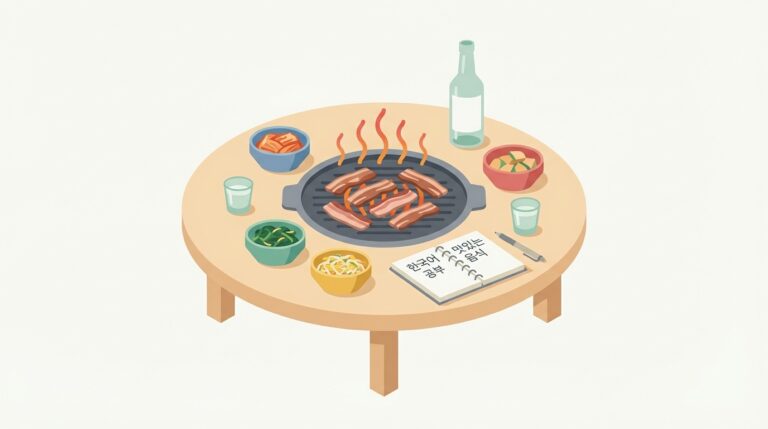
Setting: Friday night, 7:00 PM. A smoky, bustling Samgyeopsal (pork belly) restaurant near Gangnam Station. Sizzling meat, clinking soju glasses, and lively chatter fill the air.
Characters:
* YOU: An expat on your 3rd month in Korea, attending your first team dinner.
* Minsu: (32, your Korean coworker, humorous, friendly, and taking care of the grill).
Dialogue:
Minsu: 와, 오늘 고기 진짜 맛있네요! 많이 드세요.
(Wa, oneul gogi jinjja masinneyo! Mani deuseyo.)
(Wow, the meat is really good today! Please eat a lot.)
(🎭 Stage Direction: Minsu flips a piece of pork belly and puts it on your plate.)
YOU: 감사합니다. 잘 먹겠습니다!
(Gamsahamnida. Jal meokgetseumnida!)
(Thank you. I will eat well!)
Minsu: 에이, 그건 너무 딱딱해요. 그냥 편하게 드세요. 한잔 할래요?
(Ei, geugeon neomu ttakttakaeyo. Geunyang pyeonhage deuseyo. Hanjan hallaeyo?)
(Hey, that’s too formal. Just eat comfortably. Do you want a drink?)
(🎭 Stage Direction: Minsu picks up a bottle of Soju, ready to pour.)
YOU: 네, 좋습니다!
(Ne, joseumnida!)
(Yes, sounds good!)
(🎭 Stage Direction: You lift your glass with BOTH hands.)
Minsu: 짠~합시다!
(Jjan~hapsida!)
(Let’s cheers!)
YOU: 짠!
(Jjan!)
(Cheers!)
(🎭 Stage Direction: You turn your head slightly to the side to drink, remembering the rule!)
Minsu: 오~ 한국 예절 잘 아시네요! 눈치가 빠른데요?
(O~ hanguk yejeol jal asineyo! Nunchiga ppareundeyo?)
(Oh~ You know Korean etiquette well! You have quick Nunchi!)
Minsu: 야, 오늘 고기는 제가 쏠게요!
(Ya, oneul gogineun jega ssolgeyo!)
(Hey, I’m paying for the meat today!)
🔀 Your Turn! How should you respond?
* A) “그래요? 그럼 각자 계산합시다.” (Really? Let’s just pay for ourselves.)
* B) “아, 정말요? 그럼 다음에는 제가 커피 쏠게요!” (Ah, really? Then I’ll buy coffee next time!)
* C) “대박! 땡큐!” (Daebak! Thank you!)✅ Best Choice: B — Reason: Outright refusing is okay, but gracefully accepting and offering to buy the “second round” (usually coffee or dessert) is the ultimate Korean social move. It ensures the relationship continues.
⚠️ Choice A Analysis: Insisting on going Dutch when a senior colleague offers to treat can actually be seen as rejecting their kindness (their Jeong).
Bonus Scenario: The Banchan Refill
(You ate all the Kimchi and want more)
YOU: 사장님! (Sajangnim! / Boss!)
Staff: 네~ (Ne~ / Yes~)
YOU: 여기 김치 좀 더 주세요! (Yeogi gimchi jom deo juseyo! / Please give us more Kimchi here!)
Staff: 네, 바로 드릴게요~ (Ne, baro deurilgeyo~ / Yes, I’ll give it to you right away~)
Phase 6: 10-Second Shadowing Drill
Practice asking for a side dish refill with the perfect natural rhythm! Follow the slashes (/) for pauses and match the emotion.
😊 사장님! / 여기 / 반찬 좀 / 더 주세요~
(Sajangnim! / yeogi / banchan jom / deo juseyo~)
“Boss! Please give us some more side dishes here~”
- Pro Tip: End the sentence with a slight, friendly upward intonation (~). Don’t sound demanding!
Phase 7: K-Culture Mini Dictionary
| Korean | Romanization | English | Cultural Context |
|---|---|---|---|
| 눈치 | nunchi | Social intelligence / reading the room | The core of Korean social interaction. Knowing when to pour a drink or pay the bill requires good nunchi. |
| 회식 | hoesik | Company dinner | A crucial team-building event in Korean corporate culture, often involving lots of BBQ and alcohol. |
| 정 | jeong | Warmth / affection / attachment | The invisible bond between people, often expressed through sharing food and treating each other to meals. |
| 반찬 | banchan | Side dishes | Small plates of food served alongside rice. They are almost always complimentary and refillable! |
| 1차, 2차 | il-cha, i-cha | 1st round, 2nd round | Korean dining often happens in “rounds.” 1st round is dinner, 2nd round is a pub, 3rd round is karaoke! |
Phase 8: Traveler’s Survival Kit
If you are traveling to Korea, the dining experience might be slightly different from what you’re used to back home. Here are the top survival phrases and tips!
🆘 Survival Phrases TOP 3
1. 🇰🇷 “몇 분이세요?” (Myeot buniseyo?) – “How many people?”
* 🗣️ Reply with fingers or say: “두 명이요” (Du myeong-iyo / Two people).
2. 🇰🇷 “저기요, 계산할게요.” (Jeogiyo, gyesanhalgeyo.) – “Excuse me, I’d like to pay.”
* 📍 Where to use: Most Korean restaurants require you to take your bill to the front counter to pay, rather than paying at the table.
3. 🇰🇷 “포장해 주세요.” (Pojanghae juseyo.) – “Please pack this to go.”
* 💡 Pro Tip: Useful at cafes or if you have leftover fried chicken!
📌 Editor’s Travel Note:
* The Magic Call Bell: Look at your table. See a little button? Press it when you need to order. You don’t need to make eye contact or wait for the waiter to pass by!
* Tipping Culture: DO NOT TIP. There is absolutely no tipping culture in Korea. Tipping will cause confusion, and the staff might think you accidentally left your change.
* Cutlery Location: If you sit down and there are no chopsticks, check the hidden drawer attached to the side or front of your table.
Phase 9: Critical Thinking — “One Step Deeper”
Food & Identity (음식과 정체성)
🧠 Think Deeper:
Let’s think about the phrase “식구” (Sikgu), which is another word for “family” in Korean. Literally translated, it means “mouths that eat together.” In Western cultures, dining is often individualized—your plate, your portion, your bill. In Korea, the communal pot of stew and shared banchan symbolize collective identity over individualism. Sharing food isn’t just about efficiency; it’s the physical manifestation of Jeong (정). When a senior colleague places a choice piece of meat on your plate, they are crossing a boundary to say, “I care for you as my own.” By understanding this, you realize that navigating Korean table manners isn’t about memorizing strict rules, but rather understanding how Koreans build intimacy.💬 Your Turn: Does your home culture have a similar concept of communal eating? Or is individual plating strictly preferred? Let us know in the comments!
Phase 10: FAQ & Avoiding Misunderstandings
- Q: Can I stick my chopsticks into my rice bowl to rest them?
- A: ABSOLUTELY NOT. 🚫 This is the biggest dining taboo. Chopsticks stuck vertically in a bowl of rice resemble incense sticks burned at funerals for ancestors. Always rest them on the chopstick rest or on top of a side plate.
- Q: I don’t drink alcohol. Is it rude to refuse a shot of Soju at a hoesik?
- A: Not anymore! While it used to be strictly enforced, modern Korean culture is very understanding. Simply accept the first glass (let them pour it), say “짠” (Cheers), and discreetly put it down without drinking, or ask for soda (사이다 – cider) instead.
- Q: Can I blow my nose at the dining table?
- A: Better to avoid it. Sniffling is acceptable (especially when eating spicy food!), but blowing your nose loudly at the table is considered unappetizing. Excuse yourself to the restroom.
❌ Common Mistake #1: Picking up a soup bowl to drink from it like a cup.
✅ Do this instead: Leave the bowl flat on the table and use your stainless steel spoon to eat the soup. Only pick up the bowl if there’s just a tiny sip left at the very end!
Phase 11: Summary & Action Items
One-Liner Summary: Mastering Korean dining etiquette is less about strict formality and more about showing respect, sharing Jeong, and reading the Nunchi of the room!
Action Mission 3 Steps:
* 🥉 Bronze (Solo): Stand in front of a mirror and practice holding an imaginary glass with two hands while turning your head slightly.
* 🥈 Silver (Online): Leave a comment below telling us what Korean food you would love to say “잘 먹겠습니다” to!
* 🥇 Gold (Real World): Visit a local Korean restaurant (or a BBQ joint). Press the call bell, and politely ask for a side dish refill using: “사장님, 반찬 좀 더 주세요!”
🎬 K-Culture Mission:
Watch one episode of any K-Drama featuring a drinking or BBQ scene (e.g., Itaewon Class or Hospital Playlist). Spot the exact moment someone turns their head to drink in front of a senior. It’s everywhere once you know to look for it!
Phase 12: Quiz — Interactive Challenge
Test your new Nunchi skills!
1. Situational Judgment: You are eating dinner with your company’s CEO. The CEO pours you a glass of Soju. What should you do?
* A) Hold the glass with one hand and say “Thanks!”
* B) Hold the glass with two hands, clink glasses, and drink while looking directly into the CEO’s eyes.
* C) Hold the glass with two hands, clink glasses, and turn your head away to drink.
2. Fill in the Blank:
You just finished a delicious meal at a friend’s house. You say: “너무 맛있어요! 잘 _______.”
* A) 먹겠습니다 (meokgetseumnida)
* B) 먹었습니다 (meogeotseumnida)
3. True or False – K-Culture Edition:
* “If the service at a Korean restaurant is amazing, you should leave a 15% tip to show your appreciation.” (T/F)
💡 Click here for the answers!
- C is correct. Two hands show respect, and turning the head is proper etiquette when drinking with a high-ranking senior.
- B is correct. Since the meal is finished, you must use the past tense: 잘 먹었습니다 (I ate well).
- False. Tipping is not customary in Korea and will likely cause confusion. A warm “잘 먹었습니다!” is the best tip you can give!
Frequently Asked Questions (FAQ)
Q: What does "잘 먹겠습니다" mean in Korean and how do you pronounce it?
A: In Korean, "잘 먹겠습니다" is pronounced [Jal meokgetseumnida] and means: Literal: "I will eat well." / Real nuance: "Thank you for the meal" or "Bon appétit!"
Q: What does "잘 먹었습니다" mean in Korean and how do you pronounce it?
A: In Korean, "잘 먹었습니다" is pronounced [Jal meogeotseumnida] and means: Literal: "I ate well." / Real nuance: "That was a wonderful meal. Thank you."
Q: What does "제가 쏠게요!" mean in Korean and how do you pronounce it?
A: In Korean, "제가 쏠게요!" is pronounced [Jega ssolgeyo!] and means: Literal: "I will shoot!" / Real nuance: "It's on me! I'll pay!"







