

Phase 1: Empathy & The K-Drama Moment
Hello there! It’s your Daily Hangul Editor.
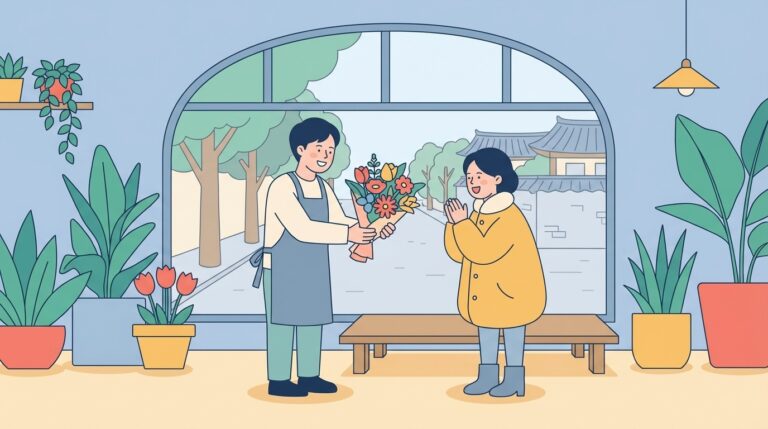
Picture this typical K-Drama scene: The male lead is standing awkwardly in a beautiful flower shop. He wants to buy a bouquet for his crush, but he has no idea what to choose. He just points at something pretty. Cut to the next day—the flowers are already wilting! Tragic, right?
If you live in or visit Korea, you’ll likely need to buy flowers. Koreans love gifting flowers for cafe openings, graduations, exhibitions, or special days like Eoboeinal (Parents’ Day). But buying flowers can be intimidating, especially if you want something that survives longer than your average K-Pop music video!
Today, I’m going to teach you exactly how to ask a Korean florist for long-lasting flowers—so you get your money’s worth and impress the recipient. This guide is built from the real struggles of my A2-level students who ended up with beautiful but short-lived peonies. Let’s dive in!
Phase 2: Core Expressions Deep Dive
Here are the top three expressions you need when you want flowers that will last.
1. 오래가는 꽃으로 추천해 주세요.
- Pronunciation: [oraeganeun kkocheuro chucheonhae juseyo] + [oh-rae-ga-neun kkot-eu-ro choo-cheon-hae joo-se-yo]
- Meaning: Please recommend long-lasting flowers.
- K-Culture Moment: You’ll hear “추천해 주세요” (Please recommend) everywhere in Korea—cafes, restaurants, and shops. In a trendy Yeonnam-dong flower shop, saying this instantly makes the florist smile because they love showing off their expertise.
- Editor’s Insight: The verb “가다” usually means “to go,” but when talking about flowers, batteries, or food, it means “to last.” So “오래가는” literally means “long-going.”
- Situation Spectrum:
- Casual with friends: ⚠️ (Use ‘오래가는 거 추천해 줘’)
- To a shop staff (Polite): ✅
- Formal/Elders: ✅
- 🤔 Think About It: Why do Koreans love asking for recommendations? Is it because of a culture that highly respects the “expert” in the room? Do you ask for shop staff recommendations in your home country?
2. 이 꽃은 며칠 정도 가요?
- Pronunciation: [i kkocheun myeochil jeongdo gayo] + [ee kko-cheun myeo-chil jeong-do ga-yo]
- Meaning: About how many days does this flower last?
- K-Culture Moment: You see a beautiful, delicate flower. Before you buy it, you ask this. The florist might say, “That one is pretty, but it only lasts two days.” Crisis averted!
- Editor’s Insight: “며칠” (how many days) and “정도” (about/approximately) are a perfect pair. It sounds much more natural and polite than demanding exactly when the flower will die!
- Situation Spectrum:
- Casual with friends: ✅ (Drop ‘요’ -> 가?)
- To a shop staff (Polite): ✅
- Formal/Elders: 🚫
- 🤔 Think About It: Time and efficiency are huge in Korea (the Palli-Palli culture). Does knowing the exact lifespan of a gift matter as much in your culture?
3. 키우기 쉬운 식물 있어요?
- Pronunciation: [kiugi swiun singmul isseoyo] + [ki-oo-gi shwi-oon shing-mool isseo-yo]
- Meaning: Do you have plants that are easy to take care of (raise)?
- K-Culture Moment: Instead of cut flowers, giving a potted plant is incredibly popular in Korea, especially for a friend opening a new cafe (개업 – Gaeeop).
- Editor’s Insight: Notice the verb “키우다” (to raise). In Korea, we don’t just “grow” plants; we “raise” them, almost like pets!
- Situation Spectrum:
- Casual with friends: ✅ (Drop ‘요’)
- To a shop staff (Polite): ✅
- Formal/Elders: ✅
Phase 3: Textbook vs. Real Korean
Let’s look at how language actually lives and breathes outside the textbook.
[Situation 1: Asking for a recommendation]
* 📖 Textbook Korean: 어떤 꽃이 생명력이 깁니까? (Which flower has a long life force?)
* 🗣️ Real Korean: 오래가는 걸로 추천해 주세요. (Please recommend something that lasts long.)
* 💡 Why the difference?: “생명력” (vitality) sounds like you are a scientist conducting an experiment. Real Koreans just use the simple verb “오래가다” (to go long) for everyday items.
[Situation 2: Asking if it’s easy to maintain]
* 📖 Textbook Korean: 이 식물은 관리가 용이합니까? (Is the management of this plant facile?)
* 🗣️ Real Korean: 이거 키우기 쉬워요? (Is this easy to raise?)
* 💡 Why the difference?: Everyday Korean prefers native Korean verbs (키우다, 쉽다) over heavy, formal Sino-Korean vocabulary (관리, 용이하다) in casual shopping settings.
Phase 4: Cultural Context — K-Culture Deep Dive
4-1. Non-Verbal Tips: The “Eye-Shopping” Rule
In Korean flower shops, do not touch the flower petals! Flowers are delicate, and touching them can bruise the petals, making them unsellable. Use your words, or point gently from a distance. If you must gesture, use an open palm to point at a bucket, not your index finger. Also, read the Nunchi (눈치)—if the florist is busy making a bouquet, wait patiently before asking your questions.
4-2. K-Culture Link: The “Pet Plant” (반려식물) Trend
Recently, instead of short-lived bouquets, younger Koreans (Millennials and Gen Z) are obsessed with Banlyeo-sikmul (반려식물), which translates to “Pet Plants.” Just like a pet dog or cat, they talk to their plants, name them, and care for them deeply. It fits perfectly with the single-person household lifestyle in Seoul. So, if you want a gift that truly lasts, ask for a small pet plant! It’s a very “Insider” (인싸) gift right now.
Phase 5: Real-Life Roleplay Scenario
Setting: A trendy, aesthetic flower shop in Seongsu-dong. Soft indie K-Pop is playing. You are buying a gift for your Korean friend’s new cafe opening.
Characters:
* YOU: An A2 Korean learner, determined not to buy a flower that dies tomorrow.
* Florist (사장님 – Sajangnim): A friendly professional wearing a linen apron.
Dialogue:
사장님: 안녕하세요~ 찾으시는 꽃 있으세요? 🌸
(annyeonghaseyo~ chajeusineun kkot isseuseyo?)
[Hello~ Is there a specific flower you’re looking for?]
YOU: 친구 카페 개업 선물하려고요. 혹시 오래가는 꽃으로 추천해 주세요.
(chingu kape gaeeop seonmulharyeogoyo. hoksi oraeganeun kkocheuro chucheonhae juseyo.)
[I want to gift it for a friend’s cafe opening. Could you please recommend long-lasting flowers?]
사장님: 아, 개업 선물이면 화분은 어떠세요? 이 식물 예쁘죠?
(a, gaeeop seonmurimyeon hwabuneun eotteoseyo? i singmul yeppeujo?)
[Ah, for an opening gift, how about a potted plant? Isn’t this plant pretty?]
YOU: 예쁘네요! 이거 키우기 쉬워요?
(yeppeuneyo! igeo kiugi swiwoyo?)
[It is pretty! Is this easy to raise?]
사장님: 네, 물은 일주일에 한 번만 주시면 돼요.
(ne, mureun iljuire han beonman jusimyeon dwaeyo.)
[Yes, you just need to water it once a week.]
🔀 Your Turn! How do you reply?
– A) “아니요, 너무 비싸요.” (No, it’s too expensive.)
– B) “우와, 대박! 그럼 이걸로 할게요.” (Wow, awesome! I’ll take this one then.)
– C) “물 싫어요. 다른 거 주세요.” (I hate water. Give me another.)✅ Best Choice: B — It shows enthusiasm and naturally finalizes the purchase using “이걸로 할게요” (I’ll do this one / I’ll take this one).
⚠️ Choice A & C Analysis: They are too blunt. If it’s too expensive or you don’t like it, politely ask: “혹시 다른 것도 볼 수 있을까요?” (Could I perhaps see something else?)
Phase 6: 10-Second Shadowing Drill
Let’s practice the rhythm! Pay attention to the slashes for pauses.
😊 사장님, / 오래가는 꽃으로 / 추천해 주세요!
(sajangnim, / orae-ga-neun kkot-eu-ro / chu-cheon-hae ju-se-yo!)
Speak it brightly! A friendly tone will almost always get you a prettier wrapping or a few extra greenery sprigs for free (that’s Korean Jeong – 정)!
Phase 7: K-Culture Mini Dictionary
| 한국어 | Romanization | English | Context |
|---|---|---|---|
| 꽃집 | kkotjib | Flower shop | Literally “flower house.” |
| 화분 | hwabun | Potted plant | Popular for business openings or housewarmings. |
| 개업 | gaeeop | Business opening | Koreans often send large plants with ribbon banners to celebrate. |
| 반려식물 | banlyeosikmul | Pet plant | Treating a plant as a lifelong companion. |
| 추천 | chucheon | Recommendation | A magic word in Korea for indecisive shoppers. |
Phase 8: Traveler Survival Kit
Even if you aren’t buying flowers, you will visit shops in Korea. Here are your absolute survival phrases.
🆘 Survival Phrases #1
– 🇰🇷 “이걸로 할게요.” (igeollo halgeyo)
– 🗣️ Pronunciation: [ee-geol-lo hal-ge-yo]
– 📍 Where to use: Flower shops, cafes, clothing stores, restaurants.
– 💡 Meaning: “I will take this one.” (The ultimate phrase to finalize a choice!)📌 Editor’s Travel Note
– Finding a Shop: Open KakaoMap or Naver Map and search “꽃집” (Kkotjib). If you want trendy designs, search Instagram for#[Neighborhood]꽃집(e.g.,#홍대꽃집).
– Payment: Korea is a cashless society. 99% of flower shops accept foreign credit cards.
– Wrapping: Korean flower wrapping is an art form! If you want a minimal look, ask for “포장 간단하게 해주세요” (Please wrap it simply).
Phase 9: Critical Thinking — “A Step Deeper”
The Culture of “Chucheon” (Recommendation) & Trust
🧠 Think Deeper:
Why is the phrase “추천해 주세요” (Please recommend) so incredibly common in Korea? It goes beyond just not knowing what to buy. In Korean society, there is a strong cultural respect for the “expert” of a space. Whether it’s the barista at a cafe or the florist in a shop, trusting the owner’s choice is seen as acknowledging their skill. It also reflects a collective mindset: Koreans feel comfortable knowing they are getting the “best” or “most popular” option validated by others.💬 Your Turn: In your culture, do you usually trust the shop owner’s recommendation, or do you prefer to browse and decide entirely on your own? Share in the comments!
Phase 10: FAQ & Avoiding Common Mistakes
Q: “Can I use ‘추천해 주세요’ to my boss at work?”
A: Yes! It’s polite. For example, if you are having a team lunch, you can ask your boss, “메뉴 추천해 주세요” (Please recommend a menu).
Q: “Can I just pick flowers out of the water buckets myself?”
A: NO! Please wait for the florist to pull them out. Stems can tangle and break easily.
❌ Common Mistake #1: Saying “이 꽃 오래 살아요?” (Does this flower live long?)
✅ Do This Instead: Say “이 꽃 오래가요?” (Does this flower last long?)
Why? “살다” (to live) is used for humans and animals. For cut flowers, batteries, or food freshness, we use “가다” (to go/last).
Phase 11: Summary & Action Items
One-Liner Summary: To get flowers that won’t die tomorrow, simply ask the florist: “오래가는 꽃으로 추천해 주세요!”
Action Mission 3 Steps:
– 🥉 Bronze (Solo): Look in the mirror and practice asking for a recommendation 3 times.
– 🥈 Silver (Online): Go to a Korean learning forum and write: “저는 꽃을 좋아해요. 오래가는 꽃 추천해 주세요!”
– 🥇 Gold (Real Life): Visit a Korean flower shop, buy a small single flower, and ask “이 꽃 며칠 정도 가요?”
🌸 K-Culture Mission:
Go to Instagram and search the hashtag #연남동꽃집 (Yeonnam-dong flower shop). Look at the beautiful wrapping styles and find a “반려식물” (pet plant) you would love to raise!
Did you ever buy flowers that died way too fast? Tell me your story below! 👇
Phase 12: Quiz — Interactive Challenge
1. Situational Judgment:
You are buying flowers for a friend, but you want them to last a long time. What should you say?
– A) 어떤 꽃이 제일 비싸요? (Which flower is the most expensive?)
– B) 오래가는 꽃으로 추천해 주세요. (Please recommend long-lasting flowers.)
– C) 꽃 만져도 돼요? (Can I touch the flowers?)
2. Fill in the Blank:
사장님, 이 꽃은 며칠 정도 ( _____ )?
– A) 가요 (lasts)
– B) 살아요 (lives)
3. True or False – K-Culture Edition:
In Korea, it is considered polite to pick the flowers out of the buckets yourself to save the florist time.
– True / False
Click here for Answers!
1. B – Asking for a recommendation for long-lasting flowers is the safest bet!
2. A (가요) – We use “가다” for the lifespan of cut flowers, not “살다”.
3. False – Never touch or pull the flowers yourself! They are delicate, so always ask the florist to get them for you.
Frequently Asked Questions (FAQ)
Q: What does "오래가는 꽃으로 추천해 주세요." mean in Korean and how do you pronounce it?
A: In Korean, "오래가는 꽃으로 추천해 주세요." is pronounced [oraeganeun kkocheuro chucheonhae juseyo] and means: Please recommend long-lasting flowers.
Q: What does "이 꽃은 며칠 정도 가요?" mean in Korean and how do you pronounce it?
A: In Korean, "이 꽃은 며칠 정도 가요?" is pronounced [i kkocheun myeochil jeongdo gayo] and means: About how many days does this flower last?
Q: What does "키우기 쉬운 식물 있어요?" mean in Korean and how do you pronounce it?
A: In Korean, "키우기 쉬운 식물 있어요?" is pronounced [kiugi swiun singmul isseoyo] and means: Do you have plants that are easy to take care of (raise)?







