

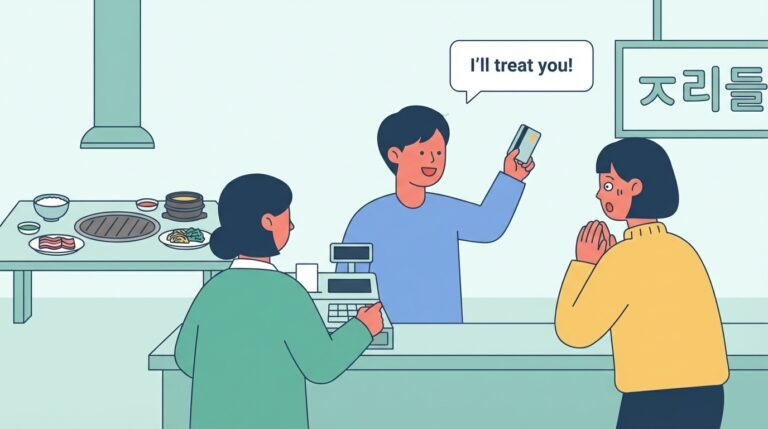
Phase 1: Empathy (The K-Culture Cold Open)
Hello there! It’s your Daily Hangul Editor.
Picture this: You are watching your favorite K-Drama. The main characters have just finished eating Samgyeopsal (pork belly) and drinking Soju at a lively pojangmacha (street tent). Suddenly, they rush to the counter. What starts as a friendly dinner turns into a physical wrestling match.
“Put your wallet away!”
“No, I’m paying today!”
“Are you crazy? Give me that receipt!”
To an outsider, it looks like a fight. But to a Korean, this is a heartwarming display of affection. In Korea, buying someone a meal is the ultimate expression of gratitude, friendship, and care. If someone helped you move, covered your shift, or gave you great advice, a simple “Thank you” (감사합니다) often feels incomplete. The true Korean way to say “I appreciate you” is through food.
But how do you actually say, “I want to treat you to a meal” without sounding like a textbook robot? Let’s dive into the real, insider Korean expressions that will make you sound like a local!
Phase 2: Deep Dive into Core Expressions
1. 제가 밥 한 번 살게요.
- Pronunciation: je-ga bap han beon sal-ge-yo. (Think of sal like the ‘sal’ in ‘salad’, and ge like ‘get’ without the ‘t’).
- Meaning: (Literal) I will buy rice once. / (Real Nuance) I’ll buy you a meal sometime.
- K-Culture Moment: You bump into an old friend on the street, or a coworker helps you fix a jammed printer. You say this to show your appreciation and intention to hang out.
- Editor’s Insight: This is the golden standard. It’s polite, friendly, and natural. But beware! Sometimes, this is used as an empty greeting (like “See you later” in English) rather than a concrete plan. If they specify a date, it’s real. If they don’t, it’s just a polite sign off.
- Situation Spectrum:
- Casual (Friends): ✅
- Semi-formal (Colleagues): ✅
- Formal (Bosses/Elders): ⚠️ (It’s okay, but there’s a better word for elders!)
- 🤔 Think About It: Why does bap (rice) mean an entire meal? How important was rice in Korea’s agricultural history to become synonymous with food itself?
2. 제가 식사 대접하고 싶습니다.
- Pronunciation: je-ga sik-sa dae-jeop-ha-go si-peo-yo. (dae rhymes with ‘day’, jeop sounds like ‘jup’ in ‘jump’).
- Meaning: (Literal) I want to treat you to a meal. / (Real Nuance) I would be honored to host you for a proper meal as a token of my deep gratitude.
- K-Culture Moment: You are thanking a professor who wrote your recommendation letter, or a senior manager who mentored you. You wouldn’t take them for a quick bowl of ramen; you’d take them for a nice Korean course meal.
- Editor’s Insight: The keyword here is 대접 (Dae-jeop). It means “to treat with great respect or hospitality.” Using this word elevates your Korean instantly. It shows you understand respect.
- Situation Spectrum:
- Casual (Friends): 🚫 (Way too stiff!)
- Semi-formal (Colleagues): ⚠️ (Only if thanking for a massive favor)
- Formal (Bosses/Elders): ✅
- 🤔 Think About It: Does your language have a different vocabulary word for “buying food” depending on the status of the person you are feeding?
3. 오늘은 제가 쏠게요!
- Pronunciation: o-neul-eun je-ga ssol-ge-yo! (ssol sounds like ‘soul’ but with a sharp, hissing ‘S’).
- Meaning: (Literal) Today, I will shoot! / (Real Nuance) Drinks/Food are on me today!
- K-Culture Moment: It’s payday! Or you just passed your Korean proficiency exam. You gather your friends and declare that you are the hero of the night.
- Editor’s Insight: 쏘다 (Ssoda) literally means “to shoot” (like a gun or an arrow). In slang, it means you are “shooting” your money for everyone’s benefit. It’s fun, enthusiastic, and confident.
- Situation Spectrum:
- Casual (Friends): ✅
- Semi-formal (Colleagues): ✅ (Among peers)
- Formal (Bosses/Elders): 🚫 (Never say you will ‘shoot’ for your boss!)
- 🤔 Think About It: Why do you think a somewhat aggressive verb like “shoot” evolved into a generous slang term for buying food?
Phase 3: Textbook vs. Real Korean
[Situation 1: Thanking a colleague for helping you move]
* 📖 Textbook: 도와주셔서 감사합니다. 제가 음식을 사겠습니다. (Thank you for helping. I will buy food.)
* 🗣️ Real Korean: 진짜 고마워요! 제가 조만간 밥 한 번 살게요! (Thanks so much! I’ll buy you a meal sometime soon!)
* 💡 Why the difference?: Koreans rarely say “I will buy food” (eumsigeul sagetseumnida). We specify bap (rice/meal) and add “sometime” (han beon) to make it sound less transactional and more relational.
[Situation 2: Showing off to friends after getting a bonus]
* 📖 Textbook: 오늘은 제가 모든 비용을 지불하겠습니다. (Today, I will pay all the expenses.)
* 🗣️ Real Korean: 야, 오늘 고기는 내가 쏜다! 많이 먹어! (Hey, meat is on me today! Eat up!)
* 💡 Why the difference?: Formal language among close friends creates weird distance. Slang like “내가 쏜다” (I’m shooting/treating) bridges that gap and hypes up the mood.
(Bottom Note: B1 Learners, try sticking to “제가 살게요” in daily life—it is perfectly balanced and safe for 90% of situations!)
Phase 4: Cultural Context — K-Culture Deep Dive
4-1. The Art of “Secret Paying” (Non-verbal Nunchi)
In Korea, telling someone you will pay is great, but secretly paying is a legendary power move. It requires top-tier 눈치 (Nunchi). Midway through the meal, excuse yourself to “go to the restroom.” Instead, march straight to the counter, hand them your card, and pay the bill. When your guest tries to pay on the way out, the cashier will say, “It’s already been paid” (이미 계산하셨습니다). The look of surprised gratitude on your guest’s face? Priceless.
4-2. The Push and Pull (Mil-dang) of Paying
When you say, “제가 살게요” (I’ll pay), a Korean person will almost always refuse at first. “아니에요, 괜찮아요!” (No, it’s fine! Let’s split it). This is not a rejection; it is K-Etiquette. You must insist at least once more: “아니에요, 진짜 고마워서 그래요!” (No really, it’s because I’m so thankful!). This push-and-pull shows that both parties care about each other.
Phase 5: Interactive Roleplay Scenario
Setting: Friday 7 PM. A bustling K-BBQ restaurant near Gangnam Station. Smoke is rising from the grills, and the sound of clinking Soju glasses fills the air.
Characters:
– YOU: A foreign professional who just finished a massive project.
– Min-su (32): Your Korean coworker who stayed up late to help you finish the project.
The Dialogue:
YOU: 민수 씨, 이번 프로젝트 도와주셔서 정말 감사합니다.
(Min-su ssi, ibeon peurojekteu dowajusyeoseo jeongmal gamsahamnida.)
[Thank you so much for helping with this project, Min-su.]
Min-su: 에이, 별말씀을요. 고생 많았어요!
(Ei, byeolmalsseumeullyo. Gosaeng manasseoyo!)
[Oh, don’t mention it. You worked hard!]
(Min-su picks up the bill from the table to check it)
Min-su: 자, 이제 일어날까요? 제가 낼게요.
(Ja, ije ireonalkkayo? Je-ga nael-ge-yo.)
[Alright, shall we get up? I’ll pay.]
🔀 YOUR TURN! How do you respond?
– A) “아, 감사합니다! 잘 먹겠습니다!” (Ah, thank you! I will eat well!)
– B) “아니에요! 오늘은 제가 살게요. 진짜 고마워서 그래요!” (No way! I’m buying today. It’s because I’m really thankful!)
– C) “대박! 제가 쏠게요!” (Awesome! I’ll shoot!)✅ Best Choice: B — Reason: Min-su helped YOU. If you choose A, you are letting the person who did you a favor also pay for your food (a big faux pas!). Choosing B shows proper gratitude and insists on returning the favor.
⚠️ Choice C Analysis: “대박” and “쏠게요” are too casual for a work colleague in this context. Keep it semi-formal!
[Bonus K-Culture Scenario: The Cashier Standoff]
(You and Min-su both rush to the cashier with your credit cards out.)
YOU: (Handing card to cashier) 여기요! 제가 계산할게요! (Here! I’ll pay!)
Min-su: (Blocking your hand) 아니에요 사장님, 제 카드로 해주세요! (No boss, please use my card!)
Cashier: (Laughing) 두 분 다 카드는 넣으시고요, 한 분만 주세요! (Both of you put your cards away and just give me one!)
Phase 6: 10-Second Shadowing Drill
Practice reading these out loud, focusing on the pauses (/) and the emotion!
- 😊 (Warm and grateful)
진짜 고마워요. / 제가 / 밥 한 번 / 살게요!
(jinjja gomawoyo. / je-ga / bap han beon / sal-ge-yo!) -
🙇♂️ (Polite and respectful)
도와주셔서 감사합니다. / 제가 / 식사 한 번 / 대접하고 싶습니다.
(dowajusyeoseo gamsahamnida. / je-ga / sik-sa han beon / dae-jeop-ha-go si-peum-ni-da.) -
😎 (Hyped and cool)
여러분, / 오늘 고기는 / 내가 / 쏜다!!
(yeoreobun, / oneul gogineun / nae-ga / sson-da!!)
Phase 7: K-Culture Mini Dictionary
| Korean | Romanization | English | Cultural Context |
|---|---|---|---|
| 눈치 | nunchi | Nunchi (Social sense) | The ability to read the room. Crucial for knowing when to offer to pay or when to back down. |
| 한턱내다 | hanteongnaeda | To treat (someone) | Similar to “쏘다”, meaning to treat people generously to celebrate good news. |
| 더치페이 | deochipei | Going Dutch / Split bill | Becoming more popular among the younger generation, though treating is still common. |
| 정(情) | jeong | Deep affection/bond | The invisible feeling of connection Koreans build, often reinforced by sharing food. |
| 회식 | hoesik | Company dinner | Work dinners where usually the company or the boss pays the bill. |
Phase 8: Traveler’s Survival Kit
Even if you aren’t living in Korea, knowing how to handle the bill is essential for any traveler!
🆘 Survival Phrases at the Register
– 🇰🇷 “제가 낼게요.” (je-ga nael-ge-yo.)
– 🗣️ Meaning: I will pay.
– 🇰🇷 “따로 계산할게요.” (tta-ro gye-san-hal-ge-yo.)
– 🗣️ Meaning: We will pay separately (split the bill).
– 🇰🇷 “영수증 버려주세요.” (yeong-su-jeung beo-ryeo-ju-se-yo.)
– 🗣️ Meaning: Please throw away the receipt.📌 Editor’s Travel Note: Paying in Korea
– Card is King: Korea is practically a cashless society. Even a $1 bottle of water can be bought with a card.
– Two Hands: When handing your card to the cashier, use two hands (or support your right arm with your left hand) as a sign of respect.
– NO TIPS! There is no tipping culture in Korea. If you leave money on the table, the waiter might chase you down the street thinking you forgot your change!
Phase 9: Critical Thinking — “One Step Deeper”
🨀 Food & Identity (음식과 정체성)
Have you noticed how much Korean language relies on food? We greet people with “Have you eaten?” (밥 먹었어?). We express gratitude with “I’ll buy you a meal” (밥 한 번 살게). We even say we are “eating age” (나이를 먹다) to mean getting older. Historically, Korea went through periods of extreme hardship and poverty. Sharing a warm bowl of rice wasn’t just a polite gesture; it was a matter of survival. Food became the ultimate symbol of love, care, and community (Jeong). So, when a Korean friend insists on buying you dinner, they aren’t just paying for calories—they are sharing their heart with you.
💬 Your Turn: In your culture, what is the ultimate way to show deep gratitude? Is it a gift, a card, or food as well? Share in the comments!
Phase 10: FAQ & Avoiding Mistakes
Q: “Can I say 내가 쏜다 (I’ll shoot/treat) to my boss?”
A: NO! Please don’t! It sounds arrogant and too casual. Use “제가 식사 한번 대접하겠습니다” instead.
Q: “If a Korean friend says ‘Let’s grab a meal sometime’, should I wait for them to text me a time?”
A: Maybe. Often, “밥 한 번 먹자” is just a friendly goodbye. Unless they follow up with “Are you free next Friday?”, don’t take it as a legally binding contract.
Q: “Is splitting the bill rude?”
A: Not anymore! Among younger Koreans (Gen Z/Millennials), “더치페이” (Dutch pay) is very common. However, the older tradition is taking turns: “You buy lunch today, I’ll buy coffee afterward.”
❌ Common Mistake #1: Calculating the bill down to the exact cent with a close friend.
✅ Do This Instead: Say, “I’ll get the food, you get the dessert!” (밥은 제가 살게요, 디저트는 OOO씨가 사세요!). This creates an excuse to go somewhere else together and keeps the relationship flowing naturally.
Phase 11: Summary & Action Items
One-Liner Summary: To say “Thank you” like a true Korean, use “제가 살게요” (I’ll pay) or “대접하고 싶어요” (I want to treat you) — and be prepared for a friendly battle for the bill!
Action Missions:
– 🥉 Bronze: Stand in front of a mirror, pull out your credit card, and say “오늘은 제가 쏠게요!” with your best confident face.
– 🥈 Silver: Leave a comment in a Korean learning community: “제가 한국어를 가르쳐주신 선생님께 식사를 대접하고 싶어요.”
– 🥇 Gold: Next time you go out with a Korean friend, try to secretly pay the bill before they do. Tell them “제가 샀어요!” (I bought it!).
🇰🇷 K-Culture Mission:
Watch one episode of a K-Drama this week. Pay close attention to any scene in a restaurant. Who pays? Do they argue about it? Notice the “Nunchi” involved!
Phase 12: Interactive Quiz 🧠
1. Situational Judgment: Your older colleague helped you prepare for a presentation. You want to buy them a nice dinner to say thank you. What should you say?
A) 야, 내가 쏜다!
B) 선배님, 제가 식사 한 번 대접하고 싶습니다.
C) 선배님, 제 카드로 더치페이 해요.
2. True or False – K-Culture Edition:
If the service at a Korean restaurant is amazing, you should leave a 15% tip on the table.
3. Fill in the Blank:
진짜 고마워요! 제가 나중에 ___ 한 번 살게요!
(Thanks so much! I’ll buy you a ____ sometime later!)
👉 Click here for the answers!
1. B (You must use formal language ‘대접하다’ to show respect to a senior colleague. A is slang. C means ‘let’s split it on my card’, which makes no sense).
2. False (There is no tipping culture in Korea! A polite ‘잘 먹었습니다’ is enough!).
3. 밥 (bap – rice/meal. Even if you eat pizza, you can still use the word ‘bap’!).
Frequently Asked Questions (FAQ)
Q: What does "제가 밥 한 번 살게요." mean in Korean and how do you pronounce it?
A: In Korean, "제가 밥 한 번 살게요." is pronounced [je-ga bap han beon sal-ge-yo. (Think of sal like the 'sal' in 'salad', and ge like 'get' without the 't'] and means: (Literal) I will buy rice once. / (Real Nuance) I'll buy you a meal sometime.
Q: What does "제가 식사 대접하고 싶습니다." mean in Korean and how do you pronounce it?
A: In Korean, "제가 식사 대접하고 싶습니다." is pronounced [je-ga sik-sa dae-jeop-ha-go si-peo-yo. (dae rhymes with 'day', jeop sounds like 'jup' in 'jump'] and means: (Literal) I want to treat you to a meal. / (Real Nuance) I would be honored to host you for a proper meal as a token of my deep gratitude.
Q: What does "오늘은 제가 쏠게요!" mean in Korean and how do you pronounce it?
A: In Korean, "오늘은 제가 쏠게요!" is pronounced [o-neul-eun je-ga ssol-ge-yo! (ssol sounds like 'soul' but with a sharp, hissing 'S'] and means: (Literal) Today, I will shoot! / (Real Nuance) Drinks/Food are on me today!







