

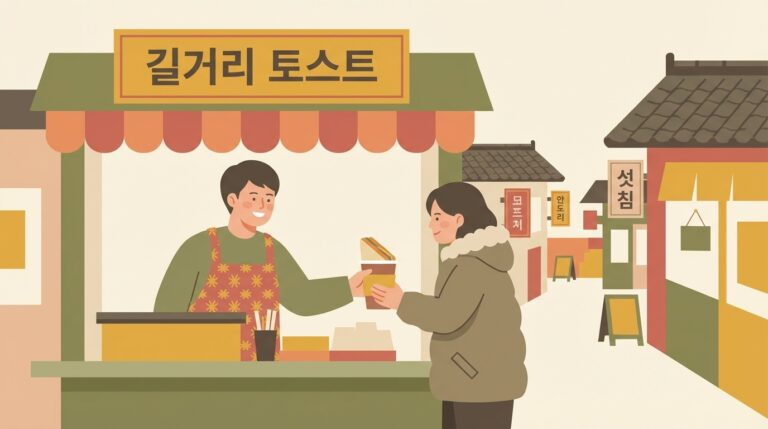
Phase 1: Empathy & The Morning Hustle
Hello! I’m your Daily Hangul editor.
Imagine this: It’s 8:00 AM in Seoul. You’re watching a K-Drama, and the main character is sprinting to work. They stop by a small cart near the subway station, grab a square sandwich wrapped in a paper cup, and run off. The cart smells like melting butter, sweet egg, and sizzling cabbage. This is the legendary Korean Street Toast (길거리 토스트).
But wait—what happens when you are standing in front of that cart? The stall owner (often a friendly auntie) is flipping five egg patties at lightning speed and asks you a question. Your mind goes blank. If you don’t know what to say, you might end up with a toast that is surprisingly… sweet. (Yes, Koreans love sugar on their savory egg sandwiches!)
Don’t worry! This guide is built from the real panics and triumphs of my A2-level students. By the end of this post, you’ll be ordering that buttery goodness like a true Seoulite.
Phase 2: Core Expressions Deep Dive
1. 햄치즈 토스트 하나 주세요
- Pronunciation: Haem-chijeu toseuteu hana juseyo [Ham-cheese toast ha-na joo-se-yo]
- Meaning: (Literal) Ham cheese toast one please. / (Real nuance) I’ll have one ham and cheese toast, please.
- K-Culture Moment: You’ll hear this exactly as it is at famous chains like Isaac Toast or local street carts. It’s the standard, polite, and most efficient way to order.
- Editor’s Insight: Forget complex grammar. At a busy food cart, [Item] + [Number] + [주세요 (Please give me)] is your golden formula. It sounds natural and respectful.
- Situation Spectrum:
- Casual (Friends): ⚠️ (Friends usually say “하나 줘”)
- Semi-formal (Stall owner/Staff): ✅
- Formal (Boss): 🚫 (You wouldn’t order for a boss like this)
- 🤔 Think About It: Why does the number “하나(one)” come after the noun in Korean? In English, it’s “One toast.” In Korean, it’s “Toast one.” How does this reflect the Korean language’s focus on identifying the main topic first before adding details?
2. 설탕은 빼주세요
- Pronunciation: Seoltangeun ppaejuseyo [Sul-tang-eun ppae-joo-se-yo]
- Meaning: (Literal) As for sugar, please take it out. / (Real nuance) No sugar, please.
- K-Culture Moment: Korean street food heavily relies on the 단짠 (Dan-jjan, Sweet and Salty) flavor profile. Aunties will generously sprinkle white sugar over your savory ham and egg. If you prefer a Western-style savory breakfast, this phrase is your lifesaver.
- Editor’s Insight: The word 빼다 (to subtract/remove) combined with 주세요 (please do it for me) is the magical way to customize any Korean food. “오이 빼주세요 (No cucumber)” or “매운 소스 빼주세요 (No spicy sauce).”
- Situation Spectrum:
- Casual: ⚠️
- Semi-formal: ✅
- Formal: 🚫
- 🤔 Think About It: Notice the “주세요” (do it for me). Koreans don’t just say “No sugar.” They ask the owner to “kindly remove it for my benefit.” How does this show the relational nature of Korean culture?
3. 포장해 주세요
- Pronunciation: Pojanghae juseyo [Po-jang-hae joo-se-yo]
- Meaning: (Literal) Please pack it. / (Real nuance) To-go, please.
- K-Culture Moment: In K-Dramas, when a character brings late-night food to their hard-working colleague, they “포장 (pojang)” it. It’s an essential survival word for any traveler.
- Editor’s Insight: While English speakers say “to-go” or “takeout,” Koreans use the word for “packaging.” If you just want to eat it right there while standing, you can simply say “먹고 갈게요 (I’ll eat and go).”
- Situation Spectrum:
- Casual: ⚠️
- Semi-formal: ✅
- Formal: 🚫
- 🤔 Think About It: Is taking food to-go common in your country? Korea has an enormous “Pojang” and delivery culture. Why do you think that is?
Phase 3: Textbook vs. Real Korean
[Situation 1: Ordering the Food]
* 📖 Textbook Korean: 햄치즈 토스트 한 개 주시겠습니까? (Would you please give me one ham and cheese toast?)
* 🗣️ Real Korean: 햄치즈 하나요. (Ham and cheese, one.)
* 💡 Why the difference?: Street carts operate on the 빨리빨리 (Ppalli-ppalli, hurry-hurry) culture. Adding “~요” at the end makes it perfectly polite without being unnecessarily long.
[Situation 2: Asking to Take It Out]
* 📖 Textbook Korean: 이것을 포장해 주십시오. (Please package this item.)
* 🗣️ Real Korean: 포장요. / 가져갈게요. (For packaging. / I’ll take it with me.)
* 💡 Why the difference?: Efficiency! In a fast-paced Seoul morning, minimizing words while keeping the polite “요(yo)” ending is the ultimate sign of a local.
Bottom Note: For A2 learners, “[Item] 하나요” and “포장요” are slightly casual but totally acceptable at street carts. If you want to be extra safe and polite, stick to “[Item] 하나 주세요.”
Phase 4: Cultural Context — K-Culture Deep Dive
4-1. Non-Verbal Elements: The Art of “Nunchi” at the Cart
When ordering at a street stall, 눈치 (Nunchi – reading the room) is key. If there’s a long line of office workers, don’t take 5 minutes to decide. Have your order ready! Also, when paying, Koreans typically hand their credit card or cash using two hands (or with the right hand supported by the left hand) to show respect to the stall owner, who is usually older.
4-2. K-Food Connection: The “Dan-jjan” Magic
Korean street toast isn’t just breakfast; it’s nostalgia. It started as an affordable, filling meal for students and busy workers. The signature taste? A mountain of shredded cabbage, a square egg patty, and… a generous dusting of sugar and ketchup. This is the ultimate 단짠 (Sweet and Salty) combo. If you’ve ever watched a Korean mukbang or a slice-of-life drama (like Hospital Playlist), you’ll notice how Koreans love finding the perfect balance between sweet and savory.
Phase 5: Real-Life Roleplay Scenario
Setting: 8:15 AM, right outside Myeongdong Subway Station Exit 3. The air is chilly, and the smell of butter is irresistible. The cart is run by a warm but fast-paced Korean Auntie.
Characters:
– YOU: A hungry traveler who needs a quick breakfast before a tour.
– 이모님 (Emo-nim / Auntie): The stall owner. She’s flipping eggs with one hand and taking orders with the other.
Dialogue:
이모님: 어서 와요! 뭐 해줄까? 😊
(Eoseo wayo! Mwo haejulkka?)
[Welcome! What can I make for you?]
(🎭 Stage Direction: She looks at you with a welcoming smile while cracking an egg on the grill)
YOU: 안녕하세요! 베이컨 치즈 토스트 하나 주세요.
(Annyeonghaseyo! Beikeon chijeu toseuteu hana juseyo.)
[Hello! One bacon cheese toast, please.]
이모님: 네~ 먹고 갈 거야, 포장할 거야?
(Ne~ Meokgo gal geoya, pojanghal geoya?)
[Okay~ Are you eating here or taking it to-go?]
YOU: 포장해 주세요.
(Pojanghae juseyo.)
[To-go, please.]
이모님: 설탕 뿌려줘?
(Seoltang ppuryeojwo?)
[Should I sprinkle sugar?]
🔀 Your Turn! How do you reply?
– A) “네, 조금만 뿌려주세요.” (Yes, just a little bit please.)
– B) “설탕 싫어요!” (I hate sugar!)
– C) “아니요, 설탕은 빼주세요.” (No, please take out the sugar.)✅ Best Choice: C — It’s polite and natural. Choice A is great if you want to try the authentic Korean style but are scared it’ll be too sweet!
⚠️ Choice B Analysis: “싫어요” sounds a bit childish and direct. It’s better to request “빼주세요” (please remove) rather than stating your hatred for the ingredient!
(Let’s assume you chose C)
YOU: 아니요, 설탕은 빼주세요.
(Aniyo, seoltangeun ppaejuseyo.)
[No, please take out the sugar.]
이모님: 알았어요. 케첩만 넣을게~ 자, 다 됐어요. 4,000원!
(Arasseoyo. Kecheopman noeulge~ Ja, da dwaesseoyo. Sachon-won!)
[Got it. I’ll just put ketchup~ Here, it’s done. 4,000 won!]
YOU: 여기 카드요. 영수증은 버려주세요.
(Yeogi kadeuyo. Yeongsujeungeun beoryeojuseyo.)
[Here is my card. Please throw away the receipt.]
이모님: 네, 맛있게 먹고 좋은 하루 보내요!
(Ne, masitge meokgo joeun haru bonaeyo!)
[Yes, enjoy your meal and have a good day!]
YOU: 감사합니다! 수고하세요!
(Gamsahamnida! Sugohaseyo!)
[Thank you! Keep up the good work!]
🎁 Bonus K-Culture Scenario: Asking for Napkins
Street food can get messy! Here’s a quick 3-turn survival chat:
– YOU: 이모님, 혹시 휴지 좀 주실 수 있어요? (Auntie, could you give me some tissues by any chance?)
– 이모님: 그럼~ 저기 통 안에 있어요. 꺼내 써요. (Of course~ It’s in that box over there. Take some.)
– YOU: 아, 네! 감사합니다. (Ah, okay! Thank you.)
Phase 6: 10-Second Shadowing Drill
Practice speaking like a local! Focus on the pauses (/) and the intonation.
😊 안녕하세요! / 햄치즈 토스트 / 하나 주세요. (Annyeonghaseyo! / haem-chijeu toseuteu / hana juseyo.)
🥺 아! / 그리고 / 설탕은 빼주세요. (Ah! / geurigo / seoltangeun ppaejuseyo.)
😊 네, / 포장해 주세요! / 감사합니다~ (Ne, / pojanghae juseyo! / gamsahamnida~)
Phase 7: K-Culture Mini Dictionary
| 한국어 | Romanization | English | Contextual Explanation |
|---|---|---|---|
| 눈치 | nunchi | Social sense | The ability to read the room. Crucial when ordering in a fast-moving line! |
| 이모 / 이모님 | imo / imo-nim | Auntie | Originally “aunt (mother’s sister),” but widely used to affectionately/respectfully call female restaurant or cart owners. |
| 단짠 | dan-jjan | Sweet & Salty | A massive flavor trend in Korea. A combination of 달다 (sweet) and 짜다 (salty). |
| 길거리 토스트 | gilgeori toseuteu | Street Toast | The specific style of Korean egg/cabbage sandwich sold on streets. |
| 빨리빨리 | ppalli-ppalli | Hurry-hurry | The fast-paced culture of Korea, highly visible during morning commutes. |
Phase 8: Traveler Survival Kit
Getting street food is the ultimate local experience. Here are your top survival phrases!
🆘 Survival Phrase #1: Can I use a card?
– 🇰🇷 “카드 돼요?” (Kadeu dwaeyo?)
– 🗣️ Sound-alike: Ka-deu dway-yo?
– 📍 Where to use: Street stalls, traditional markets, small shops.
– 💡 Pro Tip: Most of Korea is a cashless society, but some older street carts still prefer cash or bank transfers. Always ask first!🆘 Survival Phrase #2: How much is this?
– 🇰🇷 “이거 얼마예요?” (Igeo eolmayeyo?)
– 🗣️ Sound-alike: Ee-guh ul-ma-yay-yo?
– 📍 Where to use: Everywhere!🆘 Survival Phrase #3: Please throw away the receipt.
– 🇰🇷 “영수증은 버려주세요.” (Yeongsujeungeun beoryeojuseyo.)
– 🗣️ Sound-alike: Young-soo-jeung-eun buh-ryuh-joo-se-yo.
– 📍 Where to use: Convenience stores, cafes, carts.📌 Editor’s Travel Note
– Useful Apps: Never use Google Maps in Korea for walking directions; it doesn’t work well! Download Naver Map or KakaoMap.
– Tipping Culture: There is absolutely NO tipping in Korea. If you leave money on the counter, the Auntie will chase you down the street to give it back!
Phase 9: Critical Thinking — “One Step Deeper”
Food & Identity: From Communal Dining to “Ppalli-ppalli”
Korean food culture is historically famous for sharing—large stews placed in the center of the table, everyone eating from the same side dishes. However, street toast represents the modern, industrialized face of Seoul. As the country developed rapidly, the “빨리빨리 (hurry-hurry)” culture was born. Street toast is individual, fast, and designed to be eaten while walking to a subway. It perfectly captures the contrast between Korea’s traditional communal roots and its hyper-modern, individualistic city lifestyle.
💬 Your Turn: Does your country have a specific “rush hour” breakfast food? How does it reflect the lifestyle of your city? Share in the comments!
Phase 10: FAQ & Avoiding Mistakes
Q: Can I call the stall owner “아줌마 (Ajumma)”?
– A: Maybe, but better not. While “Ajumma” means a middle-aged woman, it has taken on a slightly rude or dismissive tone in modern times. Calling her “이모님 (Imo-nim – Auntie)” or “사장님 (Sajang-nim – Boss/Owner)” will get you much friendlier service!
Q: Is it rude to eat while walking in Korea?
– A: Not necessarily, but… Eating a small snack like a toast or a hotdog on the street is fine. However, eating on public transit (subways, buses) is strictly prohibited. It’s best to eat it standing near the cart or wait until you get outside.
❌ Common Mistake #1: Saying “설탕 없어요” (Sugar doesn’t exist / I don’t have sugar) instead of “설탕 빼주세요” (Please remove sugar).
✅ Do this instead: Always use the verb 빼다 (to remove) + 주세요 when customizing food!
Phase 11: Summary & Action Items
One-Liner Summary: Remember the golden formula: [Item] + 하나 주세요 and [Ingredient] + 빼주세요 to order like a true Seoulite!
Action Mission 3 Steps:
– 🥉 Bronze (Solo): Stand in front of your mirror and say “포장해 주세요” (To-go, please) three times with a smile.
– 🥈 Silver (Online): Write “저는 [your favorite food] 하나 주세요!” in the comment section below.
– 🥇 Gold (Real-world): Next time you visit a Korean cafe or market, confidently say “영수증은 버려주세요” (Please throw away the receipt) when paying.
🎬 K-Culture Mission:
Search “Korean Street Toast” on YouTube today. Watch how fast the owners cook, and see if you can hear them ask customers if they want to “포장” (pack it)!
Phase 12: Quiz — Interactive Challenge
1. Situational Judgment:
You are at a busy street toast cart. You want to buy one toast and eat it right there. What is the most natural thing to say?
– A) 햄치즈 토스트를 여기서 먹고 싶습니다.
– B) 햄치즈 토스트 하나요. 먹고 갈게요.
– C) 햄치즈 하나 주세요. 포장요.
View Answer
Answer: B. It’s concise and uses “먹고 갈게요” (I will eat and go), which is perfect for eating at the stall.
2. True or False – K-Culture Edition:
If the Auntie gives you extra food for free (called ‘Service’), you should give her a tip as a thank you.
View Answer
Answer: False! Tipping does not exist in Korea and can cause confusion. Just say a bright “감사합니다!” (Thank you!).
3. Fill in the Blank:
You hate spicy food. You are ordering a sandwich and want to ask them to remove the spicy sauce (매운 소스).
“매운 소스는 _______ 주세요.”
View Answer
Answer: 빼 (ppae). “매운 소스는 빼주세요” (Please remove the spicy sauce).
Frequently Asked Questions (FAQ)
Q: What does "햄치즈 토스트 하나 주세요" mean in Korean and how do you pronounce it?
A: In Korean, "햄치즈 토스트 하나 주세요" is pronounced [Haem-chijeu toseuteu hana juseyo [Ham-cheese toast ha-na joo-se-yo] and means: (Literal) Ham cheese toast one please. / (Real nuance) I'll have one ham and cheese toast, please.
Q: What does "설탕은 빼주세요" mean in Korean and how do you pronounce it?
A: In Korean, "설탕은 빼주세요" is pronounced [Seoltangeun ppaejuseyo [Sul-tang-eun ppae-joo-se-yo] and means: (Literal) As for sugar, please take it out. / (Real nuance) No sugar, please.
Q: What does "포장해 주세요" mean in Korean and how do you pronounce it?
A: In Korean, "포장해 주세요" is pronounced [Pojanghae juseyo [Po-jang-hae joo-se-yo] and means: (Literal) Please pack it. / (Real nuance) To-go, please.







