

Phase 1: Welcome to the K-Drama Living Room Myth
안녕하세요! (Hello!) I’m the Lead Editor of Daily Hangul, your veteran tutor and local culture navigator.
Picture this K-Drama scene: The main characters are drinking canned beer in their apartment living room. The room is incredibly spacious, wide enough to fit a huge sofa, a giant TV, and maybe even an indoor tent. You look at the screen and think, “Wow, Seoul apartments are huge!”
But wait… when you look at actual Seoul real estate prices, it doesn’t add up. How do average Koreans afford such massive living spaces?
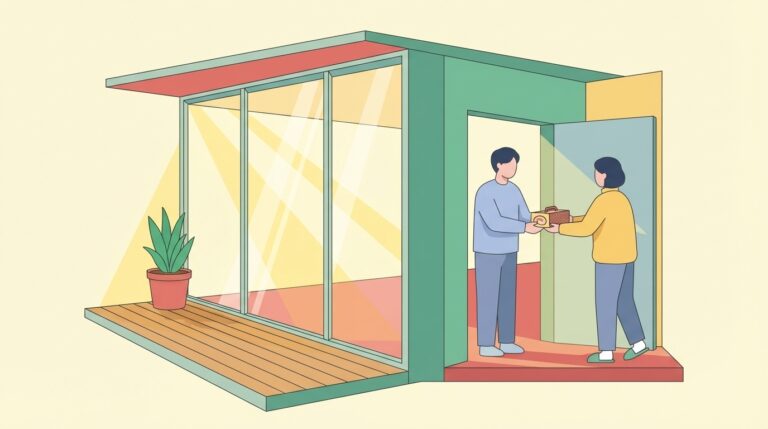
The secret isn’t necessarily being a Chaebol (재벌). It’s a magical architectural trick known as 베란다 확장 (Balcony Expansion). If you ever rent an apartment, watch a Korean real estate variety show, or simply live next door to someone renovating their home in Korea, you are going to encounter this phrase.
Today, we are going completely off the textbook to explore the real-life Korean apartment culture. Let’s dive in! 🏢
Phase 2: Core Expressions – The Renovation Toolkit
1. 베란다 확장했어요
- Pronunciation: [beranda hwakjang-haesseoyo]
- Sound-alike guide: ‘hwa’ sounds like you’re blowing out a candle, ‘jang’ sounds like ‘Jahng’.
- Meaning: We expanded the balcony. (Literal: Balcony expanded did.)
- K-Culture Moment: If you watch Korean real estate shows like “Where is My Home (구해줘! 홈즈)”, the hosts will dramatically open their arms and shout, “Look at this space! 베란다 확장형이에요! (It’s the balcony-expanded type!)” Almost 90% of modern Korean apartments remove the sliding doors separating the living room and the balcony to make the main living area bigger.
- Editor’s Insight: Koreans use the word ‘베란다’ (veranda) instead of ‘발코니’ (balcony) for apartments. Even though architecturally it might be a balcony, if you say ‘발코니’, people will think of a European castle. Just stick to ‘베란다’!
- Situation Spectrum:
- Real Estate Agent / Landlord: ✅
- Friends & Family: ✅
- Formal Business Presentation: ⚠️ (Depends on the context)
- 🤔 Think About It: Why are Koreans so obsessed with expanding the balcony? How does the high cost of land in Seoul affect how people view ‘extra space’ in their homes?
2. 공사 때문에 좀 시끄러울 거예요
- Pronunciation: [gongsa ttaemune jom sikkeureoul geo-yeyo]
- Sound-alike guide: ‘ssi’ sounds like a sharp ‘shee’, ‘kkeu’ is that disgusted sound you make when stepping in gum.
- Meaning: It will be a bit noisy because of the construction.
- K-Culture Moment: In Korea, if you do a balcony expansion (which involves smashing concrete), it gets loud. Before construction begins, it is an absolute cultural rule to visit your neighbors, hand them a box of roll cakes or a bundle of standard garbage bags (종량제 봉투), and say this phrase with an apologetic smile.
- Editor’s Insight: Notice the word 좀 (a little bit). Even if the noise sounds like an earthquake, Koreans soften the blow by saying “It will be a little noisy.” It’s the ultimate polite understatement!
- Situation Spectrum:
- Neighbors (Casual/Polite): ✅
- Landlord: ✅
- Close Friends: 🚫 (They don’t live with you, so they won’t hear it!)
- 🤔 Think About It: Why do Koreans give gifts when they are the ones causing an inconvenience? Does your culture have a similar ‘pre-apology’ ritual?
3. 샷시 새로 했어요
- Pronunciation: [syassi saero haesseoyo]
- Sound-alike guide: ‘syassi’ sounds exactly like ‘sash-ee’.
- Meaning: We got new window frames. / We installed new chassis.
- K-Culture Moment: Because the balcony is gone, the living room is directly exposed to the cold winter wind. Therefore, getting high-quality double-glazed windows is crucial. Koreans adopted the English word “sash” (window frame) and turned it into the Konglish word 샷시.
- Editor’s Insight: If you rent an apartment in winter and it’s freezing, you might need to check if the ‘샷시’ is old. It’s a survival word!
- Situation Spectrum:
- Real Estate / Maintenance: ✅
- Friends (bragging about your new house): ✅
Phase 3: Textbook vs. Real Korean
[Looking for an Apartment]
* 📖 Textbook Korean: 이 집은 발코니를 넓혔습니까? (Did you enlarge the balcony of this house?)
* 🗣️ Real Korean: 여기 베란다 확장형이에요? / 베란다 텄어요?
* 💡 Why is it different?: ‘트다’ (to open up/clear out) is a very natural verb used when talking about knocking down walls between rooms.
[Apologizing to Neighbors]
* 📖 Textbook Korean: 이웃 여러분께 양해를 구합니다. (I ask for the understanding of the neighbors.)
* 🗣️ Real Korean: (Holding a roll cake) 안녕하세요, 다음 주에 인테리어 공사해서 좀 시끄러울 거예요. 죄송해요!
* 💡 Why is it different?: The textbook version is what you write on the official notice board in the elevator. The real version is what you actually say face-to-face.
Bottom Note: For B1 learners, mastering the word 좀 (a little/please) is your secret weapon. It instantly makes any request or apology sound 10x more natural and softer.
Phase 4: Cultural Context — K-Culture Deep Dive
4-1. The Art of “Nunchi” and the Pre-Apology
When you do a 베란다 확장 공사 (Balcony expansion renovation), you are legally and culturally required to get the signatures of your neighbors. This requires high-level 눈치 (Nunchi)—reading the room. You shouldn’t visit them too late at night, and you must use a soft, apologetic tone. Body language is key: give a slight bow (about 30 degrees) and hand over the gift with two hands.
4-2. K-Culture Connections
K-Drama Tropes (Media vs Reality):
Have you noticed in K-Dramas like “Crash Course in Romance” or “My Love from the Star”, the characters always seem to run into their neighbors in the elevator? In real Korean apartment life, elevator etiquette is huge. If there is an “Apology Notice for Renovation” taped inside the elevator, neighbors will read it and mentally prepare.
K-Food Connection (The Moving Day Ritual):
What do Koreans eat on the day the renovation finishes and they move in? 짜장면 (Jajangmyeon – Black Bean Noodles)! It’s the ultimate fast food you order when the kitchen isn’t set up yet. You sit on the floor of your newly expanded, empty living room and eat noodles from the delivery bowls. It’s a rite of passage!
Phase 5: Real-Life Roleplay Scenario
Setting: Saturday morning, 10:00 AM. You are standing in front of your downstairs neighbor’s door. You just bought a 20-year-old apartment in Seoul and you are doing a massive “balcony expansion” starting Monday. You are holding a premium Roll Cake from Paris Baguette.
Characters:
* YOU: An expat who just bought their first Korean apartment.
* Min-su (32): Your downstairs neighbor. Friendly, but clearly just woke up.
(Ding-dong 🔔)
민수: 네, 누구세요?
(Ne, nuguseyo?)
[Yes, who is it?]
YOU: 안녕하세요, 위층(502호)에 새로 이사 온 사람인데요.
(Annyeonghaseyo, wicheung(obaeg-i-ho)e saero isa on saramindeyo.)
[Hello, I’m the person who newly moved in upstairs (Unit 502).]
민수: 아, 네! 안녕하세요.
(Ah, ne! Annyeonghaseyo.)
[Ah, yes! Hello.]
(🎭 Stage Direction: Min-su opens the door slightly, looking curious.)
YOU: 다름이 아니라, 다음 주부터 저희 집 베란다 확장 공사를 해요.
(Dareumi anira, daeum jubuteo jeohui jip beranda hwakjang gongsareul haeyo.)
[The thing is, starting next week, we are doing a balcony expansion renovation.]
민수: 아… 네. (His eyes widen slightly in fear of the noise)
(Ah… ne.)
[Ah… I see.]
YOU: 그래서 며칠 동안 많이 시끄러울 거예요. 정말 죄송합니다.
(Geuraeseo myeochil dongan mani sikkeureoul geo-yeyo. Jeongmal joesonghamnida.)
[So it will be very noisy for a few days. I am really sorry.]
🔀 Your Turn! How will you hand over the Roll Cake?
* A) “이거 케이크예요. 드세요!” (This is a cake. Eat it!)
* B) “약소하지만… 이거 좀 드세요. 시끄럽게 해서 죄송해요.” (It’s not much, but… please have this. Sorry for the noise.)
* C) “시끄러우면 저한테 전화하세요!” (If it’s noisy, call me!)✅ Best Choice: B. “약소하지만” (It’s not much / literally: it is meager) is the most polite and culturally accurate way to present a gift in Korea. It shows humility.
⚠️ Choice A & C Analysis: ‘A’ is too direct and sounds like an order. ‘C’ is a terrible idea—in Korea, noise complaints should go through the Management Office (관리사무소), not directly between neighbors, to avoid fights!
민수: 아유, 감사합니다. 공사 잘 하세요!
(Ayu, gamsahamnida. Gongsa jal haseyo!)
[Oh my, thank you. Good luck with the renovation!]
Phase 6: 10-Second Shadowing Drill
Practice making your apology sound soft and empathetic.
- 😊 (Friendly & Apologetic):
다음 주에 / 베란다 공사 때문에 / 쪼~금 시끄러울 거예요. / 죄송해요!
(daeum ju-e / beranda gongsa ttaemune / jjo~geum sikkeureoul geo-yeyo. / joesonghaeyo!)
(Pro tip: Stretch out the ‘쪼’ [jjo] to emphasize how sorry you are!)
Phase 7: K-Culture Mini Dictionary
| 한국어 (Korean) | Romanization | English | Context |
|---|---|---|---|
| 눈치 | nunchi | Social sense/Tact | The core of Korean social interaction. Reading the room. |
| 층간소음 | cheung-gan-soeum | Inter-floor noise | A huge social issue in Korea. The noise traveling between apartment floors. |
| 샷시 | syassi | Window frame / Chassis | Konglish word used for the heavy glass doors/windows in apartments. |
| 관리비 | gwallibi | Maintenance fee | The monthly fee paid to the apartment management. |
| 집들이 | jip-deuri | Housewarming party | What you do after your balcony expansion is successfully finished! |
Phase 8: Expat Survival Kit (Apartment Hunting)
If you are hunting for an apartment or an Airbnb in Korea, the balcony status is crucial info!
🆘 Survival Phrases #1
* 🇰🇷 “여기 베란다 확장형이에요?” (yeogi beranda hwakjang-hyeong-ieyo?)
* 🗣️ Meaning: Is the balcony expanded here?
* 📍 Where to use: Real estate agency (부동산), asking an Airbnb host.
* 💡 Pro Tip: Expanded balconies mean a bigger living room, but sometimes it means the house gets colder in winter. Always check if the windows (샷시) are double-glazed (이중창)!📌 Editor’s Real Estate Note
* Useful App: [직방 (Zigbang), 다방 (Dabang), 네이버 부동산 (Naver Real Estate)]
* Boiler / Ondol: Korean apartments use floor heating (보일러). If the balcony is expanded, make sure the floor heating pipes reach the new expanded area!
Phase 9: Think Deeper — Media vs Reality
Media vs Reality: The Illusion of Space in K-Dramas
In K-Dramas, apartments often look incredibly spacious, with high ceilings and floor-to-ceiling windows. But in reality, Seoul has one of the highest population densities in the world. Space is an absolute luxury. This is exactly why the “베란다 확장” (Balcony Expansion) culture was born. Instead of having a small outdoor space for plants, Koreans sacrifice the balcony to gain a few extra square meters for their living room sofa. The language of renovation reflects the reality of surviving in a hyper-competitive real estate market.
💬 Your Turn: Does your culture value outdoor space (like a patio or balcony) more, or indoor living space? Share your thoughts in the comments!
Phase 10: FAQ & Avoiding Common Mistakes
Q: Can I complain directly to my neighbor if their construction is too loud?
A: NO! In Korea, direct confrontation about noise (층간소음) is highly discouraged and can lead to serious arguments. Always call the 관리사무소 (Management Office) or security guard (경비 아저씨) and ask them to make a polite broadcast or call the unit.
Q: I saw the word ‘발코니’ in a dictionary. Can I use it?
A: Maybe, but stick to 베란다. Koreans legally and culturally use ‘베란다’ to refer to apartment balconies.
❌ Common Mistake #1: Starting construction without getting your neighbors’ signatures (공사 동의서).
✅ Do this instead: In Korean apartments, you must get the signatures of over 50% of the residents in your building block before loud construction can legally begin.
Phase 11: Summary & Action Items
- One-Liner Summary: In Korea, surviving apartment renovations requires knowing the word ‘베란다 확장’ and mastering the polite ‘roll-cake apology’.
Your Action Mission:
* 🥉 Bronze (Solo): Say “베란다 공사 때문에 좀 시끄러울 거예요” out loud 3 times while imagining holding a cake.
* 🥈 Silver (Online): Go to a K-Drama subreddit or forum and explain why Korean living rooms look so big (Hint: Balcony expansion!).
* 🥇 Gold (Real Life): Next time you pass by a real estate office (부동산) in Korea, look at the window listings and try to spot the word “확장”!
K-Culture Mission: Watch an episode of the Korean variety show “구해줘! 홈즈 (Where is My Home)” on YouTube. Count how many times the hosts shout “베란다 확장!” when entering the living room.
Phase 12: Interactive Quiz
1. Situational Judgment:
You are doing a loud “베란다 확장” renovation tomorrow. You meet your neighbor in the elevator. What is the BEST thing to say?
* A) “내일 발코니 넓혀요!” (I’m enlarging the balcony tomorrow!)
* B) “내일 공사 때문에 좀 시끄러울 거예요. 죄송합니다.” (It will be a bit noisy tomorrow due to construction. I’m sorry.)
* C) “시끄러우면 귀마개를 쓰세요.” (Use earplugs if it’s loud.)
2. True or False – K-Culture Edition:
* If your upstairs neighbor is doing construction, it is culturally acceptable to go bang on their door and yell at them. (T/F)
3. Fill in the Blank:
* Because the balcony is gone, the cold wind comes in. We need to replace the ________. (Hint: Konglish word for window frames)
(Answers: 1. B – Always apologize politely with ‘좀’. / 2. False – Always use the Management Office! / 3. 샷시 (Syassi))
Frequently Asked Questions (FAQ)
Q: What does "베란다 확장했어요" mean in Korean and how do you pronounce it?
A: In Korean, "베란다 확장했어요" is pronounced [beranda hwakjang-haesseoyo] and means: a key conversational Korean expression covered in this lesson.
Q: What does "공사 때문에 좀 시끄러울 거예요" mean in Korean and how do you pronounce it?
A: In Korean, "공사 때문에 좀 시끄러울 거예요" is pronounced [gongsa ttaemune jom sikkeureoul geo-yeyo] and means: a key conversational Korean expression covered in this lesson.
Q: What does "샷시 새로 했어요" mean in Korean and how do you pronounce it?
A: In Korean, "샷시 새로 했어요" is pronounced [syassi saero haesseoyo] and means: a key conversational Korean expression covered in this lesson.







