

Phase 1: Empathy (Immersive Opening)
Hello! I’m your Daily Hangul Editor.
Imagine this: It’s Friday night in Seoul. You’ve just finished eating a delicious half-and-half Korean fried chicken (반반치킨) in your Airbnb or officetel. You gather your trash, head down to the basement, and suddenly… you freeze.
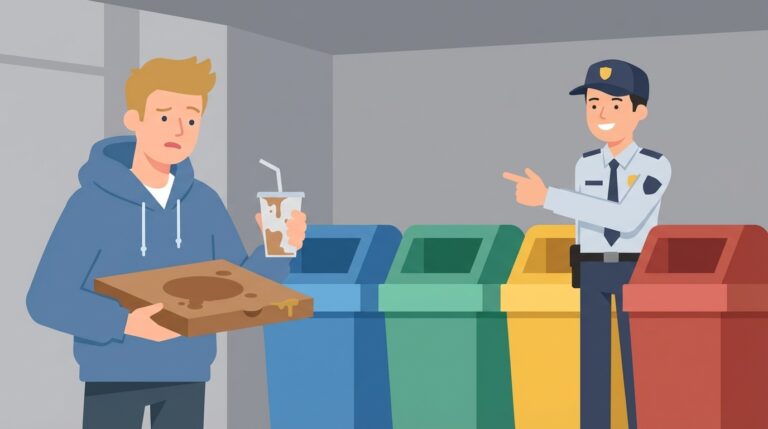
Before you stand 10 different colored bins. One for plastics, one for vinyl, one for paper, and one for… wait, what goes in the white bag? Suddenly, the strict-looking security guard (경비 아저씨) approaches. Your heart pounds. You want to ask for help, but how?
If you’ve watched K-Dramas, you know the apartment recycling area is a classic spot for neighbors to gossip, or for the main characters to accidentally bump into each other wearing messy tracksuits. But in real life, Korea’s recycling system (분리수거) is famous for being incredibly strict.
Don’t worry! I’ve been there, and I’ve seen countless students panic over a greasy pizza box. Today, we’re going to learn the essential survival phrases for doing housework and recycling in Korea. You’ll not only save yourself from fines but also earn the respect of your Korean neighbors!
Phase 2: Core Expressions Deep Dive
1. 이거 어디에 버려요? (Where do I throw this away?)
- Pronunciation: [igeo eodie beoryeoyo?] – Sounds like: ee-goh / uh-dee-eh / buh-ryuh-yo?
- Meaning: Literal: Where do I throw this? / Real nuance: I have no idea which bin this belongs to, please help!
- K-Culture Moment: You’re holding a bizarre mix of cardboard and plastic. You make eye contact with the friendly neighbor next to you and ask this. It instantly shows you are trying to respect their rules.
- Editor’s Insight: The verb 버리다 (to throw away) is very versatile. We use it for trash, but we also use it for feelings, or even when someone gets dumped!
- Situation Spectrum:
- Casual (Close friends): ✅ (Drop the ‘요’: 이거 어디에 버려?)
- Semi-formal (Neighbors, Clerks): ✅ (Perfect!)
- Formal (Boss): ⚠️ (A bit too direct, better to say ‘이것은 어떻게 처리할까요?’)
- 🤔 Think About It: Why do Koreans ask ‘Where’ instead of ‘How’ to recycle? Because physical space (finding the exact right bin) is the biggest challenge in Korean apartment complexes!
2. 일반 쓰레기예요. (It’s general waste.)
- Pronunciation: [ilban sseuregiyeyo] – Sounds like: eel-bahn / sseu-reh-gee-yeh-yo.
- Meaning: Literal: It is general trash. / Real nuance: It cannot be recycled, put it in the special paid bag.
- K-Culture Moment: You try to put a greasy chicken box into the paper recycling. The guard stops you and says, “No, no, 일반 쓰레기!”
- Editor’s Insight: This is the most important classification. If it’s dirty, greasy, or weirdly textured, it’s usually 일반 쓰레기.
- Situation Spectrum:
- Casual: ✅ (일반 쓰레기야)
- Semi-formal: ✅
- Formal: 🚫 (Not a phrase you’d typically say to a boss anyway!)
- 🤔 Think About It: In Korea, throwing away general waste costs money. Do you have a similar ‘pay-as-you-throw’ system in your home country?
3. 종량제 봉투 (Standardized garbage bag)
- Pronunciation: [jongnyangje bongtu] – Sounds like: jong-nyang-jeh / bong-too.
- Meaning: Volume-based waste fee bag.
- K-Culture Moment: You go to a Korean convenience store (CU, GS25) and ask for a plastic bag for your groceries. The clerk asks, “종량제 봉투 드릴까요?” (Shall I give you a trash bag?). They do this so you can use the shopping bag as a trash bag later! Pure efficiency.
- Editor’s Insight: This isn’t a sentence, but it’s a magic noun. You CANNOT throw away general waste in just any black plastic bag. You must buy these specific bags at the local mart or convenience store.
- Situation Spectrum: N/A (It’s a noun).
- 🤔 Think About It: Why do these bags look different in every single district (구) in Seoul? It reflects how local taxes work in Korea!
Phase 3: Textbook vs. Real Korean
[Situation 1: Asking how to sort your trash]
* 📖 Textbook: 분리수거를 어떻게 합니까? (How do I do the recycling?)
* 🗣️ Real Korean: 이거 따로 버려요? (Do I throw this separately?)
* 💡 Why the difference?: Koreans love efficiency. Instead of using the formal noun ‘recycling’ (분리수거), we just use the adverb ‘따로’ (separately) because the action itself implies recycling.
[Situation 2: Buying the trash bag at the convenience store]
* 📖 Textbook: 쓰레기 봉투 하나 주십시오. (Please give me one garbage bag.)
* 🗣️ Real Korean: 종량제 봉투 10리터(십리터)짜리 주세요. (Please give me a 10-liter standard bag.)
* 💡 Why the difference?: You have to specify the size (liters). If you just say ‘trash bag’, the clerk will stare at you waiting for the size!
Bottom Note: For A2 learners, simply memorizing “[Size] + 리터 주세요” (e.g., 십 리터 주세요 – 10 liters please) will make you look like a total local!
Phase 4: Cultural Context — K-Culture Deep Dive
4-1. Non-verbal Nunchi (눈치) at the Bins
When you are at the recycling center, Nunchi (the Korean art of reading the room) is crucial. Don’t just toss your bag and run! The polite non-verbal behavior is to carefully wash your plastic delivery containers (especially getting that red spicy Tteokbokki sauce out!) before bringing them down. If you make a mistake and the guard corrects you, bow your head slightly and say “아, 네! 죄송합니다” (Ah, yes! Sorry).
4-2. The K-Food Connection: Delivery Culture
Korea is the king of 배달 (delivery). But with great delivery food comes great recycling responsibility. When you order Jajangmyeon (black bean noodles) or Jokbal (pig’s trotters), you get dozens of little plastic side dish containers.
- Pro Tip: If the plastic is stained red from Kimchi or Gochujang and cannot be washed clean with soap, it is NO LONGER recyclable. It becomes 일반 쓰레기 (general waste). Many expats get scolded for putting red-stained plastic into the recycling bin!
Phase 5: Real-life Roleplay Scenario
Setting: Tuesday, 9:00 PM. The dimly lit basement recycling area of your officetel. You are wearing comfortable sweatpants. You have a stack of flattened cardboard boxes and a greasy pizza box.
Characters:
* YOU: An expat who moved to Korea a month ago. You want to be a good resident.
* Guard Ajeossi (Security Guard): 60s. Wears a neat uniform. He is strict about the rules but actually very warm-hearted.
Dialogue:
YOU: 안녕하세요! 수고하십니다.
(Annyeonghaseyo! Sugohasimnida.)
[Hello! Thank you for your hard work.]
Guard: 네, 학생. 박스 버리려고?
(Ne, haksaeng. Bakseu beoryeoryeogo?)
[Yes, student. Are you trying to throw away boxes?]
(🎭 Stage Direction: He points at your pile of cardboard)
YOU: 네. 이거 종이에 버려요?
(Ne. Igeo jong-i-e beoryeoyo?)
[Yes. Do I throw this in the paper (bin)?]
Guard: 잠깐만. 그 피자 박스 봐봐.
(Jamkkanman. Geu pija bakseu bwabwa.)
[Wait a minute. Look at that pizza box.]
YOU: 아… 이거요?
(Ah… igeoyo?)
[Ah… this one?]
Guard: 거기에 기름 묻었잖아. 일반 쓰레기예요.
(Geogie gireum mudeotjana. Ilban sseuregiyeyo.)
[There’s grease on it. It’s general waste.]
YOU: 아! 기름이 있으면 일반 쓰레기예요?
(Ah! Gireumi isseumyeon ilban sseuregiyeyo?)
[Ah! If there’s grease, is it general waste?]
Guard: 그렇지! 종량제 봉투에 넣어서 버려요.
(Geureochi! Jongnyangje bongtue neo-eoseo beoryeoyo.)
[Exactly! Put it in the standard bag and throw it away.]
🔀 Your Turn! How do you reply?
* A) “아니요, 종이입니다!” (No, it is paper!)
* B) “아, 몰랐어요. 감사합니다!” (Ah, I didn’t know. Thank you!)
* C) “대박! 진짜요?” (Daebak! Really?)✅ Best Choice: B — Acknowledging you didn’t know and thanking him is the best way to melt a strict Korean guard’s heart.
⚠️ Choice A & C Analysis: Arguing (A) will make your life in that building very hard. “Daebak” (C) is too slangy to use with an elder you barely know.
Phase 6: 10-Second Shadowing Drill
Let’s practice the most important survival question. Say it out loud!
🥺 아저씨, / 이거 / 어디에 버려요?
(Ah-jeo-ssi, / i-geo / eo-di-e beo-ryeo-yo?)
Focus: Pause slightly after ‘이거’ (this). Make sure your tone goes UP at the end to show it’s a question. Look slightly confused and cute (🥺) so they want to help you!
Phase 7: K-Culture Mini Dictionary
| Korean | Romanization | English | Context |
|---|---|---|---|
| 눈치 | nunchi | Social awareness | Reading the room to see how others sort their trash. |
| 일반 쓰레기 | ilban sseuregi | General waste | Trash that goes into the paid, standardized bag. |
| 음식물 쓰레기 | eumsikmul sseuregi | Food waste | Must go into a separate food waste bin or bag. |
| 종량제 봉투 | jongnyangje bongtu | Standardized bag | The paid trash bag you buy at the convenience store. |
| 배달 | baedal | Delivery | The beautiful Korean system that causes 90% of your plastic recycling. |
Phase 8: Traveler Survival Kit
Even if you are staying in an Airbnb for just a week, you MUST know how to deal with trash.
🆘 Survival Phrases for Airbnbs & Convenience Stores
* 🇰🇷 “종량제 봉투 10리터 주세요.” (jongnyangje bongtu simniteo juseyo)
* 🗣️ English: Please give me a 10L standard trash bag.
* 📍 Where to use: Convenience stores.
* 💡 Pro Tip: Need a plastic bag to carry your snacks? Just buy a 종량제 봉투! You can carry your items home in it, and then use it as your actual trash bag later. Two birds, one stone!📌 Editor’s Travel Note
* Toilets in older cafes/buildings: You might see a small trash can next to the toilet with a sign saying “휴지는 휴지통에” (Put tissues in the trash can). In older Korean plumbing systems, flushing toilet paper can cause clogs!
Phase 9: Critical Thinking — “One Step Deeper”
The Nunchi of the Recycling Bin (Community vs. Individual)
Why does Korea have one of the highest recycling rates in the world? It comes down to the cultural concept of ‘우리’ (We/Us) and collective responsibility. In many Western cultures, recycling is often seen as a personal environmental choice. In Korea, it is a strict community rule. If you fail to separate your trash properly, the entire apartment building can get fined, or the garbage collectors will refuse to take the building’s trash. The pressure of Nunchi (what my neighbors think of me) acts as a powerful social glue that keeps the streets clean.
💬 Your Turn: In your culture, is recycling a personal choice or a strict community rule? Do neighbors check on each other’s trash? Let us know in the comments!
Phase 10: FAQ & Mistake Prevention
- Q: Can I just throw food waste into the general trash bag?
- A: NO! This is illegal and you can be heavily fined. Food waste (음식물 쓰레기) goes into its own specific yellow bag or a smart RFID food waste bin.
- Q: Can I call the security guard “아저씨” (Ajeossi)?
- A: Maybe. “Ajeossi” is commonly used, but in newer, fancier apartment complexes, residents prefer calling them “경비원 선생님” (Security Teacher/Sir) or “기사님” (Driver/Engineer) as a sign of higher respect. For A2 beginners, a polite “아저씨, 안녕하세요!” is totally fine!
❌ Common Mistake #1: Throwing chicken bones (치킨 뼈) into the Food Waste bin.
✅ Do this instead: Bones, eggshells, and onion skins cannot be eaten by animals, so they are classified as 일반 쓰레기 (General Waste) in Korea! Put them in the standard bag.
Phase 11: Summary & Action Items
One-Liner Summary: To survive Korean recycling, remember to ask “이거 어디에 버려요?” and never put greasy items in the recycling bins!
Action Mission 3 Steps:
* 🥉 Bronze (Solo): Look at a piece of trash in your room right now and say “이거 어디에 버려요?” out loud.
* 🥈 Silver (Online): Find a picture of a Korean convenience store on Google. Imagine asking the cashier for a “종량제 봉투”.
* 🥇 Gold (Real World): Next time you are in Korea or a Korean mart, actually buy a 종량제 봉투 (Standardized bag) in Korean!
K-Culture Mission:
Go to YouTube and search “Korean officetel tour” or “Korean apartment tour”. Pay close attention to the balcony or front door area—you will almost always see neatly stacked recycling bins!
Phase 12: Quiz — Interactive Challenge
1. You finished eating spicy fried chicken. You have leftover chicken bones. Where do they go?
A) 음식물 쓰레기 (Food waste)
B) 일반 쓰레기 (General waste)
C) 플라스틱 (Plastic)
(Answer: B! Bones cannot be processed as animal feed, so they go in general waste!)
2. Fill in the blank: You want to buy a 10L trash bag at GS25.
“_________ 봉투 10리터 주세요.”
(Answer: 종량제 – jongnyangje)
3. True or False: If a plastic food delivery container is heavily stained with red chili paste, you should still put it in the plastic recycling bin.
(Answer: False. If it cannot be washed clean, it must be thrown away as 일반 쓰레기.)
Did you get them all right? You’re officially ready to be a great Korean neighbor! 🥳
Frequently Asked Questions (FAQ)
Q: What does "이거 어디에 버려요? (Where do I throw this away?)" mean in Korean and how do you pronounce it?
A: In Korean, "이거 어디에 버려요? (Where do I throw this away?)" is pronounced [igeo eodie beoryeoyo?] and means: Literal: Where do I throw this? / Real nuance: I have no idea which bin this belongs to, please help!
Q: What does "일반 쓰레기예요. (It's general waste.)" mean in Korean and how do you pronounce it?
A: In Korean, "일반 쓰레기예요. (It's general waste.)" is pronounced [ilban sseuregiyeyo] and means: Literal: It is general trash. / Real nuance: It cannot be recycled, put it in the special paid bag.
Q: What does "종량제 봉투 (Standardized garbage bag)" mean in Korean and how do you pronounce it?
A: In Korean, "종량제 봉투 (Standardized garbage bag)" is pronounced [jongnyangje bongtu] and means: Volume-based waste fee bag.







