

Phase 1: Empathy & Hook (The K-Culture Cold Open)
Hello! I’m the Daily Hangul Editor, your personal Korean tutor and local culture navigator.
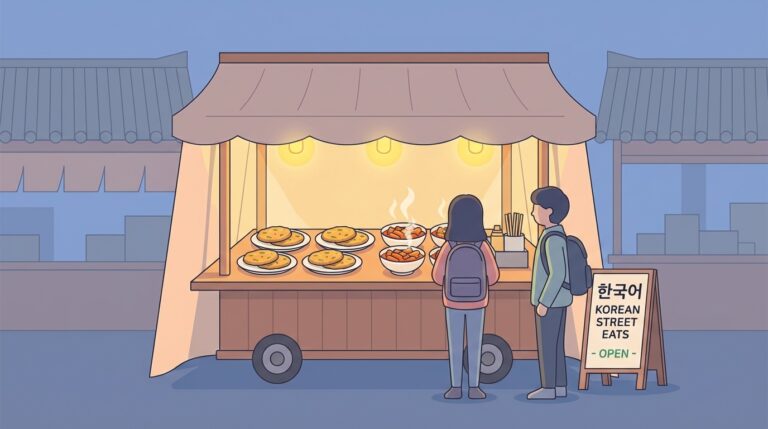
Picture this: You just arrived at Gwangjang Market in Seoul. The smell of sizzling oil fills the air, colorful neon signs are flashing, and there are hundreds of food stalls stretching out in every direction. It looks exactly like that scene from your favorite K-Drama, or a vlog from your favorite K-Pop idol.
But then, the panic sets in. The menus are entirely in Korean. Even if there are pictures, everything looks delicious, but you have no idea what the absolute must-try item is. You want to eat what the locals are eating, not the tourist trap food.
What do you do? Open a translation app and awkwardly type “What is good?”
Don’t worry. Today, I’m going to teach you the ultimate “insider” phrase that will immediately make Korean shop owners smile and point you to the best item in the house. This post is based on real SOS messages I’ve received from my A1 beginner students who felt lost in Korean markets. Trust me, learning this one phrase will upgrade your Korea trip from “tourist” to “local insider!”
Phase 2: Deep Dive into Core Expressions
Let’s master the magic words that will save you from menu anxiety.
1. 여기서 유명한 게 뭐예요?
- Pronunciation: Yeogi-seo / yumyeong-han ge / mwoyeyo? [Yo-gee-saw / yoo-myung-han geh / mwo-yay-yo?]
- Sound-alike guide: “mwoyeyo” sounds a bit like “mwah-yay-yo” said quickly.
- Meaning:
- Literal: What is the famous thing here?
- Real nuance: What’s your signature dish? / What do you recommend?
- K-Culture Moment: Picture a K-Drama where the main characters go on a road trip to a small seaside town. They walk into a cozy, old restaurant. They don’t even look at the menu; they just look at the grandma cooking and ask, “여기서 유명한 게 뭐예요?” It’s the ultimate phrase for discovering hidden gems!
- Editor’s Insight: This phrase is incredibly polite but natural. It shows that you respect the owner’s expertise and value their local reputation.
- Situation Spectrum:
- Casual (Street food stall): ✅
- Semi-formal (Nice restaurant): ✅
- Formal (High-end dining): ✅
- 🤔 Think About It: Why do Koreans care so much about “famous” (유명한) things? In Korean culture, popularity often equals trust. If many people have tried it and loved it, it’s considered safe and delicious. Does your culture rely heavily on word-of-mouth recommendations too?
2. 추천해 주세요.
- Pronunciation: Chucheon-hae juseyo. [Choo-chun-heh joo-say-yo.]
- Meaning:
- Literal & Real nuance: Please recommend (something).
- K-Culture Moment: You’ll often see K-Pop idols doing V-Live broadcasts asking fans, “오늘 저녁 메뉴 추천해 주세요!” (Please recommend a dinner menu for today!).
- Editor’s Insight: This is a fantastic, versatile “copy-paste” phrase. You can use it in restaurants, cafes, cosmetic shops, or even when asking for travel destinations.
- Situation Spectrum:
- Casual: ✅
- Semi-formal: ✅
- Formal: ✅
- 🤔 Think About It: “주세요” (juseyo) means “please give me.” In Korean, we “give” a recommendation. It reflects how much we value the act of sharing information as a gift.
Phase 3: Textbook vs. Real Korean
Let’s see how the textbooks compare to the vibrant streets of Seoul.
[Situation 1: Asking for a recommendation at a restaurant]
* 📖 Textbook Korean: 이 식당의 대표 메뉴는 무엇입니까? (I sikdang-ui daepyo menyu-neun mueos-imnikka? – What is the representative menu of this restaurant?)
* 🗣️ Real Korean: 사장님 추천이요! (Sajangnim chucheon-iyo! – Boss’s recommendation, please!) OR 여기 제일 잘 나가는 게 뭐예요? (Yeogi jeil jal naganeun ge mwoyeyo? – What sells the best here?)
* 💡 Why the difference?: Textbook Korean sounds like a news reporter! Real Koreans prefer using “잘 나가는” (best-selling) or simply relying on the “Sajangnim” (boss/owner) for a quick, friendly interaction.
Bottom Note: Since you are at the A1 (Absolute Beginner) level, stick to “여기서 유명한 게 뭐예요?” It’s the perfect middle ground—polite, easy to pronounce, and totally natural.
Phase 4: Cultural Context — K-Culture Deep Dive
4-1. Non-Verbal Elements: How to Point Politely
When you ask “What is famous here?”, the owner might point at a menu on the wall. If you want to say, “I’ll have that,” do not point with one index finger! In Korea, pointing with one finger can seem aggressive or rude. Instead, use your whole hand, palm facing up, to gesture toward the menu or the food. It’s a small detail, but it shows great Nunchi (social awareness)!
4-2. K-Food Connection: The “In-sim” (Generosity) Culture
Korean traditional markets and local restaurants run on “인심” (In-sim), which means generosity or a warm heart. When you humbly ask the “이모” (Imo – Auntie/female staff) for her recommendation, you are respecting her craft. Often, this warm interaction leads to “서비스” (Service – free bonus food!).
If you say, “Wow, this looks amazing! What is famous here?” she might just give you an extra dumpling or a bigger portion, simply because she likes your polite attitude!
Phase 5: Practical Roleplay Scenario
Setting: Gwangjang Market, 6:30 PM. The market is bustling with locals getting off work. You sit down at a small stall. A warm, energetic “Imo” (Auntie) is flipping crispy pancakes (Bindaetteok) on a massive grill.
Characters:
– YOU: A hungry traveler exploring Seoul, tired but excited.
– Imo (Auntie): 60s, friendly, calls all young customers “student.”
Dialogue:
Imo: 어서 와요, 학생! 여기 앉아요. (Eoseo wayo, haksaeng! Yeogi anjayo.)
[Welcome, student! Sit here.]
(🎭 Stage Direction: Imo wipes the table and hands you a menu with 20 items)
YOU: 안녕하세요! 와, 다 맛있어 보여요. (Annyeonghaseyo! Wa, da masisseo boyeoyo.)
[Hello! Wow, everything looks delicious.]
YOU: 저기요… 여기서 유명한 게 뭐예요? (Jeogiyo… yeogiseo yumyeong-han ge mwoyeyo?)
[Excuse me… What is famous here?]
Imo: 우리 집은 녹두빈대떡이 제일 유명하지! 바삭바삭하고 맛있어. (Uri jibeun nokdu-bindaetteok-i jeil yumyeong-haji! Basak-basak-hago masisseo.)
[Our house is most famous for Mung Bean Pancakes! It’s crispy and delicious.]
YOU: 아, 그럼 그거 하나 주세요! (Ah, geureom geugeo hana juseyo!)
[Ah, then please give me one of those!]
Imo: 탁월한 선택! (Takwolhan seontaek!)
[Excellent choice!]
(🎭 Stage Direction: Imo starts cutting the hot pancake with scissors)
Imo: 빈대떡엔 막걸리인데, 막걸리도 한 병 줄까? (Bindaetteok-en makgeolli-inde, makgeolli-do han byeong julkka?)
[Pancakes go best with Makgeolli (rice wine). Shall I give you a bottle of Makgeolli too?]
🔀 Your Turn! How do you reply to the Makgeolli offer?
– A) “아니요. 안 마셔요.” (No. I don’t drink.)
– B) “네! 막걸리도 추천해 주세요!” (Yes! Please recommend a Makgeolli too!)
– C) “막걸리가 뭐예요?” (What is Makgeolli?)✅ Best Choice: B — Embracing the local pairing! Using “추천해 주세요” here makes Imo pick her favorite local drink for you.
⚠️ Choice A Analysis: It’s a bit direct. If you don’t drink, it’s softer to say “아, 저는 술을 못 마셔요” (Ah, I can’t drink alcohol) with an apologetic smile.
YOU: 네! 막걸리도 추천해 주세요! (Ne! Makgeolli-do chucheon-hae juseyo!)
[Yes! Please recommend a Makgeolli too!]
Imo: 아이구, 학생 먹을 줄 아네! 장수 막걸리로 줄게! (Aigu, haksaeng meogeul jul ane! Jangsu makgeolli-ro julge!)
[Oh my, you know how to eat! I’ll give you Jangsu Makgeolli!]
Phase 6: 10-Second Shadowing Drill
Let’s practice the flow. Read the Romanization and focus on the pauses (/) and the emotion tags!
😊 여/기/서 / 유/명/한/ 게 / 뭐/예/요?
(yeo/gi/seo / yu/myeong/han/ ge / mwo/ye/yo?)
Imagine you are super excited and curious looking at the menu.
🥺 사장님, / 추/천/해 / 주/세/요!
(Sa-jang-nim, / chu/cheon/hae / ju/se/yo!)
Use your best cute/polite voice, trusting their expert opinion.
Phase 7: K-Culture Mini Dictionary
| Korean | Romanization | English | Context/Meaning |
|---|---|---|---|
| 맛집 | matjib | Famous/Good Restaurant | A combination of “mat” (taste) and “jib” (house). A must-know keyword for Korea travel! |
| 이모 / 사장님 | imo / sajangnim | Auntie / Boss | How to respectfully call restaurant staff. “Imo” is for casual places; “Sajangnim” works everywhere. |
| 인심 | in-sim | Generosity | The warm-hearted nature of Korean markets, often resulting in extra food or kindness. |
| 서비스 | seobiseu | Service (Freebie) | In Korea, “service” doesn’t mean a tip! It means complimentary food given by the owner. |
Phase 8: Traveler Survival Kit
If you are exploring Korean markets or cafes, keep these survival phrases in your back pocket!
🆘 Survival Phrases TOP 3
1. 이거 얼마예요? (Igeo eolmayeyo?)
– 🗣️ Meaning: How much is this?
– 📍 Where to use: Street stalls, markets, underground shopping malls.2. 맵지 않게 해 주세요. (Maepji anke hae juseyo.)
– 🗣️ Meaning: Please make it not spicy.
– 📍 Where to use: Any restaurant! (If you don’t like spicy food, this is a lifesaver).3. 포장해 주세요. (Pojang-hae juseyo.)
– 🗣️ Meaning: Please pack it for takeout.
– 📍 Where to use: Cafes, bakeries, or when you have leftovers.📌 Editor’s Travel Note
– Navigating: Google Maps doesn’t work well for walking directions in Korea! Download Naver Map or KakaoMap.
– Payment: Korea is a cashless society, but traditional markets are the exception. Keep around 20,000~50,000 KRW in cash for street food!
– Tipping: Korea has NO tipping culture. Leaving money on the table will confuse the staff, and they might chase you down the street to return your money!
Phase 9: Critical Thinking — “One Step Deeper”
Food & Identity: The “Matjib” Culture
🧠 Think Deeper:
Have you noticed how much Koreans love waiting in line for a “Matjib” (famous restaurant)? In Korea, food isn’t just about feeding yourself; it’s a shared social experience. Discovering a famous spot, sharing it with friends, and eating the exact same trendy food is a way of building “정” (Jeong – emotional connection) and feeling part of the community. Asking “What is famous here?” isn’t just about taste—it’s about participating in the collective cultural experience!💬 Your Turn: Do people in your country wait 2 hours in line just to try a “famous” dessert? Share your food culture in the comments!
Phase 10: FAQ & Avoiding Misunderstandings
Q: Can I ask “여기서 유명한 게 뭐예요?” to a random person on the street?
A: Usually, this phrase is used inside a shop or restaurant. If you want to ask a stranger on the street for general local recommendations, it’s better to say: “근처에 맛집 추천해 주세요!” (Geuncheo-e matjib chucheon-hae juseyo! – Please recommend a good restaurant nearby!).
Q: Is it rude to order only one dish at a market?
A: In street stalls, it’s totally fine! However, in formal sit-down BBQ restaurants, you usually must order a minimum of two portions of meat, even if you are alone.
❌ Common Mistake #1: Saying “You” to the owner.
Using “당신” (dangsin – you) is a huge mistake in Korean! Instead of “What do you recommend?”, Koreans omit the subject entirely and just say “추천해 주세요” (Please recommend).
Phase 11: Summary & Action Items
- One-Liner Summary: Beat menu anxiety by simply asking, “여기서 유명한 게 뭐예요?” (What is famous here?)
-
Action Mission 3 Steps:
- 🥉 Bronze (Solo): Stand in front of your mirror and practice “여기서 유명한 게 뭐예요?” 3 times with a bright smile.
- 🥈 Silver (Online): Find a Korean food video on YouTube and write “추천해 주세요!” in the comments.
- 🥇 Gold (Real Life): Visit a Korean restaurant in your city and try asking the staff for a recommendation using today’s phrase!
- K-Travel Mission: Open Naver Map (or Google Maps), find a cafe in Seoul, look at the photos of the pastries, and imagine yourself pointing and asking, “여기서 유명한 게 뭐예요?”
Phase 12: Quiz — Interactive Challenge
1. Situational Judgment: You enter a cute Korean cafe in Hongdae. The menu has 50 items. What is the most natural way to ask for their signature drink?
– A) 대표 메뉴는 무엇입니까?
– B) 여기서 유명한 게 뭐예요?
– C) 커피 한 잔 주세요.
2. True or False — K-Culture Edition:
“If the restaurant service was excellent, you should leave a 15% tip on the table.”
3. Fill in the Blank:
사장님, 이 식당 메뉴 하나만 ______해 주세요! (Please recommend just one menu item, Boss!)
– A) 포장 (pojang)
– B) 추천 (chucheon)
– C) 계산 (gyesan)
(Answers: 1: B – A is too textbook, C just means ‘one coffee please’. 2: False! No tipping in Korea. 3: B – chucheon)
Great job today! You are now fully equipped to explore the delicious world of Korean food without any fear. See you in the next lesson! 화이팅! (Hwaiting!)
Frequently Asked Questions (FAQ)
Q: What does "여기서 유명한 게 뭐예요?" mean in Korean and how do you pronounce it?
A: In Korean, "여기서 유명한 게 뭐예요?" is pronounced [Yeogi-seo / yumyeong-han ge / mwoyeyo? [Yo-gee-saw / yoo-myung-han geh / mwo-yay-yo?] and means: a key conversational Korean expression covered in this lesson.
Q: What does "추천해 주세요." mean in Korean and how do you pronounce it?
A: In Korean, "추천해 주세요." is pronounced [Chucheon-hae juseyo. [Choo-chun-heh joo-say-yo.] and means: Literal & Real nuance: Please recommend (something).







