

Phase 1: Empathy & Immersion
Hello, everyone! I’m the Lead Editor at Daily Hangul.
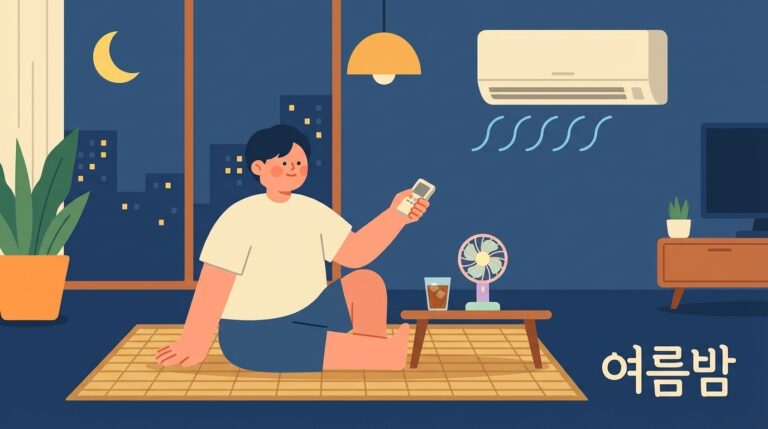
Imagine this: You’re watching a slice-of-life K-Drama. It’s the middle of July. The entire family is dragged out of their bedrooms to sleep on a bamboo mat (대자리) in the living room, sharing a single fan. Suddenly, the teenage son sneaks the AC remote and turns it on. The mom wakes up, smacks him on the back, and screams about the “electric bill!” Have you ever wondered why Korean families fight so passionately over the air conditioner?
Or perhaps you’re currently in Seoul. The sun went down hours ago, but you’re still sweating through your pajamas, tossing and turning.
Welcome to the Korean summer, specifically the phenomenon known as 열대야 (Yeoldaeya – Tropical Night). If you’re at a B2 level, simply saying “덥다” (It’s hot) isn’t enough anymore. You need to know how to navigate the intricate culture of Korean air conditioning—from asking a cafe staff to crank it up, to understanding the very real fear of “AC sickness.” Let’s dive in!
Phase 2: Core Expressions Deep Dive
1. 열대야 (Tropical Night)
- Pronunciation: [yeoldaeya] (Sounds like: yull-dae-ya)
- Meaning: (Literal) Tropical night vs. (Real nuance) A sweltering summer night where the temperature doesn’t drop below 25°C, making it impossible to sleep.
- K-Culture Moment: You’ll hear this non-stop on the morning news. When you meet your coworkers grabbing iced Americanos in the morning, someone will inevitably sigh, “어제 열대야 때문에 한숨도 못 잤어요” (I couldn’t sleep a wink last night because of the tropical night).
- Editor’s Insight: This isn’t just a weather term; it’s a shared national struggle. Using this word instantly makes you sound like a local who understands the true pain of a Korean August.
- Situation Spectrum:
- Friends (Casual): ✅
- Coworkers (Semi-formal): ✅
- Boss/Elders (Formal): ✅ (It’s a standard noun!)
- 🤔 Think About It: Why does Korea have a specific, universally used word for “a hot night”? How does naming a shared discomfort help build community in Korean culture?
2. 에어컨 빵빵하게 틀어주세요 (Please crank up the AC)
- Pronunciation: [eeokeon ppangppanghage teureojuseyo] (Sounds like: air-con ppang-ppang-ha-ge teul-uh-joo-se-yo)
- Meaning: (Literal) Please turn on the air conditioner fully/roundly vs. (Real nuance) Please crank up the AC / Make it freezing in here.
- K-Culture Moment: You walk into a BBQ restaurant (고깃집). The grill is roasting your face. You desperately flag down the owner and use this phrase. The owner nods approvingly and blasts the AC.
- Editor’s Insight: The word “빵빵하게” originally means “fully inflated” (like a balloon), but Koreans use it to describe blasting the AC, heater, or even car speakers. Also, notice we use “틀다” (to turn/play) instead of the textbook “켜다” (to switch on) for appliances with a dial or flow.
- Situation Spectrum:
- Friends (Casual): ✅ (에어컨 빵빵하게 틀자!)
- Coworkers/Restaurant Staff (Semi-formal): ✅
- Boss/Elders (Formal): ⚠️ (A bit too casual. Say: 에어컨 좀 세게 틀어주시겠어요?)
- 🤔 Think About It: “틀다” originally meant turning a physical knob or faucet. Why do Koreans still use “틀다” for digital ACs and YouTube videos? What does this say about language evolution?
3. 냉방병 조심하세요 (Watch out for AC sickness)
- Pronunciation: [naengbangbyeong josimhaseyo] (Sounds like: nang-bang-byung jo-shim-ha-se-yo)
- Meaning: (Literal) Beware of room-cooling disease vs. (Real nuance) Don’t catch a cold from the AC / Be careful of air-conditioning sickness.
- K-Culture Moment: Summer in a Korean office. It’s 35°C outside but 18°C inside. Your coworker is wearing a thick fleece cardigan at their desk. When you sneeze, they will hand you a warm tea and say this.
- Editor’s Insight: “냉방병” (air-conditioning sickness) is treated almost like a seasonal flu in Korea. It refers to the fatigue, headache, and sniffles you get from the extreme temperature difference between indoors and outdoors. It shows you care about someone’s well-being.
- Situation Spectrum:
- Friends (Casual): ✅ (냉방병 조심해)
- Coworkers (Semi-formal): ✅
- Boss/Elders (Formal): ✅ (건강/냉방병 조심하십시오)
- 🤔 Think About It: In many Western cultures, a cold is just a cold caused by viruses. Why is “illness caused by artificial cold” such a prominent cultural concept in Korea?
Phase 3: Textbook vs. Real Korean
[Complaining about the unbearable heat]
* 📖 Textbook Korean: 밤에도 날씨가 너무 덥습니다. (The weather is very hot even at night.)
* 🗣️ Real Korean: 와, 오늘 밤도 완전 열대야야. 쪄 죽겠어. (Wow, tonight is a total tropical night. I’m boiling to death.)
* 💡 Why the difference?: Koreans love dramatic expressions for weather. “쪄 죽겠다” (steaming to death) perfectly captures the intense humidity of a Korean summer.
[Asking to turn down the AC because it’s too cold]
* 📖 Textbook Korean: 에어컨을 꺼 주시겠습니까? (Could you turn off the air conditioner?)
* 🗣️ Real Korean: 저기… 에어컨 온도 좀 높여주실 수 있나요? (Excuse me… could you raise the AC temperature a bit?)
* 💡 Why the difference?: Asking someone to completely turn off (끄다) the AC in a public space lacks “Nunchi” (consideration for others). Asking to “raise the temperature” (온도를 높이다) or “reduce the wind” (바람 좀 줄이다) is much more polite and socially acceptable.
Phase 4: Cultural Context — K-Culture Deep Dive
4-1. Non-Verbal Cues & “Nunchi” (눈치)
When you want the AC adjusted in a shared space like an office or a cafe, you don’t just blurt it out. Korean Nunchi dictates a subtle ritual. First, rub your arms gently and let out a soft “아, 춥다…” (Ah, it’s cold…). If your coworkers agree, then you collectively decide to adjust the AC. It’s all about reading the room before taking action.
4-2. The “Electric Tax Bomb” (누진세) in K-Dramas
In almost every family-centric K-Drama, there is a recurring trope: The Dad or the teenage kid turns on the AC, and the Mom immediately turns it off, yelling about the “누진세” (progressive electricity tax).
In Korea, the more electricity you use, the higher the rate becomes. Going into the highest tier is called a “세금 폭탄” (tax bomb). This is why traditional Korean families historically preferred sleeping on cool bamboo mats (대자리), keeping windows open, and suffering through the Yeoldaeya rather than leaving the AC on all night.
Critical View: While dramas often play this for laughs, the progressive tax is a real economic stressor for many households during the summer.
Phase 5: Real-Life Roleplay Scenario
Setting: A Friday night in mid-August. You are at a bustling BBQ restaurant in Hongdae. The grills are blazing, and outside it’s a humid 30°C. You are with Minsu, your Korean coworker.
Characters:
– YOU: A foreigner living in Korea, currently sweating profusely.
– Minsu (32): Your friendly Korean coworker who is aggressively grilling the pork belly (삼겹살).
Dialogue:
Minsu: 와, 밖은 완전 찜통인데 여긴 천국이네!
(Wa, bakkeun wanjeon jjimtonginde yeogin cheongugine!)
[Wow, it’s a total steamer outside, but it’s heaven in here!]
(🎭 Stage Direction: Minsu wipes his forehead and flips the meat.)
YOU: 맞아요. 어제 밤에도 열대야 때문에 한숨도 못 잤어요.
(Majayo. eoje bamedo yeoldaeya ttaemune hansumdo mot jasseoyo.)
[Right. I couldn’t sleep a wink last night because of the tropical night either.]
Minsu: 그쵸? 근데 우리 자리가 에어컨 바람이 잘 안 오나 봐요. 좀 덥지 않아요?
(Geuchyo? Geunde uri jariga eeokeon barami jal an ona bwayo. Jom deopji anayo?)
[Right? But I guess the AC breeze isn’t reaching our table well. Aren’t you a bit hot?]
YOU: 네, 고기 불 때문에 더 더운 것 같아요.
(Ne, gogi bul ttaemune deo deoun geot gatayo.)
[Yeah, I think it’s hotter because of the grill fire.]
Minsu: 저기요! 이모님~!
(Jeogiyo! Imonim~!)
[Excuse me! Auntie~!]
(🎭 Stage Direction: Minsu raises his hand high to call the staff.)
🔀 Your Turn! The staff arrives. How do you chime in to ask for more AC?
- A) “너무 더워요. 에어컨 켜주세요!” (I’m too hot. Turn on the AC!)
- B) “이모님, 여기 에어컨 좀 빵빵하게 틀어주실 수 있어요?”
- C) “에어컨 온도가 몇 도입니까?”
✅ Best Choice: B — Reason: Asking them to “crank it up” (빵빵하게 틀어주다) with polite respect (주실 수 있어요?) is the most natural, local way to request more cool air in a busy restaurant.
⚠️ Choice A Analysis: You shouldn’t say “켜주세요” (turn it on) because it’s already on! Plus, it sounds a bit demanding.
⚠️ Choice C Analysis: Asking “What is the AC temperature?” sounds like a health inspector, not a customer!
Staff: 아유, 미안해요! 지금 젤 세게 틀어줄게요!
(Ayu, mianhaeyo! Jigeum jel sege teureojulgeyo!)
[Oh my, sorry! I’ll turn it on the strongest setting right now!]
YOU: 감사합니다! 이제야 살 것 같네요.
(Gamsahamnida! Ijeya sal geot ganneyo.)
[Thank you! I feel like I can live now.]
Phase 6: 10-Second Shadowing Drill
Let’s practice the most important survival phrase for summer. Pay attention to the pauses (/) and the emotion!
🥵 사장님~ / 여기 / 에어컨 좀 / 빵~빵하게 / 틀어주세요!
(Sajangnim~ / yeogi / eeokeon jom / ppang~ppanghage / teureojuseyo!)
Tip: Stretch out the “빵” (ppang) slightly to emphasize how strong you want the AC!
Phase 7: K-Culture Mini-Dictionary
| 한국어 | Romanization | English | Cultural Context |
|---|---|---|---|
| 열대야 | yeoldaeya | Tropical Night | When nighttime temps stay above 25°C. A common excuse for being tired in summer. |
| 냉방병 | naengbangbyeong | AC Sickness | Catching a cold/fatigue from excessive AC. Koreans take this very seriously! |
| 누진세 | nujinse | Progressive Tax | The reason Korean moms get angry when you leave the AC on too long. |
| 손풍기 | sonpunggi | Handheld Fan | A portmanteau of 손 (hand) + 선풍기 (fan). An absolute essential survival item in Korea. |
| 피서 | piseo | Summer Getaway | Literally “escaping the heat.” Often used for going to the beach or mountains in August. |
Phase 8: Traveler Survival Kit
If you are traveling in Korea during July or August, the heat can be brutal.
🆘 Survival Phrases for the Heat
– 🇰🇷 “에어컨 좀 줄여주실래요?” (eeokeon jom juryeojusillaeyo?)
– 🗣️ Meaning: Could you turn down the AC (make it less cold)?
– 📍 Where to use: Taxis, cafes, buses.
– 💡 Pro Tip: In Korean taxis, drivers often blast the AC. Use this phrase if you’re shivering in the back seat!📌 Editor’s Travel Note: Escaping to the “Bank”
– Historically, before cafes were everywhere, Koreans used to “escape the heat” (피서) by going to the local Bank (은행). Banks are notoriously famous for having the strongest, most “ppang-ppang” AC in the country. Today, you can just hop into any Olive Young or Mega Coffee to cool down instantly!
Phase 9: Critical Thinking Corner — “One Step Deeper”
Media vs Reality (미디어와 현실의 차이)
In K-Dramas, summer scenes often feature actors wearing perfectly styled linen suits or flawless makeup, looking breezy while walking down the Han River. The reality? Real Korean summers are a battle against intense humidity (습기). If you step outside during a Yeoldaeya, your makeup melts in 5 minutes, and everyone is aggressively holding a buzzing Sonpunggi (handheld fan) an inch from their face. The media creates an aesthetic version of summer, but the language of the people—”쪄 죽겠다” (steaming to death), “에어컨 빵빵하게” (blasting AC)—reflects the gritty, sweaty reality of surviving the season.
🧠 Think Deeper:
How does your country’s media portray summer versus the actual reality? Do you have slang specifically born out of weather struggles?💬 Your Turn: Share your country’s ultimate “It’s too hot” slang in the comments!
Phase 10: FAQ & Avoiding Misunderstandings
Q: “Can I ask a taxi driver to turn down the AC? Will they be offended?”
Yes, you absolutely can! It is not rude at all. Just use polite form: “기사님, 추운데 에어컨 좀 줄여주시겠어요?” (Driver, it’s cold, could you turn down the AC?).
Q: “When visiting a Korean friend’s house, can I turn on their AC if I’m hot?”
No! Remember the Nujinse (Electric tax)? Turning on someone else’s AC without asking is considered very presumptuous. Instead, say “오늘 날씨가 진짜 덥네요~” (The weather is really hot today~). The host will catch your Nunchi and turn it on for you.
❌ Common Mistake #1: Using 열다 (to open) and 닫다 (to close) for Air Conditioners.
✅ Do this instead: Because an AC is a machine, you must use 켜다/틀다 (to turn on) and 끄다 (to turn off). Do NOT say “에어컨 열어주세요!” (Open the AC!).
Phase 11: Summary & Action Items
- One-Liner Summary: To survive a Korean Yeoldaeya (Tropical Night), remember to ask for the AC to be turned on ppang-ppang-ha-ge, but don’t catch Naengbangbyeong!
-
Action Mission 3 Steps:
- 🥉 Bronze (Solo): Say “아유, 오늘 열대야네!” (Oh man, it’s a tropical night today!) to yourself tonight.
- 🥈 Silver (Online): Comment on your favorite idol’s summer post with “날씨 더운데 냉방병 조심하세요!” (It’s hot out, but be careful of AC sickness!).
- 🥇 Gold (Real World): Next time you are at a Korean restaurant or cafe, confidently say “에어컨 좀 빵빵하게 틀어주세요!”
- K-Culture Mission: Watch any slice-of-life K-Drama (like Reply 1988). Can you spot a scene where characters fight over the electric fan (선풍기) or sleep on the living room floor?
Phase 12: Quiz — Interactive Challenge
1. Situational Judgment:
You are freezing in a Korean cafe because the AC is blowing directly on you. What is the MOST natural thing to say to the barista?
– A) 에어컨 닫아주세요. (Close the AC)
– B) 에어컨 온도를 좀 높여주실 수 있나요? (Could you raise the AC temp a bit?)
– C) 냉방병에 걸렸어요. (I caught AC sickness.)
(Answer: B. A is incorrect verb usage. C is oversharing your medical history!)
2. True or False – K-Culture Edition:
“Koreans love to sleep with the AC on full blast all night without worrying about the electric bill.”
(Answer: False! The fear of the progressive tax (누진세) makes many Koreans set a 2-hour timer before falling asleep!)
3. Fill in the Blank:
여름밤에 날씨가 너무 더워서 잠을 못 자겠어요. 오늘 밤도 ________ 인가 봐요.
(The weather is so hot tonight I can’t sleep. It must be a _______ tonight too.)
(Answer: 열대야 / Yeoldaeya)
Frequently Asked Questions (FAQ)
Q: What does "열대야 (Tropical Night)" mean in Korean and how do you pronounce it?
A: In Korean, "열대야 (Tropical Night)" is pronounced [yeoldaeya] and means: (Literal) Tropical night vs. (Real nuance) A sweltering summer night where the temperature doesn't drop below 25°C, making it impossible to sleep.
Q: What does "에어컨 빵빵하게 틀어주세요 (Please crank up the AC)" mean in Korean and how do you pronounce it?
A: In Korean, "에어컨 빵빵하게 틀어주세요 (Please crank up the AC)" is pronounced [eeokeon ppangppanghage teureojuseyo] and means: (Literal) Please turn on the air conditioner fully/roundly vs. (Real nuance) Please crank up the AC / Make it freezing in here.
Q: What does "냉방병 조심하세요 (Watch out for AC sickness)" mean in Korean and how do you pronounce it?
A: In Korean, "냉방병 조심하세요 (Watch out for AC sickness)" is pronounced [naengbangbyeong josimhaseyo] and means: (Literal) Beware of room-cooling disease vs. (Real nuance) Don't catch a cold from the AC / Be careful of air-conditioning sickness.







