

Phase 1: Empathy & The K-Culture Cold Open
Hello! This is your Daily Hangul Editor.
Picture this: You are watching a sleek K-Drama. The handsome CEO protagonist walks into his high-rise penthouse in Gangnam, loosens his tie, and casually says to the empty room, “Turn on movie mode.” Instantly, the heavy curtains draw themselves, the lights dim to a moody warm glow, and smooth jazz starts playing from invisible speakers.
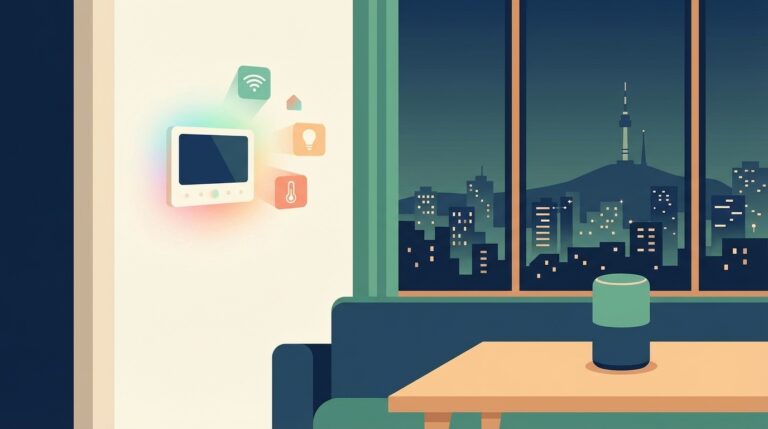
Fast forward to reality. You’ve just moved into a modern Korean officetel (오피스텔) or are staying at a fancy Airbnb in Seoul. The host proudly points to a glowing digital screen on the wall—the almighty Wall Pad (월패드)—and tells you that your lights, heating, and security are all connected. You try to pair your phone to the Bluetooth speaker, but it fails. You want to ask the AI assistant to turn off the air purifier. Suddenly, your C1-level Korean freezes. The textbooks taught you how to say “Please turn on the television” (텔레비전을 켜십시오), but how do you talk about syncing IoT devices, dropped pairings, or navigating a smart home ecosystem like a true local?
As advanced learners, you know that mastering Korean is no longer just about survival; it’s about seamless integration. Today, we are diving deep into the vocabulary of the Internet of Things (IoT) and Smart Home Appliance Connectivity. This guide is built on the real-life struggles (and triumphs!) of expats navigating Korea’s hyper-connected smart homes.
Phase 2: Core Expressions Deep Dive
1. 연동하다 (To sync / link up)
- Pronunciation: [yeon-dong-hada] (Say ‘yeon’ like a quick “yawn”, and ‘dong’ like the sound of a bell: yawn-dong-hada)
- Meaning: Literal: To interlock/link. Real nuance: To sync software, apps, or smart devices together (e.g., linking your phone to the smart fridge).
- K-Culture Moment: You buy a new Samsung Smart Monitor. Your Korean tech-savvy friend comes over and says, “스마트싱스 앱이랑 연동했어?” (Did you sync it with the SmartThings app?). It’s the ultimate buzzword for anyone setting up their digital life in Korea.
- Editor’s Insight: While 연결하다 (to connect) is used for basic things like Wi-Fi or plugging in a cable, 연동하다 implies a smarter, two-way software synchronization. It makes you sound incredibly fluent and tech-literate!
- Situation Spectrum:
- Casual (Friends): ✅ “폰이랑 연동했어?” (Did you sync it with your phone?)
- Semi-formal (Coworkers): ✅ “기기 연동이 안 되네요.” (The device syncing isn’t working.)
- Formal (Customer Service): ✅ “어플리케이션과 연동해 주십시오.” (Please sync it with the application.)
- 🤔 Think About It: Why does Korean have so many specific words for “connecting” (연결하다, 연동하다, 접속하다, 호환되다)? How does this reflect Korea’s status as a fast-paced IT powerhouse?
2. 호출하다 (To summon / call out)
- Pronunciation: [ho-chul-hada] (‘Ho’ like Santa’s laugh, ‘chul’ like chull in “chill”)
- Meaning: Literal: To call/summon. Real nuance: Specifically used in smart homes for “calling the elevator” via the Wall Pad.
- K-Culture Moment: A classic morning scene in any Korean household: You are putting on your shoes in the Hyeon-gwan (현관, entryway), and you press the “엘리베이터 호출” (Elevator Call) button on the smart switch panel. By the time you step out the door, the elevator is waiting for you. It’s the peak of Pali-pali (빨리빨리, hurry-hurry) culture.
- Editor’s Insight: You wouldn’t use this word to call a friend (that’s 전화하다 or 부르다). 호출하다 is strictly used for dispatching things to your location: elevators, taxis (카카오택시 호출), or sending a ping to a smart device.
- Situation Spectrum:
- Casual: ✅ “엘베 호출 눌렀어?” (Did you press the elevator call? Note: 엘베 is slang for elevator)
- Formal: ✅ “엘리베이터를 호출했습니다.” (The elevator has been called.)
- 🤔 Think About It: Calling the elevator from inside your house is designed to save exactly 30 to 60 seconds. What does this tell you about the Korean concept of time and efficiency?
3. 먹통이다 (To be unresponsive / bricked)
- Pronunciation: [meok-tong-i-da] (‘Meok’ like muck, ‘tong’ like tongue but with an ‘o’)
- Meaning: Literal: A blind/deaf object. Real nuance: When an app, device, or smart home system freezes, crashes, or goes completely unresponsive.
- K-Culture Moment: You are trying to show off your new smart home setup to your friends at a housewarming party (집들이), but the AI speaker ignores you. You tap it, but nothing happens. You awkwardly laugh and say, “아, 이거 왜 갑자기 먹통이지?” (Ah, why is this suddenly unresponsive?)
- Editor’s Insight: This is a fantastic native-sounding slang expression. Instead of formally saying “기기가 작동하지 않습니다” (The device is not operating), saying “먹통이야” makes you sound like you’ve lived in Seoul for years.
- Situation Spectrum:
- Casual: ✅ “앱이 먹통 됐어.” (The app froze/crashed.)
- Semi-formal: ⚠️ “시스템이 먹통입니다.” (The system is down. – Acceptable in tech circles, but a bit casual)
- Formal: 🚫 (Use “작동하지 않습니다” instead).
- 🤔 Think About It: We often use very human/physical metaphors for technology failing. What’s the equivalent of “먹통이다” in your native language?
Phase 3: Textbook vs. Real Korean
Let’s upgrade your vocabulary from “classroom rigid” to “Seoulite smooth.”
[Situation 1: Asking the AI to turn up the air conditioner]
* 📖 Textbook Korean: “인공지능, 에어컨 온도를 낮추십시오.” (AI, please lower the air conditioner temperature.)
* 🗣️ Real Korean: “시리야/빅스비, 에어컨 빵빵하게 틀어 줘.” (Siri/Bixby, crank up the AC.)
* 💡 Why the difference?: The word ‘빵빵하게’ (ppang-ppang-ha-ge) is an incredibly common onomatopoeia meaning “fully/intensely,” often used for AC, heating, or internet signals. Koreans naturally use the friendly ‘-아/어 줘’ (do this for me) form even with machines!
[Situation 2: Dealing with Bluetooth pairing issues]
* 📖 Textbook Korean: “블루투스 연결이 해제되었습니다.” (The Bluetooth connection has been disconnected.)
* 🗣️ Real Korean: “아, 또 페어링 끊겼네.” (Ah, the pairing dropped again.)
* 💡 Why the difference?: Real conversation heavily incorporates English tech terms like ‘페어링’ (pairing), and ‘끊기다’ (to be cut off/dropped) is the go-to verb for digital disconnections.
[Situation 3: Putting the house in Away Mode]
* 📖 Textbook Korean: “집을 비울 때 시스템을 끄십시오.” (Turn off the system when leaving the house.)
* 🗣️ Real Korean: “나갈 때 외출 모드로 돌려놔.” (Put it on ‘Away Mode’ when you head out.)
* 💡 Why the difference?: ‘외출 모드’ (Away Mode) is a standard feature on every Korean Wall Pad. Using ‘돌려놓다’ (to switch/turn over to) sounds much more natural than simply ‘켜다/끄다’ (turn on/off) when talking about system modes.
Phase 4: Cultural Context — K-Culture Deep Dive
4-1. Non-Verbal Cues: The Wall Pad Ritual
When living in a smart Korean apartment, managing the Wall Pad is almost a subconscious ritual. It’s the command center. But there’s a non-verbal etiquette here: when a guest arrives and rings the lobby bell, you will see their face on the screen. The polite thing to do is to quickly unlock the lobby door (공동현관 문열림) via the pad, but also press the “Elevator Call” button for them so they don’t have to wait in the lobby. This shows incredible Nunchi (눈치)—anticipating someone’s needs before they even ask.
4-2. K-Drama Connection: The Chaebol’s Smart Home
If you watch K-Dramas, you’ve seen this trope a hundred times. The wealthy lead (usually a CEO or a top star) enters their sleek, minimalist home. They don’t touch a single light switch. They just say, “지니야, 나 왔어” (Genie, I’m home), and the IoT ecosystem goes to work: the robot vacuum docks itself, the air purifier hums gently, and the Ondol (floor heating) adjusts to the perfect temperature.
However, there is a critical gap between media and reality. In dramas, AI voice recognition works flawlessly on the first try while dramatic music plays. In real life? You’ll often hear Koreans yelling, “아니, 그거 말고! 티비 끄라고!” (No, not that! I said turn off the TV!) at their AI speakers when it misunderstands a command. The frustration is universal!
Phase 5: Real-Life Roleplay Scenario
Setting: Friday night, 8 PM. You are at your Korean friend Min-su’s newly built apartment in Jamsil for his housewarming party (집들이). You’re sitting on the sofa, eating fried chicken and drinking beer. Min-su wants to show off his new IoT setup and change the mood lighting.
Characters:
– YOU: An expat living in Korea. Your Korean is at a C1 level, and you are highly observant of tech culture.
– Min-su: Your Korean friend, an early adopter of tech, very proud of his new smart home.
Dialogue:
Min-su: 야, 내 새로운 스마트 조명 세팅 좀 볼래? 기가 막혀. 😎
(Ya, nae saeroun seumateu jomyeong seting jom bollae? Giga makhyeo.)
[Hey, wanna see my new smart lighting setup? It’s mind-blowing.]
YOU: 오, 전부 다 연동해 놨어? 완전 미래 도시네!
(O, jeonbu da yeondonghae nwasseo? Wanjeon mirae dosine!)
[Oh, did you sync everything up? It’s totally like a futuristic city!]
Min-su: 당연하지! 봐봐. (Clear throat) “빅스비! 무드 조명 켜 줘!”
(Dangyeonhaji! Bwabwa. “Bikseubi! Mudeu jomyeong kyeo jwo!”)
[Of course! Watch this. “Bixby! Turn on the mood lighting!”]
(🎭 Stage Direction: The AI speaker lights up, thinks for a second, and then suddenly turns on the robot vacuum instead. The vacuum starts whirring loudly across the living room.)
Min-su: 아씨… 갑자기 왜 이래? 얘 또 먹통이네.
(Assi… gapjagi wae irae? Yae tto meoktong-ine.)
[Ah, damn it… why is it doing this all of a sudden? It’s bricked again.]
🔀 Your Turn! How should you react?
– A) “기기가 작동하지 않습니다. 매뉴얼을 확인해 보세요.” (The device is not operating. Please check the manual.)
– B) “푸하하! 무드 조명이라며? 로봇청소기랑 페어링 된 거 아니야?” (Hahaha! I thought you said mood lighting? Isn’t it paired with the robot vacuum?)
– C) “내가 해볼게! 빅스비, 청소기 꺼!”✅ Best Choice: B — This is the perfect C1-level banter among friends. You successfully use the tech vocabulary (‘페어링 되다’) while naturally making fun of the situation.
⚠️ Choice A Analysis: This is textbook Korean. It sounds like you are a customer service representative reading from a script. Too stiff for a friend’s housewarming party!
Phase 6: 10-Second Shadowing Drill
Master the intonation of commanding your smart home like a native! Notice how the voice slightly rises at the end of the request.
😤 Slightly annoyed but polite (to the AI):
지니야, / 나갈 거니까 / 로봇청소기 돌리고 / 외출 모드로 / 전환해 줘.
(Jiniya, / nagal geonikka / robot cheongsogi dolligo / oechul modeuro / jeonhwanhae jwo.)
Genie, since I’m heading out, run the robot vacuum and switch to Away Mode.
Phase 7: K-Culture Mini Dictionary (Smart Home Edition)
| Korean (Hangul) | Romanization | English | Cultural Context |
|---|---|---|---|
| 월패드 | wol-pae-deu | Wall Pad | The digital command center found on the wall of modern Korean apartments, controlling doors, elevators, and heating. |
| 외출 모드 | oe-chul mo-deu | Away Mode | A crucial setting that lowers the boiler and turns off lights to save energy when leaving the house. |
| 눈치 | nun-chi | Nunchi | The subtle art of gauging the mood. Anticipating a guest’s arrival by calling the elevator via the Wall Pad is a prime example of good nunchi. |
| 집들이 | jip-deu-ri | Housewarming Party | A traditional party when moving into a new place. Guests usually bring toilet paper (for things to “roll out” smoothly) or laundry detergent (for wealth to bubble up). |
| 공동현관 | gong-dong hyeon-gwan | Communal Entrance | The main lobby door of an apartment building, which you unlock for delivery drivers directly from your Wall Pad. |
Phase 8: Traveler’s Survival Kit
Even if you aren’t living in Korea long-term, many modern hotels, Airbnbs, and guesthouses in Seoul are heavily automated. You will encounter a smart control panel. Here are the survival phrases you need when you can’t figure out the tech.
🆘 Survival Expression #1: Asking about the heating
– 🇰🇷 “여기 보일러 연동은 어떻게 해요?” (yeogi boilleo yeondongeun eotteoke haeyo?)
– 🗣️ Meaning: “How do I sync/control the boiler here?”
– 📍 Where to use: Texting your Airbnb host when the floor is freezing.🆘 Survival Expression #2: Dealing with glitches
– 🇰🇷 “월패드가 먹통인 것 같아요.” (wolpaedeuga meoktong-in geot gatayo.)
– 🗣️ Meaning: “I think the Wall Pad is unresponsive/frozen.”
– 📍 Where to use: Calling the front desk of a modern smart-hotel.📌 Editor’s Travel Note
– Ondol (Floor Heating): Unlike Western countries that use air vents for heating, Korea uses Ondol (heated floors). The smart thermostat on the wall controls the floor water temperature, not the air. It takes a while to heat up, so don’t crank it to 40°C, or you’ll wake up roasting like a sweet potato!
– Delivery (배달): If you order food via the Baemin app to a smart apartment, the driver will ring the gong-dong hyeon-gwan (lobby bell). You must press ‘문열림’ (Door Open) on your Wall Pad to let them up.
Phase 9: Critical Thinking — “A Step Deeper”
Language & Power: Should We Be Polite to Machines?
🧠 Think Deeper:
In Korean, hierarchy and politeness levels (존댓말 vs 반말) are woven into the very fabric of the language. But what happens when we talk to a machine? When AI speakers first launched in Korea, many people just barked commands: “티비 꺼” (Turn off TV). However, a fascinating social debate emerged. Parents realized their children were learning to speak rudely by mimicking how adults talked to AI. Consequently, major tech companies like Naver and Kakao began programming their AI to respond more warmly to polite requests (e.g., “TV 꺼 줘서 고마워” – Thanks for turning off the TV), and users naturally adapted. Today, many Koreans instinctively use the polite request form (-아/어 주세요 or -아/어 줘) even to an empty room and a plastic speaker. It shows how deeply ingrained the concept of 예의 (manners) is in the Korean psyche, transcending even human interaction.💬 Your Turn: Do you say “Please” and “Thank you” to Siri or Alexa in your native language? Do you think the way we speak to AI affects how we speak to humans? Share your thoughts in the comments!
Phase 10: FAQ & Avoiding Misunderstandings
Q: Can I use casual speech (반말) with an AI speaker?
Yes, absolutely. The AI won’t get offended! However, as a C1 learner, practicing the soft command form (-아/어 줘) like “음악 틀어 줘” instead of the harsh imperative “음악 틀어” helps you build a more natural, conversational rhythm that translates better when speaking to actual friends.
Q: What is the difference between 끄다 (Turn off) and 해제하다 (Deactivate/Disconnect)?
Great question! You use 끄다 for physical power (e.g., 조명 꺼 줘 – Turn off the lights). You use 해제하다 for software states or security modes (e.g., 외출 모드 해제해 줘 – Deactivate Away Mode, or 페어링 해제 – Disconnect pairing).
❌ Common Mistake: Confusing the AC with the Boiler.
When foreign visitors feel cold in a Korean apartment, they often look for the “Heater” on the Air Conditioner remote. However, in Korea, ACs are usually only for cooling. To get warm, you must find the Wall Pad and turn on the 보일러 (Boiler/Floor heating). Don’t tell your host “에어컨 안 돼요” (The AC isn’t working) if you are trying to get warm!
Phase 11: Summary & Action Items
- One-Liner Summary: From syncing (연동하다) to un-bricking (먹통을 해결하다) your devices, mastering IoT Korean allows you to navigate modern Korea’s hyper-connected smart homes like a true insider.
-
Action Mission:
- 🥉 Bronze (Solo): Change the language of your smartphone’s AI assistant (Siri/Google) to Korean and command it to set an alarm for tomorrow morning.
- 🥈 Silver (Online): Go to a Korean tech review video on YouTube (like a smart home tour) and see if you can catch the word ‘연동’ or ‘먹통’.
- 🥇 Gold (Real World): Next time you visit a friend’s modern Korean apartment or an Airbnb, locate the Wall Pad and ask, “이거 엘리베이터 호출 어떻게 연동해요?” (How do I sync/use the elevator call on this?)
Phase 12: Interactive Quiz
Let’s test your C1 smart home survival skills!
1. Situational Judgment: You are leaving your Airbnb in Seoul for a day of sightseeing. You want to save energy. What is the most natural thing to say to the AI speaker?
– A) 시스템을 파괴해. (Destroy the system.)
– B) 외출 모드로 돌려놔 줘. (Put it on Away Mode for me.)
– C) 전기 연결을 자르십시오. (Cut the electricity connection.)
2. Fill in the Blank:
“내 스마트워치랑 핸드폰이 자꾸 _______ 끊겨서 짜증나!”
(My smartwatch and phone keep losing their _______, it’s so annoying!)
– Hint: The English loanword for syncing two Bluetooth devices.
3. True or False — K-Culture Edition:
In a typical modern Korean apartment, the heating comes from hot air blown from vents in the ceiling. (T/F)
(Answers: 1. B – ‘A’ is aggressive and ‘C’ sounds like a bomb squad. / 2. 페어링 (pairing) / 3. False. Korea uses Ondol (floor heating) controlled by a central boiler panel.)
Frequently Asked Questions (FAQ)
Q: What does "연동하다 (To sync / link up)" mean in Korean and how do you pronounce it?
A: In Korean, "연동하다 (To sync / link up)" is pronounced [yeon-dong-hada] and means: Literal: To interlock/link. Real nuance: To sync software, apps, or smart devices together (e.g., linking your phone to the smart fridge).
Q: What does "호출하다 (To summon / call out)" mean in Korean and how do you pronounce it?
A: In Korean, "호출하다 (To summon / call out)" is pronounced [ho-chul-hada] and means: Literal: To call/summon. Real nuance: Specifically used in smart homes for "calling the elevator" via the Wall Pad.
Q: What does "먹통이다 (To be unresponsive / bricked)" mean in Korean and how do you pronounce it?
A: In Korean, "먹통이다 (To be unresponsive / bricked)" is pronounced [meok-tong-i-da] and means: Literal: A blind/deaf object. Real nuance: When an app, device, or smart home system freezes, crashes, or goes completely unresponsive.







