

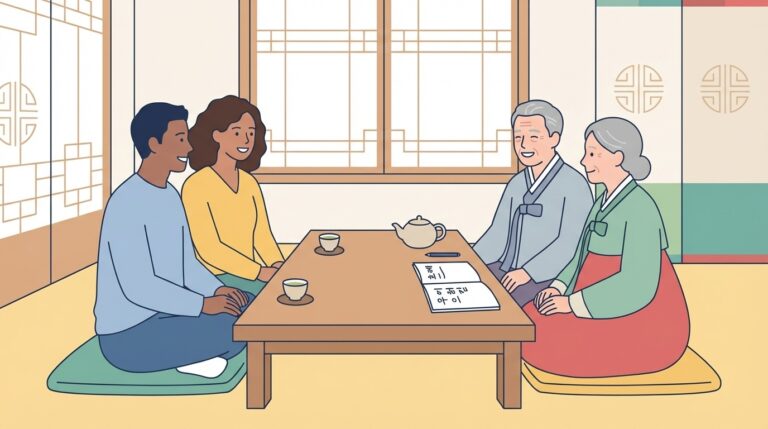
Phase 1: Empathy (Immersion Open)
Hello! I’m your Daily Hangul Editor.
Picture this: You are watching a classic K-Drama. A married couple is sitting in a dimly lit living room after visiting the in-laws. The air is thick with tension. The wife lets out a long sigh and says, “나 오늘 진짜 서운했어.” The subtitles quickly flash: “I was really upset today.”
But as an advanced Korean learner, you and I both know that translating 서운하다 as simply “upset” is like calling a Michelin-starred Kimchi Jjigae “just spicy soup.” It misses the entire universe of cultural context, unspoken expectations, and emotional vulnerability hidden inside.
In international marriages, the biggest conflicts rarely stem from massive betrayals. They sprout from these tiny, untranslatable emotional nuances. When your Korean spouse says they are “서운하다,” or when your mother-in-law gives you a look that screams “눈치 좀 챙겨” (Read the room), knowing the exact cultural weight of these words isn’t just about language—it’s about saving your marriage from unnecessary heartbreak.
This guide isn’t from a textbook; it’s crafted from the real tears, laughs, and “Aha!” moments of international couples living in Korea. Let’s dive deep into the real language of Korean marriage and family dynamics.
Phase 2: Core Expressions Deep Dive
1. 서운하다
- Pronunciation: seounhada [sew-oon-ha-da — sounds like you’re exhaling a long, sad sigh of deflation]
- Meaning:
- Literal: To feel regretful or sorry.
- Real Nuance: The complex feeling of disappointment, mild hurt, and sadness when your emotional expectations of someone you care about aren’t met. It’s not fiery anger; it’s a lingering ache.
- K-Culture Moment: You see this in every K-Drama family feud. A husband forgets to defend his wife in front of his mother. The wife isn’t yelling; she’s quietly looking out the car window, saying, “아까 당신 태도, 좀 서운하더라.” (Your attitude earlier made me feel a bit hurt/disappointed).
- Editor’s Insight: If your partner says they are “화났다” (angry), you need to apologize for a specific wrongdoing. But if they are “서운하다”, you need to validate their feelings and show them they matter to you. It’s a bid for connection, disguised as a complaint.
- Situation Spectrum:
- Casual (Spouse/Close friends): ✅
- Semi-formal (Coworkers): ⚠️ (Only if extremely close)
- Formal (In-laws/Elders): 🚫 (Saying you are ‘서운하다’ to an elder can sound entitled or disrespectful unless phrased very carefully).
- 🤔 Think About It: Why does Korean have so many words for subtle emotional pain (서운하다, 섭섭하다, 괘씸하다, 야속하다) rather than just “angry” or “sad”? How does this reflect the Korean concept of Jeong (정 – deep emotional bond)?
2. 섭섭지 않게 해드리다
- Pronunciation: seopseopji anke haedeurida [sup-sup-jee ahn-keh hae-deu-ree-da]
- Meaning:
- Literal: To do something so they don’t feel disappointed.
- Real Nuance: To provide enough financial support, gifts, or attention to elders (usually in-laws) so that they feel properly respected and cared for.
- K-Culture Moment: It’s Seollal (Lunar New Year). Your Korean spouse is putting crisp 50,000 KRW bills into an elegant envelope for their parents. They look at you and say, “이번 명절에는 부모님 섭섭지 않게 용돈 좀 넉넉히 드리자.” (Let’s give them enough pocket money this holiday so they don’t feel neglected.)
- Editor’s Insight: “섭섭하다” is a stronger, slightly more resentful version of “서운하다.” In the context of in-laws, avoiding “섭섭함” is the golden rule of family harmony. It acknowledges that family relationships require tangible proof of care and respect.
- Situation Spectrum:
- Casual (Between spouses planning for elders): ✅
- Semi-formal: ⚠️
- Formal: ✅ (e.g., “저희가 앞으로 섭섭지 않게 자주 찾아뵙겠습니다” – We will visit often so you don’t feel neglected).
- 🤔 Think About It: Does your culture have an equivalent concept where financial gifts are directly tied to an elder’s feeling of being emotionally respected?
3. 눈치 좀 챙겨
- Pronunciation: nunchi jom chaenggyeo [noon-chee jom chang-gyuh]
- Meaning:
- Literal: Pack some Nunchi.
- Real Nuance: Read the freaking room! Pick up on the subtle, non-verbal cues happening right now.
- K-Culture Moment: You are at a family dinner. Your father-in-law clears his throat and looks at his empty soju glass. You keep eating your Galbi. Under the table, your spouse kicks your shin and whispers, “아빠 잔 비었잖아. 눈치 좀 챙겨!” (Dad’s glass is empty. Read the room!)
- Editor’s Insight: Nunchi is the operating system of Korean society. In a multicultural marriage, lacking Nunchi around the in-laws can be interpreted as a lack of respect, rather than just ignorance of custom.
- Situation Spectrum:
- Casual (Spouse/Friends): ✅
- Semi-formal: 🚫
- Formal: 🚫 (Absolutely never say this to an elder; it is extremely insulting).
- 🤔 Think About It: Is “Nunchi” inherently stressful, or is it a beautiful form of high-context empathy? How do you balance being yourself with having good Nunchi?
Phase 3: Textbook vs. Real Korean
Let’s look at how marital and family communication shifts from the textbook to reality.
[Situation 1: Asking if your spouse is mad at you]
* 📖 Textbook Korean: 화났어요? (Are you angry?)
* 🗣️ Real Korean: 혹시 나한테 뭐 서운한 거 있어? (Is there something you’re feeling disappointed/hurt about regarding me?)
* 💡 Why the difference?: Asking directly about “anger” can make the other person defensive. Asking about “서운함” (disappointment) frames it as an issue of emotional connection, inviting them to open up safely.
[Situation 2: Referring to your in-laws when talking to your spouse]
* 📖 Textbook Korean: 당신의 어머니는 좋은 분이에요. (Your mother is a good person.)
* 🗣️ Real Korean: 어머님은 참 좋으신 분 같아. (Mother is such a good person.)
* 💡 Why the difference?: Using “당신” (you) and “어머니” (mother without the honorific ‘님’) creates an emotional distance. In Korean marriages, your spouse’s mother becomes “어머님” to you. You drop the possessive pronoun to show familial unity.
[Situation 3: Trying to stop an argument before it escalates]
* 📖 Textbook Korean: 그만 싸웁시다. (Let’s stop fighting.)
* 🗣️ Real Korean: 아휴, 알았어. 내가 미안해. 그만하자. (Sigh, okay. I’m sorry. Let’s drop it.)
* 💡 Why the difference?: Formal requests to stop fighting sound like a robot. A tactical “내가 미안해” (even if you aren’t 100% at fault) combined with “그만하자” is the real-world strategy to de-escalate tension.
Bottom Note: At the C2 level, your goal isn’t just to be grammatically correct; it’s to be emotionally accurate. Softeners and indirect phrasing are your best tools in resolving marital friction.
Phase 4: Cultural Context — K-Culture Deep Dive
4-1. The Non-Verbal Game of ‘Nunchi’ (눈치)
When resolving conflicts in a Korean marriage, words are only 30% of the equation. The rest is body language and Nunchi. If your spouse says, “아니야, 괜찮아” (No, it’s fine) but avoids eye contact and scrubs the dishes with aggressive force, it is absolutely not fine. In Western cultures, we are taught to take words at face value. In Korea, taking “괜찮아” literally when the atmosphere is tense is a classic rookie mistake that will earn you the title of “눈치 없는 사람” (someone with no Nunchi).
4-2. The K-Drama In-Law Trope vs. Reality
If you’ve watched K-Dramas like Something in the Rain or classic morning dramas (막장 드라마), you might think all Korean mothers-in-law (시어머니) throw envelopes of cash or water in the face of their child’s partner.
Critical Perspective: While the “Kimchi Slap” is purely for television, the underlying theme—that marriage is the union of two families, not just two individuals—is very real. In an international marriage, the Korean family might expect you to participate in ancestral rites (제사) or frequent family gatherings. The conflict often isn’t malicious; it’s a clash between individualistic boundaries and collectivist family duties.
Phase 5: Real-Life Roleplay Scenario
Setting:
Friday evening, 8:00 PM. The day before Chuseok (Korean Thanksgiving). You and your Korean husband, Minho, have just arrived at his parents’ house in Busan after a 6-hour drive. Minho’s mother immediately starts directing Minho to help peel a mountain of chestnuts, while subtly hinting that you should be helping in the kitchen.
Characters:
– YOU (Reader): An expat living in Korea for 5 years, fluent but sometimes culturally exhausted by traditional gender roles during holidays.
– Minho (34): Your husband, who is trying to be a good son but also wants to protect you.
– Mother-in-law (어머님): Traditional, well-meaning, but highly demanding.
Dialogue:
어머님: 아이고, 우리 아들 운전하느라 고생했네. 좀 쉬어라. 며늘아가(또는 사위야), 이리 와서 전 부치는 것 좀 거들어라.
(Aigo, uri adeul unjeonhaneura gosaenghaenne. Jom swieora. Myeoneuraga, iri waseo jeon buchineun geot jom geodeureora.)
[Translation] Oh my, my son, you suffered driving here. Get some rest. Daughter/Son-in-law, come here and help me fry these pancakes.
(🎭 Stage Direction: Minho looks extremely uncomfortable, torn between his mother and you.)
Minho: 엄마! OO(당신)도 차 오래 타서 피곤해요. 전은 내가 부칠게.
(Eomma! OO-do cha orae taseo pigonhaeyo. Jeoneun naega buchilge.)
[Translation] Mom! [Your Name] is tired from the long car ride too. I’ll fry the pancakes.
어머님: 쯧, 남자가 무슨 부엌일이냐. 넌 가서 과일이나 먹어.
(Jjeut, namjaga museun bueokirinya. Neon gaseo gwairina meogeo.)
[Translation] Tsk, what business does a man have in the kitchen. You go eat some fruit.
🔀 Your Turn! How do you defuse this cultural tension?
– A) “어머님, 요즘 시대엔 남자도 요리 다 해요. 민호가 할 거예요.” (Mother, in this day and age men cook too. Minho will do it.)
– B) “네, 어머님. 제가 할게요. 민호야, 넌 좀 쉬어.” (Yes, Mother. I will do it. Minho, you rest.)
– C) “어머님! 저희 둘 다 같이 할게요. 민호가 전 뒤집는 건 기가 막히게 하거든요!” (Mother! We will both do it together. Minho is amazingly good at flipping pancakes!)✅ Best Choice: C — Reason: Choice A is too confrontational and direct for Korean elders (even if true). Choice B breeds internal resentment for you. Choice C uses high-level Nunchi and Aegyo (charm). You respect her authority, but you gracefully loop your husband into the task by praising his skills, saving face for everyone.
⚠️ Choice A Analysis: Applying modern Western egalitarian logic bluntly to traditional Korean elders usually backfires, creating a “기싸움” (battle of wills) rather than harmony.
Phase 6: 10-Second Shadowing Drill
Let’s practice the tone of voicing your subtle disappointment (서운함) to your spouse.
Intonation Guide: Keep your voice soft, slightly lower pitched. Do not yell. The pause (/) is crucial for dramatic, emotional effect.
🥺 아까 / 부모님 앞에서 / 제 편 안 들어주셨을 때... / 솔직히 / 조금 서운했어요.
(Akka / bumonim apeseo / je pyeon an deureojusyeosseul ttae… / soljikhi / jogeum seounhaesseoyo.)
[Translation] Earlier… when you didn’t take my side in front of your parents… honestly… I felt a little hurt/disappointed.
Phase 7: K-Culture Mini Dictionary
| 한국어 | Romanization | English | Contextual Meaning |
|---|---|---|---|
| 시월드 | Si-world | In-law World | A slang term (combining ‘시’ for husband’s family + ‘world’) referring to the stressful, demanding environment of the husband’s family. |
| 처가 | Cheoga | Wife’s Family | The wife’s family home. Traditionally, there is a saying: “The farther the outhouse and the wife’s family, the better,” though this is rapidly changing. |
| 정(情) | Jeong | Deep Bond / Affection | The invisible thread of emotional connection. In marriage, even when fighting, Jeong is what keeps the couple tied together. It’s love, loyalty, and shared history combined. |
| 기싸움 | Gi-ssa-um | Battle of Wills | A psychological tug-of-war. Very common in the early stages of marriage between the foreign spouse and the Korean mother-in-law to establish boundaries. |
Phase 8: Traveler’s Survival Kit (Holiday Migration Edition)
In international marriages, traveling isn’t just about vacations; it’s about the “귀성길” (The great migration to hometowns) during major holidays like Seollal or Chuseok.
🆘 Survival Phrases for the Holiday Traffic Jam
– 🇰🇷 “차가 엄청 막히네요. 휴게소에 잠깐 들를까요?” (Chaga eomcheong makhineyo. Hyugesoe jamkkan deulleulkkayo?)
– 🗣️ Meaning: The traffic is terrible. Shall we stop by a rest area for a bit?
– 📍 Where to use: In the car, 4 hours into a standstill on the Gyeongbu Expressway.
– 💡 Pro Tip: Korean rest areas (휴게소 – Hyugeso) are culinary destinations. Grabbing some “Sotteok Sotteok” (sausage and rice cake skewers) is the ultimate way to de-stress with your spouse.📌 Editor’s Travel Note
– Navigation Apps: T-Map or Kakao Navi are absolute must-haves for real-time traffic updates during national holidays. Don’t rely on Google Maps for driving in Korea.
– The Train War: If you want to avoid driving, booking KTX tickets during the holidays is famously dubbed “피켓팅” (Blood Ticketing). You must book the exact minute they open online months in advance!
Phase 9: Critical Thinking — “One Step Deeper”
Language & Power in Marriage (언어와 권력)
🧠 Think Deeper:
In many Korean marriages, couples start by using casual language (반말 – Banmal) with each other. However, a fascinating shift often occurs after having children or as they age: some couples intentionally switch back to polite language (존댓말 – Jondaetmal). Why? In Korean culture, language dictates hierarchy and intimacy. Using Banmal can sometimes blur boundaries, leading to disrespect during arguments. By consciously using Jondaetmal, spouses create a linguistic buffer—a sign of mutual respect that prevents fights from turning ugly. It proves that in Korea, honorifics aren’t just for strangers; they are powerful tools for maintaining dignity in our most intimate relationships.💬 Your Turn: Does your native language have ways to adjust the “politeness level” during an argument with your partner to avoid crossing the line? Share in the comments!
Phase 10: FAQ & Avoiding Misunderstandings
Q: When I’m fighting with my spouse, can I just call them “너” (You) since we are married?
A: NO. Even in the heat of a terrible argument, using “너” (neo) or “당신” (dangsin) aggressively is a massive escalation. It signals absolute disrespect. Stick to dropping the subject entirely, or use their name/title (e.g., “OO 아빠/엄마”).
Q: How do I address my parents-in-law?
A: If you are a husband: 장인어른 (Father-in-law), 장모님 (Mother-in-law). If you are a wife: 아버님 (Father-in-law), 어머님 (Mother-in-law). Never use their first names!
❌ Common Mistake #1: Translating “I don’t care” directly into “상관없어” (Sanggwaneopseo) during a marital disagreement.
✅ Do this instead: “상관없어” sounds extremely cold and dismissive, like “You are dead to me.” Instead, say “당신 편한 대로 해” (Do whatever is comfortable for you) if you are yielding, or “난 아무래도 괜찮아” (I’m fine either way) if you genuinely don’t have a preference.
Phase 11: Summary & Action Items
One-Liner Summary: Resolving conflict in a Korean marriage requires mastering the unspoken cues of Nunchi and replacing direct confrontation with nuanced expressions like 서운하다.
Action Mission:
– 🥉 Bronze (Solo): Stand in front of a mirror and practice saying “아까 조금 서운했어요” with a soft, disappointed (not angry) expression.
– 🥈 Silver (Online): Write a short journal entry in Korean detailing a time you felt “서운하다” due to a cultural misunderstanding, and share it in a language exchange forum.
– 🥇 Gold (Real World): The next time you have a minor disagreement with your Korean partner or friend, try framing your feelings using “서운해” instead of “화났어” and observe how their reaction changes.
K-Culture Mission:
Watch an episode of a family-centric K-Drama (like Reply 1988 or Queen of Tears). Count how many times the characters use the word “서운하다” or “섭섭하다” instead of directly saying they are angry.
Phase 12: Quiz — Interactive Challenge
1. Situational Judgment: Your mother-in-law has been criticizing your cooking for ten minutes. Your spouse is sitting on the couch, playing on their phone, completely oblivious. Later, in the car, how should you express your feelings to your spouse?
– A) “너 아까 왜 나 안 도와줬어? 진짜 화나!” (Why didn’t you help me? I’m so mad!)
– B) “아까 어머님이 말씀하실 때, 당신이 가만히 있어서 좀 서운했어.”
– C) “당신 눈치 진짜 없다. 최악이야.”
2. True or False (K-Culture Edition):
– “In Korean culture, it is completely acceptable for a daughter-in-law to directly tell her mother-in-law that she is ‘서운하다’ (disappointed) with her behavior.” (T/F)
3. Fill in the Blank:
When preparing cash gifts for the in-laws during Chuseok, you want to make sure they don’t feel neglected.
“부모님 ______ 않게 용돈 넉넉히 드리자.”
– A) 화나지
– B) 섭섭지
– C) 기쁘지
👀 Click here for Answers!
1. Answer: B. It perfectly utilizes “서운하다” to express hurt without aggressive blame, opening the door for communication.
2. Answer: False. Expressing direct disappointment to an elder, especially a mother-in-law, is traditionally seen as talking back (대들다). It’s usually better to have your spouse communicate boundaries with their own parents.
3. Answer: B (섭섭지). A set phrase meaning “so they don’t feel disappointed/neglected.”
Frequently Asked Questions (FAQ)
Q: What does "서운하다" mean in Korean and how do you pronounce it?
A: In Korean, "서운하다" is pronounced [seounhada [sew-oon-ha-da — sounds like you're exhaling a long, sad sigh of deflation] and means: Literal: To feel regretful or sorry.
Q: What does "섭섭지 않게 해드리다" mean in Korean and how do you pronounce it?
A: In Korean, "섭섭지 않게 해드리다" is pronounced [seopseopji anke haedeurida [sup-sup-jee ahn-keh hae-deu-ree-da] and means: Literal: To do something so they don't feel disappointed.
Q: What does "눈치 좀 챙겨" mean in Korean and how do you pronounce it?
A: In Korean, "눈치 좀 챙겨" is pronounced [nunchi jom chaenggyeo [noon-chee jom chang-gyuh] and means: Literal: Pack some Nunchi.






