

Beyond ‘Big’: How to Talk About Seoul’s Breathtaking Skyline Like a True Local
Hello, learners! I’m the Senior Editor at Daily Hangul.
Picture this quintessential K-Drama scene: The wealthy CEO stands by the floor-to-ceiling windows of his penthouse office, sipping whiskey, looking down at the glittering Seoul skyline. Or, on the flip side, the hard-working protagonist cracks open a can of beer on her oktapbang (rooftop room), staring up at the very same gleaming skyscrapers, dreaming of success.
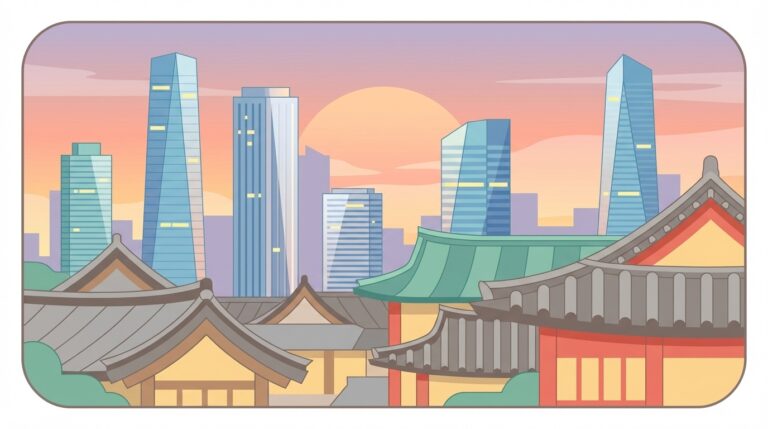
Seoul is a city of extremes. From the hyper-modern Lotte World Tower piercing the clouds to the beautifully restored traditional Hanok villages nestled right beneath them, architecture in Korea isn’t just about buildings. It’s about history, status, and breathtaking urban regeneration.
As a C1 learner, you already know words like ‘크다’ (big), ‘높다’ (high), and ‘멋있다’ (cool). But if you want to sound like a local architect, a trendsetter finding the newest hot spot, or just someone who truly appreciates the juxtaposition of Seoul, you need the vocabulary that captures the vibe. Let’s elevate your Korean to the penthouse level.
Phase 2: Core Expressions – Deep Dive
1. 압도적이다 (To be awe-inspiring / overwhelming)
- Pronunciation: [ap-tto-jeo-gi-da] (Think of the ‘ap’ sound like the ‘op’ in ‘hop’, and ‘tto’ as a sharp, tense ‘t’ sound.)
- Meaning: Literal: To be overwhelming. / Real nuance: Awe-inspiring, majestic, commanding your attention by sheer scale.
- K-Culture Moment: Imagine standing at the base of the Lotte World Tower and looking straight up until your neck hurts. It’s not just ‘tall’; it makes you feel tiny. That’s when you say, “와, 스케일이 압도적이네요.” (Wow, the scale is overwhelming.)
- Editor’s Insight: While English speakers might use ‘overwhelming’ with a negative connotation (like stress), Koreans frequently use ‘압도적’ to praise magnificent scenery, a powerful K-Pop performance, or massive architecture.
- Situation Spectrum:
- Casual with friends: ✅ (진짜 압도적이다!)
- Semi-formal (colleagues): ✅ (뷰가 정말 압도적이네요.)
- Formal (boss/elders): ✅ (건축물이 참 압도적입니다.)
- 🤔 Think About It: Why does Korean use a word related to ‘pressure’ (압 – 壓) to describe breathtaking beauty? How does your native language express being ‘blown away’ by a sight?
2. 이질적인 매력이 있다 (To have a contrasting/heterogeneous charm)
- Pronunciation: [i-jil-jeo-gin / mae-ryeo-gi / it-tta]
- Meaning: Literal: To have a heterogeneous charm. / Real nuance: A beautiful contrast, an unexpected but perfect mix of different elements (old vs. new).
- K-Culture Moment: You are walking through Ikseon-dong or Bukchon. You see a 600-year-old palace with sweeping tiled roofs, and right behind it, a sleek, glass-and-steel skyscraper reflects the sunset.
- Editor’s Insight: This is the ultimate sophisticated expression to describe Seoul’s urban regeneration. It shows you understand that Seoul’s beauty lies in the clash of eras.
- Situation Spectrum:
- Casual with friends: ⚠️ (A bit too academic for casual slang, but fine for deep talks.)
- Semi-formal (colleagues): ✅
- Formal (boss/elders): ✅
- 🤔 Think About It: Rapid modernization erased much of Korea’s past, but recent urban regeneration tries to save it. Does your city separate the ‘old’ and ‘new’, or mix them together?
3. 뷰 맛집 (A view hot-spot)
- Pronunciation: [byu / mat-jjip]
- Meaning: Literal: A view restaurant. / Real nuance: A place (cafe, bar, hotel) famous for its spectacular view, usually of the skyline or landmarks.
- K-Culture Moment: You’re searching on Instagram for a cafe near Namsan Tower. You don’t care about their coffee; you want the perfect window seat for your photos. You search the hashtag: #서울뷰맛집.
- Editor’s Insight: ‘맛집’ means a delicious restaurant, but Koreans now attach it to anything done perfectly. A place with great lighting is ‘햇살 맛집’, a great view is ‘뷰 맛집’.
- Situation Spectrum:
- Casual with friends: ✅
- Semi-formal (colleagues): ✅ (Highly used among millennials/Gen Z at work.)
- Formal (boss/elders): 🚫 (Too slangy for the CEO.)
- 🤔 Think About It: Why is the word ‘taste/flavor’ (맛) used for visual experiences? What does this say about Korean consumer culture?
Phase 3: Textbook vs. Real Korean
[Describing a massive skyscraper]
* 📖 Textbook Korean: 이 건물은 아주 높고 큽니다. (This building is very high and big.)
* 🗣️ Real Korean: 와, 건물 스케일 미쳤다. 하늘 찌르겠는데? (Wow, the scale of this building is crazy. It’s gonna pierce the sky.)
* 💡 Why the difference?: C1 learners should move beyond simple adjectives. Using ‘스케일’ (scale) and exaggerations like ‘미쳤다’ (crazy) or ‘하늘을 찌르다’ (pierce the sky) adds dramatic, native-like flair.
[Suggesting a place with a good view]
* 📖 Textbook Korean: 경치가 아름다운 카페에 갑시다. (Let’s go to a cafe with beautiful scenery.)
* 🗣️ Real Korean: 거기 완전 뷰 맛집이래. 창가 자리 무조건 사수해야 돼! (They say it’s a total view hot-spot. We absolutely have to secure a window seat!)
* 💡 Why the difference?: ‘사수하다’ (to defend/secure to the death) is playfully used when fighting for the best spots in crowded Seoul cafes, reflecting the competitive yet fun café culture.
Phase 4: Cultural Context — K-Culture Deep Dive
4-1. The Non-Verbal ‘Nunchi’ in High-Rise Spaces
When you visit a ‘뷰 맛집’ (view hot-spot) on the top floor of a skyscraper, Nunchi (눈치) is essential. If you secure a prime window seat overlooking the Han River, it is an unspoken rule not to sit there with your laptop for four hours on a busy weekend. Taking your photos, enjoying the coffee, and graciously giving up the seat to the people hovering nearby is considered having ‘good nunchi’.
4-2. The ‘Rooftop’ vs. ‘Penthouse’ K-Drama Trope
In Korean media, altitude equals social class. The higher you live, the richer you are. This is famously depicted in dramas like The Penthouse or movies like Parasite (where the wealthy live up on a hill, and the poor live in a semi-basement).
When urban regeneration projects transform old rooftop neighborhoods (옥탑방) into trendy arts districts (like Ihwa Mural Village), it creates a complex dynamic. While tourists and K-Drama fans flock there, it often leads to gentrification. Understanding this bittersweet reality of Seoul’s changing skyline will make your conversations with locals much deeper.
Phase 5: Real-Life Roleplay Scenario
Setting: Friday evening, 6:30 PM. You and your Korean architectural firm colleague, Min-ho, are standing on ‘Seoullo 7017’, a former highway overpass transformed into an elevated park. Surrounded by old Seoul Station and towering modern glass buildings, the sun is just starting to set.
Characters:
* YOU: An expat working in Seoul, fascinated by urban planning.
* Min-ho (30s): Your colleague. Passionate about Seoul’s history, loves taking photos.
Dialogue:
Min-ho: (Taking a deep breath) 크으, 여기서 보는 노을이 진짜 예술이지 않아요?
[keu-eu, yeo-gi-seo bo-neun no-eu-ri jin-jja ye-su-ri-ji a-na-yo?]
(Ah, the sunset you see from here is truly art, isn’t it?)
YOU: 맞아요. 구도심이랑 신축 빌딩들이 섞여 있어서 더 멋있는 것 같아요.
[ma-ja-yo. gu-do-si-mi-rang sin-chuk bil-ding-deu-ri seo-kkyeo i-sseo-seo deo meo-sin-neun geot ga-ta-yo.]
(Right. I think it’s even cooler because the old downtown and new buildings are mixed together.)
Min-ho: 정확해요! 옛날 고가도로를 철거 안 하고 이렇게 공원으로 살린 게 신의 한 수였죠.
[jeong-hwa-khae-yo! yen-nal go-ga-do-ro-reul cheol-geo an ha-go i-reo-ke gong-wo-neu-ro sal-lin ge si-neui han su-yeot-jjo.]
(Exactly! Not demolishing the old overpass and saving it as a park like this was a stroke of genius [God’s one move].)
🔀 Your Turn! How do you respond to show off your advanced Korean skills?
* A) 네, 아주 좋은 프로젝트입니다. (Yes, it is a very good project. – Too robotic)
* B) 맞아요. 과거와 현재가 공존하는 이질적인 매력이 진짜 압도적이네요. (Right. The heterogeneous charm of the past and present coexisting is truly overwhelming.)
* C) 대박! 완전 인스타 감성 뷰 맛집이네요! (Jackpot! It’s totally an Insta-aesthetic view hot-spot!)✅ Best Choice: B — This perfectly utilizes C1 vocabulary (공존하다, 이질적인 매력, 압도적이다) and perfectly fits the professional yet friendly context with an architect colleague.
⚠️ Choice C Analysis: It’s natural slang, but might sound a bit shallow when discussing urban regeneration with an architect.
Min-ho: (Smiling widely) 오, ‘이질적인 매력’이라니. 한국어 표현력이 갈수록 느시네요!
[o, ‘i-jil-jeo-gin mae-ryeo-gi’ra-ni. han-gu-geo pyo-hyeon-ryeo-gi gal-su-rok neu-si-ne-yo!]
(Oh, ‘heterogeneous charm’? Your Korean expressive skills are getting better and better!)
YOU: 하하, 과찬이십니다. 야경 불 들어오면 완전 다른 세상 같겠어요.
[ha-ha, gwa-cha-ni-sim-ni-da. ya-gyeong bul deu-reo-o-myeon wan-jeon da-reun se-sang gat-ge-sseo-yo.]
(Haha, you flatter me. When the night view lights come on, it will seem like a completely different world.)
Phase 6: 10-Second Shadowing Drill
Master the intonation to sound like an awe-struck local!
😲 와, / 저 스카이라인 / 스케일 / 진짜 압도적이다! / 과거랑 현재가 / 섞여 있는 게 / 너무 매력적이지 않아?
(wa, / jeo seukairain / seukeil / jinjja apttojeogida! / gwageorang hyeonjaega / seokkyeo inneun ge / neomu maeryeokjeogiji ana?)
Intonation Tip: Raise your pitch on ‘와’ and emphasize ‘압’ in 압도적이다 to show genuine amazement.
Phase 7: K-Culture Mini Dictionary (Urban Edition)
| Korean | Romanization | English | Context |
|---|---|---|---|
| 마천루 | ma-cheon-ru | Skyscraper | A more poetic/literary term for high-rises. Literally ‘a pavilion touching the sky’. |
| 스카이라인 | seu-ka-i-ra-in | Skyline | Frequently used in news or real estate when a new landmark changes the city’s silhouette. |
| 도시 재생 | do-si jae-saeng | Urban Regeneration | A huge trend in Korea. Breathing new life into old factories or neighborhoods instead of tearing them down. |
| 임장 | im-jang | On-site real estate visit | A trendy activity for young Koreans to visit new apartment complexes or regenerated areas to study the market. |
| 랜드마크 | raen-deu-ma-keu | Landmark | Used exactly like English, but often associated with wealth and city pride (e.g., Lotte Tower, 63 Building). |
Phase 8: Traveler’s Survival Kit (Landmark Edition)
Visiting massive landmarks like DDP or Lotte World Tower? It’s easy to get lost.
🆘 Survival Expressions
1. 🇰🇷 “전망대 가는 엘리베이터는 어디서 타나요?” (jeonmangdae ganeun ellibeiteoneun eodiseo tanayo?)
* Where do I catch the elevator to the observation deck?
2. 🇰🇷 “여기가 야경 명당이라던데, 맞나요?” (yeogiga yagyeong myeongdang-iradeonde, mannayo?)
* I heard this is the best spot for the night view, is that right? (‘명당’ originally refers to an auspicious site in Feng Shui, now used for ‘the best spot’.)
3. 🇰🇷 “스카이워크 입구가 어느 쪽인가요?” (seukaiwokeu ipguga eoneu jjogingayo?)
* Which way is the entrance to the skywalk?📌 Editor’s Travel Note:
Massive Korean buildings often have multiple interconnected malls (like COEX or Lotte). GPS apps like KakaoMap might struggle indoors. Look for interactive digital kiosks or use the magical phrase to a security guard: “[Destination] 가려면 어떻게 가야 돼요?” (How do I get to [Destination]?)
Phase 9: Critical Thinking — “One Step Deeper”
Language & Space: The “Apartment Republic”
In traditional Korean Hanok architecture, wealth was demonstrated horizontally—how many courtyards and wide rooms your estate had. Today, Korea is often dubbed the “Apartment Republic” (아파트 공화국). Wealth and status are now strictly vertical. The highest floor (펜트하우스) offers the most privacy and the best view of the Han River, commanding astronomical prices.
When you describe a skyscraper in Korea, you are not just describing glass and steel; you are describing the ultimate symbol of modern Korean aspiration.
💬 Your Turn: Does vertical height equal wealth in your home city, or do the wealthy prefer sprawling estates outside the city center? Let us know in the comments!
Phase 10: FAQ & Avoiding Common Mistakes
- Q: Can I use ‘압도적이다’ to describe a person?
- A: Yes, but only for their presence/skills! You can say “그 배우의 연기력은 압도적이다” (That actor’s performance is overwhelming). Don’t use it just to say someone is physically large.
- Q: Is ‘뷰 맛집’ appropriate to say to a waiter at a fancy hotel lounge?
- A: Better avoid it. It’s internet slang. To staff in a formal setting, say “경치가 정말 좋네요” (The scenery is really nice).
❌ Common Mistake #1: Confusing 빌딩 (Building) and 아파트 (Apartment).
✅ How to fix it: In English, a ‘building’ can be residential. In Korea, ‘빌딩’ almost exclusively means a commercial office/skyscraper. If people live there, it’s an ‘아파트’ (Apartment complex) or ‘오피스텔’ (Studio apartment building). Don’t say “제 빌딩에 놀러 오세요” (Come hang out at my building) unless you own the entire corporate tower!
Phase 11: Summary & Action Items
One-Liner Summary: To master the Korean urban landscape, move beyond ‘big’ and embrace words like ‘압도적이다’ (overwhelming) and ‘이질적이다’ (contrasting) to describe Seoul’s unique blend of the future and the past.
Your Mission for Today:
* 🥉 Bronze (Solo): Look out your window. Describe the tallest building you see using ‘스케일이 압도적이다’.
* 🥈 Silver (Online): Find a picture of Seoul’s skyline on Instagram and comment: “과거와 현재의 이질적인 매력이 멋져요!”
* 🥇 Gold (Real-world): Next time you visit a cafe on a high floor, tell your Korean friend: “여기 완전 뷰 맛집이네!”
K-Culture Mission: Go to Google Street View and drop your little yellow person right in the middle of ‘Gwanghwamun Square’. Look at the ancient palace gates with the towering modern office buildings directly behind them. Can you feel the ‘이질적인 매력’?
Phase 12: Interactive Challenge Quiz
1. Fill in the Blank:
You finally snagged a window seat overlooking the glowing Han River at a cafe.
“와, 여기 진짜 야경 ( _____ )이네!”
* A) 식당 (Restaurant)
* B) 명당 (Auspicious spot)
* C) 맛집 (Hot-spot/Flavor place)
2. True or False – K-Culture Edition:
In Korea, ‘도시 재생’ (Urban Regeneration) usually means completely tearing down an old neighborhood to build identical mega-apartment complexes.
3. Situational Judgment:
You are touring Lotte World Tower with your company’s CEO. You look out the window. What is the most appropriate C1-level response?
* A) 회장님, 건물이 진짜 커요. (Chairman, the building is really big.)
* B) 회장님, 스케일이 정말 압도적입니다. (Chairman, the scale is truly overwhelming.)
* C) 와, 뷰 미쳤다. (Wow, the view is crazy.)
Click here for Answers!
1. C (or B). ‘뷰 맛집’ is the trendiest answer. ‘야경 명당’ also works perfectly as a slightly more mature expression.
2. False. That is redevelopment (재개발). ‘도시 재생’ (Urban Regeneration) focuses on preserving the history and structure while modernizing the area (like cafes in old Hanoks or parks on old highways).
3. B. It is formal, respectful, and uses advanced vocabulary suitable for a CEO.
Frequently Asked Questions (FAQ)
Q: What does "압도적이다 (To be awe-inspiring / overwhelming)" mean in Korean and how do you pronounce it?
A: In Korean, "압도적이다 (To be awe-inspiring / overwhelming)" is pronounced [ap-tto-jeo-gi-da] and means: Literal: To be overwhelming. / Real nuance: Awe-inspiring, majestic, commanding your attention by sheer scale.
Q: What does "이질적인 매력이 있다 (To have a contrasting/heterogeneous charm)" mean in Korean and how do you pronounce it?
A: In Korean, "이질적인 매력이 있다 (To have a contrasting/heterogeneous charm)" is pronounced [i-jil-jeo-gin / mae-ryeo-gi / it-tta] and means: Literal: To have a heterogeneous charm. / Real nuance: A beautiful contrast, an unexpected but perfect mix of different elements (old vs. new).
Q: What does "뷰 맛집 (A view hot-spot)" mean in Korean and how do you pronounce it?
A: In Korean, "뷰 맛집 (A view hot-spot)" is pronounced [byu / mat-jjip] and means: Literal: A view restaurant. / Real nuance: A place (cafe, bar, hotel) famous for its spectacular view, usually of the skyline or landmarks.






