

Phase 1: Empathy (The K-Culture Cold Open)
Hello! I’m the Lead Editor of Daily Hangul.
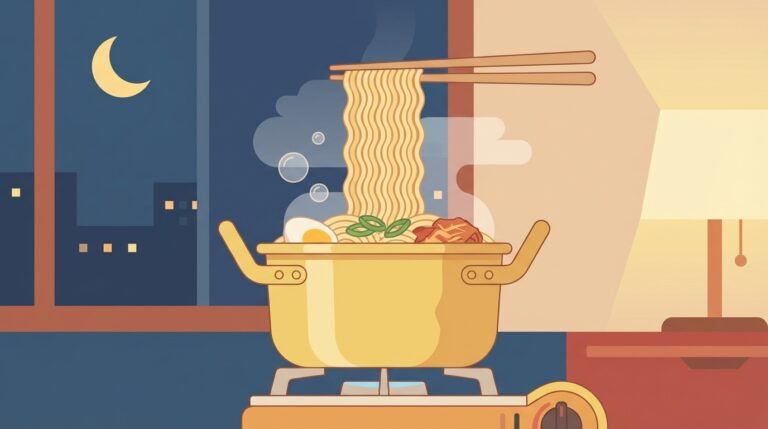
It’s 11:30 PM. You’re watching your favorite K-Drama. The main characters have just survived a dramatic day, and they end up in a cozy convenience store or a messy apartment. Someone pulls out a shiny, dented gold pot. The water boils, the red soup bubbles, and then… they lift the noodles high into the air with their chopsticks before devouring them from the pot lid.
Suddenly, you are starving. But more than that, you wonder: “Why do they lift the noodles like that? Why do they eat from the lid? And how do I order my ramyeon to be perfectly chewy like theirs?”
If you simply say “I will cook ramyeon” (라면을 요리할게요) like a textbook teaches, a Korean might tilt their head. Today, as your local culture navigator and veteran tutor, I’ll teach you the B2-level real Korean expressions for making the perfect Noodle Dishes (면 요리), specifically focusing on the sacred art of cooking ramyeon.
This guide is based on real questions from my students who wanted to experience K-Food culture exactly like the locals do. Let’s dive in!
Phase 2: Core Expression Deep Dive
1. 꼬들꼬들하게 끓여주세요
- Pronunciation: kko-deul-kko-deul-ha-ge kkeu-ryeo-ju-se-yo
(Sound guide: Say ‘kko’ like a sharp catch in the back of your throat—similar to a slight cough. The ‘eu’ sounds like the disgusted sound you make when stepping in gum.) - Meaning: Please cook it al dente. (Literal: Please boil it chewy-chewy.)
- K-Culture Moment: You are at a Bunsikjeom (Korean snack shop) ordering classic Shin Ramyun. If you just say “라면 주세요,” you get whatever the chef decides. But if you request it kko-deul-kko-deul-ha-ge, the auntie (이모님) will immediately recognize you as a true ramyeon connoisseur.
- Editor’s Insight: Korean ramyeon is all about texture. Kko-deul means the noodles are slightly undercooked, retaining a firm, springy bite. It’s the ultimate preference for most young Koreans.
- Situation Spectrum:
- Friends (Casual): ✅ “야, 나 꼬들면으로 끓여줘.” (Hey, make mine chewy.)
- Restaurant Staff (Semi-formal): ✅ “꼬들꼬들하게 끓여주세요.”
- Formal Business Dinner: 🚫 (You wouldn’t usually order ramyeon in a formal setting!)
- 🤔 Think About It: Why does the Korean language have so many specific adjectives for food textures (like 꼬들꼬들, 쫄깃쫄깃, 바삭바삭)? What does this reveal about Korean culinary values compared to your culture?
2. 면발을 들었다 놨다 하다
- Pronunciation: myeon-ba-reul deu-reot-da nwat-da ha-da
- Meaning: To lift and drop the noodles repeatedly while boiling.
- K-Culture Moment: Whenever a K-Pop idol cooks ramyeon on a reality show, you will see them vigorously lifting the noodles out of the boiling water and dropping them back in.
- Editor’s Insight: This isn’t just for dramatic effect! Giving the noodles “airtime” creates a sudden temperature drop, which shocks the noodles and makes them much more kko-deul-kko-deul. It’s a scientific survival skill for Korean college students.
- Situation Spectrum:
- This is mostly a descriptive phrase used when cooking together.
- Casual: ✅ “면을 들었다 놨다 해야 맛있어!”
3. 물 조절이 생명이다
- Pronunciation: mul jo-jeo-ri saeng-myeong-i-da
- Meaning: Water control is crucial. (Literal: Water control is life.)
- K-Culture Moment: A tense moment on a camping trip (MT – Membership Training) with your university club. Someone is about to pour water into the giant pot for 5 packs of ramyeon. The senior student strictly oversees them, muttering this phrase.
- Editor’s Insight: We use “~이/가 생명이다” (~ is life) to emphasize the absolute most important factor of something. Too much water? You get tasteless “Hangang water” (한강물). Too little? It’s too salty.
- Situation Spectrum:
- Friends (Casual): ✅
- Coworkers (Semi-formal): ✅
Phase 3: Textbook vs Real Korean
[Cooking the Noodles]
* 📖 Textbook: 라면을 요리해요. (I cook ramyeon.)
* 🗣️ Real Korean: 라면 끓여요. (I’m boiling ramyeon.)
* 💡 Why is it different?: In Korean, “요리하다” (to cook) sounds too grand, like making a steak or a traditional stew. Because ramyeon is an instant food focused on boiling water, we exclusively use “끓이다” (to boil).
[Choosing the Texture]
* 📖 Textbook: 조금 덜 익혀 주세요. (Please undercook it a bit.)
* 🗣️ Real Korean: 꼬들면으로 해주세요. (Please make it chewy noodles.)
* 💡 Why is it different?: Koreans categorize ramyeon lovers into two distinct factions: Kkodeul-myeon (chewy/undercooked) vs Peojin-myeon (soft/overcooked). Using the specific noun shows you understand the cultural debate.
[Adding the Egg]
* 📖 Textbook: 계란을 섞지 마세요. (Do not mix the egg.)
* 🗣️ Real Korean: 계란 풀지 마세요. (Don’t scramble the egg.)
* 💡 Why is it different?: “풀다” literally means “to untie/unravel,” but in cooking, it means to scramble or mix an egg into the broth. Purists prefer their broth clean, so they ask not to “unravel” the egg.
Bottom Note: For B2 learners, mastering verbs like 끓이다, 풀다, and descriptive nouns like 꼬들면 will instantly make your Korean sound infinitely more natural than translating directly from English!
Phase 4: Cultural Context — K-Culture Deep Dive
4-1. Non-verbal Cue: The Golden Pot (양은냄비)
When cooking ramyeon, equipment matters. The yellow, often dented pot you see in dramas is called a Yang-eun Naembi (nickel-silver pot). It heats up incredibly fast and cools down quickly, which is perfect for cooking ramyeon quickly without turning it to mush. Also, Koreans love eating ramen directly from the pot, using the upside-down lid as a makeshift bowl to catch the noodles and cool them down just enough so they don’t burn their tongue.
4-2. K-Food Link: The Art of Slurping (면치기)
If you’ve watched Korean variety shows (like I Live Alone or Omniscient Interfering View), you’ve probably seen celebrities doing Myeon-chi-gi (면치기). This is the act of aggressively slurping a long strand of noodles without biting it off.
While in some Western cultures slurping is considered bad manners, in Korea (especially on TV and casually with friends), a hearty slurp is a compliment to the chef! It shows you are passionately enjoying the food. However, in quiet or formal settings, it’s still best to eat quietly.
Phase 5: Real-life Roleplay Scenario
Setting: 8:00 PM on a breezy Friday at Yeouido Hangang Park. You and your Korean friend, Min-su, just bought two packs of ramyeon from the convenience store to use the famous “Hangang Ramyeon Machines.”
Characters:
– YOU: An expat in Seoul, hungry and excited to try outdoor machine ramyeon for the first time.
– Min-su (28): Your energetic Korean friend who takes immense pride in his ramyeon skills.
Dialogue:
Min-su: 와, 오늘 날씨 진짜 좋다. 역시 한강엔 라면이지!
(Wa, oneul nalssi jinjja jota. Yeoksi hangangen ramyeoniji!)
[Wow, the weather is so nice today. As expected, Hangang means ramyeon!]
(🎭 Stage Direction: Min-su places the aluminum bowls on the machine.)
YOU: 나 기계로 끓이는 건 처음이야. 이거 어떻게 하는 거야?
(Na gigyero kkeurineun geon cheoeumiya. Igeo eotteoke haneun geoya?)
[It’s my first time cooking with a machine. How do you do this?]
Min-su: 엄청 쉬워. 면이랑 스프 넣고, 바코드 찍은 다음에 조리 시작 누르면 돼.
(Eomcheong swiwo. Myeonirang seupeu neoko, bakodeu jjigeun daeume jori sijak nureumyeon dwae.)
[Super easy. Put the noodles and powder in, scan the barcode, and press the start cooking button.]
YOU: 오, 물이 자동으로 나오네? 대박. 물 조절 완벽하겠다.
(O, muri jadongeuro naone? Daebak. Mul jojeol wanbyeokhagetda.)
[Oh, the water comes out automatically? Awesome. The water control will be perfect.]
Min-su: 기계가 물 조절이 생명이란 걸 아는 거지. 젓가락으로 면발을 좀 들었다 놨다 해볼래?
(Gigye-ga mul jojeori saengmyeongiran geol aneun geoji. Jeotgarageuro myeonbareul jom deureotda nwatda haebollae?)
[The machine knows water control is life. Want to try lifting and dropping the noodles with your chopsticks?]
YOU: 이렇게? 와, 냄새 미쳤다. 나 꼬들면 좋아하는데 언제 꺼내야 돼?
(Ireoke? Wa, naemsae michyeotda. Na kkodeulmyeon joahaneunde eonje kkeonaeya dwae?)
[Like this? Wow, the smell is crazy. I like chewy noodles, when should I take it out?]
Min-su: 1분 남았을 때 꺼내면 딱 꼬들꼬들해. 아, 계란 가져왔지?
(1-bun namasseul ttae kkeonaemyeon ttak kkodeulkko-deul-hae. A, gyeran gajyeowatji?)
[Take it out when there’s 1 minute left, it’ll be perfectly chewy. Ah, you brought the egg, right?]
🔀 Your Turn! How do you respond to the egg question?
– A) “응! 나 계란 완전히 풀어서 먹는 거 좋아해!” (Yes! I love scrambling the egg completely!)
– B) “응, 근데 난 국물 탁해지는 거 싫어서 계란은 안 넣을래.” (Yes, but I hate the broth getting cloudy, so I won’t put the egg in.)
– C) “계란? 라면엔 치즈 아니야?” (Egg? Isn’t cheese the best for ramyeon?)✅ Editor’s Best Choice: B — Reason: This proves you are a B2-level K-Food master! Knowing that an egg makes the soup “cloudy” (탁해지다) is a huge debate in Korea.
⚠️ Choice A Analysis: Perfectly fine Korean, but be prepared for Min-su to gasp if he is a “clean broth” purist!
Min-su: (Laughing) 오~ 한국인 다 됐는데? 취향 존중할게. 난 풀어서 먹어야지.
(O~ hangugin da dwaenneunde? Chwihyang jonjunghalge. Nan pureoseo meogeoyaji.)
[Oh~ you’ve practically become Korean! I’ll respect your preference. I’m going to scramble mine.]
YOU: 빨리 먹자! 냄비 뚜껑이 없어서 아쉽네.
(Ppalli meokja! Naembi ttukkeongi eopseoseo aswimne.)
[Let’s eat quickly! It’s a shame we don’t have a pot lid.]
Min-su: 한강에선 은박지 감성이지! 잘 먹겠습니다!
(Hangangeseon eunbakji gamseongiji! Jal meokgetseumnida!)
[At Hangang, it’s all about the aluminum foil vibe! Thanks for the food!]
Phase 6: 10-Second Shadowing Drill
Practice this B2-level sentence out loud to nail your intonation!
😤 저는 / 퍼진 면 말고 / 무조건 / 꼬들면이 / 좋아요!
(jeo-neun / peojin myeon malgo / mu-jo-geon / kko-deul-myeo-ni / jo-a-yo!)
[Translation: For me, rather than soft noodles, I unconditionally love chewy noodles!]
(Editor’s Tip: Say “mu-jo-geon” firmly to show your strong conviction, and raise your pitch slightly at “jo-a-yo” with a smile!)
Phase 7: K-Culture Mini Dictionary
| Korean | Romanization | English | Cultural Context |
|---|---|---|---|
| 꼬들면 / 퍼진면 | kkodeul-myeon / peojin-myeon | Chewy noodles / Soft (overcooked) noodles | The ultimate Korean culinary debate. Young people usually prefer kkodeul-myeon. |
| 파송송 계란탁 | pa-song-song gye-ran-tak | Chopped green onions and a cracked egg | A classic phrase/sound-symbolism for the perfect ramyeon recipe. |
| 한강 라면 | hangang ramyeon | Han River Ramyeon | Eating instant ramyeon cooked in a foil bowl using outdoor induction machines at Hangang Park. |
| 양은냄비 | yang-eun naembi | Nickel-silver pot | The lightweight, dented yellow pot essential for the true retro K-ramyeon experience. |
Phase 8: Traveler’s Survival Kit
Planning to visit Seoul and try the famous Hangang Ramyeon? Here is your survival kit for the convenience store!
🆘 Survival Phrases for Hangang Park
– 🇰🇷 “기계 전용 그릇은 어디 있어요?” (gigye jeonyong geureuseun eodi isseoyo?)
– 🗣️ Where are the bowls specifically for the machine?
– 📍 Use: When you buy the ramyeon but can’t find the paper/foil bowls.
- 🇰🇷 “조리 시작 버튼이 안 눌려요.” (jori sijak beoteuni an nullyeoyo.)
- 🗣️ The ‘Start Cooking’ button isn’t pressing/working.
- 📍 Use: If you get stuck at the machine.
📌 Editor’s Travel Note
– Pro Tip: At the machine, DO NOT add the egg before the water boils! If you add the egg onto the dry noodles, the bottom will burn, and the machine might break. Wait until 1 minute is left on the timer.
– Payment: Convenience stores at Hangang accept cards and T-money cards. No cash needed!
Phase 9: Critical Thinking Corner — “Going Deeper”
Food & Identity: The Pot Lid & “Jeong” (정)
🧠 Think Deeper:
Have you ever noticed K-Drama characters eating ramyeon out of the exact same pot, fighting over the lid to cool their noodles down? In many Western cultures, eating directly from a shared soup pot with your own spoon might be considered unhygienic. But in Korea, sharing a single yang-eun naembi is a symbol of intimacy and community, deeply rooted in the concept of Jeong (정 – an emotional bond of affection). The pot lid serves as a practical, shared plate that breaks down social barriers. When a Korean offers you a bite from their pot lid, they are officially declaring you a close friend.💬 Your Turn: Does your culture have a specific food or eating habit that signifies closing the social distance between people? Share it in the comments!
Phase 10: FAQ & Avoiding Mistakes
Q: Is it polite to slurp my noodles in a fancy Korean restaurant?
Maybe not. While myeon-chi-gi (slurping) is celebrated with ramyeon or casual noodle dishes (like Jajangmyeon or Naengmyeon), you should eat quietly at a fine dining restaurant or a formal business dinner. Context is everything!
Q: Does “라면 먹고 갈래?” (Do you want to eat ramyeon before going?) really mean… you know?
Yes, but it’s mostly a meme now! Originating from the movie One Fine Spring Day (2001), it became the Korean equivalent of “Netflix and chill.” However, nowadays it’s used so jokingly that if someone says it, they might literally just be hungry. But use it with caution!
❌ Common Mistake #1: Saying “라면을 요리할게요” (I will cook ramyeon).
✅ Do This Instead: Say “라면을 끓일게요” (I will boil ramyeon). Ramyeon is not considered a “dish” (요리) that you prep; it’s something you simply boil.
Phase 11: Summary & Action Items
One-Liner Summary: To master the Korean ramyeon experience, remember to boil (끓이다), lift for chewiness (면을 들었다 놨다), and protect your water ratio (물 조절이 생명)!
Your Action Missions:
– 🥉 Bronze (Solo): Look at your kitchen pot and declare loudly: “물 조절이 생명이다!”
– 🥈 Silver (Online): Post a picture of your next instant noodle meal on social media with the hashtag #꼬들면.
– 🥇 Gold (Real World): Visit a Korean grocery store, buy a Yang-eun naembi and a pack of Shin Ramyun, and cook it while actively practicing giving the noodles “airtime”!
K-Culture Mission:
Next time you watch a K-Drama or a K-Pop idol’s vlog, pay close attention to the ramyeon scenes. Can you spot them doing the chopsticks air-lift?
Phase 12: Interactive Challenge (Quiz)
1. Fill in the blank (Situational Judgment):
You are cooking ramyeon for your Korean friend. They love chewy noodles. You should say:
“난 푹 퍼진 면 말고, _____ 끓여줄게!”
A) 꼬들꼬들하게
B) 요리하게
C) 물 조절하게
2. True or False – K-Culture Edition:
“Koreans always cook ramyeon with a lot of vegetables and consider it a healthy main dish.”
3. Roleplay Application:
If you chose to scramble the egg (Choice A in Phase 5), how might Min-su respond if he prefers a clean broth?
A) “Oh, the broth is so clear now!”
B) “Ah, the soup became thick and cloudy (탁해졌어).”
(Highlight below to see answers)
Click to reveal answers!
1. A (꼬들꼬들하게 – chewy)
2. False. It is considered a quick, comforting junk food/snack, not a healthy “yori” (요리).
3. B. Scrambling the egg makes the broth thick and cloudy, changing the fundamental taste of the soup!
Frequently Asked Questions (FAQ)
Q: What does "꼬들꼬들하게 끓여주세요" mean in Korean and how do you pronounce it?
A: In Korean, "꼬들꼬들하게 끓여주세요" is pronounced [kko-deul-kko-deul-ha-ge kkeu-ryeo-ju-se-yo] and means: Please cook it al dente. (Literal: Please boil it chewy-chewy.)
Q: What does "면발을 들었다 놨다 하다" mean in Korean and how do you pronounce it?
A: In Korean, "면발을 들었다 놨다 하다" is pronounced [myeon-ba-reul deu-reot-da nwat-da ha-da] and means: To lift and drop the noodles repeatedly while boiling.
Q: What does "물 조절이 생명이다" mean in Korean and how do you pronounce it?
A: In Korean, "물 조절이 생명이다" is pronounced [mul jo-jeo-ri saeng-myeong-i-da] and means: Water control is crucial. (Literal: Water control is life.)







