

Phase 1: Empathy & Immersion
Hello! This is your Daily Hangul editor.
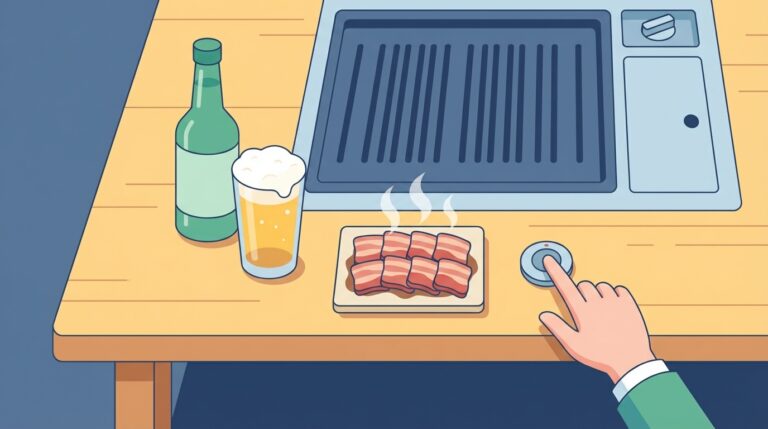
Picture this: You are watching your favorite K-Drama. The main characters have just finished a grueling day at work. They head to a smoky pojangmacha (street tent bar) or a bustling BBQ joint. The green bottles of soju line up, meat is sizzling on the grill, and someone enthusiastically yells to the owner, asking for a cold beer.
Now, imagine you are in Seoul, sitting at that exact same table. The music is loud, the vibe is incredible, but your throat is dry. You want to order a beer, but your mind goes blank. “Wait, what did my textbook say? Would you kindly bring me a beverage?”
If you freeze up here, don’t worry! This post is inspired by the real panic moments of my A1 beginner students who found themselves in a loud Hongdae pub and didn’t know how to get the waiter’s attention.
Today, we aren’t just learning how to say “Please give me a beer.” We are learning how to dive straight into the heart of Korean drinking culture—confidently and respectfully. Grab a glass, and let’s get started!
Phase 2: Core Expressions Deep Dive
1. 맥주 주세요 (Beer, please)
- Pronunciation: maekju juseyo [Mac-joo joo-se-yo]
(Think of ‘Mac’ in Mac & Cheese, and ‘joo’ like in juice!)- Meaning: Please give me a beer. (Literal: Beer give-me).
- K-Culture Moment: You will hear this in almost every episode of a Korean drama featuring a dinner scene (hoesik). When the spicy food hits, this phrase is the ultimate lifesaver.
- Editor’s Insight: The beauty of beginner Korean is the magic word 주세요 (juseyo). Just put whatever you want in front of it! It sounds polite, natural, and gets the job done immediately.
- Situation Spectrum:
- Casual (Friends): ✅ (Though friends might just say ‘maekju jwo’)
- Semi-formal (Coworkers/Waitstaff): ✅ (Perfect!)
- Formal (Boss/Elders): ✅ (Safe and polite)
- 🤔 Think About It: In English, we soften our orders: “Could I possibly get a beer?” But in Korea, “Beer, please” (맥주 주세요) is perfectly polite. Why do you think Korean service culture prefers this directness?
2. 사장님! (Boss / Owner!)
- Pronunciation: sajangnim [Sah-jang-neem]
- Meaning: Boss / Owner (Real nuance: “Excuse me, waiter!”)
- K-Culture Moment: In a loud Korean BBQ restaurant, raising your hand quietly won’t work. You need to confidently call out “Sajangnim!” to get service.
- Editor’s Insight: Don’t yell “Excuse me” (Sillyehamnida) to order food! That’s for bumping into people on the subway. Calling the staff “Boss” is a friendly, respectful way to get attention.
- Situation Spectrum:
- Casual (Friends): 🚫 (Don’t call your friends boss!)
- Semi-formal (Restaurant staff): ✅
- Formal: ⚠️
- 🤔 Think About It: By calling the server “Boss,” Koreans show respect for the person’s work. Does your culture have a special title for service workers?
3. 짠! (Cheers!)
- Pronunciation: jjan! [Jjan!]
(Make the ‘J’ sound very tight and short, like two glasses clinking together!)- Meaning: Cheers! (Onomatopoeia for clinking glasses).
- K-Culture Moment: K-Pop idols do this all the time on their V-Live or Weverse streams when drinking water or juice with fans!
- Editor’s Insight: It’s cute, universally understood, and instantly breaks the ice.
- Situation Spectrum:
- Casual (Friends): ✅
- Semi-formal (Coworkers): ✅
- Formal (Boss/Elders): ⚠️ (Use ‘Geonbae’ instead for formal settings)
- 🤔 Think About It: “Jjan” is actually a sound effect. Korean relies heavily on mimetic words (words that mimic sounds or feelings) to make conversations more colorful!
Phase 3: Textbook vs. Real Korean
[Situation 1: Trying to order a drink]
* 📖 Textbook Korean: 저기요, 맥주 한 잔 주시겠어요? (Excuse me, would you please give me a glass of beer?)
* 🗣️ Real Korean: 사장님, 여기 맥주요! (Boss, beer over here!)
* 💡 Why is it different?: Korean restaurants move fast (the famous ‘Ppalli-ppalli’ culture). Short, direct noun-focused sentences are much more efficient!
[Situation 2: Proposing a toast]
* 📖 Textbook Korean: 건배합시다! (Let us toast!)
* 🗣️ Real Korean: 짠~ (Jjan~)
* 💡 Why is it different?: ‘Geonbae’ can feel a bit stiff or old-fashioned, usually reserved for formal company dinners or weddings. ‘Jjan’ is what friends say to keep the vibe light and fun.
Bottom Note: As an A1 learner, sticking to “[Noun] + 주세요 (juseyo)” is your best weapon. It is perfectly polite and incredibly natural. Don’t overcomplicate it!
Phase 4: K-Culture Deep Dive
4-1. The Unspoken Rules (Non-verbal Etiquette)
Language is only half the battle. If you want to impress locals, you need to master Korean drinking etiquette—often called the ultimate test of 눈치 (Nunchi), the ability to read the room.
– Two Hands are Better than One: When receiving a glass of beer (or pouring one) for someone older or higher in rank, always use two hands. Support your pouring arm with your free hand.
– Turn Away: If you are drinking with someone much older (like a boss or your partner’s parents), it is customary to turn your head slightly to the side while taking a sip, rather than drinking while looking straight at them.
4-2. Food, Drinks, and Bonding
In Korea, alcohol is rarely consumed without food. Drinking culture is deeply tied to K-Food.
– Anju (안주): This means ‘drinking snacks’. If you order a beer, you must order food! Whether it’s spicy fried chicken (forming the legendary combo 치맥 Chimaek) or a hearty stew.
– The Empty Glass Rule: In K-Dramas, you’ll notice people constantly pouring drinks for each other. In Korea, you never pour your own drink. You pour for your friends, and they pour for you. It’s a beautiful symbol of taking care of one another.
Phase 5: Real-Life Roleplay Scenario
Setting: Friday night, 7:00 PM. A lively Samgyeopsal (pork belly) restaurant near Gangnam Station. The air is thick with the smell of roasting meat. You are here with your Korean coworker, Minsu.
Characters:
– YOU: An expat on your first week in Korea, eager to try local culture.
– Minsu (32): Your Korean coworker. He is friendly, loud, and acts as your local guide.
Dialogue:
Minsu: 오늘 진짜 고생했어요! 삼겹살 제가 쏠게요!
(oneul jinjja gosaenghaesseoyo! samgyeopsal jega ssolgeyo!)
[You worked really hard today! I’ll pay for the pork belly!]
(🎭 Stage Direction: Minsu grabs the tongs and starts grilling the meat.)
YOU: 우와, 감사합니다!
(uwa, gamsahamnida!)
[Wow, thank you!]
Minsu: 고기에는 맥주죠! 사장님! 여기 맥주 주세요!
(gogieneun maekjujyo! sajangnim! yeogi maekju juseyo!)
[Meat needs beer! Boss! Please give us beer here!]
YOU: 저도 맥주 좋아요.
(jeodo maekju joayo.)
[I like beer too.]
Minsu: 자, 받으세요.
(ja, badeuseyo.)
[Here, please receive (this drink).]
(🎭 Stage Direction: Minsu holds the bottle with two hands and pours beer into your glass.)
🔀 Your Turn! How should you react while receiving the drink?
– A) Hold your glass with one hand while checking your phone.
– B) Hold your glass with two hands and say “감사합니다 (Gamsahamnida)”.
– C) Snatch the bottle and say “I can pour it myself!”✅ Best Choice: B — Holding the glass with two hands shows respect and appreciation. It’s the golden rule of Korean drinking!
⚠️ Choice C Analysis: While independent in Western cultures, refusing someone pouring for you in Korea can accidentally reject their gesture of bonding.
YOU: 감사합니다!
(gamsahamnida!)
[Thank you!]
Minsu: 자, 수고하셨습니다. 짠!
(ja, sugohasyeotseumnida. jjan!)
[Well, great job today. Cheers!]
YOU: 짠!
(jjan!)
[Cheers!]
🍗 Bonus K-Culture Scenario: Han River Picnic
(You are sitting on a picnic mat at the Han River, ordering delivery)
Delivery Rider: 치킨 배달 왔습니다! (chikin baedal watseumnida! – Chicken delivery is here!)
YOU: 감사합니다. 우리 치맥 해요! (gamsahamnida. uri chimaek haeyo! – Thank you. Let’s do Chimaek!)
Phase 6: 10-Second Shadowing Drill
Practice reading these out loud. Pay attention to the pauses (/) and the emotion tags!
- 🙋♂️ (Confidently and loud) 사장님! / 여기 / 맥주 주세요!
(Sajangnim! / yeogi / maekju juseyo!)- Boss! / Over here / beer please!
- 🍻 (Cheerfully, raising glass) 우리 / 짠 / 할까요?
(Uri / jjan / halkkayo?)- Shall we / cheers?
- 🥺 (Politely, declining alcohol) 저는 / 콜라 / 주세요.
(Jeoneun / kolla / juseyo.)- As for me / cola / please.
Phase 7: K-Culture Mini Dictionary
| Korean | Romanization | English | Cultural Context |
|---|---|---|---|
| 소맥 | somaek | Soju + Beer | The ultimate Korean cocktail. A mix of Soju and Maekju (Beer). |
| 치맥 | chimaek | Chicken + Beer | Fried chicken eaten with cold beer. A staple of Korean nightlife and sports watching. |
| 회식 | hoesik | Company Dinner | Essential bonding time for Korean coworkers, usually involving lots of food and drinks. |
| 콜 | kol | Call! (I’m in!) | Used when agreeing to an idea enthusiastically. “Beer tonight?” “Kol!” |
Phase 8: Traveler’s Survival Kit
If you are visiting Korea, these are the absolute must-know phrases for any restaurant or pub.
🆘 Survival Expression #1: Ordering
– 🇰🇷 “이거 주세요” (igeo juseyo)
– 🗣️ Pronunciation: [Ee-guh joo-se-yo]
– 📍 Where to use: Literally anywhere! Point at the menu and say this.
– 💡 Pro Tip: If you don’t know the Korean word for a drink, just point and use this magic phrase.🆘 Survival Expression #2: Asking for more side dishes
– 🇰🇷 “반찬 좀 더 주세요” (banchan jom deo juseyo)
– 🗣️ Pronunciation: [Ban-chan johm duh joo-se-yo]
– 📍 Where to use: BBQ places, traditional restaurants.
– 💡 Pro Tip: Side dishes (Banchan) are FREE to refill in Korea! Don’t be shy.📌 Editor’s Travel Note
– The Magic Button: Look at your table. Most Korean restaurants have a small call button (벨 – bel). Don’t wait for the waiter to make eye contact; just press the button!
– Tipping: There is NO tipping culture in Korea. If you leave money on the table, the staff might run out to the street to return it to you!
Phase 9: Critical Thinking — “One Step Deeper”
🧠 Think Deeper: Food, Drinks, and Identity (Jeong/정)
Have you ever wondered why Koreans almost never pour their own drinks? In Korean culture, food and drinks are not just about feeding yourself; they are the physical manifestation of 정 (Jeong)—a deep sense of connection, affection, and community. By pouring a drink for your friend, you are actively saying, “I am looking out for you.” By waiting for them to pour yours, you are allowing them to care for you in return. It transforms a simple act of drinking beer into a continuous exchange of mutual respect and bonding.
💬 Your Turn:
In your culture, do people share dishes and pour drinks for each other, or does everyone order and manage their own meals? Share your cultural perspective in the comments!
Phase 10: FAQ & Mistake Prevention
Q: “Can I say ‘맥주 주세요 (Maekju juseyo)’ to my boss?”
– Maybe. It is polite, but if you want to sound extra respectful to a strict boss, you might say “맥주 한 병 주문할까요? (Shall we order a bottle of beer?)”. But for a restaurant waiter, Maekju juseyo is 100% perfect.
Q: “What if I don’t drink alcohol at a company dinner?”
– No problem! Korean culture has changed a lot. It is perfectly acceptable to say “저는 술을 못 마셔요” (I can’t drink alcohol) and order a soda. You can still clink glasses with a Coke!
❌ Common Mistake #1: Pouring a drink with one hand while the other hand is in your pocket.
✅ Do this instead: Always use two hands when pouring or receiving a drink from someone older. Keep your hands out of your pockets!
Phase 11: Summary & Action Items
✨ One-Liner Summary: To survive a Korean pub, confidently call the waiter with “Sajangnim!” and order with “[Noun] + 주세요 (juseyo)!”
🚀 Your Action Missions:
– 🥉 Bronze (Solo): Stand in front of your mirror and confidently raise your hand, practicing “사장님! 맥주 주세요!” 3 times.
– 🥈 Silver (Online): Drop a comment below using today’s phrase! Tell me what you want: 맥주 (Beer), 소주 (Soju), or 콜라 (Cola)?
– 🥇 Gold (Real World): Next time you visit a Korean restaurant or a K-BBQ spot, order your drink entirely in Korean.
🎬 K-Culture Mission:
Watch one episode of your favorite K-Drama tonight. Every time you see a green soju bottle or hear someone say “짠 (Jjan)”, take a sip of your drink (water counts!).
Phase 12: Interactive Challenge (Quiz)
1. You want to get the waiter’s attention in a crowded, loud K-BBQ restaurant. What should you do?
– A) Sit quietly and make intense eye contact.
– B) Yell “Sillyehamnida! (Excuse me!)”
– C) Press the call button on the table or enthusiastically call out “Sajangnim!”
2. Fill in the blank: To ask for a beer, you should say “맥주 _________”
– A) 감사합니다 (Gamsahamnida)
– B) 주세요 (Juseyo)
– C) 안녕 (Annyeong)
3. True or False: In Korea, you should pour your own drink as soon as your glass is empty to avoid bothering others.
– True / False
(Answers: 1. C – Eye contact doesn’t work well in busy Korean pubs! 2. B – Juseyo means please give me. 3. False – Always let someone else pour for you, and pour for them!)
Frequently Asked Questions (FAQ)
Q: What does "맥주 주세요 (Beer, please)" mean in Korean and how do you pronounce it?
A: In Korean, "맥주 주세요 (Beer, please)" is pronounced [maekju juseyo [Mac-joo joo-se-yo] and means: Please give me a beer. (Literal: Beer give-me).
Q: What does "사장님! (Boss / Owner!)" mean in Korean and how do you pronounce it?
A: In Korean, "사장님! (Boss / Owner!)" is pronounced [sajangnim [Sah-jang-neem] and means: Boss / Owner (Real nuance: "Excuse me, waiter!")
Q: What does "짠! (Cheers!)" mean in Korean and how do you pronounce it?
A: In Korean, "짠! (Cheers!)" is pronounced [jjan! [Jjan!] and means: Cheers! (Onomatopoeia for clinking glasses).






