

Phase 1: Empathy & The “Cheongcheopjang” Moment
Hello there! I’m your Daily Hangul Editor, your local Korean friend and veteran tutor. 😊
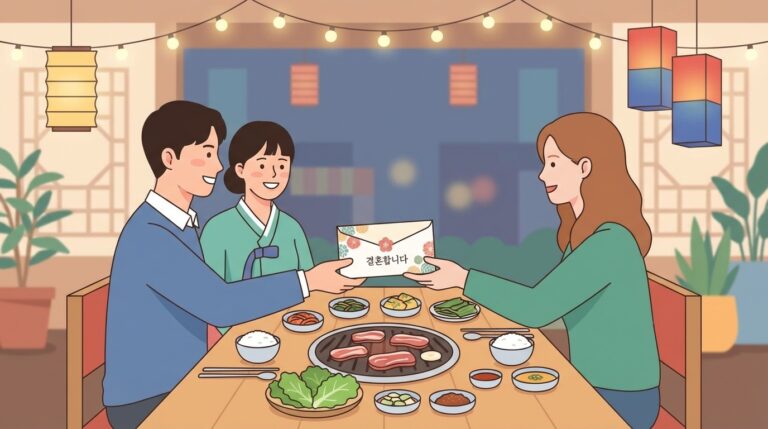
Imagine this K-Drama scene: You are sitting at a bustling Korean BBQ restaurant. The smell of grilled pork belly fills the air, glasses are clinking, and suddenly, your coworker slides a beautiful, thick envelope across the table. They look a bit shy but very happy. You open it, and it’s a wedding invitation!
In your home country, you might just get an RSVP card in the mail. But in Korea, handing out physical wedding invitations—called 청첩장 (cheongcheopjang)—is a huge cultural event. The bride or groom will actually invite you to a meal, pay for the dinner, and personally hand you the invitation. We call this a 청첩장 모임 (Cheongcheopjang Moim).
If you don’t know how to react, you might just say “Thank you” and awkwardly put it in your bag. But if you know the right Korean expressions? You’ll instantly become an “Insider” (인싸) who truly understands Korean heart and culture. This guide is built from real experiences of my students who panicked when they received their first beautiful Korean wedding envelope. Let’s dive in!
Phase 2: Deep Dive into Core Expressions
Here are the top 3 expressions you need when someone hands you that beautiful envelope.
1. 결혼 축하해요! (Congratulations on your wedding!)
- Pronunciation: [gyeolhon chukahaeyo!] (Sounds like: gyul-hon choo-ka-hae-yo!)
- Meaning: Literal: Wedding congratulations! / Real nuance: I’m so happy for your marriage!
- K-Culture Moment: You will hear this in every Korean drama wedding scene. When the envelope is handed to you, this is the very first thing that should come out of your mouth, accompanied by a big smile and a slight bow of the head.
- Editor’s Insight: It’s bright, polite, and universally safe. The “해요” (haeyo) ending makes it polite enough for coworkers, but friendly enough for acquaintances.
- Situation Spectrum:
- Close Friends (Casual): ✅ (Drop the ‘yo’: 결혼 축하해!)
- Coworkers (Semi-formal): ✅
- Boss/Elders (Formal): ⚠️ (Better to say: 결혼을 진심으로 축하드립니다)
- 🤔 Think About It: Why do Koreans usually say “결혼” (wedding) instead of just “축하해요” (congratulations)? It’s because we like to be specific about what we are celebrating to show genuine interest. Does your language specify the event, or just say “congrats”?
2. 꼭 갈게요! (I will definitely go!)
- Pronunciation: [kkok galgeyo!] (Sounds like: kkok! (like a chicken cluck) gal-gae-yo!)
- Meaning: Literal: I will surely go. / Real nuance: I wouldn’t miss it for the world!
- K-Culture Moment: Unlike Western weddings where you strictly RSVP via mail or a website months in advance, Korean wedding halls are huge, and the guest list is flexible. Saying “꼭 갈게요!” right when you receive the invitation is the verbal RSVP that makes the couple feel relieved.
- Editor’s Insight: The word 꼭 (kkok) means “firmly” or “without fail.” Adding this tiny word transforms a simple “I’ll go” into a warm promise.
- Situation Spectrum:
- Close Friends (Casual): ✅ (꼭 갈게!)
- Coworkers (Semi-formal): ✅
- Boss/Elders (Formal): ⚠️ (꼭 참석하겠습니다 – I will definitely attend)
- 🤔 Think About It: Why is verbal confirmation so important in Korea? It’s related to “Nunchi”—showing your immediate enthusiasm reassures the couple who might be stressed about how many people will actually show up!
3. 초대해 주셔서 감사해요. (Thank you for inviting me.)
- Pronunciation: [chodaehae jusyeoseo gamsahaeyo.] (Sounds like: cho-dae-hae joo-syuh-suh gam-sa-hae-yo)
- Meaning: Literal: Thank you for doing the favor of inviting me. / Real nuance: I’m honored to be invited.
- K-Culture Moment: When a Korean idol holds a fan meeting, they always tell the fans, “와 주셔서 감사합니다” (Thank you for coming). This structure (Action + 주셔서 감사합니다) is the ultimate polite way to express gratitude for someone’s effort.
- Editor’s Insight: Use this right after congratulating them. It shows you recognize that inviting you (and buying you dinner!) is a special gesture.
- Situation Spectrum:
- Close Friends (Casual): ✅ (초대해 줘서 고마워!)
- Coworkers (Semi-formal): ✅
- Boss/Elders (Formal): ✅ (초대해 주셔서 감사합니다)
- 🤔 Think About It: Notice the “주셔서” (giving the action to me). Korean language is very focused on acknowledging when someone gives you their time, effort, or an invitation.
Phase 3: Textbook vs. Real Korean
Let’s upgrade your textbook Korean to what you’ll actually hear in the streets of Seoul!
[Situation 1: Receiving the Invitation]
* 📖 Textbook Korean: 결혼을 진심으로 축하합니다. (I sincerely congratulate your marriage.)
* 🗣️ Real Korean: 우와! 대박! 진짜 축하해요! (Wow! Daebak! Seriously, congrats!)
* 💡 Why the difference?: Textbooks teach formal written Korean. But in real life, adding emotional reactions like “우와” (Wow) or “대박” (Jackpot/Awesome) shows genuine excitement.
[Situation 2: Reacting to the meal they bought you]
* 📖 Textbook Korean: 식사를 제공해 주셔서 감사합니다. (Thank you for providing the meal.)
* 🗣️ Real Korean: 잘 먹겠습니다! (I will eat well!)
* 💡 Why the difference?: In Korea, when someone buys you food to celebrate, simply using the standard meal greeting “잘 먹겠습니다” warmly acknowledges their generosity without sounding like a robot.
Bottom Note: As an A2 learner, stick to adding small reactions like “우와” (Wow) before saying your polite sentences. It makes your Korean sound 10x more natural!
Phase 4: Cultural Context — K-Culture Deep Dive
4-1. Non-verbal Elements: The “Two-Hand” Rule
When someone hands you a beautifully printed wedding invitation, never take it with one hand. Always reach out with both hands, or place your left hand gently under your right arm as you receive it. Take a few seconds to actually look at the design and compliment it! Saying “우와, 청첩장 너무 예뻐요!” (Wow, the invitation is so pretty!) will make the couple’s day.
4-2. K-Food Connection: The Cost of Inviting
In Korea, receiving an invitation means free food. The bride and groom spend weeks meeting different friend groups (college friends, coworkers, high school friends) at nice restaurants to hand out invitations. This 청첩장 모임 (Invitation Gathering) is deeply rooted in Korean food culture. We believe that sharing a hearty meal is the best way to ask for someone’s blessing.
Critical View: Because of this culture, couples often spend thousands of dollars just on dinners before the wedding! It’s a heavy financial burden, which is why Koreans deeply appreciate it when guests show up and bring 축의금 (Congratulatory money) to help offset the costs.
Phase 5: Real-Life Roleplay Scenario
Let’s put you in the scene.
Setting: Friday night, 7:00 PM. A lively Korean BBQ restaurant near Gangnam Station. Smoke is rising from the grills, and soju glasses are ready.
Characters:
– YOU: A foreign employee who has been working in Korea for 6 months.
– Minji (30): Your friendly Korean coworker who is getting married next month.
Dialogue:
Minji: 여러분! 오늘 고기는 제가 쏠게요! 많이 드세요. 🥩
(yeoreobun! oneul gogineun jaega ssolgeyo! mani deuseyo.)
[Everyone! I’m treating you to meat today! Please eat a lot.]
(🎭 Stage Direction: Minji confidently picks up the grilling tongs)
YOU: 우와, 민지 씨! 오늘 무슨 좋은 일 있어요?
(uwa, minji ssi! oneul museun joeun il isseoyo?)
[Wow, Minji! Is there something good happening today?]
Minji: 사실… 저 다음 달에 결혼해요! 자, 여기 청첩장이에요.
(sasil… jeo daeum dare gyeolhonhaeyo! ja, yeogi cheongcheopjangieyo.)
[Actually… I’m getting married next month! Here, this is the invitation.]
(🎭 Stage Direction: Minji shyly hands you a pink envelope with both hands)
YOU: 대박! 진짜요? 결혼 축하해요! 🎉
(daebak! jinjjayo? gyeolhon chukahaeyo!)
[Daebak! Really? Congratulations on your wedding!]
Minji: 고마워요. 바쁘겠지만 시간 되면 꼭 와 주세요.
(gomawoyo. bappeugejjiman sigan doemyeon kkok wa juseyo.)
[Thank you. You must be busy, but please come if you have time.]
YOU: 당연하죠! 꼭 갈게요!
(dangyeonhajyo! kkok galgeyo!)
[Of course! I will definitely go!]
Minji: 다행이네요. 와서 축하해 주면 정말 기쁠 거예요.
(dahaengineyo. waseo chukahae jumyeon jeongmal gippeul geoeyo.)
[That’s a relief. I would be really happy if you come and congratulate us.]
YOU: 초대해 주셔서 감사해요. 청첩장 너무 예쁘네요.
(chodaehae jusyeoseo gamsahaeyo. cheongcheopjang neomu yeppeuneyo.)
[Thank you for inviting me. The invitation is so pretty.]
Minji: 고마워요! 자, 고기 다 익었어요. 얼른 먹어요!
(gomawoyo! ja, gogi da igeosseoyo. eolleun meogeoyo!)
[Thank you! Here, the meat is cooked. Hurry and eat!]
🔀 Your Turn! How should you respond as she gives you the food?
– A) “아뇨, 오늘은 제가 낼게요!” (No, I will pay today!)
– B) “우와! 잘 먹겠습니다!” (Wow! I will eat well!)
– C) “저 고기 안 좋아해요.” (I don’t like meat.)✅ Best Choice: B — Reason: In a “Cheongcheopjang Moim,” the person giving the invitation must pay. It is their way of treating you. Offering to pay (A) might seem polite in your culture, but it will make Minji very uncomfortable. Simply accepting it with a cheerful “잘 먹겠습니다” is the best Korean Nunchi!
Phase 6: 10-Second Shadowing Drill
Read these sentences out loud. Pay attention to the pauses (/) and emotions!
- 😊 우와! / 결혼 / 너무너무 / 축하해요!
(uwa! / gyeolhon / neomu-neomu / chukahaeyo!)
[Brightly! Like you just heard the best news ever] -
🥺 초대해 주셔서 / 정말 / 감사해요.
(chodaehae jusyeoseo / jeongmal / gamsahaeyo.)
[Warmly, looking them in the eyes] -
😤 걱정 마세요. / 저 / 꼭! / 갈게요!
(geokjeong maseyo. / jeo / kkok! / galgeyo!)
[Confidently nodding your head]
Phase 7: K-Culture Mini Dictionary
| 한국어 | Romanization | English | Context |
|---|---|---|---|
| 청첩장 | cheongcheopjang | Wedding invitation | Usually beautifully designed paper cards, often handed out in person. |
| 모임 | moim | Gathering/Meeting | “청첩장 모임” is the dinner party to hand out invitations. |
| 축의금 | chuguigeum | Congratulatory money | Cash given in a white envelope at the wedding hall. It replaces wedding gifts in Korea. |
| 예식장 | yesikjang | Wedding hall | The venue where Korean weddings take place. They usually have a huge buffet! |
| 쏘다 | ssoda | To treat (slang) | Literally means “to shoot,” but used as “I will pay for the meal.” (내가 쏠게!) |
Phase 8: Traveler Survival Kit
Even if you live in Korea, navigating to a Korean wedding hall can feel like a survival mission. Wedding halls are often near subway stations, but finding the right floor or the ATM can be tricky!
🆘 Survival Phrases for the Wedding Day
– 🇰🇷 “ATM(현금인출기)이 어디에 있어요?” (ATM-i eodie isseoyo?)
– 🗣️ English Sound: [A-T-M-ee eo-di-e is-seo-yo?]
– 📍 Where to use: Inside the wedding hall when you need cash for the 축의금 envelope.
- 🇰🇷 “예식장이 몇 층이에요?” (yesikjangi myeot cheung-ieyo?)
- 🗣️ English Sound: [ye-sik-jang-ee myut cheung-ee-eh-yo?]
- 📍 Where to use: In the lobby, asking the staff.
📌 Editor’s Travel Note
– Useful App: Naver Map or KakaoMap. Search the exact name of the wedding hall, because many have similar names!
– Cash is King here: Korea is a card-only society, except for weddings. You absolutely need crisp cash to put in your envelope. Always withdraw money before arriving at the venue, as the ATMs there will have long lines!
Phase 9: Critical Thinking — “One Step Deeper”
🧠 Think Deeper: Food & Identity (음식과 정체성)
Why do Koreans go through the stress of buying expensive dinners for dozens of people just to hand out a piece of paper? In Korean culture, food is deeply tied to the concept of 정 (Jeong)—a feeling of connection, affection, and shared community. By feeding you, the couple is saying, “You are an important part of our village, and we want to share our joy with you.” It transforms the invitation from a mere notification into a shared life event.💬 Your Turn: In your culture, how do people usually deliver wedding invitations? Is there a special ritual, or is it mostly sent through the mail? Share in the comments!
Phase 10: FAQ & Mistake Prevention
Q: Do I have to RSVP to a Korean wedding?
Mostly, no! Traditional paper invitations don’t have RSVP cards. You just show up. However, recently, couples send “Mobile Invitations” (모바일 청첩장) via KakaoTalk that sometimes have an RSVP button. If you see one, click it! But saying “꼭 갈게요!” in person is usually enough.
Q: How much 축의금 (money) should I give?
It depends on how close you are. A general rule: 50,000 KRW for acquaintances (if you don’t eat the buffet), 100,000 KRW if you go and eat, and 150,000+ KRW for close friends.
❌ Common Mistake #1: Trying to split the bill at a Cheongcheopjang Moim.
✅ Do this instead: Let them pay! Just say “잘 먹겠습니다” (I will eat well) and promise to give them a good 축의금 at the wedding.❌ Common Mistake #2: Wearing a white dress or white suit to the wedding.
✅ Do this instead: In Korea, white is strictly reserved for the bride. Wear dark or muted colors to let the bride shine!
Phase 11: Summary & Action Items
One-Liner Summary: When handed a Korean wedding invitation, smile brightly, receive it with both hands, and say “결혼 축하해요! 꼭 갈게요!”
Action Mission:
– 🥉 Bronze (Solo): Stand in front of a mirror, pretend to receive an envelope with both hands, and say “우와! 결혼 축하해요!” 3 times.
– 🥈 Silver (Online): Go to a K-Drama YouTube clip of a wedding scene and leave a comment: “결혼 축하해요! 🎉”
– 🥇 Gold (Real Life): Next time someone shares good news with you (even if it’s not a wedding), practice saying “우와! 진짜 축하해요!”
K-Culture Mission:
Search “한국 모바일 청첩장” (Korean mobile wedding invitation) on Google Images. Notice how different they look from Western invitations—they often look like mini websites with beautiful pre-wedding photo galleries!
Did you ever attend a Korean wedding? What was the most surprising part? Let me know in the comments below! 👇
Phase 12: Quiz — Interactive Challenge
1. Situational Judgment: Your coworker hands you a wedding invitation and says they will buy you lunch. What is the BEST reaction?
– A) “I will pay for my own lunch, thank you.”
– B) “우와! 축하해요. 잘 먹겠습니다!” (Wow! Congrats. I will eat well!)
– C) “I can’t go to the wedding, so don’t buy me lunch.”
2. Fill in the Blank:
“초대해 _______ 감사해요.” (Thank you for inviting me.)
– A) 주셔서 (jusyeoseo)
– B) 먹어서 (meogeoseo)
– C) 가서 (gaseo)
3. True or False – K-Culture Edition:
“When you receive a paper wedding invitation in Korea, you must immediately mail back the RSVP card.”
(Answers: 1: B – Let them treat you and show gratitude. 2: A – 주셔서 means ‘for doing the action for me’. 3: False – Traditional Korean invitations do not use mail-back RSVP cards!)
Frequently Asked Questions (FAQ)
Q: What does "결혼 축하해요! (Congratulations on your wedding!)" mean in Korean and how do you pronounce it?
A: In Korean, "결혼 축하해요! (Congratulations on your wedding!)" is pronounced [gyeolhon chukahaeyo!] and means: Literal: Wedding congratulations! / Real nuance: I'm so happy for your marriage!
Q: What does "꼭 갈게요! (I will definitely go!)" mean in Korean and how do you pronounce it?
A: In Korean, "꼭 갈게요! (I will definitely go!)" is pronounced [kkok galgeyo!] and means: Literal: I will surely go. / Real nuance: I wouldn't miss it for the world!
Q: What does "초대해 주셔서 감사해요. (Thank you for inviting me.)" mean in Korean and how do you pronounce it?
A: In Korean, "초대해 주셔서 감사해요. (Thank you for inviting me.)" is pronounced [chodaehae jusyeoseo gamsahaeyo.] and means: Literal: Thank you for doing the favor of inviting me. / Real nuance: I'm honored to be invited.







