

Phase 1: Empathy (The K-Culture Cold Open)
Hello there! It’s your lead editor at Daily Hangul.
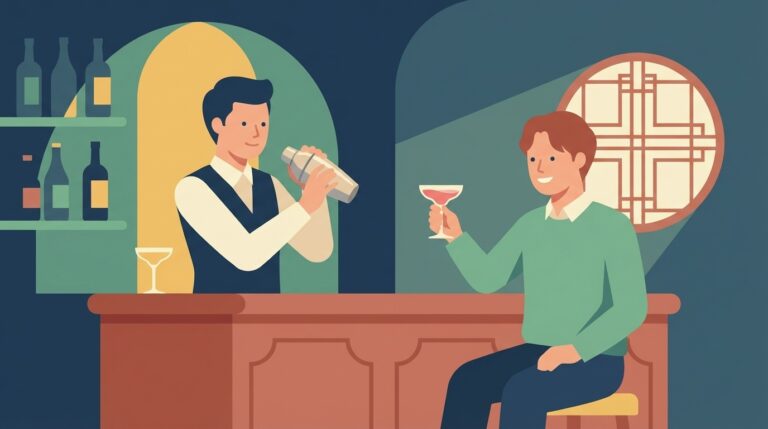
Picture this: You push a hidden door masquerading as a vintage bookshelf in ‘Hipjiro’ (Euljiro) or walk into a dimly lit, aesthetic lounge in Cheongdam-dong. The K-Drama Itaewon Class vibes are immaculate. The bartender glides over, slides a coaster your way, and asks, “어떤 스타일로 준비해 드릴까요?” (What style should I prepare for you?).
In your Korean textbook, you might have learned to say, “주스 주세요” or “맥주 한 병 주세요.” But at a craft cocktail bar, simply saying “Give me a sweet drink” feels a bit… flat, doesn’t it? When you’re at a C1 (Upper-Intermediate/Advanced) level, you want to articulate your exact taste profile—whether you want a heavy, woody finish or a light, refreshing kick.
If you’ve ever felt intimidated staring at a menu without pictures or fumbled trying to explain that you want something “strong but not too sugary,” you are in the right place. Today, we are mastering the sophisticated art of Korean Bar Talk. Let’s upgrade your vocabulary so you can order like a true Seoulite!
Phase 2: Core Expressions Deep Dive
Let’s break down the most essential, high-level expressions you need at a Korean cocktail bar.
1. “달달한데 도수는 좀 높은 걸로 부탁드려요.”
- Pronunciation: [daldalhande dosuneun jom nopeun geollo butakdeuryeoyo] + ‘do-su’ sounds like ‘dough-sue’.
- Meaning: Make it sweet, but with a high ABV (Alcohol By Volume) please.
- K-Culture Moment: You’ll hear this exactly like this in Korean nightlife. It’s the go-to phrase for people who hate the taste of strong liquor but still want to get a buzz going.
- Editor’s Insight: The word 도수 (dosu) is an absolute must-know. Instead of saying “Make it strong” (which sounds a bit aggressive), Koreans specify the dosu. Also, notice the use of 달달하다 (to be pleasantly sweet) instead of just 달다 (sweet). It adds a softer, more nuanced feeling!
- Situation Spectrum:
- Casual with friends: ✅ (야, 도수 센 걸로 시켜!)
- Ordering from a Bartender: ✅
- Formal Company Dinner: ⚠️ (Depends on the vibe, but usually fine)
- 🤔 Think About It: Why do Koreans use a scientific-sounding word like “Alcohol By Volume” (도수) in casual conversation? It reflects a culture that is very specific and numerical about alcohol consumption—just think about how Koreans count the number of Soju bottles on the table!
2. “단맛은 덜하고 깔끔한 스타일이 좋아요.”
- Pronunciation: [danmaseun deolhago kkalkkeumhan seutairi joayo] + ‘kkalkkeum’ sounds like ‘kkal-gum’ (with a tense K).
- Meaning: I prefer less sweetness and a clean finish.
- K-Culture Moment: Picture a sleek-suited executive in a K-Drama ordering a Martini after a long day of corporate plotting. They always want something kkalkkeum-hada.
- Editor’s Insight: 깔끔하다 (kkalkkeum-hada) is the holy grail of Korean taste descriptions. It means “clean,” “neat,” or “refreshing without a lingering heavy aftertaste.” If you use this word to describe food or drinks, Koreans will immediately think, “Wow, their Korean is native level.”
- Situation Spectrum:
- Casual with friends: ✅
- Ordering from a Bartender: ✅
- Formal Company Dinner: ✅
- 🤔 Think About It: “Kkalkkeum-hada” is used for drinks, clothes, and even someone’s personality. What does this reveal about the aesthetic and social values in Korean society?
3. “제가 술이 좀 약해서요. 도수 낮게 타 주실 수 있나요?”
- Pronunciation: [jega suri jom yakhaeseoyo. dosu natge ta jusil su innayo?]
- Meaning: I’m a bit of a lightweight. Can you make it with low alcohol?
- K-Culture Moment: When you’re on a blind date (소개팅) at a nice lounge and want to keep a clear head, you politely let the bartender know you are a lightweight (술이 약하다).
- Editor’s Insight: Literally, “My alcohol is weak.” We don’t say “I can’t drink much” outright; we blame our tolerance! The verb 타다 (tada) here means “to mix (drinks/powder).” You also use it for making instant coffee (커피 타다) or mixing Soju and Beer (소맥 타다).
- Situation Spectrum:
- Casual with friends: ✅
- Ordering from a Bartender: ✅
- Formal Company Dinner: ✅ (A great, polite excuse to avoid overdrinking!)
Phase 3: Textbook vs. Real Korean
Let’s see how C1 learners can ditch the robotic textbook phrases for natural, native-level slang.
[When asking to make the drink stronger]
* 📖 Textbook Korean: 알코올을 많이 넣어 주시겠어요? (Could you put in a lot of alcohol?)
* 🗣️ Real Korean: 도수 좀 세게 해주세요. / 독하게 타주세요. (Make the ABV strong / Make it potent.)
* 💡 Why the difference?: Koreans use “세다” (strong) or “독하다” (toxic/potent) for strong liquor. It sounds much more natural than requesting “more alcohol.”
[When asking for a recommendation]
* 📖 Textbook Korean: 이 술집에서 무엇이 가장 맛있습니까? (What is the most delicious thing in this bar?)
* 🗣️ Real Korean: 시그니처 칵테일 중에 저한테 추천해 주실 만한 거 있나요? (Among the signature cocktails, is there anything you’d recommend for me?)
* 💡 Why the difference?: Modern Korean bar culture heavily revolves around “Signature” (시그니처) menus. Asking for a customized recommendation fits the personalized speakeasy vibe.
Bottom Note: At a C1 level, weaving English loan words like 시그니처 (signature), 바디감 (body/weight of the drink), and 피니시 (finish) into your Korean sentences sounds incredibly natural in trendy Seoul bars.
Phase 4: Cultural Context — K-Culture Deep Dive
4-1. Non-Verbal Nuances in Bars
In a Korean cocktail bar, the atmosphere is often intimate. Unlike a loud Soju tent (Pojangmacha), you don’t shout “이모!” (Auntie!) or press a call bell. Instead, you use Nunchi (눈치). Catch the bartender’s eye with a soft nod or slightly raise your hand and say a gentle “저기요” (Excuse me).
4-2. The K-Drama & Speakeasy Connection
Have you noticed how in K-Dramas, when a character is stressed, they go to a loud Soju place with a friend, but when they are heartbroken, deeply in thought, or wealthy, they sit alone at a dimly lit whiskey or cocktail bar?
This perfectly mirrors Seoul’s modern drinking culture. Cocktail bars are seen as a space for “healing” and “individualism,” a sharp contrast to the collective “Gunbae!” (Cheers!) of corporate Hoesik (회식) culture. If you go to a speakeasy in Korea, you’ll notice people speak in hushed tones, deeply respecting each other’s private space.
Phase 5: Real-World Roleplay Scenario
Setting: It’s Friday night, 9 PM. You and your Korean colleague, Minsu, just finished a loud, chaotic company dinner. You both slipped away to a hidden, aesthetic cocktail bar in Itaewon for a quieter “2차” (Round 2). The bartender, dressed in a crisp vest, hands you a menu with no pictures.
Characters:
– YOU: A foreign expat who knows their way around Seoul.
– Minsu (32): Your Korean colleague, friendly, but doesn’t know much about cocktails.
– Bartender: Polite, professional, ready to customize.
Dialogue:
Minsu: 와, 여기 분위기 진짜 좋다. 자주 오는 곳이에요? 😲
(Wa, yeogi bunwigi jinjja jota. Jaju oneun gosieyo?)
[Wow, the vibe here is amazing. Do you come here often?]
YOU: 네, 가끔 혼자 술 마시고 싶을 때 와요. 뭐 마실래요?
(Ne, gakkeum honja sul masigo sipeul ttae wayo. Mwo masillaeyo?)
[Yeah, I come here sometimes when I want to drink alone. What do you want to drink?]
Minsu: 음… 전 칵테일 잘 몰라서요. 알아서 추천 좀 해줄래요?
(Eum… jeon kakteil jal mollaseoyo. Araseo chucheon jom haejullaeyo?)
[Hmm… I don’t know much about cocktails. Can you just recommend something?]
YOU: 단맛 나는 거 좋아해요, 아니면 좀 깔끔한 거?
(Danmat naneun geo joahaeyo, animyeon jom kkalkkeumhan geo?)
[Do you like sweet things, or something clean?]
Minsu: 전 너무 단 건 별로예요. 도수도 좀 있었으면 좋겠고.
(Jeon neomu dan geon byeolloyeyo. Dosudo jom isseosseumyeon joketgo.)
[I don’t really like things that are too sweet. And I’d like it to have a bit of a kick (ABV).]
(🎭 Stage Direction: You turn to the bartender who is wiping a glass.)
YOU: 바텐더님, 주문할게요. 제 일행은 달지 않고 도수 좀 센 걸로 추천해 주시겠어요?
(Batendeonim, jumunhalgeyo. Je ilhaengeun dalji anko dosu jom sen geollo chucheonhae jusigesseoyo?)
[Bartender, we’ll order. For my companion, could you recommend something not sweet with a high ABV?]
Bartender: 네, 진 베이스의 드라이 마티니 어떠신가요? 깔끔하고 도수가 높습니다. 손님은 어떤 걸로 하시겠어요?
(Ne, jin beiseuui deuraui matini eotteosingayo? Kkalkkeumhago dosuga nopseumnida. Sonnimeun eotteon geollo hasigesseoyo?)
[Yes, how about a Gin-based Dry Martini? It’s clean and has a high ABV. What will you have?]
🔀 YOUR TURN! How do you reply?
– A) “저는 주스 주세요.” (I’ll have juice.)
– B) “저는 시그니처 메뉴 중에, 상큼하고 가벼운 걸로 한 잔 부탁드려요.”
– C) “아무거나 맛있는 걸로 줘요!”✅ Best Choice: B. “I’ll have one of your signature menus, something refreshing and light.” This is the ultimate C1 response. It uses “시그니처” (signature), “상큼하다” (refreshing/tangy), and “가볍다” (light).
⚠️ Choice C Analysis: “아무거나 줘요!” (Give me whatever!) is very blunt and disrespectful to a professional bartender unless you are close friends.
Bartender: 알겠습니다. 저희 시그니처인 유자 하이볼로 상큼하게 준비해 드리겠습니다.
(Algesseumnida. Jeohui sigeunicheoin yuja haibollo sangkeumhage junbihae deurigetseumnida.)
[Understood. I’ll prepare our signature Yuzu Highball for a refreshing taste.]
YOU: 네, 좋아요. 아, 그리고 기본 안주도 같이 주시나요?
(Ne, joayo. A, geurigo gibon anjudo gachi jusinayo?)
[Yes, sounds good. Oh, and do you serve basic bar snacks with it?]
Bartender: 네, 프레첼과 크래커 준비해 드리겠습니다.
(Ne, peurechelgwa keuraekeo junbihae deurigetseumnida.)
[Yes, I’ll prepare pretzels and crackers for you.]
Phase 6: 10-Second Shadowing Drill
Time to get your tongue used to the rhythm! Let’s practice ordering like a regular. Pay attention to the pauses (/) and the emotional tags.
🧐 Thoughtful / Polite
바텐더님, / 저는 / 단맛보다는 / 좀 상큼하고 / 깔끔한 칵테일이 / 좋아요.
(Batendeonim, / jeoneun / danmatbodaneun / jom sangkeumhago / kkalkkeumhan kakteiri / joayo.)
“Bartender, rather than sweet, I like a cocktail that is refreshing and clean.”
Phase 7: K-Culture Mini Dictionary
Here are the must-know vocabulary words for Korean bar hopping:
| Korean | Romanization | English | Context/Meaning |
|---|---|---|---|
| 도수 | dosu | ABV (Alcohol By Volume) | Used to describe how strong a drink is numerically. |
| 안주 | anju | Bar snacks / Food | In Korea, drinking without eating is rare. Bars always serve food! |
| 깔끔하다 | kkalkkeumhada | Clean finish | The best compliment you can give to a drink (or someone’s outfit). |
| 논알콜 | non-alkol | Non-alcoholic | Often shortened in daily conversation. |
| 킵하다 | kip-hada | To keep a bottle | Buying a whole bottle of whiskey and asking the bar to “keep” it for your next visit. |
| 바디감 | badigam | Body (of a drink) | Borrowed from wine culture, used heavily in craft cocktail/whiskey bars. |
Phase 8: Traveler’s Survival Kit 🆘
Even if you’re just visiting Seoul for a week, you’ll likely end up in a bar. Here are your absolute survival phrases!
🆘 Survival Phrase #1: Finding the Restroom
– 🇰🇷 “화장실 비밀번호가 뭐예요?” (hwajangsil bimilbeonhoga mwoyeyo?)
– 🗣️ Meaning: What is the restroom passcode?
– 📍 Where to use: Literally everywhere. Most Korean bars have locked bathrooms, and the code is usually on the receipt or you have to ask!🆘 Survival Phrase #2: The Cover Charge
– 🇰🇷 “여기 커버 차지 있나요?” (yeogi keobeo chaji innayo?)
– 🗣️ Meaning: Is there a cover/table charge here?
– 📍 Where to use: Upscale bars in Gangnam or Itaewon.🆘 Survival Phrase #3: Splitting the Bill
– 🇰🇷 “각자 계산할게요.” (gakja gyesanhalgeyo.)
– 🗣️ Meaning: We will pay separately.
– 📍 Where to use: At the counter when leaving. It’s perfectly normal in Korea to split cards!📌 Editor’s Travel Note:
Did you know? Tipping is completely NOT a thing in Korea! Even if the bartender makes you a phenomenal custom cocktail, do not leave cash on the bar. It will confuse them, and they might chase you down the street thinking you forgot your change!
Phase 9: Critical Thinking Corner — “한 발 더 깊이”
The Shift in Korean Drinking Culture: From Collectivism to Individualism
🧠 Think Deeper:
Historically, Korean drinking culture was heavily collective. The iconic Hoesik (company dinner) involved everyone drinking the exact same Somac (Soju + Beer) bomb at the exact same time, shouting “건배!” (Cheers!). It was about group bonding and hierarchy. However, the explosive popularity of speakeasies, whiskey bars, and customized cocktails reflects a massive societal shift among Millennials and Gen Z. By ordering a drink with a specific “dosu” and “badigam,” young Koreans are rejecting the “one-size-fits-all” drinking culture. They are using their drink choices to express their individuality and personal taste. A cocktail bar is no longer just a place to get drunk; it’s a sanctuary for personal preference.💬 Your Turn: How is the drinking culture in your country? Is it more about the “group experience” or “individual taste”? Share in the comments below!
Phase 10: FAQ & Avoiding Common Mistakes
Q: “Can I call the bartender ‘Oppa’ or ‘Hyung’ to be friendly?”
No! Unless you are a long-time regular and have built a personal friendship, stick to “바텐더님” (Bartender-nim) or “사장님” (Boss/Owner). Using familial terms too early can make them extremely uncomfortable.
Q: “Do I have to order Anju (food)?”
In many casual Korean pubs (Hof, Izakaya), ordering at least one food item is mandatory (called “안주 필수”). However, in authentic craft cocktail bars or speakeasies, it’s totally fine to just order drinks! They usually provide free basic snacks like pretzels.
❌ Common Mistake #1: Saying “알코올 많이 주세요” (Give me lots of alcohol).
✅ Do This Instead: Say “도수 좀 센 걸로 부탁드려요” (Please make it with a high ABV). It sounds much classier!
Phase 11: Summary & Action Items
🍸 One-Liner Summary: To order a cocktail like a native in Seoul, stop translating “strong” and “sweet” literally, and start using sophisticated terms like Dosu (ABV) and Kkalkkeum-hada (Clean finish)!
🚀 Your Action Missions:
– 🥉 Bronze (Solo): Stand in front of your mirror and practice the phrase, “단맛은 덜하고 깔끔한 스타일이 좋아요” three times.
– 🥈 Silver (Online): Find a Korean bar on Google Maps (like ‘Bar Cham’ in Seochon) and read the Korean reviews. Can you spot the word “도수” or “시그니처”?
– 🥇 Gold (Real Life): Next time you go to a Korean restaurant or bar, ask them, “이거 술 도수가 어떻게 돼요?” (What is the ABV of this drink?).
Phase 12: Interactive Quiz
Let’s test your C1 bar talk skills!
1. Situational Judgment: You want a drink that won’t give you a bad hangover, something very refreshing without a heavy, syrupy aftertaste. Which word MUST you use to describe this to the bartender?
– A) 달달하다 (Daldalhada)
– B) 독하다 (Dokhada)
– C) 깔끔하다 (Kkalkkeumhada)
2. True or False – K-Culture Edition:
– “If the bartender gives you exceptional service in Seoul, you should leave a 15% tip on the counter.” (T/F)
3. Fill in the Blank:
“제가 술이 좀 약해서요. ____ 좀 낮게 타 주실 수 있나요?”
(I’m a bit of a lightweight. Can you make it with a low _______?)
(Answers: 1. C – Kkalkkeumhada is perfect for a clean finish! / 2. False – Tipping is not practiced in Korea! / 3. 도수 – dosu / ABV)
Frequently Asked Questions (FAQ)
Q: What does ""달달한데 도수는 좀 높은 걸로 부탁드려요."" mean in Korean and how do you pronounce it?
A: In Korean, ""달달한데 도수는 좀 높은 걸로 부탁드려요."" is pronounced [daldalhande dosuneun jom nopeun geollo butakdeuryeoyo] and means: Make it sweet, but with a high ABV (Alcohol By Volume) please.
Q: What does ""단맛은 덜하고 깔끔한 스타일이 좋아요."" mean in Korean and how do you pronounce it?
A: In Korean, ""단맛은 덜하고 깔끔한 스타일이 좋아요."" is pronounced [danmaseun deolhago kkalkkeumhan seutairi joayo] and means: I prefer less sweetness and a clean finish.
Q: What does ""제가 술이 좀 약해서요. 도수 낮게 타 주실 수 있나요?"" mean in Korean and how do you pronounce it?
A: In Korean, ""제가 술이 좀 약해서요. 도수 낮게 타 주실 수 있나요?"" is pronounced [jega suri jom yakhaeseoyo. dosu natge ta jusil su innayo?] and means: I'm a bit of a lightweight. Can you make it with low alcohol?







