

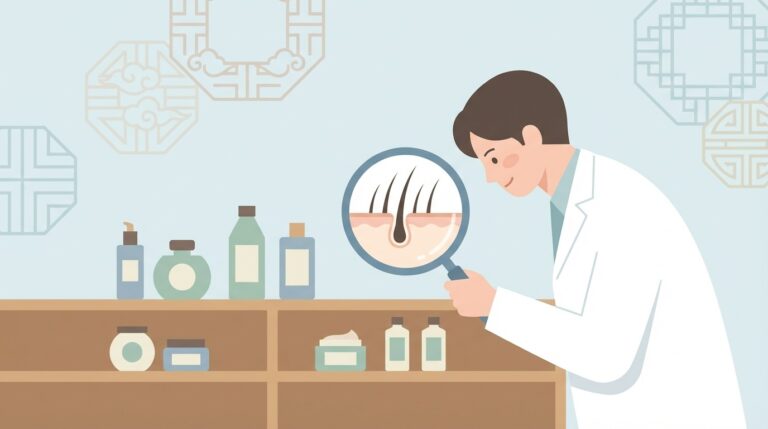
Phase 1: Empathy (The K-Culture Cold Open)
Hello! I’m your Daily Hangul Lead Editor.
Have you ever watched a K-Pop music video and wondered, “How on earth do their scalps survive after bleaching their hair platinum blonde, then neon pink, and back to black in a single month?” Meanwhile, you’re sitting in your Seoul apartment, looking at the shower drain, thinking the hard water is conspiring against your hairline.
Hair loss (탈모, talmo) is a deeply sensitive yet incredibly common concern in Korea. With over 10 million Koreans seeking some form of scalp care, it has spawned a massive sub-sector within K-Beauty and Korean medicine. Walking into an Olive Young, you are bombarded with walls of “anti-hair loss” shampoos. But when you finally muster the courage to visit a dermatologist in Gangnam, the medical vocabulary hits you like a brick wall.
At the C2 (Advanced) level, simply saying “My hair is falling out” isn’t enough. You need to navigate the nuances between cosmetic symptom alleviation and professional medical intervention, all while adhering to the unspoken social rules of discussing appearance in Korea. Let’s dive deep into the advanced vocabulary of Korean scalp care!
Phase 2: Core Expressions Deep Dive
1. 탈모 증상 완화 (기능성 화장품)
- Pronunciation: [tal-mo jeung-sang wan-hwa] → ‘wan-hwa’ sounds like a soft sigh of relief.
- Meaning: Alleviation of hair loss symptoms (Functional cosmetics).
- K-Culture Moment: You pick up a premium ginseng-infused shampoo. The label doesn’t say “cures hair loss” (which is illegal for cosmetics under Korean FDA rules). It strictly says “탈모 증상 완화” to indicate it helps mitigate the issue, not medically cure it.
- Editor’s Insight: This is crucial legal and marketing terminology in Korea. As an advanced speaker, understanding the difference between 완화 (alleviation/mitigation) and 치료 (cure/treatment) shows native-level comprehension of Korean consumer markets.
- Situation Spectrum:
- Reading labels/Talking to store clerks: ✅
- Explaining to a doctor what products you use: ✅
- Promising a friend this shampoo will “cure” their baldness: 🚫 (Legally and factually inaccurate!)
- 🤔 Think About It: Why does Korean law mandate such strict linguistic boundaries between cosmetics (화장품) and medicine (의약품)? How does this protect the highly beauty-conscious consumer?
2. 머리가 한 움큼씩 빠지다
- Pronunciation: [meo-ri-ga han um-keum-ssik ppa-ji-da] → ‘um-keum’ sounds like a heavy clump falling.
- Meaning: Hair is falling out in handfuls / clumps.
- K-Culture Moment: A character in a K-Drama is going through a horrific divorce or corporate bankruptcy. They run their hands through their hair out of sheer stress, and pull away a clump of hair. They stare at it in horror.
- Editor’s Insight: Koreans love vivid, quantifying imagery. Using “한 움큼” (a handful/clump) emphasizes the emotional distress of the physical symptom. It’s much more natural than clinically saying “탈모가 심합니다” (My hair loss is severe) when talking to a friend.
- Situation Spectrum:
- Casual with friends (Venting): ✅
- Describing symptoms to a doctor: ✅
- Small talk with a boss: 🚫 (TMI!)
- 🤔 Think About It: Does your native language use dramatic physical imagery to express stress-induced physical changes?
3. 모낭 주사나 모발 이식 상담을 받다
- Pronunciation: [mo-nang ju-sa-na mo-bal i-sik sang-dam-eul bat-da]
- Meaning: To receive a consultation for hair follicle injections or a hair transplant.
- K-Culture Moment: Over an iced Americano, your male friend casually mentions he’s taking a week off work. Not for a vacation to Jeju, but to recover from a “모발 이식” (hair transplant) he finally booked in Apgujeong.
- Editor’s Insight: Cosmetic procedures are highly normalized in Korea, but there’s a linguistic protocol. We rarely say “I am getting surgery” outright initially; we soften it by saying “I am getting a consultation (상담을 받다)” or “I’m looking into it (알아보고 있다)” to sound less impulsive.
- Situation Spectrum:
- Close friends: ✅
- Coworkers (if they are open about procedures): ⚠️
- Formal business settings: 🚫
- 🤔 Think About It: The word 상담 (consultation) is used for everything from mental health to plastic surgery in Korea. Why is “consulting an expert” so deeply embedded in Korean consumer habits?
Phase 3: Textbook vs. Real Korean
[Describing a Receding Hairline]
* 📖 Textbook Korean: 저는 이마에 탈모가 쥄증입니다. (I have hair loss on my forehead.)
* 🗣️ Real Korean: 저 요즘 M자(엠자) 탈모 즥행 중이라 완전 멘붕이에요. (My M-shaped hairline is progressing lately, I’m having a total mental breakdown.)
* 💡 Why the difference?: Koreans alphabetize physical traits (S-line, V-line). “M자” vividly and specifically describes male-pattern baldness at the temples.
[Asking for a Product Recommendation]
* 📖 Textbook Korean: 탈모 예방 샴푸를 추천해 주세요. (Please recommend a hair loss prevention shampoo.)
* 🗣️ Real Korean: 두피 열 내려주는 탈모 샴푸 중에 쿨링감 좋은 거 있나요? (Are there any hair loss shampoos that lower scalp heat and have a good cooling sensation?)
* 💡 Why the difference?: K-Beauty emphasizes the root cause. Traditional Korean medicine dictates that “scalp heat (두피 열)” from stress causes hair loss, so asking for a “cooling sensation (쿨링감)” shows you are an educated consumer.
Bottom Note: At the
C2level, using terms like “두피 열” (scalp heat) or “즥행 중” (in progress) elevates your Korean from a textbook learner to someone who truly understands the societal discourse around health and beauty.
Phase 4: Cultural Context — K-Culture Deep Dive
4-1. Non-verbal Elements & 눈치 (Nunchi)
In Korea, pointing out someone’s physical changes—like weight loss or a new haircut—is common. However, hair loss is the ultimate taboo. Unless the person brings it up first, staring at someone’s 정수리 (crown of the head) or casually mentioning that their hair looks “thinner today” is a massive breach of Nunchi. When discussing hair loss, it usually happens in a hushed, confessional tone between close friends, often accompanied by sharing links to specialized clinics.
4-2. K-Beauty & K-Travel Connection: The Head Spa Phenomenon
If you’ve watched K-Beauty vloggers recently, you’ll know that 두피 스케일링 (Scalp Scaling) and Head Spas have become massive tourist attractions in Seoul.
Korean dermatologists and salons treat the scalp exactly like facial skin. Just as you exfoliate your face, Koreans believe you must deeply cleanse the scalp follicles to prevent hair loss. Clinics utilize high-tech macro cameras to show you the sebum buildup in your follicles before and after the treatment. This medicalization of beauty means that “going to the clinic” isn’t just for sick people; it’s a routine preventative measure for maintaining youth and vitality.
Phase 5: Real-life Roleplay Scenario
Setting: A Friday evening at a bustling Olive Young near Gangnam Station. You are standing in front of the massive “Hair Care” aisle, overwhelmed by the options. Your Korean friend, Min-ji (29, a self-proclaimed K-Beauty guru who visits the dermatologist bi-weekly), is helping you.
Characters:
– YOU: An expat who has been noticing more hair in the drain lately, possibly due to stress or Seoul’s water.
– Min-ji: Supportive, straightforward, and highly knowledgeable about skincare and scalp care.
Dialogue:
YOU: 민지 씨, 저 요즘 스트레스 때문인지 머리가 한 움큼씩 빠준어요. 탈모 샴푸 좀 추천해 줄 수 있어요?
(Min-ji ssi, jeo yojeum seuteureseu ttaemuninji meorigahan umkeumssik ppajyeoyo. Talmo syampu jom chucheonhae jul su isseoyo?)
[Min-ji, lately, maybe because of stress, my hair is falling out in handfuls. Can you recommend a hair loss shampoo?]
Min-ji: 헐, 진짜요? 일단 두피 열부터 내려야 해요. 이 쿨링 샴푸가 탈모 증상 완화에는 제일 유명해요.
(Heol, jinjayo? Ildan dupi yeolbuteo naeryeoya haeyo. I kulling syampuga talmo jeungsang wanhwaeneun jeil yumyeonghaeyo.)
[Omg, really? First, you need to bring your scalp heat down. This cooling shampoo is the most famous for alleviating hair loss symptoms.]
(🎭 Stage Direction: Min-ji hands you a dark green bottle with a picture of ginseng on it.)
YOU: 아, 기능성 화장품이군요. 근대 샴푸만으로 효과가 있을까요?
(A, gineungseong hwajangpumigunyo. Geunde syampumaneuro hyogwaga isseulkkayo?)
[Ah, it’s a functional cosmetic. But will shampoo alone be effective?]
Min-ji: 솔직히 샴푸는 보조 수단일 뿐이에요. 심하면 피부과 가서 모낭 주사 상담 받아보는 게 어때요? 제가 다니는 병원 알려줄까요?
(Soljikhi syampuneun bojo sudanil ppunieyo. Simhamyeon pibugwa gaseo monang jusa sangdam badaboneun ge eottaeyo? Jega danineun byeongwon allyeojulkkayo?)
[Honestly, shampoo is just a supplementary measure. If it’s severe, how about going to a dermatologist and getting a consultation for follicle injections? Shall I tell you the clinic I go to?]
🔀 Your Turn! How do you respond to Min-ji?
– A) “아니요, 제 머리는 제가 알아서 할게요.” (No, I’ll take care of my own hair.)
– B) “와, 고마워요! 안 그래댄 전문적인 치료를 알아보려던 참이었어요.” (Wow, thanks! I was actually just about to look into professional treatments.)
– C) “모낭 주사? 그건 너무 오버 아니에요?” (Follicle injections? Isn’t that overkill?)✅ Best Choice: B — Reason: It shows gratitude and elegantly uses advanced C2 vocabulary (“전문적인 치료를 알아보려던 참이었다” – I was just in the middle of looking into professional treatments).
⚠️ Choice C Analysis: Calling cosmetic procedures “오버” (overkill/too much) can sound judgmental in Korea, where preventative dermatology is seen as standard self-care, not an extreme measure.
Bonus Scenario: Calling the Clinic
(You decide to call the dermatologist Min-ji recommended)
Receptionist: 안녕하세요, 오라클 피부과입니다.
YOU: 안녕하세요, 탈모 상담 때문에 전화드렸는데요. 초진인데 예약 가능한가요?
Receptionist: 네, 두피 쥄단과 원장님 상담 예약 도와드릴게요.
Phase 6: 10-Second Shadowing Drill
Speak like a true Seoulite giving advice to a friend. Pay attention to the pauses and the empathetic but firm tone.
😌 샴푸는 / 보조 수단일 뿐이고요, / 진짜 치료는 / 피부과에 / 가셔야 해요.
(syampuneun / bojo sudanil ppunigoyo, / jinjja chiryoneun / pibugwae / gasyeoya haeyo.)
Phase 7: K-Culture Mini Dictionary
| 한국어 | Romanization | English | Context / Nuance |
|---|---|---|---|
| 탈모 | talmo | Hair loss | The standard, clinical term for hair loss. |
| M자 탈모 | M-ja talmo | Receding hairline | Specifically refers to a hairline receding at the temples in an ‘M’ shape. |
| 정수리 | jeongsuri | Crown of the head | Often the focus of hair loss worries for women. |
| 두피 열 | dupi yeol | Scalp heat | A concept from Eastern medicine; heat rising to the scalp due to stress, believed to weaken follicles. |
| 모낭 주사 | monang jusa | Follicle injection | A popular clinic treatment involving injecting nutrients/medicine directly into the scalp. |
Phase 8: Traveler’s Survival Kit
Are you visiting Korea and want to experience the famous K-Beauty scalp care or buy some high-quality shampoos before your flight home? Here are your essential phrases.
🆘 Survival Phrase #1 (At Olive Young)
– 🇰🇷 “두피가 예민한데, 성분이 순한 탈모 샴푸 있나요?”
– 🗣️ (dupiga yeminhande, seongbuni sunhan talmo syampu innayo?)
– 📝 [My scalp is sensitive, do you have a hair loss shampoo with mild ingredients?]🆘 Survival Phrase #2 (At a Hair Salon or Head Spa)
– 🇰🇷 “두피 스케일링 받고 싶은데, 예약 없이도 가능한가요?”
– 🗣️ (dupi seukeilling batgo sipeunde, yeyak eopsido ganeunghangayo?)
– 📝 [I want to get scalp scaling, is it possible without a reservation?]📌 Editor’s Travel Note:
– Useful Apps: Use Gangnam Unni (강남언니) or Babit (바비톡) to check reviews and prices for dermatology clinics. Many now have English interfaces.
– Pharmacies (약국): You cannot buy prescription hair loss medication (like Propecia) over the counter in Korea. You MUST see a doctor first for a prescription (처방전).
Phase 9: Critical Thinking — A Step Deeper
Media vs Reality: The Medicalization of Beauty in Korea
When you watch K-Dramas or K-Pop performances, every star seems to have impeccably thick, voluminous hair, regardless of how often it’s dyed or styled. This media portrayal creates immense pressure on the general public. In Korea, “managing yourself” (자기관리) is seen as a reflection of your work ethic and character. Therefore, hair loss is rarely viewed merely as a natural aging process; it’s perceived as a “condition” that requires proactive, often medical, management. The line between cosmetic care and medical treatment is heavily blurred, driving the massive success of both “functional shampoos” and specialized scalp clinics.
🧠 Think Deeper: How does the media in your country portray hair loss? Is it something to be medically “treated,” gracefully accepted, or covered up?
💬 Your Turn: Share in the comments how your culture approaches hair loss and aging!
Phase 10: FAQ & Avoiding Common Mistakes
Q: Can I tell an older coworker that a certain shampoo is good for hair loss?
A: 🚫 NO. Do not bring up hair loss with elders, bosses, or acquaintances unless they explicitly ask you for advice. It touches on age, stress, and appearance—a risky trifecta in Korean hierarchy.
Q: Can I just walk into a dermatologist in Seoul for a scalp check?
A: Maybe. Popular clinics in Gangnam or Apgujeong are strictly by appointment (예약제). However, smaller neighborhood clinics (동네 피부과) often accept walk-ins (당일 접수), though you might wait a while.
❌ Common Mistake #1: Asking for “린스” (Rinse) expecting a deep treatment. In Korea, 린스 is just a basic surface conditioner. If your hair is damaged or falling out, you should ask for a 트리트먼트 (Treatment) or 헤어 팩 (Hair Pack).
❌ Common Mistake #2: Confusing 완치 (complete cure) with 완화 (alleviation). Never tell a Korean that a cosmetic product will “완치” their hair loss; it sounds like a scam (사기).
Phase 11: Summary & Action Items
One-Liner Summary: To discuss hair loss in Korea like a native C2 speaker, you must differentiate between cosmetic alleviation (완화) and professional medical intervention (치료), respecting the cultural sensitivity of the topic.
Action Mission:
– 🥉 Bronze (Solo): Look at the shampoo bottles in your bathroom. Imagine explaining their “기능” (functions) in Korean out loud.
– 🥈 Silver (Online): Go to a K-Beauty subreddit or forum and write a post recommending a product using the phrase “두피 열 내려주는 샴푸” (shampoo that lowers scalp heat).
– 🥇 Gold (Real World): Visit a Korean cosmetic store (or Olive Young if you’re in Korea) and ask a clerk: “성분이 순한 탈모 완화 샴푸 추천해 주세요.”
K-Culture Mission:
Go to Olive Young Global’s website (or the actual store) and search for “Scalp” or “Talmo.” Count how many products mention “완화” (Alleviation) in their Korean descriptions!
Phase 12: Interactive Quiz
1. Situational Judgment: Your close Korean friend sighs and says, “My M-shaped hairline is getting worse.” What is the most culturally appropriate C2-level response?
– A) 네가 나이가 들어서 그래. (It’s because you’re getting old.)
– B) 샴푸만 믿지 말고 피부과 상담 한 번 받아봐. (Don’t just trust shampoos, try getting a dermatologist consultation.)
– C) 맞아, 너 요즘 정수리가 비어 보여. (Right, your crown looks empty lately.)
2. Fill in the Blank:
이 샴푸는 탈모를 치료하는 약이 아니라, 탈모 증상 [ ________ ]에 도움을 주는 화장품입니다.
(Hint: The legal term for ‘alleviation’)
3. True or False – K-Culture Edition:
If you want to buy prescription hair loss pills in Korea, you can just ask the pharmacist at any local pharmacy without seeing a doctor. (T / F)
🗝️ Click to reveal answers!
- B – A and C are incredibly rude and lack Nunchi. B offers practical, culturally normalized advice.
- 완화 (wanhwa) – The crucial distinction between cosmetic and medical.
- False – You must consult a doctor (often a dermatologist) to get a prescription (처방전) for strong hair loss medication in Korea.
Frequently Asked Questions (FAQ)
Q: What does "탈모 증상 완화 (기능성 화장품)" mean in Korean and how do you pronounce it?
A: In Korean, "탈모 증상 완화 (기능성 화장품)" is pronounced [tal-mo jeung-sang wan-hwa] and means: Alleviation of hair loss symptoms (Functional cosmetics).
Q: What does "머리가 한 움큼씩 빠지다" mean in Korean and how do you pronounce it?
A: In Korean, "머리가 한 움큼씩 빠지다" is pronounced [meo-ri-ga han um-keum-ssik ppa-ji-da] and means: Hair is falling out in handfuls / clumps.
Q: What does "모낭 주사나 모발 이식 상담을 받다" mean in Korean and how do you pronounce it?
A: In Korean, "모낭 주사나 모발 이식 상담을 받다" is pronounced [mo-nang ju-sa-na mo-bal i-sik sang-dam-eul bat-da] and means: To receive a consultation for hair follicle injections or a hair transplant.







