

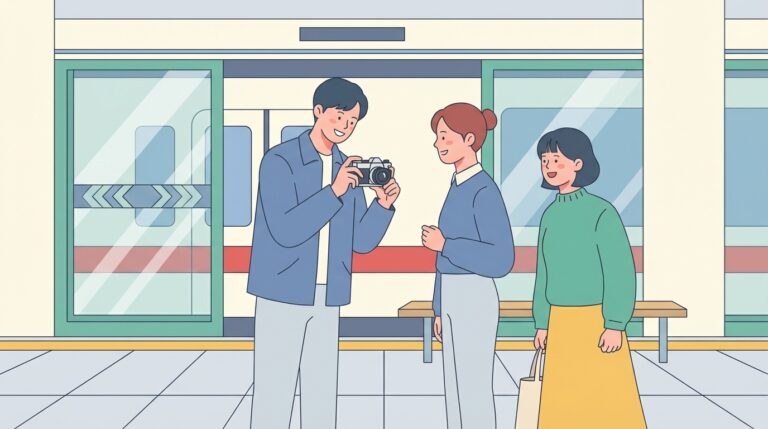
Phase 1: Empathy
Hello! I’m your Daily Hangul Editor.
Imagine this: You are standing near Exit 9 of Hongdae Station on a Friday evening. You have a tote bag over your shoulder and you are nervously checking your phone. Suddenly, a local approaches you, makes awkward eye contact, and cautiously asks… “Are you… Danggeun?”
No, they aren’t asking if you are a carrot! In Korea, Danggeun Market (당근마켓) is the absolute king of second-hand trading apps. From K-Pop photocards to vintage cameras, everyone uses it. But here is the tricky part: You finally meet the seller. They hand you the item. You need to check it for scratches, test if it works, or just look at it closely.
How do you ask to inspect the item without sounding rude or suspicious? In K-Dramas, business deals are sealed with a dramatic handshake, but in real life, standing outside a subway station, you need practical, polite Korean.
I’ve seen so many of my beginner students just nod, pay, and go home—only to find a scratch later because they were too shy to ask! Today, we are going to learn exactly how to check your second-hand items like a confident local.
Phase 2: Core Expressions Deep Dive
1. 한 번 봐도 될까요? (Can I take a look?)
- Pronunciation: han beon bwado doelkkayo? [han beon bwa-do dwel-kka-yo?]
- Tutor’s Tip: ‘dwel’ sounds like the word “dwell” but cut short.
- Meaning: Literal: “Can I look at it once?” / Real nuance: “May I inspect this item?”
- K-Culture Moment: You are buying a second-hand K-Pop lightstick. Before handing over the cash, you gently point at the box and use this phrase. It shows respect for the seller’s property before it officially becomes yours.
- Editor’s Insight: The phrase “한 번 (han beon – once)” is a magic softening word in Korean. You aren’t just saying “Can I look?” which sounds aggressive. You are saying “Can I just take one little look?” It makes everything sound softer and friendlier.
- Situation Spectrum:
- Casual/Friendly: ✅ (With friends, drop the ‘yo’: 한 번 봐도 돼?)
- Semi-formal (Strangers/Trading): ✅ (Perfect!)
- Formal: ⚠️ (A bit too casual for strict business meetings)
- 🤔 Think About It: Why do Koreans add “한 번 (once)” to so many requests? It reflects the cultural desire to not burden the other person. Does your native language have a “softening” word like this?
2. 작동 잘 돼요? (Does it work well?)
- Pronunciation: jakdong jal dwaeyo? [jak-dong jal dwae-yo?]
- Tutor’s Tip: ‘jak’ rhymes with ‘rock’, ‘dong’ rhymes with ‘song’.
- Meaning: Literal & Real nuance: “Does it operate/work well?”
- K-Culture Moment: You are buying a film camera from a seller in a convenience store parking lot. You press the shutter, but you want verbal confirmation that there are no hidden internal issues.
- Editor’s Insight: This is the ultimate practical question for any electronics or mechanical items. It is direct but perfectly polite because of the ‘-yo’ ending.
- Situation Spectrum:
- Casual: ✅
- Semi-formal: ✅
- Formal: 🚫 (Use ‘작동 잘 됩니까?’ instead)
- 🤔 Think About It: In Korea, if a seller lies about an item working well, they can be reported on the app and lose their “Manner Temperature” (매너온도 – a user rating system). How is trust built in online marketplaces in your country?
3. 여기 흠집이 있네요. (There is a scratch here.)
- Pronunciation: yeogi heumjibi inneyo. [yeo-gi heum-ji-bi in-ne-yo]
- Tutor’s Tip: For ‘heum’, make an ‘h’ sound, then make the disgusted ‘eu’ sound (like stepping in gum), then close your lips for ‘m’.
- Meaning: Literal: “There is a scratch here, I see.” / Real nuance: “I just noticed a scratch here.”
- K-Culture Moment: You are inspecting a photocard and see a slight bend. You don’t want to accuse the seller of tricking you. You simply state your observation gently.
- Editor’s Insight: The ending ‘~네요 (~neyo)’ is crucial here! If you say “흠집 있어요” (There is a scratch), it sounds like a complaint. “~네요” expresses mild surprise or a sudden realization. It sounds like “Oh, I just noticed there is a scratch,” which prevents the seller from getting defensive.
- Situation Spectrum:
- Casual: ✅
- Semi-formal: ✅
- Formal: ⚠️
- 🤔 Think About It: Notice how the Korean language uses verb endings to manage the other person’s feelings? This is a core part of Korean communication—avoiding direct confrontation.
Phase 3: Textbook vs. Real Korean
Let’s see how textbook Korean compares to the natural phrases used on the streets of Seoul!
[When asking to inspect the item]
* 📖 Textbook Korean: 이것을 확인하겠습니다. (I will check this.)
* 🗣️ Real Korean: 한 번 볼게요. (I’ll take a look.)
* 💡 Why the difference?: Textbook Korean sounds like a police officer inspecting evidence. “한 번 볼게요” is casual, polite, and completely natural for everyday transactions.
[When asking if there are any defects]
* 📖 Textbook Korean: 결함이 있습니까? (Are there defects?)
* 🗣️ Real Korean: 혹시 하자 있어요? (By any chance, are there any flaws?)
* 💡 Why the difference?: “결함 (defect)” is used for cars or factory machines. For second-hand goods (clothes, albums, small items), Koreans use the slang/everyday term “하자 (haja – flaw)”.
(Bottom Note: As an A2 learner, using “하자 (haja)” instead of “결함” will make you sound incredibly natural!)
Phase 4: Cultural Context — K-Culture Deep Dive
4-1. Non-verbal Nunchi (눈치) during Trading
When you are checking an item, Nunchi (눈치 – social awareness) is key. While inspecting the item, do not stare directly at the seller’s face for too long. Focus your eyes on the item, hold it carefully with two hands (this is very important to show respect), and keep your tone light. If you find a flaw, point to it gently, don’t shove it in their face!
4-2. The “Danggeun Market” Subculture
In Korea, direct second-hand trading (직거래 – Jik-geo-rae) is a huge part of daily life. Because Seoul is so dense and safe, meeting a stranger at a subway station to buy a used K-Pop album or a jacket is completely normal.
Sellers often pack items with extreme care. If you buy a K-Pop photocard, you might find it wrapped in bubble wrap, hard sleeves, and maybe they even included a small snack (덤 – deom, extra freebies) inside! It is a culture of high trust. But remember, once you say “Looks good!” and hand over the cash/transfer the money, the deal is done. That is why checking the item politely is your most important mission.
Phase 5: Real-life Roleplay Scenario
Setting: Saturday afternoon, Exit 2 of Hongdae Station. It’s crowded. You are meeting a local seller to buy a second-hand K-Pop album that is out of print. You have your cash ready.
Characters:
– YOU: A foreign K-Pop fan who really wants this album but wants to make sure the CD isn’t scratched.
– Minji (22): The Korean seller. She approaches you holding a small paper bag.
Dialogue:
Minji: 혹시… 당근이세요? 🥕
(hoksi… danggeuniseyo?)
[By any chance… are you Danggeun?]
YOU: 네! 안녕하세요.
(ne! annyeonghaseyo.)
[Yes! Hello.]
Minji: 네, 여기 앨범이요. 확인해 보세요.
(ne, yeogi aelbeomiyo. hwaginhae boseyo.)
[Yes, here is the album. Please check it.]
(🎭 Stage Direction: Minji hands you the bag with two hands)
🔀 Your Turn! How do you reply as you take out the album?
– A) “스크래치 있어요?” (Are there scratches?)
– B) “감사합니다. 한 번 봐도 될까요?” (Thank you. Can I take a look?)
– C) “확인하겠습니다. 기다리세요.” (I will check. Wait.)✅ Best Choice: B — Reason: It acknowledges her offering with “Thank you” and politely asks permission to inspect it.
⚠️ Choice A & C Analysis: ‘A’ sounds too suspicious right off the bat. ‘C’ sounds like a robot or a police officer giving an order!
(Assuming you chose B)
Minji: 네, 편하게 보세요!
(ne, pyeonhage boseyo!)
[Yes, take your time! (Lit: Please look comfortably!)]
YOU: (Looking at the CD) 오, 깨끗하네요.
(o, kkaekkeuthaneyo.)
[Oh, it’s clean (I see).]
Minji: 네, 거의 안 열어봤어요.
(ne, geoui an yeoreobwasseoyo.)
[Yes, I barely opened it.]
YOU: 계좌이체 해드릴게요. 감사합니다!
(gyejwaiche haedeurilgeyo. gamsahamnida!)
[I will do a bank transfer for you. Thank you!]
Phase 6: 10-Second Shadowing Drill
Read these out loud! Pay attention to the slashes for pausing and the emotion tags.
- 😊 (Politely) 감사합니다. / 한 번 / 봐도 될까요?
(gamsahamnida. / han beon / bwado doelkkayo?) - 🧐 (Curiously) 혹시 / 작동 / 잘 돼요?
(hoksi / jakdong / jal dwaeyo?) - 😢 (Softly/Cautiously) 앗, / 여기에 / 흠집이 있네요.
(at, / yeogie / heumjibi inneyo.)
Phase 7: K-Culture Mini Dictionary
| 한국어 | Romanization | English | Context |
|---|---|---|---|
| 당근마켓 | danggeun maket | Karrot Market | Korea’s most popular neighborhood-based second-hand trading app. |
| 직거래 | jikgeorae | Direct Trade | Meeting in person to trade, avoiding shipping fees and scams. |
| 하자 | haja | Flaw / Defect | A scratch, stain, or missing part on a second-hand item. |
| 네고 | nego | Negotiation | Konglish for “negotiation.” Asking for a discount. (e.g., “네고 되나요?”) |
| 잠수 타다 | jamsu tada | Ghosting | Literal: “To ride a submarine.” Used when a buyer/seller stops replying. |
Phase 8: Traveler’s Survival Kit
Even if you aren’t doing a second-hand trade, you will need these expressions when shopping in Korea!
🆘 Survival Phrases for Shopping & Checking
– 🇰🇷 “이거 입어봐도 돼요?” (igeo ibeobwado dwaeyo?)
– 🗣️ Meaning: Can I try this on? (For clothes)
– 📍 Where to use: Hongdae boutiques, underground shopping malls.
- 🇰🇷 “새 상품 있어요?” (sae sangpum isseoyo?)
- 🗣️ Meaning: Do you have a new one? (If the display item has a flaw)
- 📍 Where to use: Olive Young, Kakao Friends Store.
📌 Editor’s Travel Note
– Trying on clothes: In Korea, if you are trying on tops (like t-shirts or sweaters), store clerks will often hand you a “face cover” (페이스 커버) – a thin white hood. You must wear this to prevent makeup from staining the clothes!
– Haggling: You cannot haggle in department stores or retail shops. However, in traditional markets or second-hand trades, asking for a small “네고” (discount) is acceptable, but only after checking the item!
Phase 9: Critical Thinking Corner — “A Step Deeper”
Language & Power: The Safety of Politeness
🧠 Think Deeper:
When Koreans meet strangers for a second-hand trade, they strictly use Jondaetmal (polite language, ending in ~yo or ~mnida), even if the other person looks much younger. This polite language acts as a social buffer. It creates a “safe distance” that prevents the interaction from becoming too personal or disrespectful. By maintaining this polite linguistic boundary, both the buyer and seller feel safe conducting business on the street.💬 Your Turn: Does your language have a way to create a “safe, respectful distance” with strangers, or do you treat everyone like a friend immediately? Share your thoughts in the comments!
Phase 10: FAQ & Avoiding Misunderstandings
Q: If I find a scratch, can I just say “이거 안 좋아요 (This is bad)”?
No! That sounds very blunt and accusatory. Instead, point to the flaw and use the phrase we learned: “여기 흠집이 있네요” (Oh, there is a scratch here). Let the seller respond. Usually, they will apologize and offer a discount.
Q: Can I ask for a discount before checking the item?
It’s considered bad manners (비매너 – bad manner) to ask for a huge discount online before you even see the item. Check the item first in person, and if there is a valid reason (like a small flaw), then ask for a small discount politely.
❌ Common Mistake #1: Staring at the seller with an angry face while checking the item.
✅ Do this instead: Smile slightly, look closely at the item, and say “한 번 볼게요” (I’ll take a look). Keep the mood light!
Phase 11: Summary & Action Items
- One-Liner Summary: Remember to soften your requests with “한 번 (once)” and use “~네요” to point out flaws politely without causing offense.
-
Action Mission 3 Steps:
- 🥉 Bronze (Solo): Stand in front of a mirror holding an object and practice saying “한 번 봐도 될까요?” with a polite smile.
- 🥈 Silver (Online): Leave a comment below telling us what K-Pop merch or Korean item you want to buy second-hand!
- 🥇 Gold (Real Life): Next time you are in a Korean store, use “한 번 봐도 될까요?” before touching a display item.
- K-Culture Mission: Go to YouTube and search “당근마켓 브이로그” (Danggeun Market Vlog). Watch how actual Koreans meet up, hand over the items, and say goodbye. You will hear our core expressions!
Engage with us! Have you ever bought something second-hand in a foreign country? How did you check the item? Tell me your story below! 👇
Phase 12: Quiz — Interactive Challenge
1. Situational Judgment: You are buying a used laptop. You want to ask the seller if the keyboard works perfectly. What is the most natural way to ask?
– A) 키보드 완벽합니까?
– B) 혹시 키보드 작동 잘 돼요?
– C) 키보드 하자 찾아볼게요.
2. True or False – K-Culture Edition:
– In Korea, it is normal and safe to meet a stranger at a subway station to trade second-hand items. (True / False)
3. Fill in the Blank:
You notice a small stain on a jacket you are buying.
“앗, 여기에 얼룩이 _____”. (Oh, I see there is a stain here.)
(Hint: Use the soft realization ending!)
🚨 Click here for the answers!
1. B (Adding ‘혹시’ makes it very polite, and ‘작동 잘 돼요?’ is the perfect practical phrase.)
2. True (Thanks to CCTVs and a high-trust culture, this is exactly how millions of Koreans trade daily!)
3. 있네요 (in-ne-yo. This points out the stain gently without sounding like an attack.)
Frequently Asked Questions (FAQ)
Q: What does "한 번 봐도 될까요? (Can I take a look?)" mean in Korean and how do you pronounce it?
A: In Korean, "한 번 봐도 될까요? (Can I take a look?)" is pronounced [han beon bwado doelkkayo? [han beon bwa-do dwel-kka-yo?] and means: a key conversational Korean expression covered in this lesson.
Q: What does "작동 잘 돼요? (Does it work well?)" mean in Korean and how do you pronounce it?
A: In Korean, "작동 잘 돼요? (Does it work well?)" is pronounced [jakdong jal dwaeyo? [jak-dong jal dwae-yo?] and means: a key conversational Korean expression covered in this lesson.
Q: What does "여기 흠집이 있네요. (There is a scratch here.)" mean in Korean and how do you pronounce it?
A: In Korean, "여기 흠집이 있네요. (There is a scratch here.)" is pronounced [yeogi heumjibi inneyo. [yeo-gi heum-ji-bi in-ne-yo] and means: a key conversational Korean expression covered in this lesson.






