

Hello! I’m the lead editor of Daily Hangul.
Imagine this: It’s mid-July in Seoul. The temperature hits 35°C (95°F), and the humidity is a suffocating 80%. You step outside, feeling like a melting ice cream cone. Suddenly, your Korean coworker grabs your arm and cheerfully says, “Let’s go get some boiling hot chicken soup for lunch!”
You might think, “Are they crazy? Soup? Now?” But as you arrive at the restaurant, you see a line of hundreds of people sweating and waiting patiently under the blazing sun.
Welcome to Boknal (복날)—the three hottest days of the Korean summer.
If you don’t understand this culture, you’ll be the confused tourist eating a cold sandwich while everyone else is restoring their energy. But if you know why Koreans do this—and exactly what to say when that boiling stone pot is placed in front of you—you’ll instantly earn the respect of any local. Let’s dive into the fiery, sweaty, and delicious world of the Korean summer!
(Note: This guide is based on real questions from our Daily Hangul students who survived their first Korean summer!)
Phase 2: Core Expressions for the Summer Heat
Here are the absolute must-know expressions to sound like a true local during Boknal.
1. 이열치열 (Fighting fire with fire)
- Pronunciation: i-yeol-chi-yeol [Sounds like: ee-yull-chee-yull]
- Meaning: Literally “Controlling heat with heat.”
- K-Culture Moment: You’ll hear this everywhere in summer. When characters in K-Dramas are sweating profusely over a spicy stew in a pojangmacha (tent bar), they’ll wipe their forehead, smile, and say “Iyeolchiyeol!” It’s the ultimate Korean summer philosophy.
- Editor’s Insight: This isn’t just a word; it’s a mindset. It means embracing the heat, sweating it out, and feeling refreshed afterward.
- Situation Spectrum:
- Casual (Friends): ✅
- Semi-formal (Coworkers): ✅
- Formal (Boss/Elders): ✅ (It’s a traditional four-character idiom, so older people love it!)
- 🤔 Think About It: Why do you think traditional Korean medicine believes that eating hot food and sweating helps cool your body down? Does your culture have a similar “fight fire with fire” concept?
2. 몸보신하다 (To restore one’s health/stamina)
- Pronunciation: mom-bo-sin-ha-da [Sounds like: mome-bo-sheen-ha-da]
- Meaning: To eat highly nutritious food to regain energy.
- K-Culture Moment: If you’re on a fan app like Weverse or Bubble, your favorite K-Pop idol will definitely post a message in July saying: “Did our fans eat Samgyetang today? Make sure to mombosin-hae!”
- Editor’s Insight: In Korea, food is medicine. When you are tired from working or studying, you don’t just rest—you “mombosin” with good food.
- Situation Spectrum:
- Casual (Friends): ✅
- Semi-formal (Coworkers): ✅
- Formal (Boss/Elders): ✅
- 🤔 Think About It: Koreans often equate taking care of someone’s health with feeding them. How does your culture show care for someone who is exhausted?
3. 국물이 끝내줘요 (The broth is amazing/killer)
- Pronunciation: gung-mu-ri kkeun-nae-jwo-yo [Sounds like: goong-moo-ree kkeun-nay-jwo-yo]
- Meaning: The soup/broth is incredibly delicious.
- K-Culture Moment: Picture a middle-aged Korean man (Ahjussi) taking a sip of boiling soup. He closes his eyes, lets out a loud “Kkyaaaa~” (캬~), and says this line. It’s a classic TV commercial phrase that became a national catchphrase.
- Editor’s Insight: Use this phrase at a company lunch, and your Korean boss will probably buy you a coffee afterward. It shows you really feel the taste of Korean soul food.
- Situation Spectrum:
- Casual (Friends): ✅
- Semi-formal (Coworkers): ⚠️ (Good for a casual team lunch, but maybe not in a very strict boardroom)
- Formal (Boss/Elders): 🚫 (A bit too casual for a highly formal meeting)
- 🤔 Think About It: Why do Koreans prioritize the “broth” (국물) so much over the solid ingredients in a soup?
Phase 3: Textbook vs. Real Korean
Let’s upgrade your textbook Korean to what you’ll actually hear on the streets of Hongdae or Gangnam.
[Situation 1: Inviting someone for Samgyetang]
* 📖 Textbook: 우리 삼계탕 먹으러 갈까요? (Shall we go eat Samgyetang?)
* 🗣️ Real Korean: 오늘 중복인데, 삼계탕 콜? (It’s Jungbok today, Samgyetang, call?)
* 💡 Why the difference?: “콜” (Call) is the ultimate casual agreement word borrowed from poker. Koreans love fast, efficient communication, especially when deciding what to eat for lunch!
[Situation 2: Expressing how hot the weather is]
* 📖 Textbook: 날씨가 아주 덥습니다. (The weather is very hot.)
* 🗣️ Real Korean: 아, 오늘 진짜 쪄 죽겠다. (Ah, I’m going to steam to death today.)
* 💡 Why the difference?: Koreans love hyperbole. Adding “~죽겠다” (I’m going to die from ~) to the end of verbs is the most natural way to express extreme physical states (starving to death, full to death, hot to death).
Bottom Note: For B1 learners, using “~죽겠다” with close friends or friendly coworkers shows you’ve really grasped the Korean emotional vibe, but avoid it in professional emails!
Phase 4: Cultural Context — K-Culture Deep Dive
4-1. The Non-Verbal “Nunchi” of Samgyetang
Eating Samgyetang with coworkers requires a bit of Nunchi (눈치 – the art of reading the room). When the side dishes (especially radish kimchi called Kkakdugi) arrive, the youngest or lowest-ranking person usually grabs the scissors to cut the kimchi into bite-sized pieces for the table. Also, sweating profusely while eating is completely acceptable! Don’t feel embarrassed; just keep dabbing your face with a tissue.
4-2. The K-Pop Connection: Idol Fan Service
Boknal is a massive event in the K-Pop fandom world. Idols use this day to show their affection for fans. You’ll see countless posts on X (Twitter) or fan cafes saying, “우기야 (Our babies), it’s Chobok today! Eat something warm and stay strong!” Fans also organize food support (밥차) for their idols’ filming sets during this time. Knowing the word mombosin will help you write the perfect fan letter in July!
Phase 5: Real-Life Roleplay Scenario
Setting: Friday, 12:00 PM. Outside a famous Samgyetang restaurant near Gyeongbokgung Palace. The sun is beaming down at 34°C. You are standing in a long line with your Korean coworker, Minsu.
Characters:
– YOU: A foreign employee in Korea, experiencing your first Boknal.
– Minsu (32): Your friendly Korean coworker who acts as your local food guide.
Dialogue:
Minsu: 와, 오늘 진짜 쪄 죽겠네요. 사람 엄청 많다!
(Wa, oneul jinjja jjyeo jukgenneyo. Saram eomcheong manta!)
[Wow, I’m going to steam to death today. There are so many people!]
YOU: 그러게요. 왜 이렇게 더운 날 뜨거운 걸 먹어요?
(Geureogeyo. Wae ireoke deoun nal tteugeoun geol meogeoyo?)
[I know, right. Why do people eat hot things on such a hot day?]
Minsu: 에이, 한국은 이열치열이죠! 땀 쫙 빼면 시원해요.
(Ei, hangugeun iyeolchiyeorijyo! Ttam jjak ppaemyeon siwonhaeyo.)
[Hey, in Korea, it’s ‘fighting fire with fire’! If you sweat it all out, it feels refreshing.]
(🎭 Stage Direction: After 30 minutes, you sit down. The boiling Ttukbaegi (stone pot) arrives, bubbling aggressively.)
Minsu: 자, 몸보신합시다! 국물 먼저 드셔보세요. 어때요?
(Ja, mombosinhapsida! Gungmul meonjeo deusyeoboseyo. Eottaeyo?)
[Alright, let’s restore our energy! Try the broth first. How is it?]
🔀 Your Turn! How should you respond?
– A) “너무 뜨거워서 맛없어요.” (It’s too hot, so it tastes bad.)
– B) “캬~ 국물이 진짜 시원하네요! 끝내줘요!” (Kkya~ The broth is so refreshing! It’s killer!)
– C) “아우 뜨거워! 얼음 좀 주세요!” (Ouch, hot! Give me some ice!)✅ Best Choice: B — Saying hot soup is “시원하다” (refreshing/cool) is the ultimate Korean paradox. It means it clears your stomach and relieves fatigue. Say this, and Minsu will treat you like a true Korean.
⚠️ Choice C Analysis: Putting ice in Samgyetang is considered a culinary crime in Korea!
🌟 Bonus K-Culture Scenario: Idol Live Stream
Imagine your favorite K-Pop idol turns on a live stream while eating a chicken leg.
Idol: 여러분, 오늘 초복인데 다들 삼계탕 챙겨 먹었어요?
(Yeoreobun, oneul choboginde dadeul samgyetang chaenggyeo meogeosseoyo?)
[Everyone, it’s Chobok today, did you all make sure to eat Samgyetang?]
You (Typing in the chat): 오빠도 몸보신 제대로 하세요! 이열치열 화이팅!
(Oppado mombosin jedaero haseyo! Iyeolchiyeol hwaiting!)
[Make sure you properly restore your energy too, oppa! Fight fire with fire, fighting!]
Idol (Reading your comment): 오, 이열치열! 우리 팬들 한국어 진짜 잘하네!
[Oh, Iyeolchiyeol! Our fans are really good at Korean!]
Phase 6: 10-Second Shadowing Drill
Practice speaking like a local. Pay attention to the pauses (/) and the prolonged syllables (~).
😤 (Like an Ahjussi who just tasted the best soup in his life)
캬~ / 국물이 / 진~~짜 / 끝내줘요!
(Kkya~ / gungmuri / jin~~jja / kkeunnaejwoyo!)
Phase 7: K-Culture Mini Dictionary
| Korean | Romanization | English | Cultural Context |
|---|---|---|---|
| 복날 | Boknal | Dog days of summer | The three hottest days of the year (Chobok, Jungbok, Malbok) spanning July to August. |
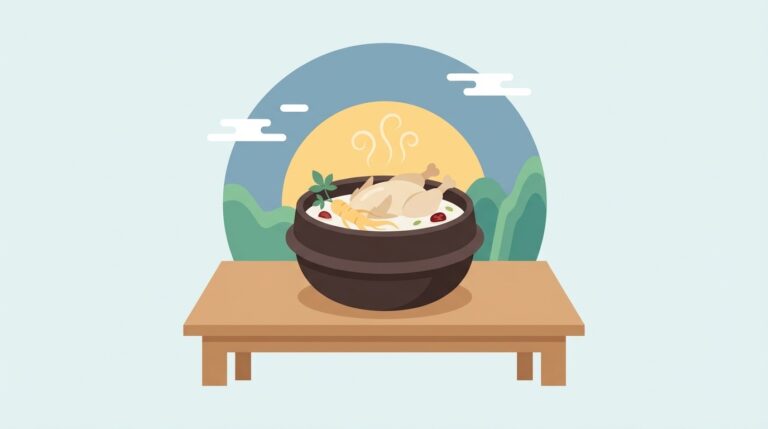
| 삼계탕 | Samgyetang | Ginseng chicken soup | A whole young chicken stuffed with sticky rice, ginseng, jujube, and garlic, boiled in a stone pot. |
| 뚝배기 | Ttukbaegi | Earthenware pot | The black bowl that keeps Korean soups boiling hot long after being removed from the stove. |
| 눈치 | nunchi | Social sense/tact | The unspoken Korean art of reading the room—like knowing when to pour water for others at the table. |
| 몸보신 | mombosin | Stamina restoration | Eating highly nutritious (often traditional) foods to recover from exhaustion. |
Phase 8: Traveler’s Survival Kit (Restaurant Edition)
If you’re traveling to Korea in the summer, going to a Samgyetang restaurant is mandatory. Here are the survival phrases you need when the place is packed and chaotic.
🆘 Survival Phrase #1: Asking for a bone bowl
– 🇰🇷 “여기요! 뼈 통 좀 주세요.” (Yeogiyo! Ppyeo tong jom juseyo.)
– 🗣️ Sound-alike: Yuh-gee-yo! Ppyuh tong jome joo-say-yo.
– 📍 Where to use: You need a place to spit out the tiny chicken bones. Usually, there’s a metal bucket on the table.🆘 Survival Phrase #2: Asking for a small plate
– 🇰🇷 “앞접시 하나만 부탁드려요.” (Apjeopsi hanaman butakdeuryeoyo.)
– 🗣️ Sound-alike: Ap-jeop-she ha-na-man boo-tak-deu-ryuh-yo.
– 📍 Where to use: The soup is boiling! You need a small plate to transfer the chicken to cool it down before eating.🆘 Survival Phrase #3: Getting more Kimchi
– 🇰🇷 “깍두기 좀 더 주실 수 있나요?” (Kkakdugi jom deo jusil su innayo?)
– 🗣️ Sound-alike: Kkak-doo-gee jome duh joo-shil soo een-na-yo?
– 📍 Where to use: Radish kimchi is the soulmate of Samgyetang. You will need refills.📌 Editor’s Travel Note:
– Table setup: Look under the table! Most Korean restaurants have a hidden drawer containing your spoon, chopsticks, and napkins.
– Tipping: DO NOT tip your server. There is zero tipping culture in Korea. Just pay at the counter near the exit on your way out.
Phase 9: Critical Thinking Corner — “A Step Deeper”
Food & Identity: The “Jeong” (정) in Korean Soup Culture
Why is food so deeply connected to Korean identity and social bonds? In Korea, you rarely eat alone. Meals, especially stamina foods like Samgyetang, are shared experiences. While Samgyetang is served in individual pots, the side dishes are placed in the center of the table for everyone to share.
Historically, surviving the brutal summer required collective effort. Asking “Did you eat?” (밥 먹었어?) is actually the most common way to say “How are you?” in Korean. By taking coworkers or loved ones to eat Samgyetang on Boknal, Koreans are saying, “I care about your health, and I want us to survive this harsh season together.” It’s a culinary expression of Jeong (정)—the deep, invisible bond of affection and community.
💬 Your Turn: How do people in your culture show they care about someone’s physical health through food? Let us know in the comments!
Phase 10: FAQ & Avoiding Misunderstandings
Q: Do I have to eat the whole ginseng root inside the chicken?
A: No! Many locals actually leave the ginseng behind. The flavor and nutrients have already seeped into the broth, so don’t force yourself to eat the bitter root if you don’t like it.
Q: Can I drink iced coffee after eating Samgyetang?
A: YES! In fact, going to a cafe for an Iced Americano immediately after sweating over Samgyetang is the ultimate modern Korean ritual. We call it “Eol-juk-ah” (얼죽아 – Iced Americano even if I freeze to death).
❌ Common Mistake: Pouring cold water into the boiling Ttukbaegi to cool it down.
✅ Do This Instead: This will ruin the deep flavor of the broth! Instead, ask for an “앞접시” (apjeopsi – small plate), take out the meat, and let it cool there.
Phase 11: Summary & Action Items
One-Liner Summary: To survive the Korean summer, embrace Iyeolchiyeol (fight fire with fire) and eat a boiling bowl of Samgyetang to mombosin (restore your stamina)!
Action Mission:
– 🥉 Bronze (Solo): Stand in front of a mirror and passionately say “국물이 끝내줘요!” with an Ahjussi sound (캬~).
– 🥈 Silver (Online): Post a picture of your next hot meal on social media with the hashtag #이열치열.
– 🥇 Gold (Real World): Visit a Korean restaurant, order a hot soup, and ask for a small plate using “앞접시 좀 주세요.”
K-Culture Mission:
Check your favorite K-Pop group’s social media accounts around mid-July to mid-August. Search for the keyword “삼계탕” (Samgyetang) or “초복” (Chobok). You’ll be amazed at how many idols post about it!
Phase 12: Interactive Quiz
Test your Boknal survival skills!
1. You are eating boiling soup and want to compliment the taste to your Korean boss. Which phrase is BEST?
A) 아, 진짜 쪄 죽겠네요! (Ah, I’m going to steam to death!)
B) 국물이 진짜 시원하네요! (The broth is really refreshing!)
C) 이 뚝배기 얼마예요? (How much is this earthenware pot?)
2. Fill in the blank: Koreans believe in the philosophy of __________, which means fighting the summer heat by eating hot food and sweating.
A) Mombosin (몸보신)
B) Nunchi (눈치)
C) Iyeolchiyeol (이열치열)
3. True or False: In a traditional Korean restaurant, you should leave a 10% tip on the table if the service was good.
(Scroll down for answers!)
Click to see Answers
1. B – Calling hot soup “시원하다” (refreshing) shows you truly understand Korean taste profiles. A is for complaining about the weather, and C is just asking for the price of the bowl!
2. C – Iyeolchiyeol! (Mombosin is the act of restoring health).
3. False – Tipping is not practiced in Korea and will likely cause confusion. The staff might chase you down the street thinking you forgot your change!
Frequently Asked Questions (FAQ)
Q: What does "이열치열 (Fighting fire with fire)" mean in Korean and how do you pronounce it?
A: In Korean, "이열치열 (Fighting fire with fire)" is pronounced [i-yeol-chi-yeol [Sounds like: ee-yull-chee-yull] and means: Literally "Controlling heat with heat."
Q: What does "몸보신하다 (To restore one's health/stamina)" mean in Korean and how do you pronounce it?
A: In Korean, "몸보신하다 (To restore one's health/stamina)" is pronounced [mom-bo-sin-ha-da [Sounds like: mome-bo-sheen-ha-da] and means: To eat highly nutritious food to regain energy.
Q: What does "국물이 끝내줘요 (The broth is amazing/killer)" mean in Korean and how do you pronounce it?
A: In Korean, "국물이 끝내줘요 (The broth is amazing/killer)" is pronounced [gung-mu-ri kkeun-nae-jwo-yo [Sounds like: goong-moo-ree kkeun-nay-jwo-yo] and means: The soup/broth is incredibly delicious.







