

Phase 1: Empathy & Immersion
Hello there! I’m your lead editor at Daily Hangul.
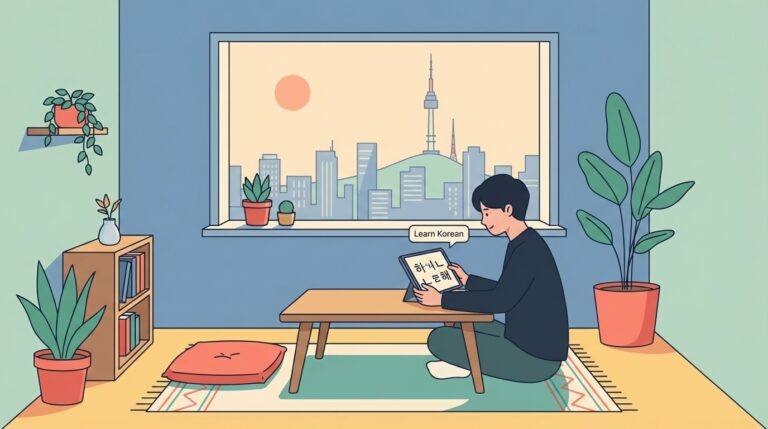
You’ve seen this scene in at least a dozen K-Dramas: The hard-working protagonist comes home to their tiny rooftop room (Oktapbang), sighs deeply at a stack of utility bills, and eats a solitary bowl of ramen. It’s romanticized on screen, but real life in a Seoul One-room (studio apartment) can be tough, especially when you’re navigating it alone.
But here’s the insider secret the dramas rarely show: The Korean government actually has an extensive list of 1인 가구 지원 정책 (Support Policies for Single-Person Households). As Korea rapidly shifts from large family units to solo living, local community centers are handing out rent subsidies, installing smart home security for single women, and even organizing social cooking classes for solo dwellers.
If you’re an expat, an exchange student, or a working professional living alone in Korea, knowing how to talk about these policies isn’t just about passing a TOPIK exam—it’s about survival, saving money, and understanding a massive cultural shift in modern Korean society. Let’s dive in!
Phase 2: Core Expressions Deep Dive
1. 1인 가구 (Single-person household)
- Pronunciation: [il-in gagu] Sound-alike: “Eel-in gah-goo”
- Meaning: Single-person household (Literal: 1-person family unit)
- K-Culture Moment: You’ll hear this constantly on Korean news channels or real estate YouTube channels. While dramas focus on the romance of living alone, the news focuses on the rise of 1-in gagu.
- Editor’s Insight: This sounds a bit administrative. In casual conversation, people usually say “저 자취해요” (I live independently/rent my own place), but when looking for government benefits, “1인 가구” is the magic keyword.
- Situation Spectrum:
- Friends (Casual): ⚠️ (Too formal, use ‘자취해’)
- Co-workers (Semi-formal): ✅
- Government/Official (Formal): ✅✅
- 🤔 Think About It: Why use the word 가구 (household/family unit) for just one person? Does this reflect how Korean society traditionally views individuals merely as parts of a family structure?
2. 청년 월세 지원 (Youth rent subsidy)
- Pronunciation: [cheongnyeon wolse jiwon] Sound-alike: “Chung-nyun wool-seh jee-won”
- Meaning: Youth monthly rent support.
- K-Culture Moment: Remember the drama Itaewon Class or Fight for My Way? The struggle to pay Wolse (monthly rent) is a universal youth experience in Korea. This is a real policy helping young adults pay their rent.
- Editor’s Insight: If you’re under 34 and living in Korea on certain visas, you might actually be eligible for this! It’s a hot topic among university students grabbing coffee in Sinchon.
- Situation Spectrum:
- Friends (Casual): ✅ (“너 월세 지원 신청했어?”)
- Community Center (Formal): ✅
- 🤔 Think About It: Korea has a unique housing deposit system called Jeonse (huge lump sum, no rent). How does the shift to Wolse (monthly rent) change the economic reality for young Koreans?
3. 안심 귀가 서비스 (Safe return home service)
- Pronunciation: [ansim gwiga seobiseu] Sound-alike: “Ahn-shim gwee-gah suh-bee-seu”
- Meaning: Safe return home service (A policy where local guards walk you home from the bus stop/subway at night).
- K-Culture Moment: Thriller K-dramas often feature creepy dark alleys. Real-life Seoul is generally very safe, but for single individuals (especially women) living in quieter neighborhoods, local districts provide this free escort service.
- Editor’s Insight: Ansim means “peace of mind.” You’ll see this word attached to many single-household policies, like “안심 택배” (Safe delivery lockers for solo dwellers who are at work all day).
- Situation Spectrum:
- Daily life/Apps: ✅
Phase 3: Textbook vs. Real Korean
[Situation 1: Explaining you live alone]
* 📖 Textbook Korean: 저는 혼자 삽니다. (I live alone.)
* 🗣️ Real Korean: 저 자취해요. (I live on my own.) OR 저 혼족이에요. (I’m a solo-triber.)
* 💡 Why the difference?: Jachwi implies you moved out of your parents’ house and are renting. Honjok is a modern slang term showing pride in the independent, solo lifestyle.
[Situation 2: Asking a friend about subsidies]
* 📖 Textbook Korean: 정부의 1인 가구 지원금을 받았습니까? (Did you receive the government’s single household subsidy?)
* 🗣️ Real Korean: 야, 너 청년 지원금 신청했어? (Hey, did you apply for the youth subsidy?)
* 💡 Why the difference?: Between friends, specifying “government 1-person household” is way too clunky. Dropping formal markers and getting straight to the point is key.
(Bottom Note: As B2 learners, using terms like 자취해요 or 지원금 신청 over textbook phrasing instantly makes you sound like a local who understands the system!)
Phase 4: Cultural Context — K-Culture Deep Dive
4-1. Non-verbal Cue: The Community Center “Nunchi”
When you visit a 주민센터 (Community Service Center) to ask about 1인 가구 지원 정책, body language matters. Always hand over your ARC (Alien Registration Card) with two hands. Even if you are frustrated with the bureaucracy, maintain a polite, slightly lowered gaze when the official explains the rules. Reading the room (Nunchi) and showing patience will often make the clerk go out of their way to find loopholes or extra benefits for you!
4-2. K-Food Connection: The Rise of “Honbap” (혼밥)
Traditionally, Korean food is meant to be shared. Stews come in massive pots, and Korean BBQ requires a minimum order of two portions. But as 1인 가구 skyrockets, the food industry has totally pivoted.
Enter Honbap (혼밥 – eating alone). You’ll now find single-seat bossam (pork belly) restaurants, 1-person delivery minimums on apps like Baemin, and convenience stores packed with high-quality single-serving meal kits. Understanding single household policies goes hand-in-hand with understanding how the Korean dinner table has literally shrunk to accommodate the solo dweller.
Phase 5: Practical Roleplay Scenario
Scenario A: The Quest for the Rent Subsidy
Setting: A Tuesday afternoon at the local 주민센터 (Community Center) in Mapo-gu. You’ve taken a half-day off work to see if you qualify for the youth rent subsidy.
Characters:
– YOU: A B2-level expat working/studying in Seoul, renting a small studio.
– 지훈 (Ji-hoon): A polite but slightly stressed civil servant (공무원) behind desk #3.
Dialogue:
지훈: 어떻게 오셨어요? 📄
(Eotteoke osyeosseoyo?)
[How can I help you / What brings you here?]
YOU: 안녕하세요, 1인 가구 청년 월세 지원 정책 때문에 왔는데요.
(Annyeonghaseyo, il-in gagu cheongnyeon wolse jiwon jeongchaek ttaemune wanneundeyo.)
[Hello, I came because of the single-person household youth rent subsidy policy.]
지훈: 아, 네. 신분증이랑 임대차 계약서 가져오셨나요?
(A, ne. Sinbunjeung-irang imdaecha gyeyakseo gajyeoosyeonnayo?)
[Ah, yes. Did you bring your ID and lease agreement?]
YOU: 네, 여기 있습니다. 외국인도 신청 가능한가요?
(Ne, yeogi itseumnida. Oegugindo sincheong ganeunghangayo?)
[Yes, here they are. Can foreigners apply too?]
지훈: 비자 종류에 따라 다른데… F-2나 F-5 비자이신가요?
(Bija jongnyue ttara dareunde… F-2-na F-5 bijaisingayo?)
[It depends on your visa type… Are you on an F-2 or F-5 visa?]
🔀 Your Turn! How do you respond?
– A) “아니요, D-2 비자입니다. 안 되나요?” (Honest and direct)
– B) “무슨 소리예요? 외국인은 다 줘야죠!” (Aggressive and entitled)
– C) “대박! 저 F-2예요! 폼 미쳤다!” (Too much slang)✅ Best Choice: A — Reason: Bureaucracy requires straightforward honesty. If you don’t qualify, they might introduce another policy you DO qualify for.
⚠️ Choice C Analysis: “대박” (Jackpot) and “폼 미쳤다” (Insane form/Crazy good) are fun slang among friends, but wildly inappropriate to say to a government worker!
지훈 (Assuming Choice A): 아, 아쉽게도 D-2 비자는 월세 지원은 어려워요. 대신 ‘1인 가구 안심 홈세트’는 신청하실 수 있어요.
(A, aswipgedo D-2 bijaneun wolse jiwoneun eoryeowoyo. Daesin ‘il-in gagu ansim homseteuneun’ sincheonghasil su isseoyo.)
[Ah, unfortunately, rent subsidy is difficult for D-2 visas. Instead, you can apply for the ‘Single Household Safe Home Set’.]
YOU: 안심 홈세트요? 그게 뭐예요?
(Ansim homseteyo? Geuge mwoyeyo?)
[Safe Home Set? What is that?]
지훈: 현관문 이중 잠금장치나 스마트 초인종을 무료로 설치해 드리는 정책입니다.
(Hyeongwanmun ijung jamgeumjangchina seumateu choinjong-eul muryoro seolchihae deurineun jeongchaegimnida.)
[It’s a policy where we install double locks or smart doorbells for free.]
YOU: 아, 그런 것도 있군요! 그럼 그걸로 신청할게요. 감사합니다!
(A, geureon geotdo itgunyo! Geureom geugeollo sincheonghalgeyo. Gamsahamnida!)
[Ah, there’s such a thing! Then I’ll apply for that. Thank you!]
Phase 6: 10-Second Shadowing Drill
Let’s practice asking about a policy. Read this out loud, focusing on the breaks and intonation!
😊 저기요, / 혹시 / 1인 가구 지원금 신청은 / 어떻게 해야 돼요?
(jeogiyo, / hoksi / il-in gagu jiwongeum sincheong-eun / eotteoke haeya dwaeyo?)
Pro-tip: Raise your pitch slightly at the end to sound polite and inquisitive. Don’t rush it; the pauses (/) make you sound much more natural than speaking in one breathless run!
Phase 7: K-Culture Mini-Dictionary
| Korean | Romanization | English | Contextual Meaning |
|---|---|---|---|
| 자취(하다) | jachwi(hada) | Living independently | Specifically refers to young people renting their own place away from family. |
| 원룸 | won-rum | One-room / Studio | A typical studio apartment. The main housing type for single households. |
| 관리비 | gwallibi | Maintenance fee | A crucial monthly expense outside of rent. Often a shock to first-time renters! |
| 혼술 | honsul | Drinking alone | A portmanteau of 혼자 (alone) and 술 (alcohol). A major trend for single households after work. |
| 주민센터 | jumin senteo | Community Center | The local government office where you register your address and apply for support policies. |
Phase 8: Traveler/Expat Survival Kit
Even if you’re not a long-term resident applying for subsidies, if you’re traveling or staying in Korea alone, these phrases are lifesavers when dealing with accommodations, convenience stores, or local services.
🆘 Survival Phrase #1: Asking about eligibility
– 🇰🇷 “이거 외국인도 되나요?” (igeo oegugindo doenayo?)
– 🗣️ Sound-alike: Eego we-gook-in-do dwe-na-yo?
– 📍 Where to use: Community centers, bank promotions, mobile phone stores.
– 💡 Pro Tip: Policies change frequently. Always ask this first before filling out piles of paperwork!🆘 Survival Phrase #2: 1+1 Convenience Store Hacks
– 🇰🇷 “이거 투플러스원(2+1) 행사 상품 맞죠?” (igeo tu-peulleoseu-won haengsa sangpum matjyo?)
– 📍 Where to use: GS25, CU, 7-Eleven.
– 💡 Pro Tip: Single households practically live at convenience stores. Look for “1+1” or “2+1” tags to save money. Just bring the items to the counter and double-check!
📌 Editor’s Travel Note:
If you live alone, downloading apps like 당근마켓 (Karrot) is essential. It’s a hyper-local second-hand app where 1인 가구 people sell appliances they don’t need, or even post in the community forum looking for someone to split a massive delivery food order with!
Phase 9: Critical Thinking — “One Step Deeper”
🧠 Think Deeper: Media vs. Reality
K-Dramas often portray the Oktapbang (rooftop room) as a cozy, romantic spot where the leads drink beer under the Seoul city lights. The reality of single-household living for many young Koreans involves battling intense summer heat, freezing winter drafts, and steep Gwallibi (maintenance fees). This stark contrast between media romanticization and economic reality is exactly why the government had to step in with the 1인 가구 지원 정책. The policies are a safety net for a society transitioning away from the traditional, multi-generational family support system. By learning these administrative words, you aren’t just learning vocabulary—you are witnessing Korean society rewriting its social contract.
💬 Your Turn: Does your country have specific support systems or cultural slang for people living alone? Let us know in the comments!
Phase 10: FAQ & Avoiding Common Mistakes
Q: Is it rude to ask a Korean friend how much their rent (월세) is?
Yes and no. Among close friends in their 20s/30s, complaining about rent is a bonding activity. However, asking an older colleague or an acquaintance is considered highly intrusive. Stick to general complaints about the economy!
Q: Do single-person households really order delivery food for one?
Yes! While it used to be hard, apps now have a dedicated “1인분 배달” (1-person portion delivery) category. Be aware that the delivery fee (배달팁) might be slightly higher.
❌ Common Mistake #1: Saying “가족이 없어요” (I have no family) to mean you live alone.
✅ Do this instead: Say “혼자 살아요” (I live alone) or “자취해요”. Saying you have no family sounds tragic and will cause immense concern to whoever you’re speaking with!
Phase 11: Summary & Action Items
- One-Liner Summary: Mastering words like 1인 가구 and 지원 정책 transforms you from a casual observer into someone who truly understands the modern Korean solo-living ecosystem.
-
Action Mission:
- 🥉 Bronze (Solo): Read the shadowing drill out loud 3 times until it flows smoothly.
- 🥈 Silver (Online): Go to Naver.com and search “[Your district name] 1인 가구 지원” (e.g., 강남구 1인 가구 지원) and see what policies pop up.
- 🥇 Gold (Real World): Visit your local 주민센터 (Community Center) and ask, “외국인을 위한 1인 가구 혜택이 있나요?” (Are there single-household benefits for foreigners?)
Phase 12: Quiz — Interactive Challenge
1. Situational Judgment: You are a B2 learner living in a Seoul studio apartment. A Korean friend asks what you did over the weekend. You spent it alone watching Netflix and eating chicken. What is the most natural, “insider” way to say this?
– A) 저는 1인 가구로서 식사를 했습니다.
– B) 집에서 혼밥하면서 넷플릭스 봤어.
– C) 저는 혼자 가족 없이 지냅니다.
Answer: B. It uses the modern slang 혼밥 (eating alone) naturally. A sounds like a robot reporting to the government, and C sounds like a tragic backstory!
2. True or False – K-Culture Edition:
In Korea, it is common to leave your packages outside your apartment door all day while you are at work.
Answer: True! Korea has a high level of safety regarding deliveries. However, for added security, the government offers “안심 택배” (safe delivery lockers) specifically as a 1인 가구 policy!
Frequently Asked Questions (FAQ)
Q: What does "1인 가구 (Single-person household)" mean in Korean and how do you pronounce it?
A: In Korean, "1인 가구 (Single-person household)" is pronounced [il-in gagu] and means: Single-person household (Literal: 1-person family unit)
Q: What does "청년 월세 지원 (Youth rent subsidy)" mean in Korean and how do you pronounce it?
A: In Korean, "청년 월세 지원 (Youth rent subsidy)" is pronounced [cheongnyeon wolse jiwon] and means: Youth monthly rent support.
Q: What does "안심 귀가 서비스 (Safe return home service)" mean in Korean and how do you pronounce it?
A: In Korean, "안심 귀가 서비스 (Safe return home service)" is pronounced [ansim gwiga seobiseu] and means: Safe return home service (A policy where local guards walk you home from the bus stop/subway at night).







