

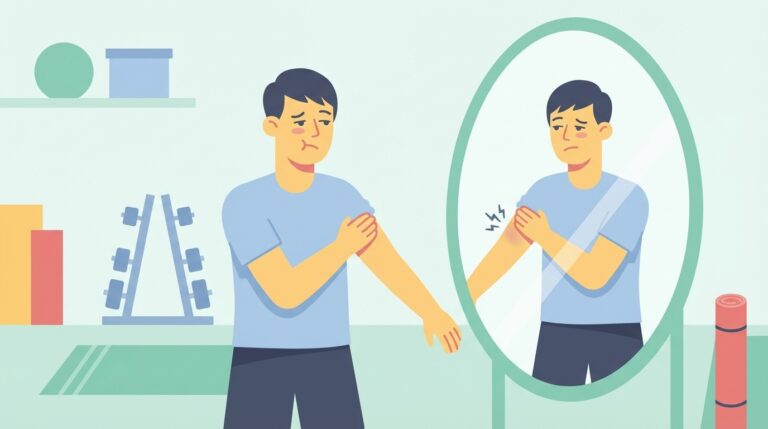
Ouch, Leg Day! How to Talk About Muscle Soreness Like a True Korean
Hello! Daily Hangul Editor here. 👋
Picture this: You’re watching your favorite K-Variety show like Running Man. A celebrity just finished an intense gym mission yesterday. The next morning, they roll out of bed, grab their calves, grimace, and groan:
“Ah… I laid an egg…”
Wait, what? 🥚 Did they turn into a bird overnight?
If you don’t know the cultural context behind this phrase, you might be seriously confused! After a hard workout at a Korean gym (헬스장, hel-seu-jang), textbooks will teach you to say, “I have muscle pain.” But in real life? Nobody says that to their friends!
Today, we are going to learn how to talk about your post-workout aches and pains just like a local. This guide is based on real struggles my foreign students face when trying to explain why they are walking like a zombie on a Monday morning. Let’s dive in!
Phase 2: Core Phrases Deep Dive
Let’s look at the absolute must-know expressions for your sore muscles.
1. 알 배겼어요 (I’ve got muscle knots / I’m sore)
- Pronunciation: [al bae-gyeo-sseo-yo]
(Sound guide: ‘Al’ sounds like the ‘Al’ in Alan. ‘Bae’ sounds like ‘bear’ without the r.) - Meaning: Literal = Eggs have been embedded. / Real nuance = My muscles are incredibly sore and cramped.
- K-Culture Moment: This is the #1 phrase you’ll hear in K-Dramas when someone is forced to do physical labor, like picking cabbages in the countryside, and they wake up the next day holding their lower back.
- Editor’s Insight: Why eggs? When your muscles are tight and sore, they feel like hard little lumps… almost like a bird laid a small egg inside your muscle! It’s a very visual, funny way to express soreness.
- Situation Spectrum:
- Friends (Casual): ✅ (Say: 알 배겼어! al bae-gyeo-sseo!)
- Co-workers (Semi-formal): ✅
- Boss / Elders (Formal): ⚠️ (Better to use phrase #3 below)
- 🤔 Think About It: Koreans love using physical, visual metaphors for bodily sensations. Does your native language have a funny metaphor for muscle cramps or soreness?
2. 온몸이 쑤셔요 (My whole body aches)
- Pronunciation: [on-mo-mi ssu-syeo-yo]
(Sound guide: ‘Ssu’ sounds like Sue, ‘syeo’ sounds like show but with a y-sound: syoh.) - Meaning: Literal = My whole body is being poked. / Real nuance = I ache all over (often used after a full-body workout or when you’re getting a cold).
- K-Culture Moment: You’ll see grandmothers in dramas saying this when it’s about to rain. But young ‘Gym Rats’ (헬창, hel-chang) also use it after an intense Deadlift session!
- Editor’s Insight: “쑤시다” gives the feeling of tiny needles gently but annoyingly poking your muscles from the inside.
- Situation Spectrum:
- Friends (Casual): ✅
- Co-workers (Semi-formal): ✅
- Boss / Elders (Formal): ✅ (Safe to use)
3. 근육통이 있어요 (I have muscle pain)
- Pronunciation: [geun-yuk-tong-i i-sseo-yo]
- Meaning: Literal & Real = I have muscle pain.
- K-Culture Moment: This is what you say when you visit a pharmacy or a doctor’s office in Korea. It’s medical and precise.
- Editor’s Insight: This is safe, polite, but a bit dry. Use this with people you aren’t close to!
- Situation Spectrum:
- Friends (Casual): 🚫 (Too robotic!)
- Co-workers (Semi-formal): ⚠️
- Boss / Elders / Doctors (Formal): ✅
Phase 3: Textbook vs. Real Korean
Let’s see how the textbook compares to the lively streets of Seoul!
[Situation 1: Explaining why you’re walking funny]
* 📖 Textbook Korean: 저는 다리에 근육통이 있습니다. (I have muscle pain in my legs.)
* 🗣️ Real Korean: 아, 다리에 알 배겼어요. 장난 아니에요. (Ah, I’ve got knots in my legs. It’s no joke.)
* 💡 Why is it different?: “장난 아니에요” (It’s no joke) is an everyday slang phrase Koreans add to emphasize how extreme a situation is.
[Situation 2: Reacting to a heavy workout]
* 📖 Textbook Korean: 오늘 운동은 정말 힘들었습니다. (Today’s exercise was very hard.)
* 🗣️ Real Korean: 오늘 진짜 죽는 줄 알았어요. 하얗게 불태웠다… (I really thought I was going to die today. I burned everything to white ashes…)
* 💡 Why is it different?: Dramatic exaggeration is a huge part of Korean conversational humor. Saying you “thought you’d die” is the ultimate compliment to a tough workout!
Bottom Note: At the
A2 (Beginner)level, try mixing in “장난 아니에요” (jang-nan a-ni-e-yo). It instantly makes you sound 50% more fluent without needing complex grammar!
Phase 4: Cultural Context — K-Culture Deep Dive
4-1. Non-Verbal Cues: The “Aigo” and the Rub
When expressing pain in Korea, body language is everything. You don’t just say “My shoulder hurts.” You have to grab your shoulder, let out a deep, soulful “Aigo…” (아이고…) and slowly rotate your arm. It’s almost a dramatic performance!
4-2. The “Siwonhada” Paradox (K-Spa & Gym Culture)
Here is a mind-blowing K-Culture concept. Imagine you have massive muscle soreness (알 배겼어요). A friend aggressively massages your shoulder. It hurts! But what does a true Korean say?
“아, 시원하다!” (Ah, si-won-ha-da!)
Wait, “siwonhada” literally means “It is cool/refreshing” (like a cold glass of water). Why say it when you are in pain? In Korea, when a painful action (like a deep tissue massage or stretching a sore muscle) results in the release of tension, it is considered deeply “refreshing.” You’ll also hear this when Koreans step into a boiling hot sauna or drink a spicy, steaming bowl of soup! It’s the ultimate Korean paradox.
Phase 5: Real-life Roleplay Scenario
Setting: A cafe near Gangnam Station, Friday morning. You and your Korean coworker Min-su went to a crazy “CrossFit” trial class together last night. You are both holding iced Americanos, barely surviving.
Characters:
– YOU: A foreign expat working in Seoul, currently questioning your life choices after yesterday’s leg day.
– Min-su (32): Your cheerful Korean coworker who is pretending he isn’t in pain.
Dialogue:
Min-su: 어제 운동 진짜 장난 아니었죠? 😅
(eo-je un-dong jin-jja jang-nan a-ni-eot-jyo?)
[Translation: Yesterday’s workout was really no joke, right?]
(🎭 Stage Direction: Min-su tries to lift his coffee cup but his arm shakes slightly.)
YOU: 네, 진짜 힘들었어요. 저 오늘 아침에 침대에서 못 일어날 뻔했어요.
(ne, jin-jja him-deu-reo-sseo-yo. jeo o-neul a-chi-me chim-dae-e-seo mot i-reo-nal ppeon-hae-sseo-yo.)
[Translation: Yes, it was really hard. I almost couldn’t get out of bed this morning.]
Min-su: ㅋㅋㅋ 저도요. 다리 괜찮아요?
(ㅋㅋㅋ jeo-do-yo. da-ri gwaen-cha-na-yo?)
[Translation: Lol me too. Are your legs okay?]
YOU: 아니요… 걷기가 너무 힘들어요.
(a-ni-yo… geot-gi-ga neo-mu him-deu-reo-yo.)
[Translation: No… it’s too hard to walk.]
Min-su: 허벅지에 근육통 생겼죠?
(heo-beok-ji-e geun-yuk-tong saeng-gyeot-jyo?)
[Translation: You got muscle pain in your thighs, right?]
🔀 YOUR TURN! How should you reply to sound like a local?
– A) 네, 근육통이 있습니다. 병원에 갈 거예요. (Yes, I have muscle pain. I will go to the hospital.)
– B) 네, 허벅지에 완전 알 배겼어요! 죽겠어요.
– C) 네, 제 허벅지에 계란이 있어요!✅ Best Choice: B — “네, 허벅지에 완전 알 배겼어요! 죽겠어요.” (Yes, my thighs are completely knotted up! I’m dying.) “완전” (completely) and “죽겠어요” (I’m dying) make it incredibly natural.
⚠️ Choice A & C Analysis: A is too robotic for a friend. C is translating the “laid an egg” metaphor too literally! Koreans don’t say “there is an egg,” they say the specific verb “알 배기다”.
YOU: (Choosing B) 네, 허벅지에 완전 알 배겼어요! 죽겠어요.
(ne, heo-beok-ji-e wan-jeon al bae-gyeo-sseo-yo! juk-ge-sseo-yo.)
[Translation: Yes, my thighs are completely knotted up! I’m dying.]
Min-su: 오! ‘알 배겼다’는 말도 알아요? 한국인 다 됐네요! 이따가 약국 가서 파스 하나 사세요.
(o! ‘al bae-gyeo-tta’neun mal-do a-ra-yo? han-gu-gin da dwaen-ne-yo! i-tta-ga yak-guk ga-seo pa-seu ha-na sa-se-yo.)
[Translation: Oh! You even know the phrase ‘al-baegyotta’? You’re practically Korean now! Go to the pharmacy later and buy a pain patch.]
Phase 6: 10-Second Shadowing Drill
Grab a mirror! Let’s practice saying you are sore, but with a proud, slightly exhausted smile.
😊 나 / 어제 스쿼트 해서 / 다리에 / 알 배겼어!
(na / eo-je seu-kwo-teu hae-seo / da-ri-e / al bae-gyeo-sseo!)
“I did squats yesterday, so my legs are sore/knotted!”
Tip: Emphasize “알” (Al) to sound dramatic!
Phase 7: K-Culture Mini Dictionary
| Korean | Romanization | English | Context |
|---|---|---|---|
| 헬스장 | hel-seu-jang | Gym | Literally “Health Club”. The most common word for a gym in Korea. |
| 알 배기다 | al bae-gi-da | To get muscle knots | The essential phrase for post-workout soreness. |
| 파스 | pa-seu | Pain relief patch | Derived from the German brand ‘Pasche’. A must-buy item at Korean pharmacies for pain! |
| 시원하다 | si-won-ha-da | Refreshing | Used for cold drinks, but ALSO for the satisfying feeling of massaging sore muscles. |
| 오운완 | o-un-wan | Workout complete | An Instagram hashtag abbreviation for “오늘 운동 완료” (Today’s Workout Complete). |
Phase 8: Traveler Survival Kit
If your muscles hurt so much that you can’t walk around Myeongdong, you need to visit a Korean pharmacy (약국, yak-guk). Look for the sign with a big “약” (Yak) on it!
🆘 Survival Phrases for the Pharmacy
– 🇰🇷 “근육통 약 있어요?” (geun-yuk-tong yak i-sseo-yo?)
– 🗣️ Meaning: Do you have medicine for muscle pain?
– 🇰🇷 “파스 좀 주세요.” (pa-seu jom ju-se-yo.)
– 🗣️ Meaning: Please give me some pain relief patches.
– 💡 Pro Tip: Korean pain patches (파스, Paseu) come in “Cool” (쿨) and “Hot” (핫) versions. The pharmacist might ask which one you want. Cool is for acute injuries (like immediately after a sprain), Hot is for lingering muscle soreness!
📌 Editor’s Travel Note:
– Pharmacies in Korea are usually not self-service for medication! You have to walk up to the counter and describe your symptoms to the pharmacist directly.
Phase 9: Critical Thinking Corner — “One Step Deeper”
The Paradox of Pain: The “Siwonhada” Identity
Why do Koreans associate the pain of a hot sauna, spicy food, or an intense muscle massage with the word “시원하다” (Refreshing)? This linguistic habit reflects a culture that values catharsis—the idea that you must push through an intense, slightly painful experience to cleanse your body and mind. It’s a society that works incredibly hard, and the physical release of that built-up tension is the ultimate “refreshment.”
💬 Your Turn: Does your culture have a concept similar to “Siwonhada”? Do you enjoy the “good pain” of a post-workout massage? Let us know in the comments!
Phase 10: FAQ & Avoiding Mistakes
Q: Can I say “알 배겼어요” to my Korean boss?
Editor says: Maybe, but be careful! It is a slightly casual, expressive phrase. If you are close with your boss and joking around, it’s fine. But if you are in a formal meeting, say “근육통이 조금 있습니다” (I have a little muscle pain) instead.
Q: Does “아파요” (It hurts) work instead?
Editor says: Yes, but it causes misunderstandings! If you say “다리가 아파요” (My legs hurt), Koreans might think you are injured or sick, and they will tell you to go to the hospital. “알 배겼어요” specifically means soreness from exercise/effort.
❌ Common Mistake #1: Saying “저는 계란이 있어요” (I have an egg) trying to translate the metaphor directly.
✅ Do This Instead: Always use the set verb phrase: “알 배겼어요” (al bae-gyeo-sseo-yo).
Phase 11: Summary & Action Items
One-Liner Summary: When your muscles are sore after a workout, don’t say you’re sick—tell your friends “알 배겼어요” (al bae-gyeo-sseo-yo) to sound like a true local!
Action Mission:
– 🥉 Bronze (Solo): Grab a muscle you worked out recently, rub it, and say “아이고, 알 배겼어…” to the mirror.
– 🥈 Silver (Online): Post a picture of your workout on Instagram with the hashtag #오운완 (Workout Complete) and write “다리에 알 배겼어요!”
– 🥇 Gold (Real World): Walk into a Korean pharmacy and successfully buy a pain patch by saying “파스 주세요.”
Phase 12: Quiz — Interactive Challenge
1. You are at the gym with your Korean friend. They ask why you are walking so slowly. What is the most natural, native-sounding reply?
A) 저는 근육통입니다. (I am muscle pain.)
B) 다리에 알 배겼어요. (I have knots/soreness in my legs.)
C) 저는 파스입니다. (I am a pain patch.)
Toggle for Answer:
Answer: B. A is too robotic (and grammatically awkward), and C means you physically turned into a medical patch!
2. True or False: When a Korean says “아, 시원하다!” while rubbing a sore muscle, it means they are feeling very cold.
Toggle for Answer:
Answer: False! In this context, “시원하다” means “refreshing/relieving tension,” not physically cold.
Happy working out, and may your “알” heal quickly! 💪
Frequently Asked Questions (FAQ)
Q: What does "알 배겼어요 (I've got muscle knots / I'm sore)" mean in Korean and how do you pronounce it?
A: In Korean, "알 배겼어요 (I've got muscle knots / I'm sore)" is pronounced [al bae-gyeo-sseo-yo] and means: Literal = Eggs have been embedded. / Real nuance = My muscles are incredibly sore and cramped.
Q: What does "온몸이 쑤셔요 (My whole body aches)" mean in Korean and how do you pronounce it?
A: In Korean, "온몸이 쑤셔요 (My whole body aches)" is pronounced [on-mo-mi ssu-syeo-yo] and means: Literal = My whole body is being poked. / Real nuance = I ache all over (often used after a full-body workout or when you're getting a cold).
Q: What does "근육통이 있어요 (I have muscle pain)" mean in Korean and how do you pronounce it?
A: In Korean, "근육통이 있어요 (I have muscle pain)" is pronounced [geun-yuk-tong-i i-sseo-yo] and means: Literal & Real = I have muscle pain.







