

Order Like a Local: Mastering Traditional Korean Market Food (Tteokbokki & Bindaetteok)
Phase 1: Empathy (The Cold Open)
Hello! I’m your Daily Hangul Editor.
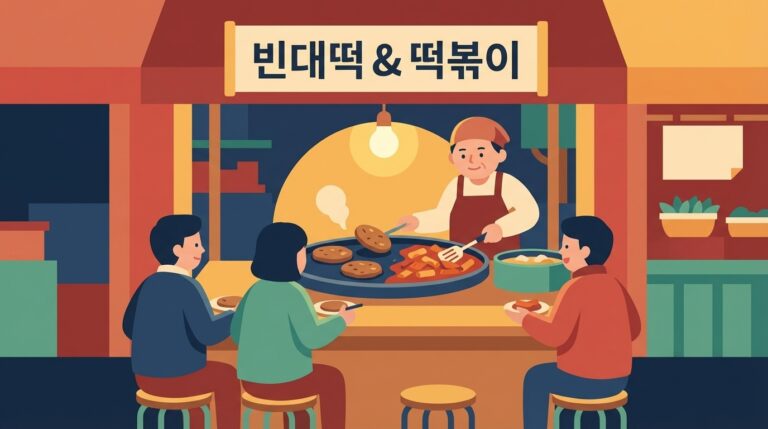
Picture this: It’s pouring rain in Seoul. You duck into the bustling alleys of Gwangjang Market to escape the downpour. The air is thick with the savory, sizzling sound of mung bean pancakes (Bindaetteok) frying in oil, competing with the loud chatter of locals sitting shoulder-to-shoulder on tiny wooden stools.
In K-Dramas, this is the exact moment the main characters bond over a bottle of Makgeolli (rice wine) and a plate of crispy Bindaetteok, sharing their deepest secrets. You want to experience this authentic vibe! But as a C1-level Korean learner, simply pointing at a menu and saying “이거 주세요” (Give me this) feels like a step backward. You don’t just want to be a tourist; you want to interact with the vendors, navigate the crowded benches, and order like a true Seoulite.
Today, we’re moving past textbook grammar. I’m going to share the insider expressions that will earn you a hearty smile and maybe even some extra Service (free food) from the market vendors. This guide is built from the real experiences of advanced learners who wanted to conquer the beautiful chaos of Korean traditional markets.
Phase 2: Core Expressions Deep Dive
To thrive in a Korean market, you need to understand the language of Insim (generosity) and efficiency. Here are the three golden phrases.
1. “이모(님), 떡볶이랑 튀김 섞어서 1인분 주세요!”
- Pronunciation: [Imo(nim), tteokbokkirang twigim seokkeoseo il-inbun juseyo!] + (‘Seok-keo-seo’ sounds like sucking air in quickly, with a crisp ‘k’ sound in the middle.)
- Meaning: (Literal) Auntie, please give me 1 serving of tteokbokki and fried food mixed together. / (Real Nuance) Auntie, give me a combo of tteokbokki and tempura, and please coat the tempura in the spicy tteokbokki sauce!
- K-Culture Moment: If you watch Korean street food vloggers, they never eat their twigim (tempura) dry. Asking to “mix it” (seokkeoseo or beombeok) means the vendor will chop up the crispy tempura and drown it in that glorious, spicy-sweet red sauce. It’s the ultimate insider move.
- Editor’s Insight: Using “이모님” (Imonim – Auntie) immediately breaks the ice. It’s a term of endearment and respect for middle-aged female vendors. And knowing to ask for the sauce mixture proves you truly understand Korean street food.
- Situation Spectrum:
- Casual Market Vendor (Friendly): ✅
- Franchise Fast Food Joint: ⚠️ (They might not do “mixed” requests)
- High-end Restaurant: 🚫
- 🤔 Think About It: Why do Koreans prefer mixing their foods (like Bibimbap or dipping everything in Tteokbokki sauce) rather than eating items strictly separately? How does this reflect the culture of harmony?
2. “자리 있나요? 혹시 합석해도 될까요?”
- Pronunciation: [Jari innayo? Hoksi hapseokaedo doelkkayo?] + (‘Hap-seok’ sounds like a quick, polite clap of the hands.)
- Meaning: (Literal) Is there a seat? By any chance, can we share the table? / (Real Nuance) It’s packed in here, do you mind if we squeeze in next to you?
- K-Culture Moment: In popular indie K-Movies, strangers often end up sharing a cramped table at a market stall, leading to unexpected conversations. Market seating is notoriously tight!
- Editor’s Insight: Traditional markets don’t have polite hosts waiting to seat you. You have to hunt for your spot. Hapseok (합석 – sharing a table with strangers) is a very common and accepted practice in old markets.
- Situation Spectrum:
- Crowded Traditional Market: ✅
- Normal City Cafe/Restaurant: 🚫 (Koreans highly value personal space outside of specific communal settings!)
- 🤔 Think About It: Koreans generally avoid sitting with strangers in modern spaces, yet in traditional markets or hiking trail restaurants, Hapseok is totally normal. What happens to the social rules in these “nostalgic” spaces?
3. “와, 사장님 인심이 진짜 후하시네요!”
- Pronunciation: [Wa, sajangnim insimi jinjja huhasineyo!] + (‘In-sim’ sounds like a gentle, warm hum.)
- Meaning: (Literal) Wow, boss, your generosity is truly abundant! / (Real Nuance) Wow, thank you so much for the huge portion/extra food! You’re the best!
- K-Culture Moment: You order one portion of sundae (blood sausage), but the vendor throws in an extra scoop of liver and lung, saying, “Here, eat up!” This is Insim.
- Editor’s Insight: This is an advanced compliment. While beginners say “감사합니다” (Thank you), a C1 speaker praises the vendor’s Insim. It acknowledges the traditional Korean virtue of generous hospitality. Say this, and they might just give you more!
- Situation Spectrum:
- Traditional Markets / Mom-and-pop stores: ✅
- Corporate Department Stores: 🚫 (They have fixed portions!)
- 🤔 Think About It: Does your culture have a specific word for the unwritten rule of vendors giving “a little bit extra” to build loyalty and warmth?
Phase 3: Textbook vs. Real Korean
Let’s upgrade your vocabulary from “classroom rigid” to “market fluid.”
[Ordering the Ultimate Combo]
* 📖 Textbook Korean: 떡볶이 일 인분, 튀김 일 인분, 순대 일 인분 주십시오. (Please give me 1 serving of Tteokbokki, Tempura, and Sundae.)
* 🗣️ Real Korean: 이모~ 여기 떡튀순 하나 주세요!
* 💡 Why the difference?: Koreans love efficiency and portmanteaus. Tteok-Twi-Sun is the holy trinity of street food, universally understood everywhere in Korea.
[Asking for Extra Broth]
* 📖 Textbook Korean: 어묵 국물을 조금 더 주실 수 있습니까?
* 🗣️ Real Korean: 사장님, 여기 국물 좀 더 주시면 안 돼요? (With a slight upward, friendly inflection at the end)
* 💡 Why the difference?: The textbook version sounds like a robot. Using “~주시면 안 돼요?” softens the request, making it sound more like a friendly plea rather than a formal demand.
Bottom Note: At the C1 level, mastering the tone is just as important as the vocabulary. A slightly whiny, friendly tone (a mild form of Aegyo) works wonders in markets when asking for extras!
Phase 4: Cultural Context — K-Culture Deep Dive
4-1. Non-verbal Communication: The Art of “Nunchi” in the Market
In a bustling place like Gwangjang Market, verbal communication is only half the battle.
– The Point and Nod: Vendors are incredibly busy. Don’t wait for them to come to you. Make eye contact, raise your hand slightly, point to the food, and hold up your fingers for the number of portions.
– Spatial Nunchi: If you see people waiting, don’t linger over your empty plate. Market food is “fast food.” Eat happily, pay promptly, and make room for the next person.
4-2. K-Food & K-Drama Connection: The Rain and Bindaetteok
Have you ever noticed in K-Dramas that whenever it rains, characters suddenly crave Jeon (Korean pancakes like Bindaetteok) and Makgeolli?
This isn’t just a random TV trope; it’s a deeply ingrained cultural habit. There are two popular theories why:
1. The Sound Theory: The sizzling sound of batter hitting a hot, oiled pan sounds remarkably similar to raindrops hitting the roof.
2. The Agricultural Theory: In the past, farmers couldn’t work in the fields on rainy days. So, they stayed home, ground up whatever grains they had (like mung beans), made pancakes, and drank alcohol to pass the time.
Critical Viewpoint: While K-Dramas make this look incredibly romantic, the reality of eating Bindaetteok at a market on a rainy day means dealing with wet umbrellas, slippery floors, and very humid heat. It’s gritty, authentic, and absolutely delicious—but leave your fancy clothes at the hotel!
Phase 5: Real-life Roleplay Scenario
Setting: Friday evening, 7:30 PM. Gwangjang Market. The air is filled with steam, the smell of hot oil, and loud chatter. You and your Korean friend, Min-su, just found two empty stools at a famous Bindaetteok stall.
Characters:
– YOU (The Learner): An advanced Korean speaker who wants to impress your friend by taking charge of the ordering.
– Min-su (30s): Your local friend who usually orders for you.
– Imo-nim (60s): The busy, charismatic stall owner wearing a floral apron.
The Dialogue:
Min-su: 와, 사람 진짜 많다. 내가 주문할까?
(Wa, saram jinjja manta. Naega jumunhalkka?)
[Wow, there are so many people. Should I order?]
YOU: 아니야, 오늘은 내가 해볼게!
(Aniya, oneureun naega haebolge!)
[No, I’ll try doing it today!]
(🎭 Stage Direction: You make eye contact with the busy Imo-nim as she flips a massive pancake)
YOU: 이모님! 저희 고기 빈대떡 하나랑 막걸리 한 병 주세요!
(Imonim! Jeo-hui gogi bindaetteok hanarang makgeolli han byeong juseyo!)
[Auntie! Please give us one meat mung bean pancake and a bottle of makgeolli!]
Imo-nim: 삼촌들, 막걸리는 장수? 지평?
(Samchondeul, makgeolrineun Jangsu? Jipyeong?)
[Uncles(young men), for makgeolli, Jangsu brand or Jipyeong brand?]
YOU: 지평으로 주세요! 아, 그리고 엄청 바삭하게 구워주세요!
(Jipyeongeuro juseyo! Ah, geurigo eomcheong basakage guwojuseyo!)
[Jipyeong, please! Oh, and please fry it super crispy!]
Imo-nim: 알았어~ 맛있게 해줄게. 자, 이건 서비스 어묵 국물!
(Arasseo~ masitge haejulge. Ja, igeon seobiseu eomuk gungmul!)
[Got it~ I’ll make it tasty. Here, this is service (free) fish cake soup!]
🔀 Your Turn! How do you reply to the free soup?
– A) “감사합니다. 얼마예요?” (Thank you. How much is it?)
– B) “와, 이모님 인심 진짜 최고! 잘 먹겠습니다!” (Wow, Auntie, your generosity is the best! I will eat well!)
– C) “저 어묵 안 시켰는데요?” (I didn’t order fish cake?)✅ Best Choice: B — Recognizing “Insim” (generosity) with enthusiasm makes the vendor’s day.
⚠️ Choice A & C Analysis: Choice A shows you don’t understand the concept of “Service” (free extras). Choice C might sound rude or overly defensive. In Korean markets, if they say “서비스” (Service), it’s a gift!
Phase 6: 10-Second Shadowing Drill
Practice this natural rhythm to sound exactly like a local ordering food.
😊 이모님~! / 여기 떡튀순 하나하고 / 어묵 국물 좀 / 많이 주세요~!
(Imonim~! / yeogi tteok-twi-sun hanahago / eomuk gungmul jom / mani juseyo~!)
Director’s Notes:
– Raise your pitch slightly on “이모님~!”.
– Pause briefly at the slashes (/).
– Drag out the “좀” (jom – a little) slightly to sound polite but friendly.
Phase 7: K-Culture Mini Dictionary
| Korean Word | Romanization | English Meaning | Cultural Context |
|---|---|---|---|
| 덤 (서비스) | deom (seobiseu) | Extra / Freebie | A small extra amount of food given for free. The backbone of traditional market charm. |
| 합석 | hapseok | Sharing a table | Sitting with strangers due to lack of space. Very common in markets and busy soup restaurants. |
| 인심 | insim | Generosity / Warmth | The warm-heartedness of vendors giving large portions or free extras. |
| 떡튀순 | tteok-twi-sun | Tteokbokki + Twigim + Sundae | The holy trinity of Korean street food. Order this combo to look like a pro. |
| 단골 | dangol | Regular customer | Vendors often give more deom to their dangol. |
Phase 8: Traveler’s Survival Kit
Heading to a market like Gwangjang, Namdaemun, or Mangwon? Keep these survival phrases ready!
🆘 Survival Phrases for the Market
– 🇰🇷 “포장해 주세요.” (Pojanghae juseyo.)
– 🗣️ Pronunciation: [Po-jang-hae joo-se-yo]
– 📍 Use it when: You want to take the food to-go. (Very important because seating is scarce!)
- 🇰🇷 “계좌이체 할게요.” (Gyejwa-iche halgeyo.)
- 🗣️ Pronunciation: [Gye-jwa-ee-che hal-ge-yo]
- 📍 Use it when: You don’t have cash. Most vendors prefer bank transfers over credit cards for small amounts.
📌 Editor’s Travel Note
– Cash is King: While Korea is a cashless society, traditional markets are the exception. Always carry some 1,000 and 10,000 KRW bills.
– Tipping: Do NOT leave a tip! Korea has absolutely no tipping culture. If you leave money on the table, the vendor will chase you down the street thinking you forgot your change.
– Navigation App: Google Maps doesn’t work well for walking directions in Korea. Download Naver Map or KakaoMap to navigate the winding market alleys.
Phase 9: Critical Thinking — “A Step Deeper”
Language & Power: The Concept of Faux-Kinship
🧠 Think Deeper:
Have you noticed that Koreans use family terms for strangers? Calling a vendor “이모” (Imo – Aunt) or a male worker “삼촌” (Samchon – Uncle) creates an instant sense of faux-kinship. In Western cultures, establishing a professional boundary between customer and service worker is considered polite. But in Korea, especially in traditional settings, dissolving that boundary by using family titles builds “Jeong” (정 – emotional bonding). It shifts the dynamic from a mere financial transaction to a community interaction. However, younger generations and modern franchises are shifting away from this, preferring formal titles like “사장님” (Sajangnim – Boss) or “직원님” (Jigwonnim – Staff).💬 Your Turn: In your culture, how do you address food vendors or service workers? Do you keep it strictly professional, or is there a way to show friendly closeness? Let us know in the comments!
Phase 10: FAQ & Mistake Prevention
Q: Can I ask for more side dishes (banchan) or broth at a market stall?
A: YES! Unlike in many Western countries, refills for side dishes, kimchi, or basic broth (like fish cake soup) are completely free. Just politely say, “사장님, 이거 조금만 더 주세요” (Boss, please give me a little more of this).
Q: Can I call a male vendor “삼촌” (Samchon – Uncle)?
A: Maybe. It’s used occasionally, but “사장님” (Sajangnim – Boss) is much safer and more common for men. “이모” (Imo) has a very specific, warm cultural nuance for female vendors.
❌ Common Mistake #1: Trying to pay separately (Dutch pay) at a busy market stall.
✅ Do this instead: Market vendors are handling hot oil and serving dozens of people; calculating separate checks for a $5 meal is a nuisance. Have one person pay for everything, and Venmo/bank transfer each other later!❌ Common Mistake #2: Waiting to be seated.
✅ Do this instead: Use your Nunchi. If you see people finishing their last bite, hover respectfully nearby. When they stand up, swoop in quickly!
Phase 11: Summary & Action Items
One-Liner Summary: To master the Korean traditional market, use faux-kinship (“이모님”), order combos like a local (“떡튀순”), and don’t be afraid to squeeze in and share a table (“합석”).
Action Mission:
– 🥉 Bronze (Solo): Stand in front of a mirror and practice ordering confidently: “이모님, 떡튀순 하나 주세요!”
– 🥈 Silver (Online): Go to YouTube, search for “광장시장 브이로그” (Gwangjang Market Vlog), and write down one new phrase you hear a vendor say.
– 🥇 Gold (Real Life): Visit a local Korean market (or a Korean street food restaurant near you) and ask for your food to be mixed: “섞어서 주세요!”
🎬 K-Culture Mission:
Next time you watch a K-Drama and see a scene with people eating under a tent (Pojangmacha) or in a market, observe the seating arrangement and how they flag down the owner. You’ll notice the Nunchi we talked about today!
Phase 12: Quiz — Interactive Challenge
Test your market mastery!
1. Situational Judgment: You are eating Bindaetteok at a crowded stall. A couple is standing nearby, looking for seats. You are almost finished. What is the most culturally appropriate action?
– A) Take your time chatting; you paid for the seat.
– B) Quickly finish your last bite, pay, and let them have the seats.
– C) Offer them a bite of your food.
(Answer: B. Market stalls rely on high turnover. Using your ‘Nunchi’ to leave quickly when done is highly respected etiquette.)
2. True or False – K-Culture Edition:
“If a vendor gives you an extra piece of tempura and says ‘서비스’ (Service), you should leave a tip on the table.”
(Answer: FALSE. Tipping is not practiced in Korea. Simply compliment their ‘Insim’ (generosity) and say thank you!)
3. Fill in the Blank:
To get your tempura coated in spicy Tteokbokki sauce, you say: “튀김은 [ _______ ] 주세요.”
(Answer: 섞어서 / seokkeoseo)
Did you enjoy this market trip? What’s your favorite Korean street food? Drop a comment below, and don’t forget to practice your phrases with Daily Hangul!
Frequently Asked Questions (FAQ)
Q: What does ""이모(님), 떡볶이랑 튀김 섞어서 1인분 주세요!"" mean in Korean and how do you pronounce it?
A: In Korean, ""이모(님), 떡볶이랑 튀김 섞어서 1인분 주세요!"" is pronounced [Imo(nim] and means: (Literal) Auntie, please give me 1 serving of tteokbokki and fried food mixed together. / (Real Nuance) Auntie, give me a combo of tteokbokki and tempura, and please coat the tempura in the spicy tteokbokki sauce!
Q: What does ""자리 있나요? 혹시 합석해도 될까요?"" mean in Korean and how do you pronounce it?
A: In Korean, ""자리 있나요? 혹시 합석해도 될까요?"" is pronounced [Jari innayo? Hoksi hapseokaedo doelkkayo?] and means: (Literal) Is there a seat? By any chance, can we share the table? / (Real Nuance) It's packed in here, do you mind if we squeeze in next to you?
Q: What does ""와, 사장님 인심이 진짜 후하시네요!"" mean in Korean and how do you pronounce it?
A: In Korean, ""와, 사장님 인심이 진짜 후하시네요!"" is pronounced [Wa, sajangnim insimi jinjja huhasineyo!] and means: (Literal) Wow, boss, your generosity is truly abundant! / (Real Nuance) Wow, thank you so much for the huge portion/extra food! You're the best!







