

Phase 1: Empathy & Immersion
Hello! I’m the Lead Editor at Daily Hangul, your veteran tutor and local culture navigator.
Have you ever watched a K-Drama wedding scene and noticed a sudden wardrobe change? One minute, the characters are in a classic white dress and tuxedo, and the next, they are wearing vibrant, multi-layered silk garments with elaborate headpieces. They bow deeply to their parents, and suddenly… someone is throwing dates and chestnuts at the bride’s skirt?
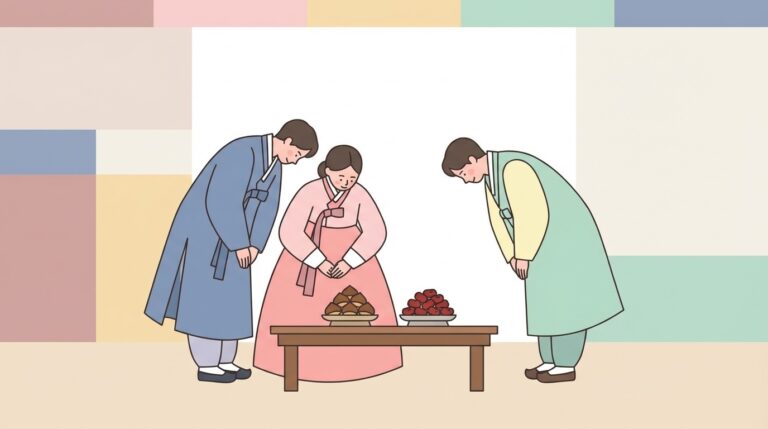
If you’ve ever attended a Korean wedding or watched one on screen, this specific ceremony—called 폐백 (Pyebaek)—might have left you fascinated but slightly confused. Why are they throwing food? What does it all mean?
Understanding traditional Korean wedding customs isn’t just about learning vocabulary; it’s about decoding the deep-rooted cultural values of family, respect, and unity. Knowing these nuances will elevate you from a mere observer to an absolute cultural insider. Trust me, if you get invited to a Korean wedding and understand what’s happening during Pyebaek, your Korean friends will be incredibly impressed. Let’s dive in!
Phase 2: Core Expressions Deep Dive
1. 폐백 (Traditional Wedding Ceremony)
- Pronunciation: pyebaek [Sounds like ‘pyeh-back’ – make the ‘ae’ sound like the ‘a’ in ‘apple’]
- Meaning: (Literal) Traditional greeting ceremony to the groom’s family / (Real nuance) A private ceremony after the main wedding where the couple pays respect to their parents and older relatives.
- K-Culture Moment: In K-Dramas, this is usually the scene where the mother-in-law gives a profound (or sometimes intimidating) piece of advice to the new bride while sitting behind a wooden table filled with traditional foods.
- Editor’s Insight: The word Pyebaek implies deep respect. Historically, it was a ceremony solely for the groom’s family to formally accept the new bride. Today, however, families usually invite both sides to participate!
- Situation Spectrum:
- Casual friends: ✅ (When talking about it: “나 내일 폐백 해”)
- Formal/Elders: ✅ (This is an inherently traditional and formal concept)
- 🤔 Think About It: Why do you think a separate ceremony for the parents is held after the public wedding? How does this reflect the Korean concept of marriage being a union of families, not just two individuals?
2. 절 받으세요 (Please accept our bow)
- Pronunciation: jeol ba-deu-se-yo [Jeol sounds like ‘juhl’]
- Meaning: (Literal) Please receive the bow / (Real nuance) We are officially paying our deepest respects to you.
- K-Culture Moment: Before the couple kneels to do the deep, traditional bow (큰절 – keun-jeol) to their parents, the ceremonial guide will often announce this, or the couple will say it. You also hear this phrase during the Lunar New Year (설날)!
- Editor’s Insight: It might sound strange in English to ask someone to “receive” a bow, but in Korean culture, offering a bow is like offering a physical manifestation of your respect.
Situation Spectrum:
- Casual friends: 🚫 (You don’t bow to friends!)
- Formal/Elders: ✅ (Used exclusively for elders/superiors)
- 🤔 Think About It: Offering respect is a gift in Korean culture. Do you have a physical gesture in your culture that carries as much weight as a deep bow?
3. 밤과 대추를 던지다 (Throwing chestnuts and jujubes)
- Pronunciation: bam-gwa dae-chu-reul deon-ji-da
- Meaning: (Literal) To throw chestnuts and jujubes / (Real nuance) Wishing the couple many children and a prosperous life.
- K-Culture Moment: The parents sit behind the table, grab a handful of chestnuts and dates, and literally toss them! The bride and groom hold up a white cloth (the bride’s apron) to catch them.
- Editor’s Insight: The number of dates and chestnuts caught traditionally foretells how many daughters and sons the couple will have. (Dates = sons, Chestnuts = daughters… or vice versa depending on the region!). It’s always a moment filled with laughter.
- Situation Spectrum:
- This is an action, not a phrase you say to someone, but you will hear guests cheering: “많이 잡아라!” (Catch a lot!)
Phase 3: Textbook vs. Real Korean
Let’s look at how people actually talk at a Korean wedding compared to what your B2 textbook might say.
[Wishing the couple well during Pyebaek]
* 📖 Textbook Korean: 자녀를 많이 낳으시고 행복하게 사십시오. (Please have many children and live happily.)
* 🗣️ Real Korean: 아들딸 구별 말고 예쁘게 잘 살아라! (Don’t distinguish between sons and daughters, just live beautifully/happily!)
* 💡 Why the difference?: In the past, having sons was highly prized in the patriarchal society. Modern Koreans use this phrase to reject that old notion, emphasizing happiness over the gender or number of children.
[Greeting the Bride and Groom in Hanbok]
* 📖 Textbook Korean: 한복이 정말 아름답습니다. (Your Hanbok is truly beautiful.)
* 🗣️ Real Korean: 와, 한복 완전 찰떡이다! 너무 예뻐! (Wow, the Hanbok is a perfect fit! So pretty!)
* 💡 Why the difference?: ‘찰떡이다’ (literally: it’s like sticky rice cake) is a very common slang expression meaning something suits someone perfectly.
Bottom Note: For B2 learners, using “찰떡이다” (chal-tteok-i-da) to compliment a friend’s wedding outfit will make you sound incredibly natural and fluent!
Phase 4: Cultural Context — K-Culture Deep Dive
4-1. Non-Verbal Communication: The ‘Keun-Jeol’ (큰절)
The deepest form of bowing in Korea is the Keun-jeol. During Pyebaek, the couple performs this bow. The non-verbal rule here is absolute humility: you must lower your head completely to the floor, moving slowly to show solemnity. As an observer, the Korean Nunchi (눈치) comes into play—you should remain quiet and respectful during the bowing, but you can clap and cheer when they try to catch the flying dates and chestnuts!
4-2. K-Drama Connection: The Generational Shift
In classic K-Dramas, the Pyebaek scene often highlights the strict hierarchy between the bride and her new mother-in-law. Historically, the bride offered Pyebaek only to the groom’s family, symbolizing her leaving her own family to join his.
Critical View: Modern Korean society has evolved rapidly. Today, it is standard practice to invite the bride’s parents to receive the bow and throw the dates as well. In fact, due to the high cost of the intricate foods and Hanbok rentals, many young couples nowadays skip the Pyebaek entirely to save money and time! K-Dramas often keep the scene because it’s visually stunning, but in reality, skipping it is becoming a major trend.
Phase 5: Real-Life Roleplay Scenario
Setting: Saturday afternoon at a glamorous Wedding Hall in Gangnam. The modern ceremony has just finished, and you are standing outside the traditional Pyebaek room. You can see your friend, the groom, sweating slightly in his heavy, colorful Hanbok.
Characters:
– YOU (The Reader): An expat living in Korea, attending your close friend’s wedding.
– Min-su (32): The Groom. Your good friend.
– Ji-ah (30): The Bride. Friendly and slightly exhausted.
Dialogue:
YOU: 민수야, 결혼 정말 축하해! 한복 완전 찰떡이다.
(Minsu-ya, gyeolhon jeongmal chukahae! Hanbok wanjeon chal-tteok-i-da.)
[Min-su, congratulations on your wedding! The Hanbok suits you perfectly.]
(🎭 Stage Direction: You give a thumbs-up)
Min-su: 와, 와줘서 고마워. 근데 한복 너무 덥다! 😅
(Wa, wajwoseo gomawo. Geunde hanbok neomu deopda!)
[Wow, thanks for coming. But this Hanbok is so hot!]
YOU: 이 방은 뭐야? 나도 들어가도 돼?
(I bangeun mwoya? Nado deureogado dwae?)
[What is this room? Can I go in too?]
Min-su: 여긴 폐백실이야. 가족들만 들어올 수 있어.
(Yeogin pyebaeksiriya. Gajokdeulman deureool su isseo.)
[This is the Pyebaek room. Only family can come in.]
Ji-ah: 밖에서 구경하는 건 괜찮아요! 사진 많이 찍어주세요~ 📸
(Bakkeseo gugyeonghaneun geon gwaenchannayo! Sajin mani jjigeojuseyo~)
[It’s okay to watch from the outside! Please take lots of pictures~]
YOU: 아, 알겠어! 부모님이 밤이랑 대추 던지는 거 볼 수 있는 거지?
(Ah, algesseo! Bumonimi bamirang daechu deonjineun geo bol su inneun geoji?)
[Ah, I see! I can see the parents throwing the chestnuts and dates, right?]
Min-su: 응, 맞아. 우리 엄마가 얼마나 많이 던지실지 무섭다.
(Eung, maja. Uri eommaga eolmana mani deonjisilji museopda.)
[Yeah, right. I’m scared of how many my mom is going to throw.]
YOU: 왜 무서워?
(Wae museowo?)
[Why are you scared?]
Ji-ah: 그거 다 낳으라는 뜻이거든요!
(Geugeo da naeuraneun tteusigeodeunyo!)
[Because it means we have to give birth to all of them!]
🔀 Your Turn! How should you reply as they prepare to catch the dates?
– A) “파이팅! 10개만 잡아!” (Fighting! Catch only 10!)
– B) “예쁘게 잘 살아라!” (Live beautifully together!)
– C) “대박 사건!” (Crazy incident!)✅ Best Choice: B — Reason: Even as a friend, wishing them to “live beautifully/happily” (예쁘게 잘 살아라) is the most natural and heartfelt blessing you can give at a wedding.
⚠️ Choice A Analysis: While funny, catching 10 dates implies having 10 kids, which might make the couple sweat even more in their heavy Hanbok!
Phase 6: 10-Second Shadowing Drill
Imagine you are the bride or groom, expressing your gratitude to the elders. Practice this phrase with the right intonation!
😊 저희 / 예쁘게 / 잘~~~ 살겠습니다!
(jeo-hui / yeppeuge / jal~~~ salgetseumnida!)
Translation: We will live beautifully/happily together!
Pro-tip: Stretch out the ‘잘’ (jal) slightly with a bright smile to sound incredibly polite and joyful.
Phase 7: K-Culture Mini Dictionary
| Korean | Romanization | English | Cultural Context |
|---|---|---|---|
| 폐백 | pyebaek | Traditional Ceremony | The post-wedding bowing ceremony for the parents. |
| 한복 | hanbok | Traditional Clothes | The beautiful silk garments worn during Pyebaek. |
| 축의금 | chuguigeum | Congratulatory Money | The cash envelope given as a wedding gift in Korea. |
| 큰절 | keun-jeol | Deep Bow | The most formal bow, where one kneels on the floor. |
| 눈치 | nunchi | Social awareness | Knowing when to be quiet during the solemn parts of the ceremony! |
Phase 8: Traveler Survival Kit (Wedding Guest Edition)
Chances are, while living in or visiting Korea, you’ll be invited to a wedding. Here are the absolute survival phrases you need!
🆘 Survival Expression #1: Finding the ATM or Envelope table
– 🇰🇷 “축의금은 어디에 내요?” (chuguigeumeun eodie naeyo?)
– 🗣️ English Guide: “Where do I submit the congratulatory money?”
– 📍 Where to use: At the wedding hall lobby.
– 💡 Pro Tip: In Korea, you rarely give physical gifts. You give an envelope of cash (축의금). Make sure you write your name vertically on the back of the white envelope!🆘 Survival Expression #2: Congratulating
– 🇰🇷 “결혼 축하해요!” (gyeolhon chukahaeyo!)
– 🗣️ English Guide: “Congratulations on your wedding!”📌 Editor’s Travel Note
– Meal Tickets (식권): After you hand in your envelope, the staff will give you a meal ticket (식권 – sik-gwon) for the buffet. Don’t lose it! The buffet is a huge part of Korean wedding culture.
– Dress Code: Do NOT wear an all-white dress! White is strictly reserved for the bride. Koreans usually wear neat, dark, or muted business casual to weddings.
Phase 9: Critical Thinking Corner — “A Step Deeper”
Tradition vs. Modernity in Globalizing Korea
🧠 Think Deeper:
The Pyebaek ceremony is a beautiful visual representation of filial piety (효 – Hyo), a core Confucian value. However, modern Korean millennials and Gen Z are increasingly questioning these traditions. The high cost of renting the special Hanbok and preparing the elaborate table, combined with shifting views on gender equality (as Pyebaek historically favored the groom’s side), has led to a sharp decline in couples performing it. It reflects a broader cultural shift in Korea: a tug-of-war between honoring ancestral heritage and seeking practical, egalitarian lifestyles.💬 Your Turn: Does your culture have a wedding tradition that the younger generation is starting to skip or modify? Share your thoughts in the comments!
Phase 10: FAQ & Avoiding Misunderstandings
Q: Can I go inside the Pyebaek room if I’m not family?
Usually, no. The inside of the room is strictly for the couple, the parents, and close relatives. However, Pyebaek rooms usually have an open front or glass windows precisely so friends can stand outside, watch, and take photos!
Q: Can I use the phrase “절 받으세요” to my boss at work to be polite?
Absolutely NOT! 🚫 “절 받으세요” is taken literally in Korea. Unless it is Lunar New Year (설날) and you are physically getting on the floor to bow, saying this will confuse or shock your boss.
❌ Common Mistake #1: Giving an unmarked envelope for a wedding.
✅ How to fix it: Always write your name on the back of the envelope. The families keep meticulous records of who gave how much, so they can return the favor when you get married!
Phase 11: Summary & Action Items
- One-Liner Summary: Pyebaek is a beautiful, deeply symbolic Korean wedding tradition that blends deep respect for parents with fun wishes for the future.
-
Action Mission 3 Steps:
- 🥉 Bronze (Solo): Read the Shadowing Drill sentence aloud 3 times, trying to sound as happy as a bride/groom.
- 🥈 Silver (Online): Look up “Korean wedding Pyebaek” on YouTube and watch how they throw the dates.
- 🥇 Gold (Real World): The next time a Korean friend gets married, use the phrase “결혼 축하해요! 예쁘게 잘 살아!”
- K-Culture Mission: Watch an episode of a K-Drama featuring a wedding (like Queen of Tears or Start-Up). Can you spot the difference between the Western-style ceremony and the Pyebaek clothes?
-
Engagement: Have you ever attended a traditional wedding in another country? What was the most shocking or beautiful part? Let me know below!
Phase 12: Quiz — Interactive Challenge
1. Situational Judgment: You are watching your friend’s Pyebaek from outside. The mother throws a huge handful of dates, and the couple catches almost all of them. What should you shout?
– A) 축의금 어디에 내요? (Where do I put the money?)
– B) 많이 잡아라! 예쁘게 잘 살아! (Catch a lot! Live beautifully!)
– C) 절 받으세요! (Please accept my bow!)
2. True or False – K-Culture Edition:
– “It is perfectly fine to wear a white dress as a guest to a Korean wedding.” (T/F)
3. Fill in the Blank:
– Wow, this Hanbok suits you perfectly!
– 와, 한복 완전 (_______)이다!
(Answers: 1. B / 2. False – Never wear white! / 3. 찰떡)
Frequently Asked Questions (FAQ)
Q: What does "폐백 (Traditional Wedding Ceremony)" mean in Korean and how do you pronounce it?
A: In Korean, "폐백 (Traditional Wedding Ceremony)" is pronounced [pyebaek [Sounds like 'pyeh-back' - make the 'ae' sound like the 'a' in 'apple'] and means: (Literal) Traditional greeting ceremony to the groom's family / (Real nuance) A private ceremony after the main wedding where the couple pays respect to their parents and older relatives.
Q: What does "절 받으세요 (Please accept our bow)" mean in Korean and how do you pronounce it?
A: In Korean, "절 받으세요 (Please accept our bow)" is pronounced [jeol ba-deu-se-yo [Jeol sounds like 'juhl'] and means: (Literal) Please receive the bow / (Real nuance) We are officially paying our deepest respects to you.
Q: What does "밤과 대추를 던지다 (Throwing chestnuts and jujubes)" mean in Korean and how do you pronounce it?
A: In Korean, "밤과 대추를 던지다 (Throwing chestnuts and jujubes)" is pronounced [bam-gwa dae-chu-reul deon-ji-da] and means: (Literal) To throw chestnuts and jujubes / (Real nuance) Wishing the couple many children and a prosperous life.







